插电混动汽车(PHEV)

Search documents
金属和内存涨价“双杀”!瑞银:车企利润将完全被吞噬
Hua Er Jie Jian Wen· 2026-01-27 04:29
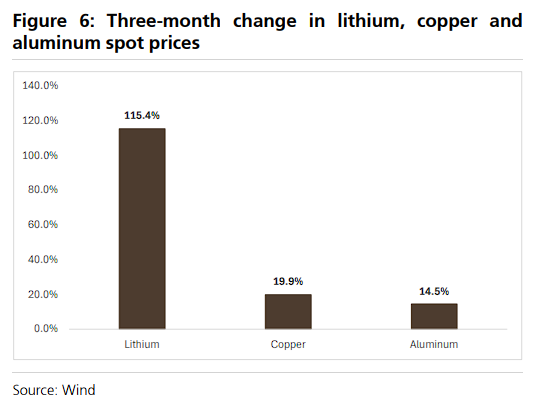
Core Viewpoint - UBS warns of a "perfect storm" forming regarding automotive costs, driven by a combination of weak demand and rising commodity prices, which could fully erode carmakers' margins [1][11]. Group 1: Cost Increases - UBS reports that the cost inflation for a typical mid-sized smart electric vehicle ranges from RMB 4,000 to RMB 7,000 due to rising prices of commodities like copper, aluminum, and lithium, as well as key components like DRAM [1][11]. - The report indicates that the cost of aluminum has increased by approximately RMB 600 per vehicle, copper by RMB 1,200, and lithium by RMB 3,800 for battery electric vehicles (BEVs) [5][6]. - The total cost increase for a BEV is calculated at RMB 5,600, with lithium contributing the most significant price surge of 109% [6][7]. Group 2: DRAM Price Surge - The report highlights a significant increase in DRAM prices, which have surged by 180% over the past three months, raising the cost per vehicle from RMB 700 to RMB 2,000, adding an additional RMB 1,300 to each vehicle's cost [7][10]. - UBS utilized a weighted model to confirm that this increase in DRAM costs is a widespread issue across the industry [10]. Group 3: Market Dynamics - Historically, automakers have been able to pass on rising material costs to consumers; however, the current market conditions, including the reintroduction of purchase taxes and the withdrawal of stimulus policies, have weakened end-demand [11]. - The report suggests uncertainty regarding how the additional costs, estimated between RMB 4,000 and RMB 7,000, will be shared among suppliers, OEMs, and consumers [11].

摩洛哥电动汽车市场加速发展
Shang Wu Bu Wang Zhan· 2025-06-19 16:00
Group 1 - The core viewpoint of the article is that Morocco's electric vehicle market is expected to experience rapid growth, with a projected increase in sales and market penetration driven by new models, local industry development, and government incentives [1][2]. Group 2 - According to Fitch's report, Morocco's electric vehicle market is predicted to grow by 49.6% by 2025, reaching sales of 4,404 units, with penetration rates rising from 1.9% in 2024 to 2.6% [1]. - In 2024, total sales of electric and hybrid vehicles in Morocco are expected to reach 11,000 units, with traditional hybrids leading at 8,190 units, pure electric vehicles (BEVs) at 1,125 units (up 143%), and plug-in hybrids (PHEVs) at 1,819 units (up 224%) [1]. - Chinese brands are increasingly entering the Moroccan electric vehicle market, with BYD launching three models in 2023 and becoming the leading brand in the plug-in hybrid market with a 32% market share by 2024 [1]. - The Moroccan government has introduced various incentives, including VAT exemptions, reduced tariffs, and purchase subsidies of $5,000 for individuals and $10,000 for businesses [2]. - From 2025 to 2034, the annual growth rate of electric vehicle sales in Morocco is expected to average 33%, reaching 47,000 units by 2034, supported by local production capacity, supply chain improvements, and charging infrastructure expansion [2]. - Morocco aims to become a regional electric vehicle industry hub, leveraging its phosphate reserves, with local electric vehicle production currently at 40,000 to 50,000 units annually [2]. - By 2024, the expected number of electric vehicles in Morocco is around 5,700 (0.15% of total vehicles), increasing to 10,000 (0.26%) by 2025, and potentially reaching 196,000 (3.9%) by 2034 [2]. - As of 2024, there will be approximately 1,000 charging stations across Morocco [2]. Group 3 - The development of renewable energy is emphasized as a key factor in accelerating the energy transition in Morocco, with the government actively promoting large-scale clean energy projects to achieve a target of 80% renewable energy in the power structure by 2050 [3].

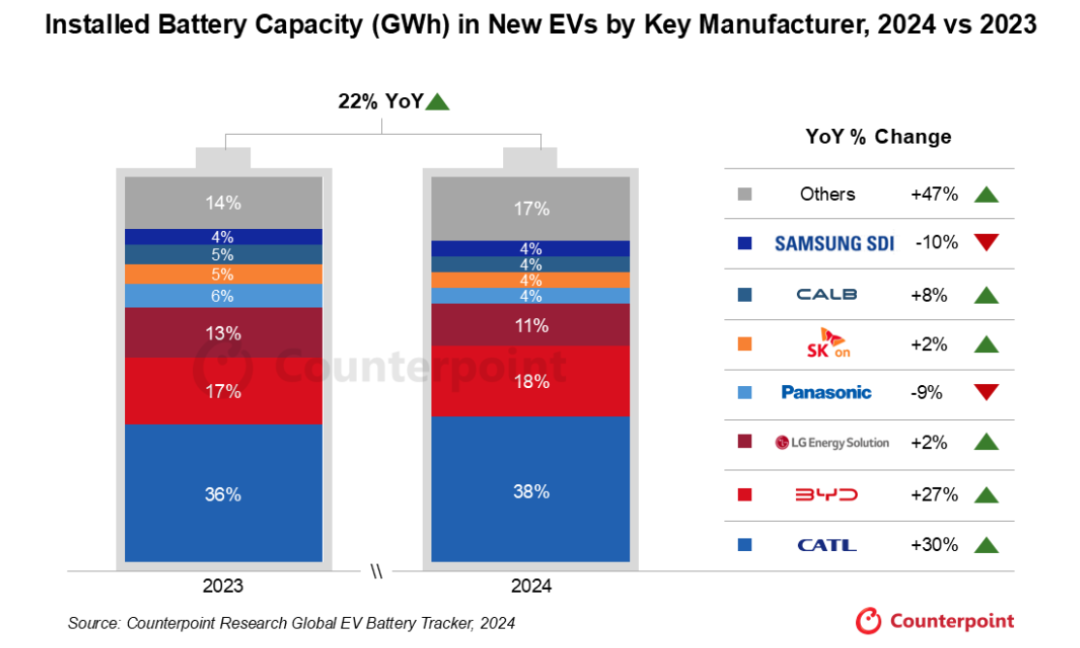
Counterpoint:2024年全球新能源汽车新车电池装机量同比增长22%
智通财经网· 2025-06-05 09:21
Group 1 - The core viewpoint of the article highlights that the global battery installation for new energy vehicles (NEVs) is expected to grow by 22% year-on-year in 2024, with Chinese manufacturers surpassing a 70% market share [1][3] - CATL leads the market with a 38% share, followed by BYD at 18%, driven by strong domestic demand and export expansion [1] - Analyst Abhik Mukherjee from Counterpoint emphasizes that China's battery advantage lies not only in cost but also in scale, execution capability, and industry integration [1] Group 2 - Despite increasing production, LG Energy Solution, Panasonic, and SK Innovation are experiencing a decline in market share due to weak demand in Europe and the US, delays in new super factory launches, and reduced orders from traditional automakers [1] - Among secondary manufacturers, only CALB is maintaining a stable momentum [1] - The average battery capacity for pure electric vehicles (BEVs) is increasing, but the overall average battery capacity for NEVs is expected to decrease by 1% due to the rising share of plug-in hybrid electric vehicles (PHEVs) from 30% in 2023 to 37% in 2024 [3]