新型推理芯片

Search documents
友军在撤退
Datayes· 2026-03-05 12:40
Core Viewpoint - The article discusses the recent performance of the A-share market, highlighting the impact of government policy announcements and sector-specific movements, particularly in technology and defense spending [1][6][11]. Market Performance - On March 5, the three major indices collectively rose, with the Shanghai Composite Index increasing by 0.64%, the Shenzhen Component by 1.23%, and the ChiNext by 1.66%. The total trading volume reached 24,127.85 billion yuan, an increase of 245.94 billion yuan from the previous day [17]. - The market saw over 4,000 stocks rise, with 79 stocks hitting the daily limit up, indicating strong bullish sentiment [17]. Government Work Report Highlights - The Chinese government plans to increase defense spending by 7% in 2026, with a GDP growth target set between 4.5% and 5% [6][11]. - The report anticipates a consumer price index (CPI) growth of around 2% and aims to create over 12 million new urban jobs [6][11]. - The government plans to issue 1.3 trillion yuan in ultra-long special sovereign bonds and 4.4 trillion yuan in new special local government bonds [6][11]. Sector Analysis - The article notes that the technology sector, particularly in quantum technology, brain-machine interfaces, and 6G, is expected to receive policy support, which could benefit related stocks [11][18]. - The CPO and Micro LED sectors experienced significant gains, with stocks like Lehman Optoelectronics and Ruifeng Optoelectronics hitting the daily limit up due to favorable market conditions and technological advancements [17][18]. Investment Insights - Citigroup emphasizes the importance of building a strong domestic market for social stability and economic protection amid global uncertainties [11]. - The focus on innovation and key technology breakthroughs is highlighted as a priority, with potential new policies expected to support these initiatives in 2026 [11][18]. Capital Flow - The article reports a net inflow of 355.87 billion yuan into the electronic industry, with significant investments in companies like Xinyi Technology and Shanghai Electric [36]. - Conversely, sectors such as non-ferrous metals and agriculture saw notable net outflows, indicating a shift in investor sentiment [36][43].






英伟达将推出新推理芯片
半导体芯闻· 2026-03-05 09:36
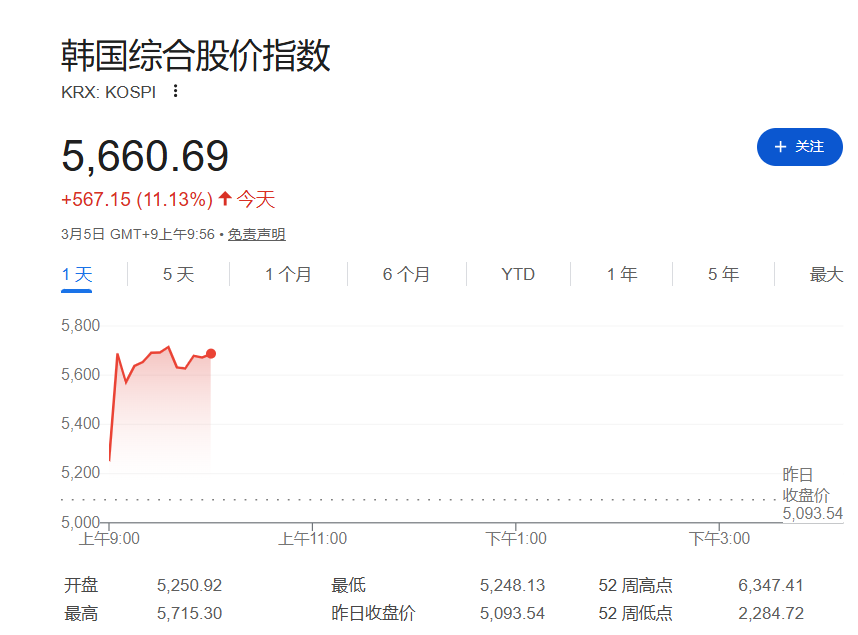
Core Viewpoint - The recent significant drop in the KOSPI index, attributed to global risk aversion due to geopolitical tensions and concerns over Nvidia's new SRAM-based inference chip, may have been misinterpreted regarding its impact on existing memory technologies [1][2]. Group 1: Market Reaction - The KOSPI index experienced a decline of over 10% in two days, marking the largest drop since 2008, primarily driven by global risk aversion following military actions involving Iran [1]. - A strong rebound was observed in the Korean stock market, with the KOSPI index increasing by 11%, and major tech companies like Samsung Electronics and SK Hynix saw significant gains of 13% and 15%, respectively [1]. Group 2: SRAM Chip Analysis - Reports indicated that Nvidia is developing a new inference chip using Groq's SRAM architecture, which raised concerns about reduced demand for existing memory types like HBM [1]. - KIS analysts clarified that the perception that low-cost SRAM chips would diminish the use of HBM reflects a misunderstanding of memory technologies, as SRAM has a larger unit area and higher cost per bit compared to DRAM [2]. Group 3: Memory Technology Diversification - SRAM architecture is not a replacement for DRAM but offers distinct advantages for specific applications requiring ultra-low latency, such as AI edge applications and certain data center workloads [5]. - The adoption of SRAM-based architectures is expected to diversify memory hierarchies within AI infrastructure, with HBM and DRAM continuing to serve as primary memory for large-scale model training and general inference servers [5][6]. - The overall potential market for the memory industry is anticipated to expand as the memory hierarchy becomes increasingly multi-tiered, incorporating SRAM, HBM, and DRAM [6].
除了中东,英伟达也导致了韩国股市暴跌
Hua Er Jie Jian Wen· 2026-03-05 02:54
Group 1 - The KOSPI index in South Korea experienced a decline of over 10% in two days, marking the largest drop since 2008, primarily due to global risk aversion triggered by Trump's military actions against Iran [1] - A report indicated that Nvidia's development of a new inference chip utilizing Groq's SRAM architecture contributed to the decline in South Korean memory stocks, raising concerns about reduced demand for main memory including HBM [1] - However, the South Korean stock market rebounded strongly, with the KOSPI index increasing by 11%, and major tech companies like Samsung Electronics and SK Hynix saw significant gains of 13% and 15% respectively [1] Group 2 - The market may have misjudged the impact of SRAM inference chips on HBM and DRAM, as KIS stated that the notion of low-cost SRAM chips reducing the use of existing main memory reflects a poor understanding of memory technology [4] - SRAM has historically been used for low-latency cache or on-chip buffering applications rather than as a primary memory for large data storage, due to its larger unit area and higher cost per bit compared to DRAM [4] - The adoption of SRAM architecture is seen as a unique option for specific workloads requiring ultra-low latency, particularly in AI applications, and is expected to diversify the memory hierarchy rather than replace DRAM [7] - KIS noted that the integration of SRAM, HBM, and DRAM will lead to a more layered memory hierarchy, ultimately expanding the total addressable market (TAM) for the memory industry [7]