
新能源通航飞机

Search documents
800亿元!上海低空经济亮出冲刺目标
Guo Ji Jin Rong Bao· 2026-01-12 08:33
Core Viewpoint - Shanghai aims to establish itself as the "world eVTOL capital" by 2028, targeting a core industry scale of over 80 billion yuan and nurturing 10 leading enterprises in the sector [1][2]. Industry Development - The implementation of the new policy marks a transition from nurturing the low-altitude economy to a phase of scaling and commercialization [2]. - By the end of 2025, Shanghai is expected to have at least 251 low-altitude economy startups, with 66 of them focusing on eVTOL and drones [2]. - Over 50% of the leading eVTOL companies in China have chosen to establish their operations in Shanghai, with five key players referred to as the "eVTOL Five Dragons" [2]. Regional Collaboration - The low-altitude economy industry alliance in Minhang District has gathered over 40 member units, covering the entire industry chain from core components to complete manufacturing [3]. - Yangpu District has introduced measures to promote low-altitude economic development, attracting over 130 related enterprises and initiating several innovative drone delivery routes [3]. Technological and Financial Support - Shanghai's comprehensive aviation industry chain, including large aircraft R&D and manufacturing, positions it advantageously in the low-altitude economy sector [4]. - The new measures include 16 support initiatives focusing on equipment R&D, industrial ecology, regional collaboration, and application scenarios [5]. - Financial support is emphasized, with initiatives to guide low-altitude industry funds to attract social capital for equity investments [7]. Future Outlook - The low-altitude economy is projected to reach a scale of over 100 billion yuan by the end of the 14th Five-Year Plan, with a focus on technological innovation and commercial demonstration [4]. - The policy aims to address key industry challenges, such as airworthiness certification, which is crucial for commercial operations [6]. - The collaboration within the Yangtze River Delta region is expected to enhance resource integration and optimize industry layout, facilitating long-term development [8].
打造新质生产力 上海建设低空经济先进制造业集群
Zhong Guo Zheng Quan Bao· 2026-01-08 22:17
Core Viewpoint - Shanghai aims to establish a low-altitude economy manufacturing cluster with a core industry scale of approximately 80 billion yuan by 2028, positioning itself as a leading global hub for eVTOL technology [1][2] Group 1: Development Measures - The measures outline three main objectives: enhancing high-end manufacturing capabilities, leveraging regional collaboration, and strengthening open innovation functions [2][3] - The plan includes attracting 10 leading companies in eVTOL and industrial drones, achieving a production capacity of over 500 new aircraft, and generating an additional investment of over 20 billion yuan [2][3] - A national-level testing platform for new low-altitude aircraft will be established, focusing on applications in logistics, public governance, and production operations [2][3] Group 2: Financial Support - Financial incentives include up to 100 million yuan for high-tech eVTOL and industrial drone projects, and up to 50 million yuan for innovations in specific technologies [3] - Support for new technology equipment in low-altitude infrastructure construction can reach up to 20 million yuan [3] Group 3: Infrastructure and Application - The measures emphasize the importance of scientific planning for low-altitude infrastructure, including the development of specialized takeoff and landing sites and intelligent network systems [3][4] - Applications in low-altitude logistics and public governance are prioritized, with a focus on safety and efficiency in urban management and emergency services [4] Group 4: Regional Policy Initiatives - Other regions, such as Guangdong, Yunnan, and Guizhou, are also implementing policies to support low-altitude economic development, focusing on safety regulation and core technology advancements [5][6] - Guizhou's action plan aims for a well-established low-altitude economic framework by 2027, including infrastructure and service systems [6] Group 5: Industry Outlook - The low-altitude economy is seen as entering a critical growth phase, driven by policy frameworks, infrastructure development, and technological innovation [6][7] - Companies in the aircraft manufacturing sector are expected to benefit first from the expansion of low-altitude applications, with increased demand for materials and components [7]
打造新质生产力上海建设低空经济先进制造业集群
Zhong Guo Zheng Quan Bao· 2026-01-08 20:50
Core Viewpoint - Shanghai aims to establish a low-altitude economy with a core industry scale of approximately 80 billion yuan by 2028, creating a complete industrial chain for new low-altitude aircraft and positioning itself as a leading global hub for eVTOL technology [1][2] Group 1: Development Goals - The measures outline three main objectives: enhancing high-end manufacturing capabilities, leveraging regional collaboration, and strengthening open innovation functions [2] - The plan includes attracting 10 leading companies in eVTOL and industrial-grade drones, achieving a manufacturing capacity of over 500 new aircraft, and generating an additional investment of over 20 billion yuan [2] Group 2: Specific Initiatives - The measures propose 16 specific initiatives focusing on building a research and manufacturing hub for low-altitude equipment, creating an industrial ecosystem, and promoting collaborative efforts in the Yangtze River Delta [2][3] - Financial support is allocated for high-tech projects, with up to 100 million yuan for eVTOL and industrial-grade drone manufacturing, and additional funding for related technological advancements [3] Group 3: Infrastructure and Application - The plan emphasizes the importance of developing low-altitude infrastructure, including specialized takeoff and landing sites and intelligent network systems, with a focus on public safety and operational efficiency [3][4] - It encourages the use of low-altitude aircraft for urban management, emergency response, and environmental monitoring, promoting innovative regulatory frameworks to facilitate these applications [4] Group 4: Regional Policy Trends - Other regions, such as Guangdong, Yunnan, and Guizhou, are also implementing policies to support low-altitude economic development, focusing on safety regulation, core technology advancements, and new application scenarios [5][6] - The low-altitude economy is seen as being at a critical growth phase, requiring a comprehensive policy framework, robust infrastructure, and innovative technologies to drive industry expansion [6][7]
剑指“世界eVTOL之都”,打造天空之城上海要链接好这片区域
2 1 Shi Ji Jing Ji Bao Dao· 2026-01-06 14:57
Core Insights - Shanghai has launched a significant development plan for the low-altitude economy, aiming to establish a comprehensive industrial chain for new low-altitude aircraft by 2028, targeting a core industry scale of approximately 80 billion yuan [1][2]. Group 1: Development Measures - The "Several Measures" document outlines the establishment of a low-altitude economic advanced manufacturing cluster in the Yangtze River Delta, with key districts in Shanghai playing pivotal roles in this initiative [1]. - The plan emphasizes collaboration with the Yangtze River Delta region to enhance low-altitude infrastructure and promote shared development of low-altitude logistics and applications [4]. Group 2: eVTOL Focus - Shanghai aims to position itself as a global hub for eVTOL (electric Vertical Take-Off and Landing) aircraft, with a goal to nurture and attract 10 leading companies in this sector by 2028, achieving a manufacturing capacity of over 500 new aircraft [2]. - The initiative includes financial incentives for high-innovation eVTOL projects, with support of up to 100 million yuan for manufacturing projects and 50 million yuan for key technology developments [2][3]. Group 3: Infrastructure and Collaboration - The plan includes the establishment of a national-level testing platform for new low-altitude aircraft and encourages cross-regional cooperation in low-altitude infrastructure development [4][5]. - It promotes the creation of a financial ecosystem that supports the low-altitude economy, including loans, leasing subsidies, and rewards for standard-setting efforts [5]. Group 4: Industry Ecosystem - The low-altitude economy is evolving beyond traditional hardware sales to a diversified profit model that includes hardware leasing, operational services, data monetization, and consulting services, creating a comprehensive value network [6].
上海剑指“世界eVTOL之都”
3 6 Ke· 2026-01-06 09:40
Core Viewpoint - Shanghai is transitioning from planning to industrialization in the low-altitude economy, aiming for a core industry scale of approximately 80 billion yuan by 2028, establishing a complete industrial chain for new low-altitude aircraft, and positioning itself as a "world eVTOL capital" [1] Group 1: Policy Development - The recent policy document, "Several Measures," supplements the previously released "Action Plan for High-Quality Development of Low-Altitude Economy (2024-2027)," focusing on manufacturing capabilities, enterprise hierarchy, application scenarios, and regional collaboration [2] - The new policy is seen as a significant boost for low-altitude enterprises in Shanghai, providing concrete support for the action plan and clarifying the goal of becoming an eVTOL hub [2][4] Group 2: Manufacturing and Capability - The "Several Measures" outlines three key tasks for building the low-altitude advanced manufacturing industry cluster, emphasizing the need for quantifiable manufacturing capabilities [3][4] - Shanghai aims to cultivate and attract 10 leading manufacturers in eVTOL, industrial-grade drones, and new energy aviation aircraft, achieving a production capacity of over 500 new aircraft and generating an additional investment of over 20 billion yuan [4] Group 3: Regional Collaboration - The policy emphasizes enhancing regional collaboration, aiming to establish a national-level testing platform for new low-altitude aircraft and promoting applications in smart logistics, public governance, and production operations [5] - The integration of resources and optimization of layouts across the Yangtze River Delta region is expected to provide substantial benefits for low-altitude enterprises [5][6] Group 4: Financial Support and Innovation - The new policy clarifies financial support for research and certification processes, reducing cash flow pressures for innovative SMEs during technology development and market validation phases [7] - Local government intervention in the testing and certification stages is intended to share risks with enterprises, accelerating the transition of technology from laboratories to market [7] Group 5: Market and Investment Trends - The low-altitude economy has been included in significant national policy documents for two consecutive years, with local governments accelerating their actions [7] - The capital market's interest is rising, with the China Securities Regulatory Commission expanding the application of the fifth set of listing standards to support enterprises in frontier technology fields, including low-altitude economy [7]
链接长三角加快建设低空经济先进制造业集群,上海发布若干措施
Di Yi Cai Jing· 2026-01-06 09:39
Core Objectives - By 2028, the core industry scale of Shanghai's low-altitude economy is expected to reach approximately 80 billion yuan, forming a complete industrial chain for new low-altitude aircraft and establishing a national advanced manufacturing cluster for the low-altitude economy, aiming to become the "world eVTOL capital" [1][3] Major Measures - Establish a high ground for low-altitude equipment research and manufacturing, focusing on building specialized industrial parks and providing comprehensive support for key projects, with a maximum support of 100 million yuan for high-innovation projects [4][5] - Support key core technology breakthroughs in eVTOL and industrial-grade drones, with a maximum support of 50 million yuan for technological advancements [4][5] - Accelerate the development of new technology testing and verification platforms, with a maximum support of 20 million yuan for testing services [4][5] - Enhance the capabilities for airworthiness certification of new aircraft, providing one-time rewards for companies obtaining type certificates and production licenses [5] Industry Ecosystem Development - Improve airworthiness technology capabilities by collaborating with national airworthiness certification agencies and establishing a "one-stop" airworthiness service platform [5][6] - Accelerate the formulation of standards and norms, with rewards for leading enterprises and research institutions involved in standard-setting [6] - Increase financial support for low-altitude enterprises, including innovative insurance products and bank loans, with a maximum subsidy of 20 million yuan for financing projects [6] Regional Collaboration - Strengthen interconnectivity of low-altitude facilities in the Yangtze River Delta region, promoting shared infrastructure and collaborative planning for low-altitude public air routes [6][7] - Encourage the application of low-altitude equipment in various scenarios, such as logistics and emergency rescue, while fostering cross-regional cooperation [6][7] Infrastructure and Safety - Develop a scientific layout for low-altitude infrastructure, ensuring land and funding support for the construction of specialized take-off and landing sites [7] - Promote safe low-altitude transportation, focusing on urban delivery and logistics, while ensuring the safety of new aircraft demonstration routes [7] - Encourage the use of low-altitude aircraft for public governance applications, such as urban management and environmental monitoring [7]
最高支持1亿元 上海真金白银竞逐“世界eVTOL之都”
Zhong Guo Jing Ying Bao· 2026-01-06 05:22
Core Viewpoint - Shanghai aims to accelerate the development of a "world eVTOL capital" by 2028, targeting a core industry scale of approximately 80 billion yuan in the low-altitude economy [3][4]. Group 1: Industry Development Measures - The Shanghai Municipal Economic and Information Commission, along with other local authorities, has released measures to enhance the low-altitude economy and advanced manufacturing cluster in the Yangtze River Delta [3]. - By 2028, the goal is to establish a complete industrial chain for new low-altitude aircraft, including eVTOLs and industrial-grade drones, with a manufacturing capacity of over 500 new aircraft [4]. - The measures include attracting and nurturing 10 leading enterprises in the eVTOL and related sectors, which is expected to drive an additional investment of over 20 billion yuan in the industry [4]. Group 2: Collaborative and Innovative Framework - The initiative emphasizes regional collaboration and innovation, aiming to create a national-level testing and verification platform for new low-altitude aircraft [4]. - The focus will be on applications in low-altitude smart logistics, public governance, and production operations, enhancing the core competitiveness of the low-altitude economy [4]. - Shanghai will leverage its "low-altitude economy reception hall" to integrate into the global low-altitude economic market and promote the international application of low-altitude equipment [4]. Group 3: Financial Support and Incentives - The Shanghai government plans to provide substantial financial support for the development of the low-altitude economy, including subsidies for manufacturing capabilities, key technology breakthroughs, and infrastructure construction [5]. - For high-innovation projects in eVTOL and industrial-grade drones, the city will offer support of up to 100 million yuan for qualifying manufacturing projects [5].

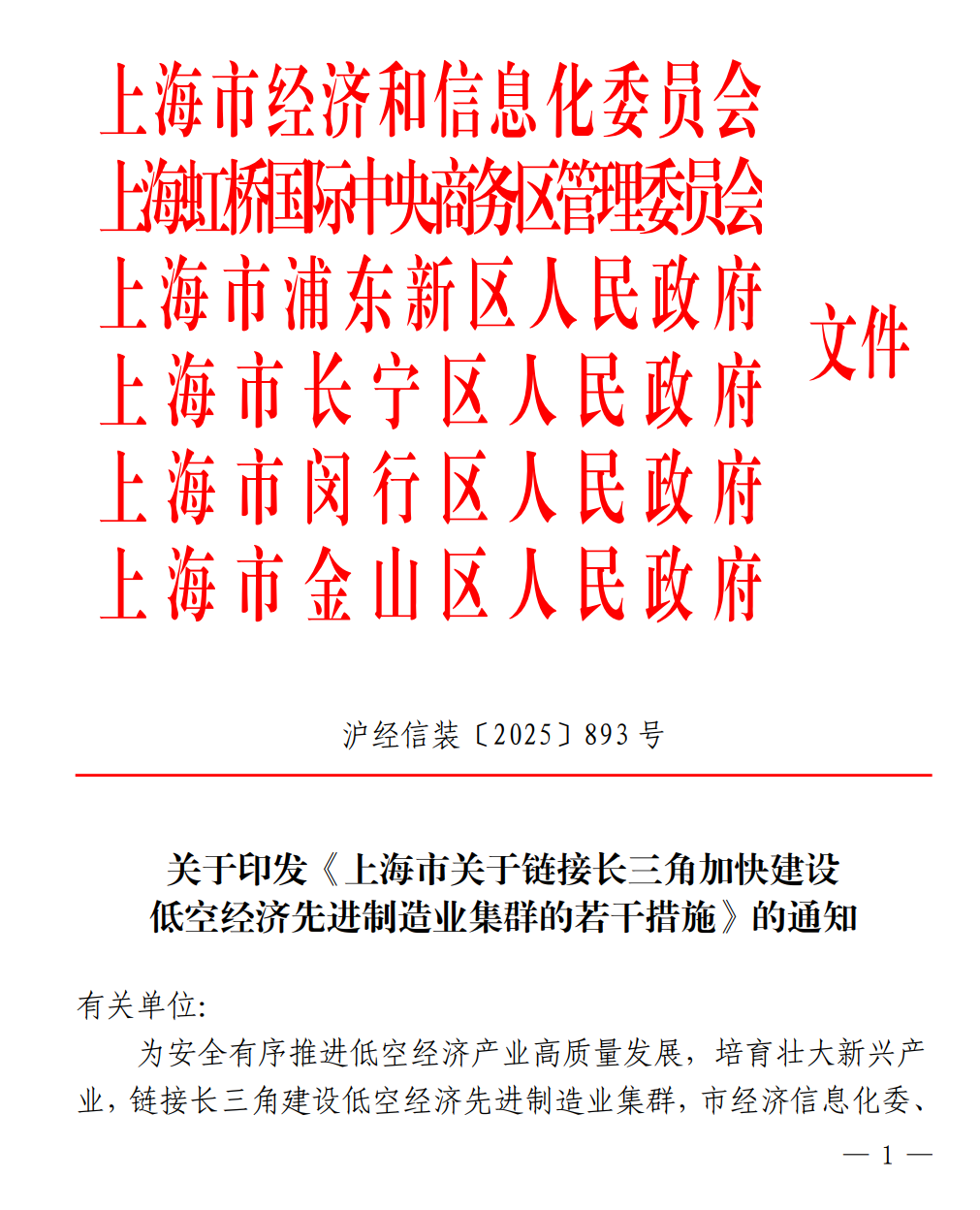
链接长三角 上海计划3年内迈向“世界eVTOL之都”
Xin Lang Cai Jing· 2026-01-05 20:49
Core Viewpoint - Shanghai aims to establish itself as a global hub for eVTOL (electric Vertical Take-Off and Landing aircraft) by 2028, targeting a core industry scale of approximately 80 billion yuan and attracting 10 leading manufacturers in the sector [1][2]. Group 1: Measures and Goals - The measures include 16 support initiatives across four areas: equipment R&D and manufacturing, industrial ecology, Yangtze River Delta collaboration, and application scenarios [2]. - By 2028, the goal is to cultivate and attract 10 leading manufacturers in eVTOL, industrial-grade drones, and new energy aviation aircraft, achieving a production capacity of over 500 new aircraft and generating an additional investment of over 20 billion yuan in the industry chain [1][2]. Group 2: Industry Development and Trends - The low-altitude economy in Shanghai has attracted a significant number of startups, with at least 251 companies in the sector, including 66 manufacturers of eVTOL, drones, and helicopters [1]. - The industry is expected to experience a "certification boom" between 2026 and 2027, which is crucial for the commercialization of low-altitude aircraft [2]. Group 3: Technological and Financial Support - The measures encourage companies to enhance their efforts in developing various eVTOL technologies, such as compound wings and tilt-rotor systems, to facilitate industrialization [2]. - Financial support initiatives include guiding low-altitude industry funds to collaborate with social capital for equity investments and supporting insurance institutions to innovate low-altitude insurance products [3]. Group 4: Regional Collaboration - The Yangtze River Delta region is seen as having complementary strengths in low-altitude economic development, with opportunities for collaborative development and resource optimization [4].
上海再出新政发展低空经济
第一财经· 2026-01-05 03:27
Core Viewpoint - Shanghai aims to become the "world eVTOL capital" by 2028, targeting a core industry scale of approximately 80 billion yuan in the low-altitude economy, supported by new policies to enhance high-end manufacturing capabilities and attract leading eVTOL and drone companies [3][4][5]. Group 1: Policy Measures - The newly released measures propose to cultivate and attract 10 leading companies in eVTOL, industrial drones, and new energy aircraft, aiming for a manufacturing capacity of over 500 new aircraft and an additional investment of over 20 billion yuan in the industry [3]. - The measures emphasize regional collaboration, aiming to establish a national-level testing platform for new low-altitude aircraft and enhance cooperation between urban and regional areas in the Yangtze River Delta [3][4]. Group 2: Industry Development - Shanghai has a strong industrial foundation for low-altitude economy, with over 50% of the country's leading eVTOL companies based in the city, forming a comprehensive ecosystem for low-altitude economic activities [5]. - The city plans to focus on low-altitude economy, commercial aerospace, embodied intelligence, biological manufacturing, and smart terminals as new growth points, targeting an overall industry scale of 1 trillion yuan by the end of the 14th Five-Year Plan [4][5]. Group 3: Infrastructure and Collaboration - The establishment of the East China Drone Base as a national pilot zone for civil unmanned aerial vehicles is highlighted, which integrates R&D, manufacturing, flight services, and training into a low-altitude industry ecosystem [8]. - The Minhang District has formed a low-altitude economic industry alliance with 41 member units, achieving a total order amount of over 15 billion dollars since 2025, while the Yangpu District has over 130 related companies focusing on low-altitude R&D and applications [8].

加快迈向“世界eVTOL之都” 上海建设低空经济先进制造业集群
Jie Fang Ri Bao· 2026-01-05 01:35
Core Insights - The Shanghai Municipal Economic and Information Commission, in collaboration with the Hongqiao International Central Business District Management Committee and four districts, has issued measures to accelerate the construction of a low-altitude economy advanced manufacturing cluster in the Yangtze River Delta, targeting a core industry scale of approximately 80 billion yuan by 2028 [1][2] Group 1: Overall Goals - The overall goal is to establish a complete industrial chain for new low-altitude aircraft and to build a national advanced manufacturing cluster for the low-altitude economy, positioning Shanghai as a global hub for eVTOL (electric Vertical Take-Off and Landing) aircraft [1] - The objectives are divided into three dimensions: enhancing high-end manufacturing capabilities, leveraging regional collaboration, and strengthening open innovation functions [1] Group 2: Specific Measures - The measures include 16 specific initiatives focused on building a low-altitude equipment R&D and manufacturing hub, an industrial ecosystem, and facilitating collaborative efforts in the Yangtze River Delta [2] - Support for leading manufacturing projects in eVTOL and industrial-grade drones can receive up to 100 million yuan, while innovative insurance products for low-altitude aircraft testing and commercial applications can receive up to 20 million yuan in subsidies [2] - There is an emphasis on enhancing low-altitude infrastructure cooperation in the Yangtze River Delta, including planning for cross-provincial low-altitude public air routes and facilities [2]