新酒饮

Search documents
白酒周期没有“第三条道路”:存量爆改,还是增量破局?丨老邵酒业评论
Sou Hu Cai Jing· 2026-02-14 22:38
Core Insights - The white liquor industry is entering a new adjustment period, with traditional business rules remaining unchanged [2][4] - The focus is on "explosive transformation" of existing business models to create new consumption cycles and commercial opportunities [5][6] Group 1: Stock Innovation - Stock innovation involves selecting the right pricing strategy or exploring higher price segments to attract new consumer groups and enhance distribution networks [2][4] - Traditional enterprises have historically succeeded in this area due to prolonged consumer upgrade cycles [2][4] Group 2: Incremental Breakthrough - Incremental breakthroughs are driven by the expansion of new categories and trends, which lead to consumption changes and the initiation of new cycles [7][8] - The emergence of new consumption patterns, such as sauce-flavored and clear-flavored liquors, reflects the evolution of industry and economic cycles [10][12] Group 3: Market Dynamics - The current market structure shows a "strong leaders, scattered middle, and weak bottom" scenario, indicating a need for clearer business and marketing models among non-leading brands [14] - There is significant potential for revenue generation for businesses that can match resources effectively in this competitive landscape [14] Group 4: Future Trends - The future of liquor consumption is expected to be more youthful and popularized, with low-alcohol and new beverage trends becoming increasingly prominent [15] - The industry provides a quality platform, but success will not come easily, contrasting with previous "windfall" profits [15][16]

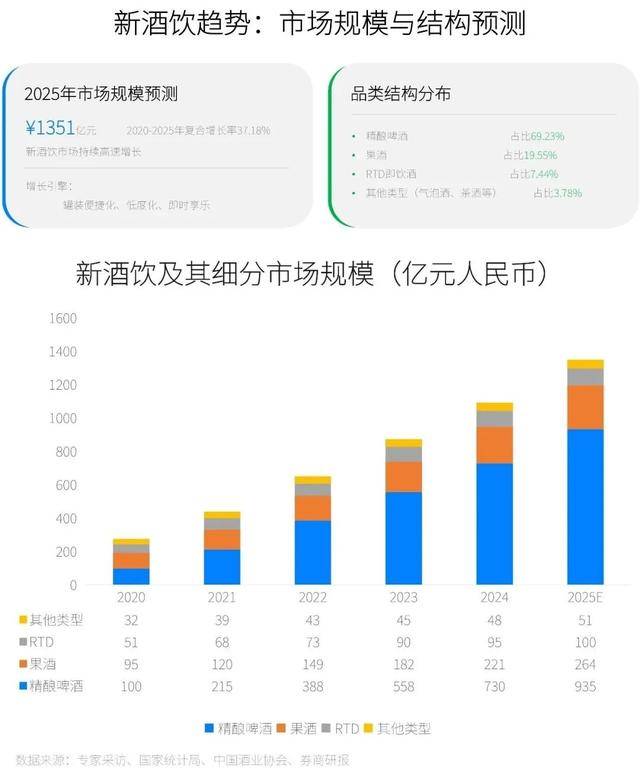
从“5%”到“1351亿”,新酒饮正定义中国酒业下一个周期
Sou Hu Cai Jing· 2026-01-23 11:28
Core Insights - The Chinese alcoholic beverage industry is undergoing a profound structural transformation driven by generational consumption shifts, scene migration, and supply innovation [1][2] - Traditional segments like liquor, beer, and wine are experiencing stagnation, while the "new alcoholic beverages" category, characterized by low alcohol content and diverse flavors, is rapidly emerging as a new growth curve [1][2] - The new alcoholic beverage market is projected to reach 135.1 billion yuan by 2025, with a compound annual growth rate (CAGR) of 37.18% from 2020 to 2025, making it the fastest-growing segment in the industry [2][3] Consumption Trends - The report highlights a significant decline in traditional liquor consumption, with the share of public consumption of liquor dropping from 40% to 5% [2][3] - The new alcoholic beverage segment is gaining traction, with 42% of consumers indicating that "treating oneself" is a major consumption trend, and scenarios like "small gatherings" and "solo drinking" accounting for nearly 80% of new beverage purchases [7][9] Industry Dynamics - The rise of new alcoholic beverages is attributed to three key industry factors: product logic redefinition, consumer demographic evolution, and channel system revolution [9][10] - Traditional alcohol development focused on product-centric approaches, while new alcoholic beverages prioritize identifying target demographics and consumption scenarios before defining products [10][12] Consumer Demographics - The core users of new alcoholic beverages are predominantly women and younger consumers, with female users of fruit wine making up 64.72% and 76.7% of the 18-30 age group preferring low-alcohol beverages [12][13] - This demographic shift is leading to a more democratized consumption landscape, emphasizing individual experience over traditional male-dominated decision-making [12][13] Channel Innovations - The channel structure for new alcoholic beverages is undergoing a fundamental transformation, with instant retail (O2O) becoming a new growth engine, projected to increase from less than 6.8% in 2020 to over 15% by 2025 [13][14] - The shift from traditional distribution to instant retail reflects a change in channel functionality from storage and planned purchasing to immediate fulfillment within 30 minutes [13][14] Industry Restructuring - The emergence of new alcoholic beverages signifies a comprehensive restructuring of the industry, affecting every aspect of the value chain, including brands, distributors, and competitive dynamics [14][15] - Brands must transition from being product-centric to becoming scene-oriented operational companies, focusing on defining scenarios and providing comprehensive solutions for distribution [15][16] Future Trends - The future of the new alcoholic beverage market will focus on health and functionality, with products increasingly featuring low-sugar and low-calorie options, as well as functional ingredients [17][20] - There will be a parallel trend of value segmentation and premiumization, with high-end products emerging based on unique ingredients and cultural narratives, indicating a willingness among consumers to pay a premium for quality [17][20] - The market is shifting from a "broad product" era to a "precision cultivation" era, where brands will need to target specific consumer segments and high-value scenarios to build loyalty and brand barriers [20]
手里有项目?5亿基金就位,20+投资机构集结,等你来融资
Sou Hu Cai Jing· 2025-11-07 07:45
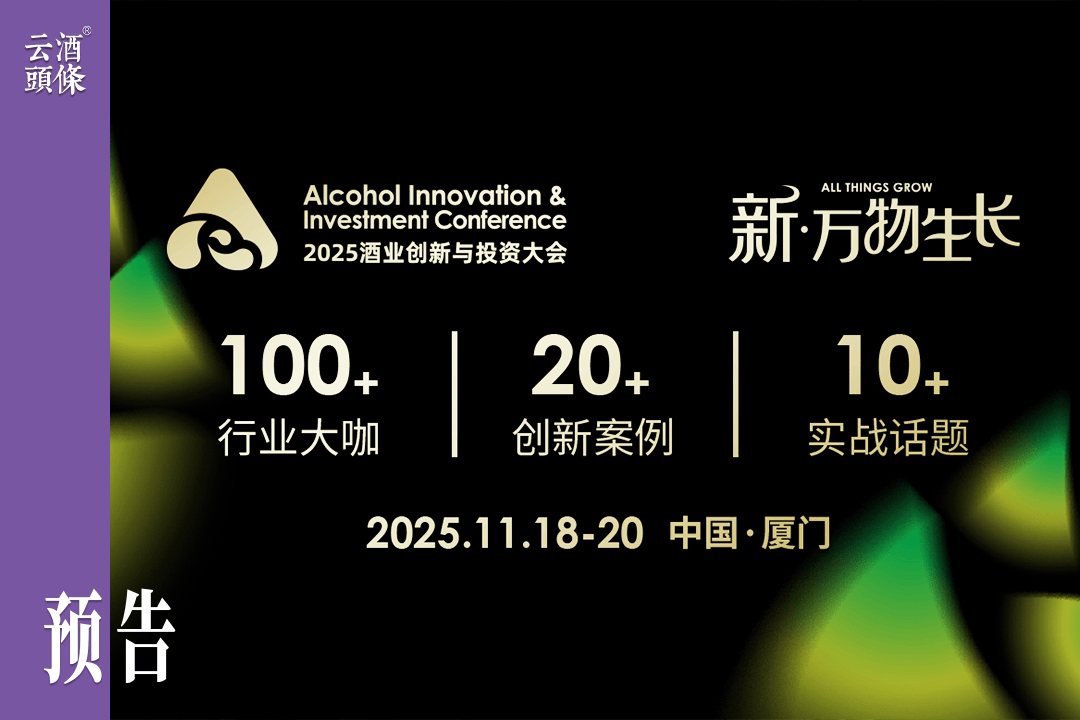
11月18-20日,来厦门AIIC 2025酒业创新与投资大会,进行一场创新与投资的双向奔赴,一次产业与未来的深度交流对于行业寻求融资的创新。 企业而言,这不仅是可以一次性、高效率直面中国酒业投资集群,与资本进行深度对话的战略窗口,也是一个直链酒类产业上下游优质资源、对接 全国渠道网络的独特平台。 文|刘娟 近年来,酒业进入存量挤压、结构升级的多重调整周期中。白酒产量连续七年下滑,白酒库存高企、价格倒挂频现;与此同时,低度酒、新酒饮却逆势增 长,资本风向迅速调转。 以新酒饮赛道为例,目前这一细分品类已重回高增长轨道,数据显示其规模预计将在2025年增至743亿-750亿元,年复合增速维持在25%-30%。 目前,大会已邀请到复星集团、晨哨集团、L Catterton路威凯腾、CPE源峰、宝捷会、黑蚁资本、嘉御资本、加华资本、美团龙珠、启承资本、天图资 本、青山资本、绝了基金、光点资本、弘章资本、草根知本、金鼎资本、凯辉基金、日初资本、华映资本等多家主流投资机构莅临现场。 这些机构覆盖消费赛道全周期投资,既有深耕酒业的产业资本,也有擅长孵化新锐品牌的创投力量,将带来最前沿的投资视角与合作机会。 大会还将携手这些 ...
从2025上半年宏观经济及酒类景气指数看酒类发展趋势报告
Sou Hu Cai Jing· 2025-09-25 10:30
Core Insights - The report highlights the significant impact of macroeconomic changes and consumer behavior on the liquor industry in the first half of 2025, indicating a shift towards online growth and personal drinking scenarios [1][4]. Economic Overview - China's GDP growth for the first half of 2025 is projected at 5.3%, reflecting resilience but facing challenges in consumer sentiment [1][13]. - Consumption policies have been implemented, with a total of nearly 370 billion yuan in subsidies targeting newborns, students, and low-income groups, contributing to market recovery [1][17]. Consumer Behavior - A "frugal" mindset is prevalent among consumers, with 72% seeking additional income sources and 47% focusing on essential purchases to avoid waste [2][11]. - Quality (35%), cost-effectiveness (31%), and brand recognition (23%) are the primary considerations for consumers, indicating a shift towards rational consumption [2][11]. Sales Channel Dynamics - In the first half of 2025, the overall sales of fast-moving consumer goods (FMCG) grew by 4.7%, with online channels leading at a growth rate of 21.1%, while offline channels saw a decline of 4.3% [2][3]. - Online sales of liquor are driven by competitive pricing and the growing influence of younger consumers, while traditional retail faces significant pressure [2][3]. Liquor Market Trends - The liquor market shows a divergence between online and offline performance, with an online index of 61.30, significantly above the benchmark, driven primarily by strong sales of white liquor [3][4]. - The offline supermarket index is at 49.77, close to the benchmark, indicating stable pricing but declining volumes, particularly in white and red wines [3][4]. Consumption Scenarios - There is a notable shift from collective drinking occasions to personal drinking experiences, with consumers increasingly favoring home consumption and relaxation [4][5]. - The demand for smaller packaging and lower-alcohol products is rising, reflecting the changing preferences of consumers [4][5]. Price Trends - The liquor market exhibits a "polarization" in pricing, with significant growth in both economy-priced and high-end products, while mid-range products see slower growth [4][5]. - Different liquor types show varying price spans, with some covering both mass and premium markets, while others focus on mass consumption [4][5]. Future Outlook - The liquor industry is expected to align closely with evolving consumer demands, channel transformations, and product innovations [5]. - Companies are encouraged to enhance online marketing and adapt to younger consumer preferences while revitalizing offline channels through experiential upgrades [5].