年末效应

Search documents
A股喜提六连阳 百点反弹后还能涨吗?
Xin Lang Cai Jing· 2025-12-24 16:48
Market Overview - The A-share market showed a narrow fluctuation pattern on Wednesday, with the three major indices gradually turning positive, closing with the Shanghai Composite Index up 0.53% at 3940.95 points, marking six consecutive days of gains [1] - The Shenzhen Component Index rose 0.88% to 13486.42 points, while the ChiNext Index increased by 0.77% to 3229.58 points [1] - The total trading volume in the Shanghai and Shenzhen markets was 188.03 billion yuan, a slight decrease of 19.6 billion yuan compared to Tuesday [1] Key Factors Driving Market Recovery - A significant easing of concerns regarding overseas liquidity has created a favorable external environment for the rebound in the A-share market [1] - The continuous appreciation of the Renminbi has boosted confidence in cross-border capital flows and enhanced the attractiveness of A-share assets [1] - The traditional "year-end effect" or "spring excitement" expectations have provided emotional support for the market [1] Market Dynamics and Future Outlook - The current market rebound relies more on existing capital rather than new inflows, with no significant signs of increased trading volume [2] - The upcoming Christmas holiday period may lead to decreased trading activity from overseas markets, potentially affecting cross-border capital flows [2] - Technically, the market continues to rebound, with the Shanghai Composite Index achieving six consecutive gains and surpassing the December 8 high of 3936 points [2] - Despite active market sectors, overall trading volume has not expanded significantly, making it challenging to maintain a continuous broad-based rally without sufficient new capital [2] Investment Strategy - Investors are advised to focus on structural opportunities, particularly high-quality stocks with strong earnings certainty and reasonable valuations [2] - Emphasis should be placed on leading stocks in sectors benefiting from supportive industrial policies and those in an upward cycle of industry prosperity, while managing risks to seize short-term investment opportunities [2]
“申”度解盘 | 春季躁动预热期
申万宏源证券上海北京西路营业部· 2025-12-15 02:16
Core Viewpoint - The market is expected to maintain an upward trend in the medium term, with a potential low point around November 24, indicating a prelude to a spring rally [7]. Market Analysis - The index has been consolidating in the range of 3800-3950 with rapid rotation of hot sectors, primarily focusing on optical chips and commercial aerospace [6]. - The market experienced significant panic selling on October 17 and November 24, leading to a reduction in margin financing by over 28 billion, establishing strong support around the 3820 level [7]. Short-term Outlook - The upcoming Bank of Japan interest rate decision is anticipated to influence global market liquidity, but the expected impact is considered limited due to prior market adjustments [7]. December Market Expectations - Historically, December sees a defensive bias in fund allocation due to year-end effects, but this year may favor small-cap growth stocks due to a combination of Fed rate cuts and a flexible monetary policy as indicated in the Central Economic Work Conference [7].


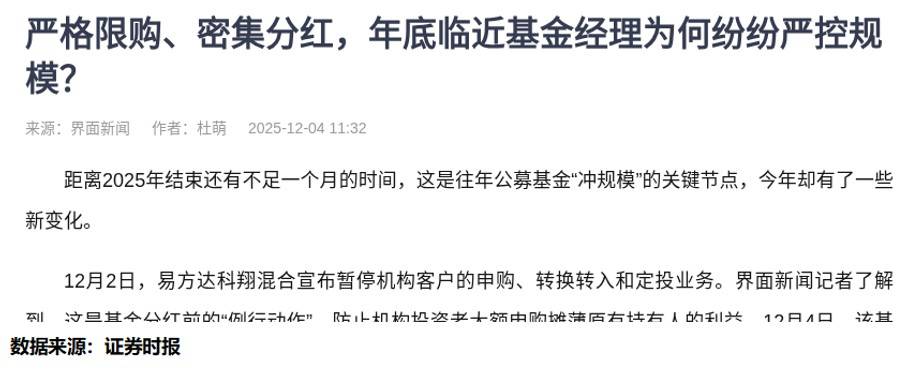
机构年底调仓:散户如何不被收割?
Sou Hu Cai Jing· 2025-12-04 18:40
Group 1 - The core observation is the simultaneous occurrence of a dividend wave and purchase limits among high-performing funds, indicating a strategic maneuver by institutions [1][2] - As of December 4, 2025, a total of 3,364 funds have distributed approximately 215.517 billion yuan in dividends, with the Huatai-PB CSI 300 ETF leading at 8.394 billion yuan [2] - The practice of large-scale dividends often coincides with market turning points, suggesting that institutions are cashing in profits to prepare for future investments [3] Group 2 - From a quantitative perspective, the analysis reveals distinct behaviors in stock movements, with one stock showing institutional accumulation while another reflects retail investor activity [6][8] - The year-end market behavior aligns with the "year-end effect," where fund managers begin positioning for the upcoming year, often starting their strategies earlier than retail investors realize [8] - The importance of understanding the underlying intentions behind dividends and purchase limits is emphasized, as they do not always correlate with positive or negative market signals [9][13] Group 3 - Recommendations for ordinary investors include recognizing the psychological impact of dividends for locking in annual returns and understanding the rationale behind purchase limits to mitigate performance risks [9][10] - The future of quantitative investing is anticipated to flourish with advancements in AI and big data, enabling individual investors to access analytical tools previously available only to institutions [12] - The focus should be on tracking capital movements and establishing a personal analytical framework to navigate the complexities of the market [13][14]