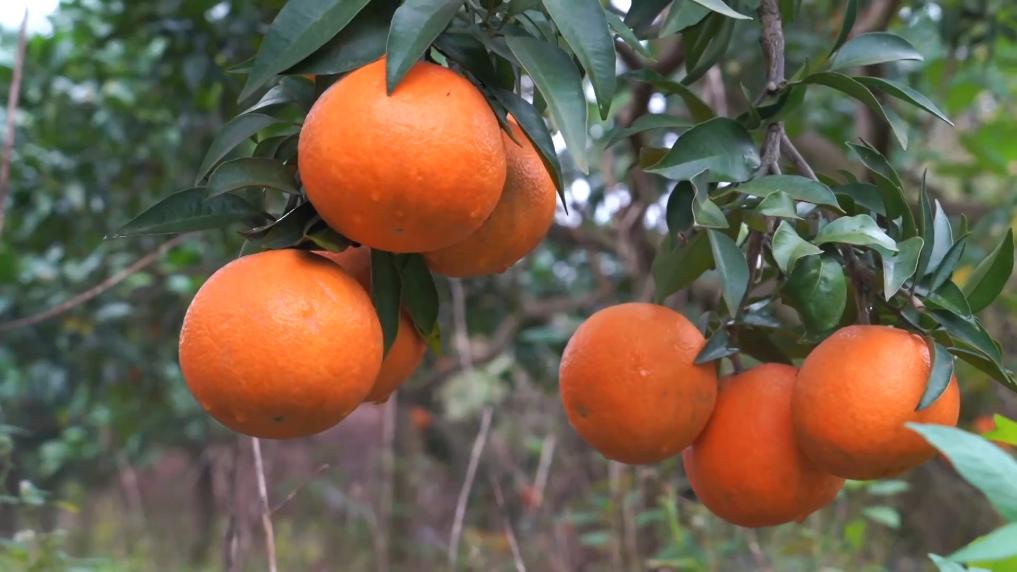
晚熟柑橘

Search documents
冬日暖阳里 听一首乡村振兴交响曲
Xin Hua Wang· 2025-12-09 07:10
Group 1: Technological Advancements in Agriculture - The modern agricultural park in Jiang'an, Sichuan, utilizes advanced technologies such as tracked orchard transport vehicles, water-based fermentation devices, and smart cloud platform management systems to enhance efficiency and sustainability in agricultural processes [1][3] - The park employs a "grass management" strategy to improve soil organic matter content, effectively using beneficial weeds to control harmful ones [3] Group 2: Economic Impact and Community Development - In Xinshan Village, Guangyuan, various models including large households, cooperatives, and family farms have been implemented to develop specialty industries, benefiting over 200 households and reinforcing poverty alleviation efforts [9] - The citrus planting area in Luzhou County exceeds 110,000 acres, generating an annual output value of approximately 280 million yuan [11] Group 3: Integration of Agriculture and Tourism - In Mianzhu, Sichuan, the local industry promotes experiential projects such as fruit picking and cooking events to attract tourists, thereby expanding market access [14] Group 4: Aquaculture Development - In Hebei's Shexian, the sturgeon industry is being developed with a complete industrial chain that includes research, processing, and sales, capitalizing on the region's suitable water conditions [16][17] - Shaanxi's Shanzhong City is advancing aquaculture with modern indoor facilities that utilize AI and big data for temperature control, oxygen management, and disease prediction, contributing to the region's agricultural modernization [20]

宜宾市翠屏区:坚持高质量发展主线 百强区进位实现“五连升”
Si Chuan Ri Bao· 2025-11-25 21:07
Economic Growth and Ranking - During the "14th Five-Year Plan" period, the regional GDP of Cuiping District is projected to grow from 104.658 billion yuan in 2020 to 161.630 billion yuan in 2024, maintaining the 5th position among county-level regions in the province and improving its national ranking from 68th to 53rd, marking five consecutive years of upward movement [2][3][4] Industrial Development - Cuiping District has established a "2+2+2" modern industrial system, featuring two trillion-level industrial clusters in liquor and power batteries, two traditional industries in equipment manufacturing and green food processing, and two emerging industries in digital economy and intelligent manufacturing [4][5] - The liquor industry has developed a complete industrial chain ecosystem, while the power battery sector has achieved significant growth, with 30 supporting enterprises in the Yangtze River Industrial Park [4][5] Infrastructure and Urban Development - The Cuiping Economic Development Zone is being developed as a new economic growth area, with the first batch of major projects launched and a focus on intelligent connected vehicles and smart manufacturing [5][6] - Urban expansion has been emphasized, with 300 key projects implemented and over 50 billion yuan invested, resulting in a new urban area of 6.22 square kilometers [6][7] Agricultural and Rural Development - The district has promoted a "5+2" characteristic agricultural industry, establishing seven modern agricultural parks, including a five-star and a four-star park [3][7] - Efforts have been made to protect arable land and enhance food security, with the establishment of urban-rural integration development pilot zones [7] Cultural and Tourism Development - Cuiping District has rich cultural resources, with significant efforts in cultural heritage protection and tourism development, leading to a 1.5 times increase in tourist reception to 38.6 million by 2024 and tourism revenue exceeding 120 billion yuan [8][9] - The district has been recognized as a national tourism city and has created several cultural landmarks, enhancing its tourism competitiveness [9]

四川蒲江:村集体赋能小农户高质量对接电商市场
Xin Hua Cai Jing· 2025-10-30 22:57
Core Insights - Rural e-commerce is a crucial pathway for farmers' wealth, addressing traditional income challenges and promoting sustainable income growth [1] - The development of rural e-commerce faces issues such as lack of unified quality standards, weak market connection capabilities of small farmers, and imbalanced profit distribution [1] - The central government's 2025 policy aims to accelerate the construction of modern circulation networks for agricultural products and support collaborative supply chain development [1] Group 1: Development Strategies - Pujin County has implemented measures such as standardizing agricultural production, establishing collective e-commerce service companies, and utilizing live streaming to enhance rural e-commerce development [1] - The county has developed over 600,000 acres of late-maturing citrus, kiwi, and tea, promoting organic farming practices and achieving a 30% premium on agricultural products [1] - By 2024, Pujin County has established a comprehensive cold chain system covering 27 provincial regions, creating a full-chain income mechanism from planting to logistics to sales [1] Group 2: Quality Improvement Initiatives - The village of Shizishu has focused on a collaborative model involving "village collective + e-commerce + agricultural social services + small farmers" to enhance product quality and market access [2] - A traceability system has been implemented, allowing consumers to access detailed agricultural records and testing reports, thereby increasing market trust and encouraging standardized production [2] - The village collective has formed an e-commerce service company to unify resources and enhance small farmers' market connection capabilities through a standardized service model [2] Group 3: Revenue Generation Models - Baiyun Village in Chaoyang Lake Town has adopted a model combining "party building + e-commerce live streaming + enterprises + agricultural social services + small farmers" to empower farmers and increase income [3] - The village has established a division of labor where the village secretary leads live sales, enhancing product credibility and consumer experience [3] - A diversified profit distribution model has been created, ensuring small farmers share in the added value of the e-commerce industry [3] Group 4: Systemic Mechanisms - The case study of Pujin County highlights the importance of a systemic mechanism for value creation, organizational collaboration, and profit sharing to empower small farmers [4] - Standardized production and product value enhancement are foundational for achieving brand premium in e-commerce [4] - Organizational empowerment is essential to overcome the challenges faced by small farmers, improving their market connection capabilities [4]
助力乡村产业更有韧性、农文旅融合更富活力 浙川牵手 给四川乡间带来了什么?
Si Chuan Ri Bao· 2025-10-15 23:58
Core Insights - The collaboration between Zhejiang and Sichuan provinces has led to significant advancements in agricultural modernization and rural revitalization, benefiting both local farmers and enterprises [3][8] Group 1: Agricultural Development - Sichuan Zhongyi Olive Development Co., Ltd. has established a model of "company + cooperative + base," providing local villagers with job opportunities and land rental income, resulting in over 1 million yuan in wages distributed annually [2] - The oil olive planting base in Baiya Town spans over 5,000 acres, with an annual output value nearing 40 million yuan [3] - The "Revitalization Workshop" initiative has created nearly 20,000 local job opportunities, with an investment of 460 million yuan in 173 projects, expected to generate an annual output value of 1.28 billion yuan [5] Group 2: Employment and Skills Training - The "Blue Eagle Project" has been implemented in 68 counties in Sichuan, training nearly 2,000 students, with a focus on those from impoverished backgrounds, achieving an average starting salary of over 6,000 yuan per month for graduates [6] - From January to July this year, Zhejiang has facilitated the transfer of employment for 51,800 individuals from Sichuan [7] Group 3: Market Integration - Sichuan's agricultural products, such as apples and green pepper, are now being marketed effectively, with initiatives to enhance branding and market access [9][10] - The establishment of modern agricultural industrial parks has diversified the agricultural structure in poverty-stricken areas, increasing the per-acre output value significantly [10] Group 4: Rural Tourism Development - Sichuan is leveraging experiences from Zhejiang to develop rural tourism, launching 10 distinctive tourism routes to attract visitors [11] - Collaborative cultural events, such as the "Red Original Grassland Music Festival," are being organized to enhance tourism appeal and cultural exchange [12][13]