
柑

Search documents
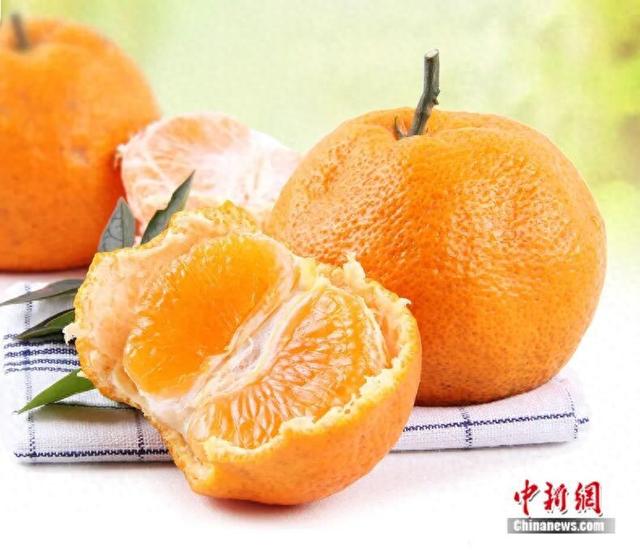
鲜嫩爆汁!这一来自苏东坡家乡的橘界“鱼子酱”让人忍不住炫
Xin Lang Cai Jing· 2026-02-13 23:52
Core Viewpoint - The article highlights the rise of Meishan, Sichuan as a leading production area for "kan" citrus, emphasizing its unique qualities and the strategies employed to enhance its market competitiveness [3][5][12]. Group 1: Production and Quality - Meishan's citrus planting area and output account for over 30% of the national total, with an annual production exceeding 2 million tons, establishing it as a core production area for late-maturing citrus in China [3][23]. - The region has implemented a "late harvesting for quality" strategy, allowing fruits to accumulate sugars and moisture, which enhances their taste and market appeal [7][12]. - The favorable subtropical climate, fertile soil, and effective agricultural practices contribute to the high quality of Meishan's citrus [5][9]. Group 2: Technological and Agricultural Support - Meishan has established a comprehensive agricultural technology promotion system, including expert teams and regular training to improve planting techniques and management [9][12]. - A late-maturing citrus research institute has been set up, focusing on variety improvement and ensuring consistent quality, which strengthens market competitiveness [12][19]. Group 3: Market Expansion and Economic Impact - The region has developed a dual sales model combining online and offline channels, with products reaching both domestic and international markets, including Russia and Southeast Asia [14][23]. - The citrus industry in Meishan has evolved into a full-chain development model, integrating planting, processing, and sales, contributing to an annual output value exceeding 4 billion yuan [16][23]. - The industry supports tens of thousands of farmers, creating a shared prosperity model that enhances rural income and drives local economic growth [24].

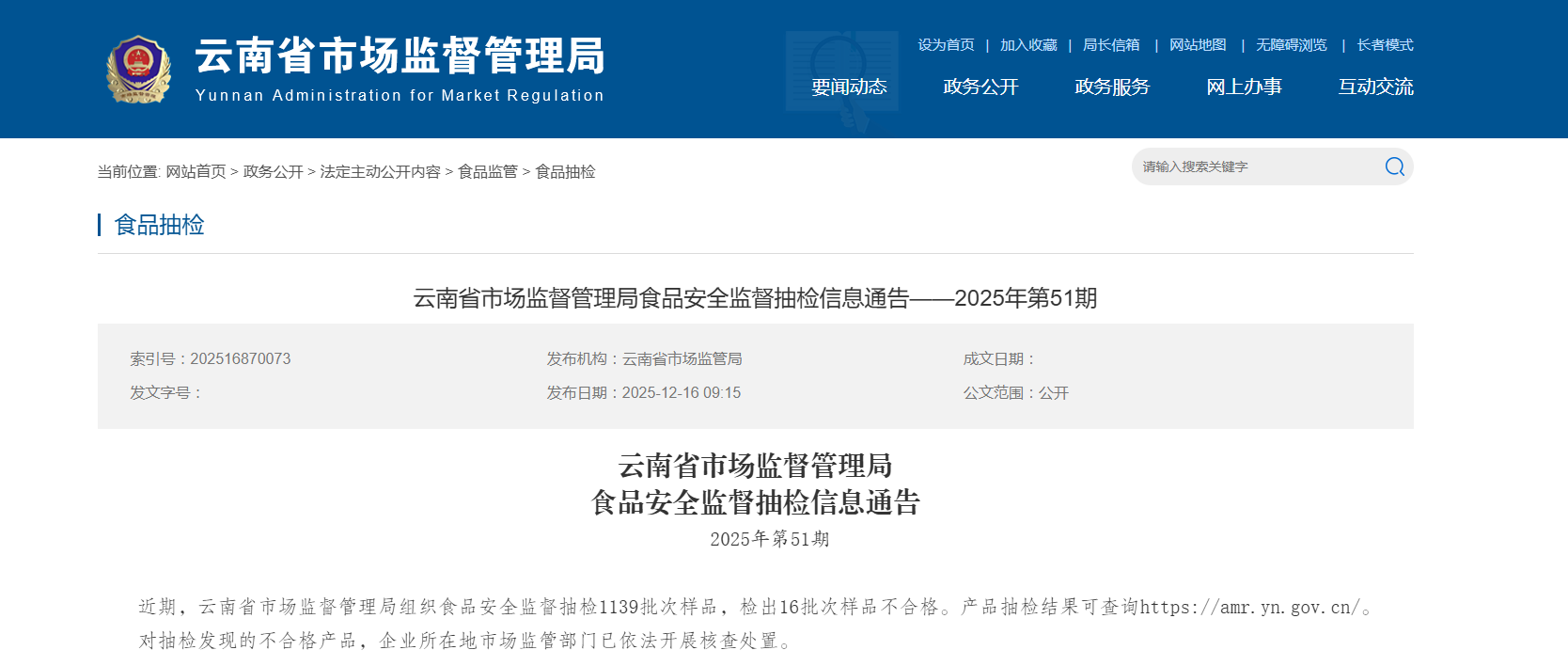
云南省市场监督管理局食品安全监督抽检信息通告2025年第51期
Zhong Guo Zhi Liang Xin Wen Wang· 2025-12-16 05:20
Core Viewpoint - The Yunnan Provincial Market Supervision Administration conducted food safety supervision and random inspections on 1,139 batches of samples, resulting in 16 batches being found non-compliant [3]. Group 1: Inspection Results - A total of 1,139 samples were inspected, with 16 batches identified as non-compliant [3]. - The non-compliant products are being investigated and handled by the local market supervision departments [3]. Group 2: Non-compliant Sample Information - Specific non-compliant products include: - Soft cake from a store in Longyang District, with aluminum residue at 362 mg/kg, exceeding the standard of 100 mg/kg [3]. - Potatoes from a vendor in Luliang County, with pesticide residue (chlorpyrifos) at 0.036 mg/kg, exceeding the standard of 0.02 mg/kg [3]. - Various other products including yam, mango, and cucumbers with different pesticide residues exceeding permissible limits [3][4].
重庆市潼南区市场监督管理局关于166批次食品安全抽检情况的通告(2025年第7号)
Zhong Guo Zhi Liang Xin Wen Wang· 2025-08-14 08:58
Core Viewpoint - The Chongqing Tongnan District Market Supervision Administration conducted food safety inspections on 166 batches of various food products, revealing that 158 batches passed while 8 batches failed to meet safety standards [2]. Group 1: Inspection Results - A total of 166 food samples were tested, covering 17 categories including restaurant food, tea, nuts, egg products, starch products, condiments, and more [2]. - Out of the 166 samples, 158 were found to be compliant with food safety standards, while 8 samples were deemed non-compliant [2]. Group 2: Actions Taken - The local market supervision authority initiated legal actions against the non-compliant products as per the Food Safety Law of the People's Republic of China [2]. - Risk control measures were implemented to trace the distribution of the non-compliant products, including recalls and removal from shelves [2]. Group 3: Non-compliant Products - Specific non-compliant products included fruits and vegetables with pesticide residues exceeding permissible limits, such as: - "Citrus" with a residue of 0.089 mg/kg (limit: ≤0.05 mg/kg) [2] - "Sweet potato" with a residue of 0.040 mg/kg (limit: ≤0.01 mg/kg) [2] - "Lychee" with a residue of 0.18 mg/kg (limit: ≤0.1 mg/kg) [2].
