
核动力破冰船

Search documents
兴趣不止格陵兰岛?北约布局北极,战略意图暴露无遗!
Xin Lang Cai Jing· 2026-02-27 13:19
Core Viewpoint - NATO is planning military exercises in the Arctic over the coming months, reflecting the strategic importance of the region amid global warming and melting ice caps [1] Group 1: Military Exercises Objectives - The exercises aim to enhance extreme environment adaptability, testing troops' survival, mobility, and combat capabilities in harsh Arctic conditions [3] - The Arctic serves as a testing ground for advanced equipment, including nuclear-powered icebreakers and F-35A fighter jets, under extreme conditions [4] - NATO emphasizes multinational joint operations, integrating various military branches to improve command coordination and logistical support in the Arctic [4] Group 2: Development of Arctic Combat Systems - NATO aims to establish a comprehensive polar combat system, focusing on developing capabilities for ice navigation, ground operations, and air support [5] - The organization is working on a dedicated communication network called "Arctic Chain" to address challenges in satellite communication and navigation in high-latitude regions [6] - NATO will enhance its strategic deterrence by optimizing anti-submarine warfare systems against concealed strategic nuclear submarines operating under the Arctic ice [7]

俄罗斯“加码”北极应对西方挑战
Xin Lang Cai Jing· 2026-02-01 17:15
Core Viewpoint - The strategic importance of the Arctic region has been highlighted by recent geopolitical tensions, particularly the U.S. interest in Greenland and increased military activities by NATO and Russia in the area [2][3][4]. Military Activities - The frequency of military exercises in the Arctic has increased from 13 to 21 annually over the past five years, with a significant rise in participating countries and the scale of operations [3]. - NATO has enhanced its reconnaissance efforts in the Arctic, with reconnaissance flights increasing by nearly 40% each year [3]. - Russia is closely monitoring NATO's military preparations, viewing them as a threat to its national security [4][7]. Geopolitical Tensions - The U.S. has expressed intentions to acquire Greenland, citing its strategic location and resource wealth, which has drawn a strong response from Russia [5][6]. - The establishment of NATO's "Arctic Sentinel" task force is seen as a provocation by Russia, which emphasizes the need to defend its Arctic interests [7]. Economic Development - The Arctic region is rich in natural resources, including oil, gas, and various minerals, which are crucial for Russia's economic development [8][10]. - Russia is accelerating the development of the Northern Sea Route, aiming to enhance its logistics capabilities and attract foreign investment [8][9]. Infrastructure and Logistics - Russia plans to develop five key ports along the Northern Sea Route to support logistics and operational needs [9]. - The cargo volume along the Northern Sea Route was 33.5 million tons last year, with projections to exceed 270 million tons annually by 2035 [10].
普京官宣大消息!
中国能源报· 2026-01-24 04:08
Group 1 - The core viewpoint of the article is that Russia is intensifying its efforts in the construction of nuclear-powered icebreakers, as stated by President Putin [3]. - Russia currently possesses 34 diesel-powered icebreakers and 8 operational nuclear-powered icebreakers [3]. - The construction of the "Chukotka" and "Leningrad" nuclear-powered icebreakers is actively underway, and the construction of the "Stalingrad" nuclear-powered icebreaker has also commenced [3]. - Plans are in place to build two additional nuclear-powered icebreakers, with the "Leader" icebreaker construction progressing as scheduled in the Russian Far East [3]. - The "Leader" icebreaker is designed to break through ice layers several meters thick, and it is expected that by 2030, Russia will possess this unprecedented icebreaker [3].

普京称正加强核动力破冰船建设
Xin Lang Cai Jing· 2026-01-24 00:02
Core Viewpoint - Russia is strengthening its nuclear-powered icebreaker construction, aiming to possess unprecedented icebreakers by 2030 [1] Group 1: Current Fleet and Construction Plans - Russia currently has 34 diesel-powered icebreakers and 8 operational nuclear-powered icebreakers [1] - The construction of the "Chukotka" and "Leningrad" nuclear-powered icebreakers is actively underway, with the "Stalingrad" nuclear-powered icebreaker also in the early stages of construction [1] - Plans are in place to build two additional nuclear-powered icebreakers [1] Group 2: Future Developments - The construction of the "Leader" nuclear-powered icebreaker is progressing as scheduled in the Russian Far East, which is designed to break through ice layers several meters thick [1] - President Putin expressed confidence that by 2030, Russia will possess the "world's unprecedented" icebreaker [1]
普京:俄罗斯正加强核动力破冰船的建设工作
Xin Hua She· 2026-01-23 18:03
Core Viewpoint - Russia is strengthening its nuclear-powered icebreaker construction efforts, with plans to enhance its fleet significantly by 2030 [1] Group 1: Current Fleet and Construction Plans - Russia currently operates 34 diesel-powered icebreakers and 8 active nuclear-powered icebreakers [1] - The construction of the nuclear-powered icebreakers "Chukotka" and "Leningrad" is actively underway, along with the initiation of the "Stalingrad" icebreaker [1] - Plans are in place to build two additional nuclear-powered icebreakers, with the "Leader" icebreaker construction progressing as scheduled in the Russian Far East [1] Group 2: Future Expectations - The "Leader" icebreaker is designed to break through ice layers several meters thick, and it is expected to be completed before 2030 [1] - President Putin expressed confidence that Russia will possess this unprecedented icebreaker by 2030, enhancing its capabilities in Arctic navigation [1]
俄罗斯提速北极开发,鼓励中日印参与
Xin Lang Cai Jing· 2026-01-21 10:21
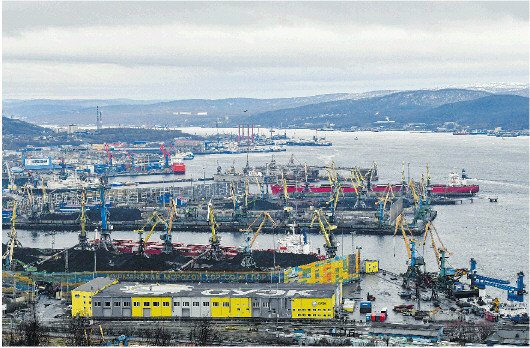
Core Insights - Russia aims to accelerate Arctic development to break Western sanctions and enhance logistics through the Arctic route, which is seen as a vital international shipping corridor [1][3][5] Group 1: Arctic Development Challenges - Russia faces significant challenges in Arctic development, including harsh natural conditions, labor shortages, high costs, outdated infrastructure, and financing difficulties [3][5] - The ongoing Ukraine conflict limits the government's ability to invest heavily in Arctic projects, making foreign investment crucial [3][5] Group 2: Investment and Infrastructure - The Arctic region comprises 10 federal subjects, covering 22% of Russia's territory, with a resident population of 2.36 million, only 1.6% of the national total [1] - The Russian government is focusing on attracting foreign investment to develop the Arctic shipping route, which is expected to optimize global trade and logistics [3][5] - Key ports along the Arctic route include Murmansk, Arkhangelsk, Sabetta, Dukinka, and Provideniya, which are being developed to support shipping operations [5][8] Group 3: Future Projections and Plans - By 2025, the cargo volume along the Arctic route is projected to reach 33.5 million tons, with expectations to exceed 270 million tons annually by 2035 [8] - The Russian government plans to establish a clear management structure for Arctic development and may create an "Arctic Development Company" to facilitate investment [8][11] - The government aims to improve living conditions in the Arctic, targeting an average life expectancy of 72.4 years and a natural population growth rate of 2% by enhancing various sectors [10][11] Group 4: International Collaboration - Russia is actively seeking foreign partners for Arctic projects, with countries like China, Japan, and India showing interest [11] - The "Arctic Express No. 1" logistics route has been established to connect Russian ports with Chinese ports, significantly reducing shipping times and costs [13][14]
俄罗斯庆祝核工业诞生80周年
Huan Qiu Wang· 2025-10-26 23:01
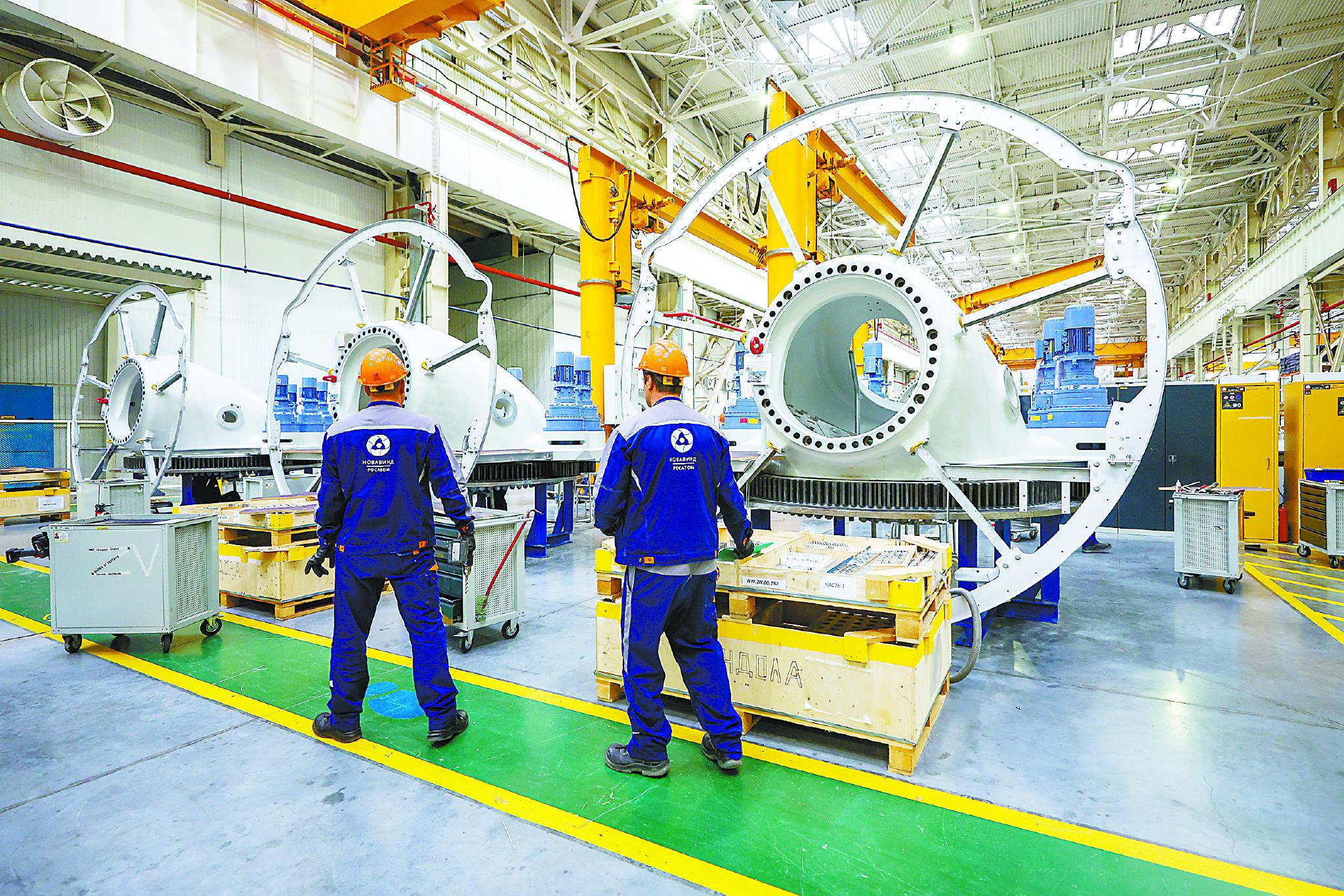
Core Viewpoint - The article highlights the 80th anniversary of Russia's nuclear industry, celebrating its historical achievements and looking forward to new projects by the Russian State Atomic Energy Corporation [1][9]. Group 1: Historical Development - The establishment of the nuclear industry in Russia dates back to August 20, 1945, when the Soviet Union formed a special committee for atomic energy utilization, marking the beginning of its nuclear history [3]. - Key figures in the development of the Soviet nuclear industry included prominent scientists and Nobel laureates, contributing to the establishment of closed nuclear cities for research and development [4]. Group 2: Technological Achievements - The first nuclear power plant for peaceful energy use, the Obninsk Nuclear Power Plant, was launched in 1954, significantly changing global perceptions of nuclear energy [5]. - Russia currently operates 11 nuclear power plants, contributing nearly 20% to the country's total electricity generation, with plans for additional plants under construction [5]. Group 3: Current Operations and Global Presence - The Russian State Atomic Energy Corporation is a leading producer of radioactive pharmaceuticals and ranks among the top five isotope producers globally, with operations in over 60 countries [7][8]. - The corporation has significant uranium reserves, ranking second globally, and is the third-largest in uranium mining and nuclear fuel production [8]. Group 4: Economic Impact - In 2024, the corporation's revenue is projected to exceed 3 trillion rubles, with record investments in the Russian economy and social sectors [8]. - The official slogan for the 80th anniversary celebration, "Glory, Inspiration, Dreams," reflects the industry's commitment to peaceful nuclear energy and its ongoing expansion [8].
特朗普还没解决俄乌冲突,又盯上中俄能源合作,想抢中国生意 ?
Sou Hu Cai Jing· 2025-08-27 05:56
Core Viewpoint - The United States is attempting to persuade Russia to abandon the use of Chinese equipment in its Arctic liquefied natural gas project and instead purchase American equipment, aiming to distance Russia from China and encourage acceptance of a peace agreement regarding Ukraine [1][3]. Group 1: Energy Cooperation - During a visit to Russia in early August, U.S. Middle East envoy Wittecoff discussed potential energy cooperation with Russian officials, including proposals for U.S. oil companies to return to Russia and the purchase of Russian nuclear-powered icebreakers [3]. - The Arctic liquefied natural gas project faced multiple rounds of U.S. sanctions since the outbreak of the Russia-Ukraine conflict in 2022, which nearly led to the project's closure until it resumed operations in July of this year [3]. Group 2: Russian Response and Concerns - There are doubts regarding Russia's willingness to accept U.S. equipment, given concerns about potential security risks, such as the possibility of U.S. devices being compromised [5]. - The ongoing investigation into the Nord Stream gas pipeline explosion has led to skepticism about U.S. intentions, as the West has been perceived to downplay the incident while implicating Ukraine as a scapegoat [5].
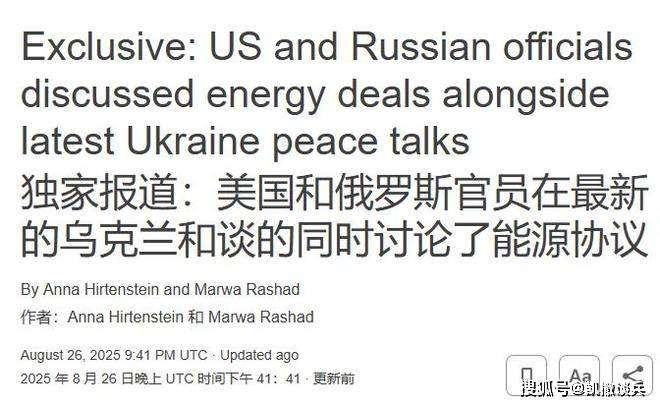
“秘密交易”曝光!为换取和平,美国曾向俄罗斯开出“能源大礼包”
Jin Shi Shu Ju· 2025-08-26 07:25
Group 1 - The U.S. and Russia are discussing energy agreements amid peace talks regarding Ukraine, aiming to encourage the Kremlin to agree to peace in exchange for easing sanctions [2] - Discussions include the potential for ExxonMobil to re-enter the Sakhalin-1 oil and gas project in Russia and the possibility of Russia purchasing U.S. equipment for its LNG projects [2][5] - The U.S. is also considering purchasing nuclear-powered icebreakers from Russia as part of these negotiations [2] Group 2 - The White House is eager to announce a significant investment agreement following the Alaska summit, reflecting President Trump's desire for a diplomatic achievement [3] - Trump has threatened to impose more sanctions on Russia and heavy tariffs on major buyers of Russian oil, such as India, if progress in negotiations is not made [4] - Recent discussions have shifted towards bilateral agreements between the U.S. and Russia, bypassing the EU's firm stance on supporting Ukraine [5] Group 3 - A decree signed by Putin may allow foreign investors, including ExxonMobil, to regain stakes in the Sakhalin-1 project, contingent on actions to support lifting Western sanctions [5] - ExxonMobil had previously exited its Russian operations, incurring a $4.6 billion impairment charge, and lost its 30% operator stake in the Sakhalin-1 project after the Kremlin seized it [5] - The Arctic LNG 2 project has faced multiple rounds of U.S. sanctions since 2022, limiting its access to necessary ice-class vessels for operations [5][6] Group 4 - The Arctic LNG 2 project, controlled by Novatek, has resumed gas processing despite low output, with five shipments already loaded onto sanctioned tankers this year [6] - The project was initially planned to have three LNG processing lines, with the third line currently in the planning stage [6] - Washington is attempting to encourage Russia to purchase American technology for its energy projects [6]
