
气象预报

Search documents
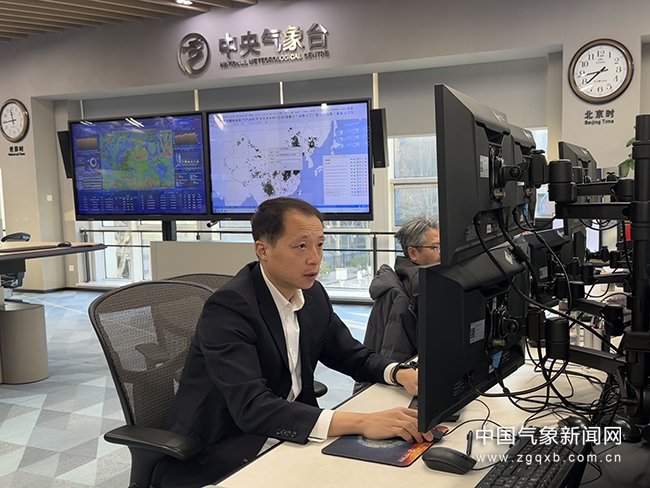
春节我在岗丨中央气象台首席董全:除夕值守,为了万家团圆
Xin Lang Cai Jing· 2026-02-16 02:31
Core Viewpoint - The article highlights the dedication and challenges faced by meteorologists, particularly during significant events like the Spring Festival, emphasizing the importance of accurate weather forecasting for public safety and travel during adverse weather conditions [2][3][4]. Group 1: Weather Forecasting and Public Safety - The chief forecaster, Dong Quan, is on duty from February 15 to 19, focusing on the impact of cold wave weather on transportation during the Spring Festival travel peak [2]. - Specific regions such as southern Shaanxi, southern Henan, and Hubei are under close observation due to potential rain and snow, which could lead to slippery roads and affect travel safety [2][3]. - The weather conditions for various Spring Festival gala venues are also monitored, with specific forecasts for cities like Harbin, Yiwu, and Hefei [3]. Group 2: Personal Sacrifices and Professional Commitment - Dong Quan's family arrangements reflect the personal sacrifices made by meteorologists, as he spends most of the Spring Festival on duty, often away from family [3][4]. - His experiences with major winter sports events have enhanced his forecasting skills, allowing for more detailed and location-specific weather predictions [4]. - The commitment to ensuring public safety during the holiday season is shared among various meteorological roles, highlighting the collective effort in weather forecasting [5].

中国气象局答澎湃:春运期间深化智能化、信息化的技术应用,及时发布最新气象预报
Xin Lang Cai Jing· 2026-01-29 04:20
Core Viewpoint - The Chinese Meteorological Administration is enhancing its weather monitoring and forecasting services to ensure safety during the 2026 Spring Festival travel season, particularly in the face of increasing extreme weather events due to global climate change [2][3]. Group 1: Weather Monitoring and Forecasting - The Chinese Meteorological Administration is improving its meteorological monitoring and forecasting service system, focusing on an integrated observation system that includes land, sea, and air [2]. - The administration is utilizing artificial intelligence models, such as "Wind Thunder," "Wind Clear," and "Wind Smooth," to enhance forecasting accuracy, which has shown initial positive results [2]. - A new national emergency warning information release system has been established to improve the public's access to meteorological warning information [2]. Group 2: Technology and Communication - During the Spring Festival travel period, the meteorological department will employ various technologies, including meteorological satellites, weather radars, digital forecasting, and artificial intelligence, to strengthen monitoring and precise forecasting of hazardous weather [3]. - The department will utilize multiple channels, including traditional media, internet new media, and map navigation, to timely disseminate the latest weather forecasts and alerts to relevant departments and the public [3]. - Meteorological experts will provide authoritative interpretations to offer more precise and considerate weather services for travelers [3]. Group 3: Collaboration and Emergency Response - The meteorological department will collaborate with relevant agencies to enhance extreme weather forecasting and emergency response in key areas such as road, rail, shipping, and water passenger transport [3]. - A focus will be placed on monitoring and warning for severe weather conditions like fog, strong winds, and rain and snow, aiming to improve the accuracy and lead time of forecasts [3]. - Prior to significant hazardous weather events, the department will strengthen joint assessments with multiple agencies, ensuring that meteorological warnings align closely with local government and emergency response measures [3].
中国气象局:春运期间深化智能化、信息化的技术应用,及时发布最新气象预报
Jin Rong Jie· 2026-01-29 04:10
Core Viewpoint - The Chinese meteorological department will enhance disaster weather monitoring and forecasting during the 2026 Spring Festival travel season using advanced technologies and multi-channel communication methods [1] Group 1: Technological Application - The meteorological department will utilize satellite, weather radar, digital forecasting, and artificial intelligence to improve weather monitoring and forecasting accuracy [1] - There will be a focus on deepening the application of intelligent and information technologies [1] Group 2: Communication and Public Service - The department plans to disseminate timely weather forecasts and alerts through traditional media, internet new media, and navigation maps [1] - Meteorological experts will provide authoritative interpretations to offer more precise and considerate weather services for the public [1]
鼓励与港澳共建气象探测设施,广东立法推动区域气象协同发展
Nan Fang Du Shi Bao· 2025-10-13 11:51
Core Points - The Guangdong Province has passed the "Regulations on Promoting Meteorological Cooperation in the Guangdong-Hong Kong-Macao Greater Bay Area," which will take effect on January 1, 2026, enhancing collaboration in meteorology among the three regions [1] - The regulations focus on the construction of meteorological facilities, forecasting and early warning systems, and technological innovation within the Greater Bay Area [1] Group 1: Meteorological Infrastructure and Data Sharing - The regulations require provincial meteorological authorities to strengthen collaboration with meteorological departments in Hong Kong and Macao for significant weather events, improving forecasting and early warning capabilities [2] - Currently, six automatic weather stations and thirteen lightning detection stations have been established, with a basic X-band phased array radar network in place, although challenges remain in site selection and equipment standardization [2] - Daily data sharing volumes for meteorological data are 22GB for Hong Kong and 16GB for Macao, but issues persist in timely transmission of refined grid products [2] Group 2: Technological Innovation and Services - The regulations support innovation and collaboration in meteorological technology, emphasizing the construction of major innovation platforms, joint research, and talent development [3] - Specific provisions are made for low-altitude and marine economic meteorological services, including the development of monitoring and forecasting technologies for low-altitude flights and marine operations [3] Group 3: Regional Development and Collaboration - The regulations promote the establishment of meteorological navigation centers in Nansha and support the development of meteorological service systems that align with the integrated development of the Greater Bay Area [4] - The regulations encourage the integration of artificial intelligence with meteorological monitoring and forecasting, enhancing disaster prevention and reduction capabilities in collaboration with Hong Kong [4]
全球气候系统变化导致华北雨季超长“待机”
Ke Ji Ri Bao· 2025-08-28 01:47
Core Insights - The article discusses the unusually long and wet rainy season in North China, which began on July 5, 2023, 13 days earlier than the average start date of July 18, marking the earliest onset since 1961 [1][2] - The average rainfall in the North China monitoring area reached 315.5 mm, which is 131% higher than the normal value of 136.6 mm [2] - The record-breaking rainfall is attributed to multiple factors, including abnormal sea temperatures in the equatorial Pacific, a strong and shifted subtropical high-pressure system, typhoon activity, and geographical influences [3][4] Summary by Sections Rainy Season Characteristics - The rainy season in North China has lasted for 52 days as of August 25, significantly longer than the typical duration of 30 days [1] - The rainy season is characterized by increased rainfall frequency, volume, and humidity, contributing to a notably damp environment [2] Factors Contributing to Abnormal Weather - The subtropical high-pressure system has been stronger and positioned further north than usual, facilitating the transport of warm, moist air from lower latitudes to northern China [3] - Historical data indicates that the combination of typhoons and the subtropical high can lead to extreme rainfall events, as seen with Typhoon "Kanu" and Typhoon "Zhu Jie Cao" [3] Climate Change Implications - The record rainfall in North China is viewed as a local manifestation of global climate system changes, emphasizing the need for improved climate adaptation and response capabilities to address extreme weather challenges [4]
今年第1号台风为何“姗姗来迟”?
Hai Nan Ri Bao· 2025-06-13 01:35
Group 1 - The first typhoon of the year, "Butterfly," is expected to make landfall in the coastal area between Sanya and Dongfang on the morning of June 13, marking it as the first typhoon to land in China this year [1][2] - The average formation date for the first typhoon in the Northwest Pacific and South China Sea is March 25, but this year, "Butterfly" formed on June 11, indicating a significant delay [1][2] - Three main reasons for the late formation of the typhoon include lower than average sea temperatures in the South China Sea, a persistent strong subtropical high in the Western Pacific suppressing tropical convection, and abnormal activity of the tropical convergence zone and monsoon [1] Group 2 - The frequency of typhoons making landfall in Hainan Island in June has been increasing, with only one recorded from 1991 to 2012, compared to three from 2013 to 2020, averaging less than one every three years [2] - Typhoons that land in June are generally weaker, with an average intensity of strong tropical storm level, and the strongest recorded June typhoon reached typhoon level [2] - Since 1949, only one first typhoon, "Raccoon," made landfall in Hainan on April 18, 2008, making "Butterfly" potentially the second recorded first typhoon to land in Hainan Island [2]