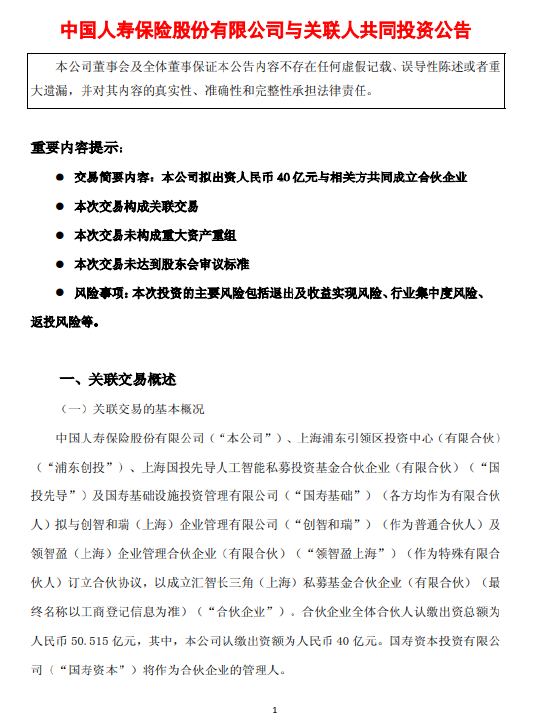
汇智长三角(上海)私募基金合伙企业(有限合伙)

Search documents
布局未来增长极 险资加速投资“养老+科创”赛道
Zhong Guo Zheng Quan Bao· 2026-01-28 00:15
Group 1 - The core viewpoint of the news is that China Life Insurance Company is investing nearly 12.5 billion yuan in two major investment plans targeting the elderly care industry and the sci-tech industry in the Yangtze River Delta region, reflecting a trend of insurance capital accelerating its layout in equity investments and diversifying its asset allocation [1][4] Group 2 - China Life plans to invest approximately 8.492 billion yuan to establish the "Beijing Guoshou Elderly Care Industry Equity Investment Fund Phase II," focusing on mergers and acquisitions of existing elderly care real estate projects and expanding new elderly care real estate projects, with a total subscription amount of 8.5 billion yuan and a duration of 15 years [2] - The company has already established a systematic development path in the elderly care sector, with operations in 17 cities and 20 elderly care projects, and manages a total scale of 50 billion yuan in health and elderly care funds [2] Group 3 - The second investment involves a planned contribution of 4 billion yuan to establish the "Hui Zhi Yangtze River Delta (Shanghai) Private Equity Fund Partnership," with a total subscription amount of 5.0515 billion yuan, focusing on artificial intelligence and biomedicine sectors [3] Group 4 - The dual investment strategy in elderly care and sci-tech sectors by China Life is indicative of the broader trend of insurance capital exploring diversified equity investments, extending beyond traditional sectors into technology innovation, healthcare, and green energy [4] - Other leading insurance companies are also taking substantial actions, such as China Pacific Insurance's establishment of a 50 billion yuan fund aimed at supporting state-owned enterprise reforms and modern industrial system construction [4] Group 5 - The increase in insurance capital's equity investments is influenced by industry dynamics and proactive policy guidance, with equity investment assets reaching 1.92 trillion yuan by the end of 2024, accounting for 6.35% of total investments, and showing a year-on-year growth of nearly 13% [5] - The macro environment, characterized by low interest rates and new accounting standards, is driving insurance capital to seek long-term stable returns through equity investments aligned with national development strategies [5][6]

超50亿,中国人寿联合设立汇智长三角(上海)基金
FOFWEEKLY· 2026-01-26 10:04
Core Viewpoint - China Life Insurance Company has announced the establishment of a private equity fund named Huizhi Yangtze River Delta (Shanghai) Private Equity Fund Partnership, with a total subscription amount of RMB 5.0515 billion, where China Life contributes RMB 4 billion [1] Group 1 - The fund aims to focus on "technology innovation and industrial upgrading" guided by artificial intelligence, collaborating with Shanghai and Pudong New Area [1] - The fund will primarily invest in artificial intelligence technologies and related applications, as well as other technology innovation industries such as integrated circuits and biomedicine, aligning with insurance capital allocation needs [1] - The partnership includes several entities such as Shanghai Pudong Leading Area Investment Center, Shanghai Guotou Pioneer Artificial Intelligence Private Investment Fund, and China Life Infrastructure Investment Management [1]

抢占投资风口 险资密集落子私募基金
Bei Jing Shang Bao· 2026-01-25 17:18
Core Viewpoint - Insurance capital is increasingly flowing into the primary market, driven by the dual forces of regulatory policies promoting long-term investments and a low-interest-rate environment, with a focus on strategic emerging industries such as artificial intelligence and renewable energy [1][4]. Group 1: Investment Activities - On January 23, China Life announced an investment of 4 billion yuan to establish the Huizhi Yangtze River Delta (Shanghai) Private Fund Partnership, focusing on artificial intelligence and related applications [3]. - China Life also plans to establish the Beijing Guoshou Pension Industry Equity Investment Fund Phase II, concentrating on the pension industry [3]. - Since 2025, there has been a surge in insurance capital entering the private investment market, with significant funds being allocated to sectors like renewable energy and healthcare [4]. Group 2: Investment Trends - The investment strategy of insurance capital continues to emphasize hard technology sectors, including new energy, automotive, and biomedicine [5]. - Insurance capital is focusing on sectors that align with national long-term strategic directions, characterized by high growth potential and technological barriers, which can provide stable long-term returns [6]. - Future trends for insurance private equity funds are expected to include broader investment areas, deeper collaboration models, and a greater emphasis on industry-specific research capabilities [6].

险资密集落子私募基金,长线资本抢占产业投资风口
Bei Jing Shang Bao· 2026-01-25 10:25
Core Insights - Insurance capital is increasingly flowing into the primary market, driven by the dual forces of regulatory policies promoting long-term investments and a low-interest-rate environment [1][4] - China Life announced a partnership to establish a private equity fund focusing on artificial intelligence and related applications, with a total investment of 4 billion yuan [3][4] - Since 2025, there has been a surge in insurance capital entering the private equity market, with significant investments in sectors like renewable energy and biomedicine [4][5] Investment Trends - Insurance funds are actively investing in private equity, with a focus on hard technology sectors such as artificial intelligence, integrated circuits, and renewable energy [5][6] - The investment strategy aligns with national strategic directions, emphasizing high growth potential and technological barriers, which are expected to yield stable long-term returns [5][6] - The insurance sector is encouraged to support venture capital through diversified investment tools, enhancing the development of long-term and patient capital [5][6] Future Outlook - Predictions indicate that insurance capital will expand its investment scope to include more hard technology and livelihood-related industries by 2026 [6] - There is an expectation for deeper collaboration models, potentially enhancing direct investment capabilities or linking with industrial capital [6] - Insurance capital is likely to focus more on niche sectors, strengthening research and investment capabilities to navigate uncertainties while adjusting investment rhythms and exit strategies [6]


中国人寿拟出资40亿元联合多方成立合伙企业
Xin Lang Cai Jing· 2026-01-23 10:55
Core Viewpoint - China Life Insurance Company plans to establish a private equity fund in partnership with Shanghai Pudong Leading Area Investment Center and others, focusing on investment in technology innovation companies in the Yangtze River Delta region, particularly in artificial intelligence, integrated circuits, and biomedicine [1][5]. Group 1: Investment Details - The total committed capital for the partnership is RMB 50.5 billion, with China Life contributing RMB 40 billion [1][5]. - The fund will be managed by Guoshou Capital Investment Co., Ltd., which constitutes a related party transaction [1][5]. Group 2: Investment Focus - The partnership aims to invest in growth-stage technology innovation enterprises within three leading industries: artificial intelligence, integrated circuits, and biomedicine [1][5][12]. - The investment strategy aligns with national policy directions and aims to enhance investment returns from insurance funds [12]. Group 3: Approval Process - The investment proposal was approved by the company's board of directors and relevant committees, with no objections from non-related directors [13]. - The transaction does not require shareholder meeting approval as it does not meet the threshold for significant asset restructuring [14][15]. Group 4: Historical Context - In the past 12 months, the cumulative amount of related party transactions between the company and its group has exceeded RMB 30 million but does not account for more than 5% of the company's latest audited net assets [16].