
汇添富中证上海国企ETF

Search documents
上亿元,基金密集发红包,多只ETF成“大户”
Zheng Quan Shi Bao· 2025-10-27 02:04
Core Insights - The year-end fund distribution trend continues to rise, with bond and passive index funds becoming the main focus, as several funds have single distribution amounts exceeding 1 billion [1][3][5] Fund Distribution Overview - A significant number of funds have distributed over 1 billion in a single payout, indicating a sustained year-end distribution trend [3] - Large distributions are primarily concentrated in bond funds and passive index funds, with notable payouts such as 2.25 billion from Guangfa Ju Xin A and 3.58 billion from Huashan Shanghai 180 ETF [3][5] - Many funds have implemented multiple distributions within the year, showcasing a trend towards normalization of distributions [3] ETF Dominance - ETFs are identified as the "red envelope big spenders," with large-scale passive products leading the distribution trend, such as Huaxia CSI 300 ETF distributing 28.7 billion [5][6] - The scale and stable returns of passive products contribute to their dominance in the distribution market, with nearly all major distributors being broad-based ETFs [5][6] Market Trends - The current distribution pattern reflects a market preference for stability and cash flow returns, with funds like Wan Jia North Exchange Wisdom Two-Year Open A achieving a distribution ratio of 21.17% [3][6] - The trend indicates that ETF distributions are likely to become a regular occurrence, as fund companies recognize the importance of distributions in enhancing investor experience and stabilizing capital [6]
上亿元!基金密集发红包 多只ETF成“大户”
Zheng Quan Shi Bao· 2025-10-27 00:17
Core Insights - The year-end fund distribution trend continues, with bond and passive index funds becoming the main focus, as several funds have single distributions exceeding 100 million yuan [1][2][3] Group 1: Fund Distribution Trends - A significant number of funds have distributed over 1 billion yuan recently, indicating a sustained year-end distribution trend [2] - Large distributions are primarily concentrated in bond funds and passive index funds, with notable examples including Guangfa Ju Xin A distributing 225 million yuan and Huaxia Shanghai-Shenzhen 300 ETF distributing 2.87 billion yuan [2][3] - Many funds have implemented multiple distributions within the year, reflecting a trend towards normalization of distributions [2] Group 2: ETF Dominance - ETFs are identified as the "red envelope big spenders," with large-scale passive products leading the distribution trend [3][4] - The Huatai-PineBridge Shanghai-Shenzhen 300 ETF has a single distribution exceeding 8 billion yuan, while other ETFs like Huaxia and E Fund also have significant distributions [3][4] - The structure of the market shows a preference for stable cash flow returns, with ETFs meeting this demand due to their large scale and stable earnings accumulation [4] Group 3: Future Outlook - ETF distributions are expected to become a norm as passive product scales continue to grow and investor structures mature [5] - Fund companies are increasingly recognizing the importance of distributions in enhancing investment experiences and stabilizing capital [5]
上亿元!基金密集发红包,多只ETF成“大户”
券商中国· 2025-10-26 23:34
Core Viewpoint - The year-end fund dividend trend is intensifying, with bond and passive index funds becoming the main contributors, as several funds have single dividends exceeding 100 million yuan [1][3]. Group 1: Fund Dividend Trends - The recent surge in fund dividends has seen multiple funds distributing over 100 million yuan in a single payout, indicating a continuation of the year-end dividend trend [3]. - Large dividends are primarily concentrated in bond funds and passive index funds, with notable payouts from mixed secondary bond funds and long-term pure bond funds [3][4]. - The trend of multiple dividends within the year is evident, with several funds having distributed dividends multiple times, reflecting a normalization of dividend payouts [3]. Group 2: ETF Dominance - ETFs are identified as the "big red envelope" contributors, with significant dividend amounts concentrated in these products, showcasing their scale advantages and stable returns [2][4]. - Major ETFs like Huaxia CSI 300 ETF and E Fund CSI 300 ETF have reported dividends exceeding 20 billion yuan, highlighting their role as the main players in the dividend market [4][6]. - The increasing scale and maturity of investor structures in ETFs suggest that dividends are transitioning from a temporary reward to a long-term norm, enhancing the attractiveness of these funds [2][6]. Group 3: Market Dynamics - The current dividend landscape reflects a market preference for stability, with investors favoring cash flow returns amid market fluctuations [6]. - The characteristics of large-scale ETFs, including high fund concentration and stable asset performance, contribute to their ability to generate substantial dividends [6]. - The outlook suggests that ETF dividends are likely to become a regular occurrence, as fund companies recognize the importance of dividends in enhancing investor experience and stabilizing capital [6].


中证上海国企指数下跌0.4%,前十大权重包含上汽集团等
Sou Hu Cai Jing· 2025-08-08 13:56
Core Viewpoint - The China Securities Index for Shanghai State-owned Enterprises (CSI Shanghai SOE Index) experienced a slight decline of 0.4% on August 8, closing at 1441.86 points, with a trading volume of 33.827 billion yuan. Despite this, the index has shown positive performance over the past month, three months, and year-to-date, with increases of 5.04%, 9.14%, and 1.95% respectively [1][2]. Group 1 - The CSI Shanghai SOE Index is composed of listed companies that are either state-controlled or significantly held by state-owned enterprises in Shanghai, reflecting the overall performance of these companies based on profitability, growth potential, and shareholder returns [1]. - The index was established with a base date of December 31, 2012, and a base point of 1000.0 [1]. - The top ten weighted stocks in the index include China Pacific Insurance (7.85%), Guotai Junan Securities (6.0%), Shanghai Airport (5.53%), and others, indicating a diverse representation of sectors [1]. Group 2 - The index is exclusively composed of stocks listed on the Shanghai Stock Exchange, with the financial sector representing the largest share at 28.15%, followed by industrials at 23.59% and consumer discretionary at 11.66% [2]. - The index samples are adjusted biannually, with changes implemented on the next trading day following the second Friday of June and December each year [2]. - Public funds tracking the CSI Shanghai SOE Index include the Huatai-PineBridge CSI Shanghai SOE ETF and its associated classes [2].

中证上海国企指数上涨0.14%,前十大权重包含上海电气等
Sou Hu Cai Jing· 2025-08-04 14:04
Group 1 - The core index of the China Securities Index for Shanghai State-owned Enterprises (CSI Shanghai SOE Index) opened low but rose, closing at 1418.09 points with a trading volume of 25.798 billion yuan [1] - The CSI Shanghai SOE Index has increased by 3.54% over the past month and 8.69% over the past three months, while it has decreased by 0.27% year-to-date [1] - The index reflects the performance of listed companies that are state-owned or significantly held by state-owned enterprises in Shanghai, selected based on profitability, growth potential, and shareholder return levels [1] Group 2 - The top ten weighted stocks in the CSI Shanghai SOE Index include China Pacific Insurance (8.03%), Guotai Junan Securities (6.12%), Shanghai Airport (5.65%), and others [1] - The index is composed entirely of stocks listed on the Shanghai Stock Exchange, with a 100% allocation [1] - The industry composition of the index shows that finance accounts for 28.15%, industry for 23.53%, and consumer discretionary for 11.54%, among others [2] Group 3 - The index samples are adjusted biannually, with adjustments occurring on the next trading day after the second Friday of June and December [2] - Public funds tracking the CSI Shanghai SOE Index include Huatai-PineBridge CSI Shanghai SOE ETF Link A and C [2]

兰生股份连跌5天,汇添富基金旗下1只基金位列前十大股东
Sou Hu Cai Jing· 2025-07-29 14:46
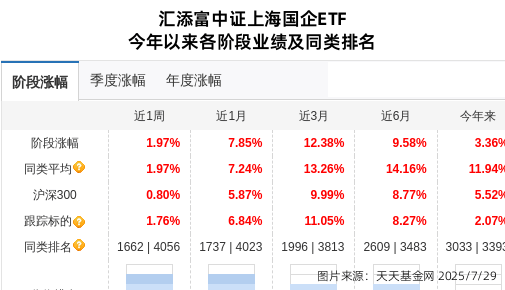
Company Overview - Lansheng Co., Ltd. has experienced a decline in stock price, with a cumulative drop of -24.79% over five consecutive trading days [1] - The company is a comprehensive state-owned listed entity under Donghao Lansheng Group, which is among China's top 500 enterprises [1] Financial Performance - The report indicates that Huatai-PB Fund's Huatai-PB CSI Shanghai State-owned Enterprises ETF reduced its holdings in Lansheng Co., Ltd. during the first quarter of this year [1] - The fund has achieved a year-to-date return of 3.36%, ranking 3033 out of 3393 in its category [1] Fund Manager Profile - The fund manager of Huatai-PB CSI Shanghai State-owned Enterprises ETF is Wu Zhenxiang, who holds a Ph.D. in Management from the University of Science and Technology of China [3] - Wu Zhenxiang has extensive experience in fund management, having held various positions since joining Huatai-PB Fund in March 2008 [3][4]

中证上海国企指数上涨0.81%,前十大权重包含浦发银行等
Sou Hu Cai Jing· 2025-07-24 13:55
Group 1 - The core viewpoint of the news is the performance of the China Securities Index for Shanghai State-owned Enterprises, which has shown positive growth in recent months, indicating a favorable market environment for state-owned enterprises in Shanghai [1][2]. - The China Securities Index for Shanghai State-owned Enterprises opened lower but closed higher, with a current value of 1439.78 points and a trading volume of 39.375 billion yuan [1]. - Over the past month, the index has increased by 7.21%, by 8.94% over the last three months, and by 0.57% year-to-date [1]. Group 2 - The index comprises companies that are state-controlled or significantly held by state-owned enterprises in Shanghai, selected based on profitability, growth potential, and shareholder return levels [1][2]. - The top ten weighted companies in the index include China Pacific Insurance (7.97%), Guotai Junan Securities (6.1%), Shanghai Airport (5.76%), and others, reflecting a diverse representation of sectors [1]. - The index is fully represented by the Shanghai Stock Exchange, indicating a concentrated market focus [1]. Group 3 - In terms of industry composition, finance accounts for 28.06%, industrials for 23.75%, consumer discretionary for 11.75%, and real estate for 10.26%, among others [2]. - The index samples are adjusted biannually, with changes implemented on the next trading day following the second Friday of June and December [2]. - Public funds tracking the Shanghai State-owned Enterprises Index include various ETFs, indicating investor interest in this sector [2].

中证上海国企指数上涨0.26%,前十大权重包含上海机场等
Jin Rong Jie· 2025-07-23 14:04
Core Viewpoint - The China Securities Index for Shanghai State-Owned Enterprises has shown a mixed performance in the A-share market, with a recent increase of 0.26% and a notable rise of 7.54% over the past month [1] Group 1: Index Performance - The China Securities Index for Shanghai State-Owned Enterprises closed at 1428.2 points with a trading volume of 44.548 billion yuan [1] - The index has increased by 7.54% in the last month, 7.98% in the last three months, and 0.31% year-to-date [1] Group 2: Index Composition - The index includes stocks from state-owned enterprises and significant shareholdings in listed companies in Shanghai, reflecting the performance of companies with good fundamentals [1] - The top ten weighted stocks in the index are China Pacific Insurance (7.98%), Guotai Junan Securities (6.06%), Shanghai Airport (5.67%), and others [1] Group 3: Sector Allocation - The sector allocation of the index shows that finance accounts for 28.15%, industry 23.69%, consumer discretionary 11.80%, and real estate 10.29% among others [2] - The index samples are adjusted biannually, with changes implemented on the next trading day after the second Friday of June and December [2] Group 4: Fund Tracking - Public funds tracking the Shanghai State-Owned Enterprises Index include Huatai-PineBridge CSI Shanghai State-Owned Enterprises ETF Link A and C [2]

中证上海国企指数上涨0.42%,前十大权重包含上汽集团等
Sou Hu Cai Jing· 2025-07-07 14:11
Group 1 - The core index of the China Securities Index Shanghai State-owned Enterprises rose by 0.42% to 1378.21 points, with a trading volume of 16.32 billion yuan [1] - Over the past month, the index has increased by 1.59%, and over the past three months, it has risen by 3.10%, while it has decreased by 3.35% year-to-date [1] - The index reflects the performance of state-owned enterprises in Shanghai, selected based on profitability, growth potential, and shareholder return levels [1] Group 2 - The top ten weighted stocks in the index include China Pacific Insurance (8.4%), Guotai Junan Securities (6.05%), Shanghai Airport (5.7%), and others [1] - The index is composed entirely of stocks listed on the Shanghai Stock Exchange, with a sector breakdown showing finance at 29.42%, industry at 22.95%, and consumer discretionary at 11.71% [2] - The index samples are adjusted biannually, with changes implemented on the next trading day after the second Friday of June and December [2]



中证上海国企指数下跌0.22%,前十大权重包含国泰海通等
Sou Hu Cai Jing· 2025-07-02 14:14
Core Points - The Shanghai Composite Index opened high and fluctuated, while the CSI Shanghai State-Owned Enterprises Index fell by 0.22% to 1364.72 points, with a trading volume of 16.31 billion yuan [1] - The CSI Shanghai State-Owned Enterprises Index has increased by 2.69% in the past month, 2.65% in the past three months, and decreased by 3.68% year-to-date [1] - The index reflects the overall performance of listed companies related to state-owned enterprises in Shanghai, selected based on profitability, growth potential, and shareholder return levels [1] Index Composition - The top ten weighted stocks in the CSI Shanghai State-Owned Enterprises Index are: China Pacific Insurance (8.35%), Guotai Junan Securities (6.09%), Shanghai Airport (5.77%), Pudong Development Bank (5.21%), Shanghai Electric (3.94%), Shanghai Bank (3.89%), Sheneng Co. (3.09%), SAIC Motor (3.05%), Orient Securities (3.04%), and Zhongwei Company (2.97%) [1] - The index is composed entirely of stocks listed on the Shanghai Stock Exchange [2] - The industry breakdown of the index includes: Financials (29.24%), Industrials (23.15%), Consumer Discretionary (11.59%), Real Estate (10.04%), Information Technology (7.45%), Healthcare (6.82%), Communication Services (5.48%), Utilities (3.09%), Consumer Staples (1.70%), and Materials (1.45%) [2] Index Adjustment - The index samples are adjusted semi-annually, with adjustments implemented on the next trading day after the second Friday of June and December each year [2] - Weight factors are adjusted in accordance with the sample adjustments, which are generally fixed until the next scheduled adjustment [2] - Public funds tracking the Shanghai State-Owned Enterprises Index include: Huatai-PineBridge CSI Shanghai State-Owned Enterprises ETF Link A, Huatai-PineBridge CSI Shanghai State-Owned Enterprises ETF Link C, and Huatai-PineBridge CSI Shanghai State-Owned Enterprises ETF [2]
