
江津花椒

Search documents
“金名片” 培育近万亿元“大产业”
Xin Lang Cai Jing· 2026-01-29 18:45
Core Insights - The geographical indication (GI) products in China have reached an annual output value close to 1 trillion yuan, marking five consecutive years of growth [1] - By the end of October 2025, China will have recognized a total of 5,066 GI products and approved over 52,000 entities to use GI special marks [1] Group 1: Brand Effect - GI certification provides a national "identity card" for local products, protecting brands and helping them access broader markets [1] - The brand value of "Zengcheng Simao Rice" in Guangdong has exceeded 5 billion yuan, with over 150 GI-related trademarks registered in the province [2] Group 2: Technology-Driven - Various regions are leveraging technology to enhance GI products, including mechanized sowing, green planting techniques, and smart production lines [3] - The "Ruichang Black Sesame" in Jiangxi has implemented a "technology courtyard" in collaboration with agricultural experts to improve yield and develop innovative products [3] Group 3: Expanding Beyond Raw Materials - Regions are moving from merely selling raw materials to extending the industrial chain, integrating cultural tourism and deep processing to create higher added value [4] - For instance, "Baoshan Small Grain Coffee" in Yunnan has developed coffee estates and processing workshops, promoting a "coffee + cultural tourism" model [4] Group 4: Economic Development - GI products are recognized as a "golden business card" for distinctive industries, effectively contributing to regional economic development [5] - The National Intellectual Property Administration plans to establish national GI protection demonstration zones and implement strategies to promote trademark branding and GI utilization [5]
“重庆村晚”总决赛燃爆万盛
Xin Lang Cai Jing· 2026-01-25 17:15
Core Viewpoint - The second "Chongqing Village Evening" event successfully showcased local talents and agricultural products, promoting cultural vitality and rural revitalization in the region [1][3]. Group 1: Event Overview - The event was held on January 23, organized by multiple local government departments, featuring 42 outstanding contestants competing in various performances [1]. - The competition received over 4,000 submissions from grassroots participants, culminating in a grand finale that highlighted local talent and culture [1]. Group 2: Performances and Cultural Significance - The opening performance included a dance titled "Joy of Harvest," which set a celebratory tone for the event, while local celebrity "Wan Yao Mei" energized the audience with her performance [2]. - The event featured a blend of traditional and contemporary performances, showcasing the rich cultural heritage and new developments in rural life [2]. Group 3: Agricultural Product Exhibition - A simultaneous agricultural product exhibition attracted significant attention, featuring a variety of local specialties such as mushrooms, pepper, cured meat, and oranges, presented in a dual online and offline format [3]. - The event aimed to create a platform for showcasing, exchanging, and trading rural products, contributing to the integration of agriculture, culture, and tourism [3]. Group 4: Future Implications - The successful execution of the "Chongqing Village Evening" is seen as a vital step in deepening cultural revitalization and promoting spiritual civilization in Chongqing [3]. - The initiative is expected to continue fostering grassroots cultural activities, enhancing community engagement, and supporting the overall revitalization of rural areas [3].
地理标志“金名片”培育近万亿元“大产业”
Xin Lang Cai Jing· 2026-01-23 22:57
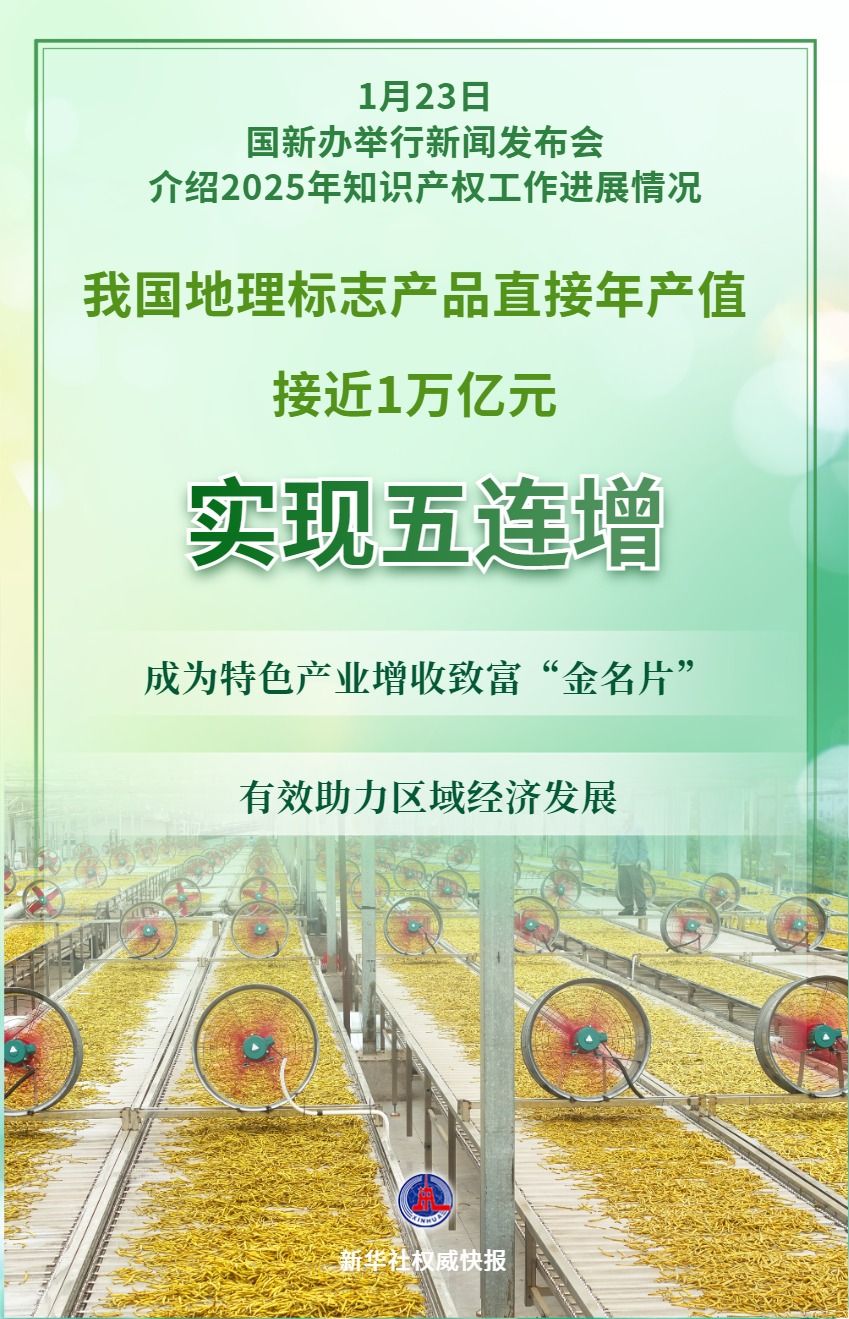
Core Insights - The geographical indication (GI) products in China have reached an annual output value close to 1 trillion yuan, marking five consecutive years of growth [1] - By the end of October 2025, China is expected to have recognized a total of 5,066 GI products and approved over 52,000 entities to use GI special marks [1] Group 1: Brand Development - The brand value of "Zengcheng Simao Rice" in Guangzhou has exceeded 5 billion yuan, showcasing the potential of GI products to transform local specialties into major brands [2] - More than 150 GI products have been registered as certification and collective trademarks in Guangdong province, facilitating their entry into markets across the Guangdong-Hong Kong-Macao Greater Bay Area and beyond [2] Group 2: Technological Innovation - Various regions are leveraging technology to enhance GI products, with advancements such as mechanized sowing, green planting techniques, and smart production lines improving efficiency and sustainability [3] - The establishment of "technology courtyards" and digital management systems in regions like Ruichang City and West Lake Dragon Well is driving modernization and traceability in production processes [3] Group 3: Value Chain Expansion - Many regions are moving beyond merely selling raw materials to extending their value chains through integration with tourism, deep processing, and cross-industry innovation [4] - For instance, the "Baoshan Small Grain Coffee" GI product in Yunnan has led to the development of coffee estates and processing workshops, promoting a "coffee + tourism" model [4] - The "Enshi Potato" in Hubei has diversified into high-end raw materials, while Fujian's "Fuding White Tea" has introduced innovative product combinations to meet new consumer demands [4]
五连增!地理标志“金名片”培育近万亿元“大产业”
Zhong Guo Jin Rong Xin Xi Wang· 2026-01-23 12:19
Core Insights - China's geographical indication products have reached an annual output value close to 1 trillion yuan, marking five consecutive years of growth [1] - By the end of 2025, China is expected to have recognized 5,066 geographical indication products and approved over 52,000 entities to use geographical indication trademarks [1] Group 1: Brand Effect - Geographical indication certification provides a national "identity card" for local products, protecting brands and helping them access broader markets [1] - The brand value of "Zengcheng Simao Rice" has exceeded 5 billion yuan, showcasing the potential of geographical indication products [2] Group 2: Technological Innovation - Various regions are leveraging technology to enhance geographical indication products, including mechanized sowing, green planting techniques, and smart production lines [3] - The "Ruichang Black Sesame" production process has become increasingly technology-driven, with collaborations for scientific breeding and innovative product development [3] Group 3: Industry Chain Expansion - Regions are moving beyond merely selling raw materials to extending into the entire industry chain, creating higher added value through integration with tourism and deep processing [4] - The "Baoshan Small Grain Coffee" geographical indication product has led to the development of coffee estates and processing workshops, promoting a "coffee + tourism" model [4] - The "Enshi Potato" has diversified into high-end raw materials, while "Fuding White Tea" companies have introduced new product combinations to meet changing consumer demands [4]
新华鲜报|五连增!地理标志“金名片”培育近万亿元“大产业”
Xin Hua She· 2026-01-23 12:17
Core Insights - The geographical indication (GI) products in China have reached an annual output value close to 1 trillion yuan, marking five consecutive years of growth [1] - By the end of October 2025, China is expected to have recognized a total of 5,066 GI products and approved over 52,000 entities to use GI special marks [1] Group 1: Brand Development - GI products are defined as those whose quality, reputation, or other characteristics are essentially determined by their geographical origin [3] - The certification of GI products provides a national "identity card" that protects brands and helps them access broader markets [3] Group 2: Economic Impact - The brand value of "Zengcheng Simao Rice" in Guangzhou has exceeded 5 billion yuan, showcasing the economic potential of GI products [4] - In Guangdong province, over 150 GI products have been registered as certification and collective trademarks, facilitating their entry into markets across the Greater Bay Area and beyond [4] Group 3: Technological Advancements - Various regions are leveraging technology to enhance GI products, including mechanized sowing, green planting techniques, and smart production lines [6] - The establishment of "technology courtyards" and digital management systems in GI product areas is driving modernization and efficiency [6] Group 4: Industry Chain Expansion - Regions are moving beyond merely selling raw materials to extending their industry chains through integration with tourism, deep processing, and cross-industry innovation [7] - Examples include the development of coffee processing workshops in Yunnan and diversified products derived from "Enshi potatoes" in Hubei [9]

重庆升级农产品批发产业 拓展国际冷链通道
Zhong Guo Xin Wen Wang· 2025-10-28 06:44
Core Viewpoint - The upgrade of Chongqing's agricultural product wholesale industry aims to establish a modernized trading service system, enhancing brand recognition, network connectivity, and digitalization in the sector [1][2]. Group 1: Industry Development - Chongqing Shuangfu International Agricultural Trade City serves as a key supplier of fresh agricultural products, distributing various goods such as vegetables, fruits, and meats to Chongqing and surrounding provinces [1]. - The upgrade will create a "1+N" market network and five major systems, along with a digital platform, positioning "Shuangfu" as a leading brand in the national agricultural wholesale industry [1][2]. Group 2: Operational Enhancements - The new trading service system will facilitate a modern operational framework that ensures efficient collaboration and safety from production to consumption [2]. - A standardized base for "Shuangfu Preferred" will be established to guarantee quality and safety, while a dynamic credit evaluation system for merchants will be implemented [2]. Group 3: Economic Impact - By the end of 2027, the trading volume at Chongqing Logistics Group's agricultural wholesale market is projected to reach 7.5 million tons, with a transaction value of 70 billion yuan [3]. - The initiative is expected to increase income for upstream growers and provide a more secure supply for local consumers' food needs [3].

标准引领品质提升,重庆江津花椒跑出“出海”加速度
Zhong Guo Chan Ye Jing Ji Xin Xi Wang· 2025-08-04 12:16
Core Insights - The article highlights the significance of Jiangjin pepper in the culinary landscape of Chongqing, emphasizing its unique flavor and the region's commitment to quality standards in production [1][2][3] Group 1: Industry Overview - Jiangjin pepper has a long cultivation history, with favorable natural conditions leading to high oil yield and strong flavor [2] - The planting area for Jiangjin pepper is 530,000 acres, with 480,000 acres currently in production, and a projected fresh pepper output of 340,000 tons by 2025 [2] - The establishment of a comprehensive 16-item industry standard system aims to enhance the quality and safety of Jiangjin pepper products [4] Group 2: Quality Control and Standards - Jiangjin district implements strict quality control measures, integrating traditional practices with modern technology to ensure high-quality pepper production [3] - Advanced techniques in fertilization, pest control, and pruning are being promoted, along with the establishment of processing centers equipped with modern machinery [3] - A robust regulatory framework is in place, including a quality supervision system and a data platform for real-time monitoring of pepper product quality [3] Group 3: Market Expansion and Innovation - Jiangjin pepper is experiencing a transformation driven by technological innovation, extending its applications into pharmaceuticals, chemicals, and tourism [5] - Collaborations with universities have led to the development of 52 innovative products, including pepper-based personal care items [5] - The establishment of an international certification testing center enhances the credibility of Jiangjin pepper in global markets, facilitating exports to 23 countries [6] Group 4: Future Development - The local government is committed to the high-quality development of the Jiangjin pepper industry, focusing on brand value enhancement and rural revitalization [7]