深圳惠家保

Search documents
锁凌燕:发挥好普惠保险“稳定器”作用
Jing Ji Ri Bao· 2026-01-30 00:09
Core Insights - The rapid development of inclusive home property insurance across the country, with over 40 projects expected by the end of 2025, highlights its role as a stabilizer in the insurance industry and an economic shock absorber [1] Group 1: Characteristics of Inclusive Home Property Insurance - The insurance features three main characteristics: universality, inclusiveness, and openness. It covers a wide range of risks, including traditional disasters and new types of risks, aiming to reach underserved populations through innovative marketing strategies [2] - The inclusive approach focuses on providing affordable and sustainable financial services to various groups, enhancing risk management capabilities to balance commercial and social value [2] - The products are designed to be simple and accessible, promoting collaboration among diverse stakeholders, such as integrating government-supported insurance into platforms for easier access [2] Group 2: Market Recognition and Operational Efficiency - The transition from initial trials to widespread promotion indicates market recognition of these insurance products, which have activated previously underserved markets and reduced families' financial worries [3] - The implementation of a "Family Risk Reduction Smart Management System" in Beijing integrates various data sources to enhance risk management, providing a comprehensive approach to preemptive measures and post-incident compensation [3] Group 3: Challenges and Strategic Responses - The need for proactive governance to address supply-demand mismatches is emphasized, suggesting the use of modular designs to cater to diverse consumer needs while maintaining simplicity [4] - The development of an intelligent risk control system is crucial to overcome information asymmetry challenges, particularly with a large number of new clients lacking historical data [4] - Establishing a cross-departmental data interaction platform is recommended to create a precise social risk governance map, allowing insurance to act as a sensor for societal safety [5]
一顿火锅钱就能护全家的家财险,为啥没人买?
Xin Lang Cai Jing· 2025-12-08 11:28
Core Viewpoint - The recent fire incident in Hong Kong has heightened public awareness regarding home insurance, prompting a renewed interest in this protective measure for households [1][13]. Group 1: Evolution of Home Insurance - Home insurance in China has evolved significantly since its inception in 1981, transitioning from basic coverage for extreme events to comprehensive protection that addresses various everyday risks [3][16]. - Initially, home insurance only covered severe incidents like fire and lightning, with premiums as low as a few yuan, primarily provided by employers [16]. - Following economic reforms, the coverage expanded to include theft and explosion damages, maintaining premiums under 100 yuan, making it accessible for ordinary families [16]. - The introduction of optional earthquake coverage post-2008 and the inclusion of common household issues like water damage in basic coverage have greatly enhanced its practicality [16]. - Recent years have seen the emergence of inclusive home insurance products, such as "Rongjiabao" in Chengdu, which cover modern risks like telecom fraud and offer additional services like appliance cleaning [3][16]. Group 2: Current Market Status - Despite improvements in home insurance offerings, the penetration rate in mainland China remains below 5%, significantly lower than over 30% in Hong Kong and 70% in Europe and the U.S. [6][19]. - In 2024, the total premium income from home insurance in China is projected to be 28.499 billion yuan, accounting for only 1.7% of the total premium income in the property insurance sector, compared to 15% in the U.S. [6][19]. Group 3: Challenges in Adoption - Many households, especially in older communities, remain uninsured due to three main challenges: lack of awareness, product misalignment, and service shortcomings [20][22]. - A significant number of consumers are unaware of home insurance or believe they do not need it, with nearly 40% not knowing that property damage can be claimed through insurance [20][21]. - Existing products often do not cater to specific regional needs, leading to inadequate coverage for common risks faced by families in different areas [20][21]. - Complicated policy terms and lengthy claims processes contribute to a negative perception of home insurance, making it less appealing to potential buyers [22]. Group 4: Future Prospects - Policy and market initiatives are underway to enhance the accessibility of home insurance, with government efforts promoting insurance as a standard practice for homeowners [23][24]. - Insurance companies are adapting their service models to proactively assist customers in risk prevention, such as conducting home safety inspections and providing quick response services [23][24]. - Following the recent fire incident, there has been a notable increase in online searches for home insurance, indicating a growing public interest, with projections suggesting that premium income could exceed 200 billion yuan by 2030 [24][26].


深圳惠家保覆盖率偏低,普惠型家财险从小众到刚需还有多远
Nan Fang Du Shi Bao· 2025-11-28 12:17
Core Insights - The recent fire incident in Hong Kong has raised public awareness regarding residential safety and the importance of household insurance, particularly home property insurance, which has been largely overlooked by the market [2][3] Group 1: Market Overview - Household property insurance currently holds a market share of approximately 1% in the insurance sector, indicating a relatively small overall size [2] - Despite the increasing risks from extreme weather, aging infrastructure, and high-density living, the coverage for household property losses remains inadequate, exposing significant protection gaps [2] Group 2: Policy and Product Development - A multi-tiered household property insurance system is being established in China, with initiatives such as the promotion of household property insurance for new citizens and the development of inclusive insurance products [3][4] - Recent products like "Rongjiabao" in Sichuan and "Hujia Bao" in Shanghai have been launched to provide comprehensive coverage for household property, personal liability, and accidental injuries [3][4] Group 3: Coverage and Claims Data - The "Shenzhen Huijia Bao" offers coverage for housing and interior property with limits of 1.5 million, 50,000, and 50,000 respectively, and has processed 280 claims with a total payout of 377,300 yuan as of October [4][5] - The household property insurance premium scale reached 16.524 billion yuan in the first half of the year, with a year-on-year growth of 11.46%, while total claims decreased by 6.23% [5] Group 4: Market Penetration and Challenges - The coverage rate for inclusive household property insurance remains low, with only 6.4% of eligible households in Shanghai covered by "Hujia Bao" and 6,000 households in Shenzhen covered by "Shenzhen Huijia Bao" [5] - The insurance penetration rate for household property insurance in China has remained below 10% for over a decade, indicating a lack of awareness and understanding among the general public [5][6] Group 5: Future Outlook - The household property insurance market in China is expected to grow rapidly, with suggestions for innovation in risk pricing models and the establishment of a more resilient insurance system supported by national policies [6][7] - Comparatively, the U.S. household property insurance market accounts for 15% of total property insurance premiums, highlighting a significant growth opportunity for China's market [6]

深圳:小微外贸贷款增20.58%个人消费贷款余额破8300亿
2 1 Shi Ji Jing Ji Bao Dao· 2025-11-25 11:01
Core Insights - Shenzhen has maintained its position as a leading city in foreign trade exports for 32 consecutive years, with retail sales surpassing 1 trillion yuan for two consecutive years [1] - The financial sector in Shenzhen is actively adapting to the changing external environment and consumer demands, focusing on supporting foreign trade and consumption [1] Financial Performance - In the first ten months, new loans issued to foreign trade enterprises by domestic banks in Shenzhen reached 763.57 billion yuan, a year-on-year increase of 9.83% [1] - The balance of personal consumption loans in Shenzhen was 835.29 billion yuan at the end of October, reflecting a year-on-year growth of 4.95% [1] - The balance of loans in the service sectors such as accommodation, catering, and cultural entertainment reached 207.99 billion yuan, up 2.04% year-on-year [1] Support for SMEs - Shenzhen has over 2.6 million small and medium-sized enterprises (SMEs), accounting for over 99% of the total number of enterprises and contributing approximately 50% to the city's GDP [1] - The financing balance for cross-border e-commerce in Shenzhen increased by 39.92% year-on-year, while loans for small foreign trade enterprises grew by 20.58% [2] Financial Initiatives - The Shenzhen Financial Regulatory Bureau has implemented various measures to support SMEs in foreign trade, including the establishment of a dedicated "foreign trade version" in the financing coordination mechanism [3] - A total of 20 measures were introduced to enhance financial support for foreign trade enterprises, focusing on increasing government financing guarantees and reducing financing costs [3] - The "Micro Trade Loan" product was launched, providing 1.82 billion yuan in credit to 1,700 small foreign trade enterprises, with financing costs reduced by over 15% [3] Consumption Promotion - The "Shenzhen Shopping Season + Financial Zone" initiative has led to over 1,000 promotional activities, with banks and insurance institutions offering customized products [4] - The "Government Subsidy + Financial Preferential" action has resulted in a total of 7.79 million yuan in fee reductions, stimulating nearly 300 million yuan in consumption [4] - Employment support initiatives, such as the "Shenzhen Military Loan," have provided nearly 60 million yuan in loans to veterans, while 10 banks have issued 12.59 billion yuan in entrepreneurial guarantee loans [4] Adaptation to New Consumer Demands - The Shenzhen Financial Regulatory Bureau is optimizing services to meet new consumer demands, focusing on enhancing support, reducing costs, and improving efficiency [5] - Personal consumption loan limits have been increased from 300,000 yuan to 500,000 yuan, with loan terms extended to seven years, resulting in a 13.98% year-on-year increase in medium to long-term personal consumption loans [5] - Innovative products such as "Home Loans" and "Cultural Tourism Consumption Loans" are being developed to cater to diverse consumer needs [5]
“深圳惠家保”已受理报案80起:保险业持续赶考超强台风
Nan Fang Du Shi Bao· 2025-09-30 15:12
Core Insights - The article highlights the rapid response of the insurance industry in Shenzhen following Typhoon Haikui, particularly focusing on the "Shenzhen Huijia Bao" insurance product which was launched less than two months prior to the typhoon [2][3] Group 1: Product Overview - "Shenzhen Huijia Bao" is a public welfare family property insurance product developed by 23 property insurance companies in Shenzhen under the guidance of the Shenzhen Insurance Association [2] - The product covers major household risks including fire, explosion, typhoons, heavy rain, and falling objects, and is applicable to both owned and rented properties [2] - Since its launch, "Shenzhen Huijia Bao" has provided risk coverage for over 54,000 households, becoming a crucial safety net for families against natural disasters [2] Group 2: Claims and Response - As of September 30, the "Shenzhen Huijia Bao" received 80 claims related to the typhoon, with a total loss amounting to 139,200 yuan, and 77 claims have been processed [2] - Specific case examples include a tenant whose property suffered water damage due to the typhoon, receiving a compensation of 2,900 yuan on the same day the claim was filed [3] - Another case involved a homeowner whose balcony glass shattered, receiving a compensation of 2,000 yuan within an hour of reporting the claim [3] Group 3: Operational Efficiency - The insurance claims process for "Shenzhen Huijia Bao" is designed for efficiency, with online claim assessments and payments being completed within hours [3] - The insurance coverage typically becomes effective within three days of purchase, allowing for quick protection against unforeseen events [3]

“桦加沙”过境深圳背后:报案超400宗 理赔最快半个钟
Nan Fang Du Shi Bao· 2025-09-27 04:11
Core Insights - Typhoon "Haikashan" caused 421 insurance claims in Shenzhen, with estimated losses of 4.0074 million yuan, which is significantly lower than previous typhoons [1][3] - The insurance industry in Shenzhen demonstrated effective disaster preparedness and rapid response capabilities, showcasing its role as an economic stabilizer [1][3] Group 1: Insurance Response - Multiple insurance companies activated disaster emergency response mechanisms, utilizing technology for rapid claims processing [1][2] - China Pacific Insurance completed a claim process in just 10 minutes after receiving a report of vehicle damage [2] - Ping An Insurance processed a claim from report to payout in 28 minutes, demonstrating efficiency in handling complex cases [1][2] Group 2: Pre-Disaster Preparedness - Insurance firms implemented pre-disaster measures, such as reinforcing structures and ensuring emergency systems were operational before the typhoon [3] - Ping An Financial Center upgraded its emergency systems a week prior to the typhoon, ensuring readiness [3] Group 3: Comparative Analysis - The number of claims and estimated losses from "Haikashan" were less than 40% of those from Typhoon "Wipha," despite "Haikashan" having stronger winds [3] - The proactive measures taken by the insurance industry contributed to the reduced impact of "Haikashan" compared to previous storms [3]
应对台风“桦加沙”,广东保险业已支付保险赔款2125.88万元
Bei Jing Shang Bao· 2025-09-26 11:49
Summary of Key Points Core Viewpoint - The insurance industry in Guangdong and Shenzhen has reported significant claims and losses due to Typhoon "Haikui," with a total of 12,456 claims and estimated losses of approximately 2.55 billion yuan as of September 25 [1] Group 1: Guangdong Insurance Industry Impact - As of September 25, the Guangdong financial regulatory bureau reported 11,400 claims with an estimated loss of 229 million yuan, and insurance payouts totaling 2.13 million yuan [1] - Breakdown of claims in Guangdong includes: - Auto insurance: 9,810 claims, estimated loss of 96.01 million yuan, payouts of 1.21 million yuan [1] - Agricultural insurance: 920 claims, estimated loss of 42.44 million yuan, payouts of 1.97 million yuan [1] - Corporate property insurance: 431 claims, estimated loss of 36.02 million yuan, payouts of 86,000 yuan [1] - Catastrophe insurance: 3 claims, estimated loss of 44.4 million yuan, payouts of 1.8 million yuan [1] Group 2: Shenzhen Insurance Industry Impact - The Shenzhen financial regulatory bureau reported 1,456 claims with an estimated loss of 25.99 million yuan, and insurance payouts totaling 192,600 yuan as of September 25 [1] - Breakdown of claims in Shenzhen includes: - Auto insurance: 1,082 claims, estimated loss of 9.91 million yuan, payouts of 37,000 yuan [1] - Corporate property insurance: 119 claims, estimated loss of 7.13 million yuan, payouts of 200 yuan [1] - "Shenzhen Huijia Bao" reported 47 claims, estimated loss of 69,300 yuan, payouts of 38,300 yuan [1]
“桦加沙”过境深圳背后:报案超400宗,理赔最快半个钟
Nan Fang Du Shi Bao· 2025-09-25 15:25
Core Insights - The impact of Typhoon "Haikui" on the insurance industry in Shenzhen has been less severe compared to previous typhoons, with reported claims at 421 and estimated losses at 400.74 million yuan, indicating a proactive response from the industry [1][3] Group 1: Insurance Response - Multiple insurance companies in Shenzhen activated disaster emergency response mechanisms, utilizing technology for rapid claims processing, showcasing the industry's role as an economic stabilizer [1] - China Pacific Insurance's Shenzhen branch implemented a "green authorization channel" for typhoon claims, completing a claim process in just 10 minutes [2] - Ping An Property & Casualty completed a claim process in 28 minutes, demonstrating efficiency in handling claims during the disaster [1][2] Group 2: Pre-Disaster Preparedness - Insurance companies took preemptive measures to strengthen their facilities and operations before the typhoon, including upgrading emergency systems and ensuring staff readiness [3] - The proactive measures included clearing drainage systems and securing outdoor items, which contributed to minimizing damage and claims [3] Group 3: Comparative Analysis - The number of claims and estimated losses from "Haikui" were significantly lower than those from Typhoon "Wipha," which had 1,100 claims and estimated losses of 1,109.75 million yuan [3] - Despite "Haikui" having stronger winds, the insurance industry's preparedness and response led to a reduction in both claims and losses compared to previous events [3]


险企推“水淹黑点”预警 简化天气证明手续
Nan Fang Du Shi Bao· 2025-09-23 23:10
Core Insights - The article discusses the impact of Typhoon "Hagupit" on vehicle owners in Shenzhen, highlighting the insurance industry's response and the measures taken to mitigate risks for car owners [1][2][3]. Group 1: Typhoon Impact and Insurance Response - As of August this year, Shenzhen's vehicle ownership exceeded 4.6 million, with significant concerns for car owners during typhoon events due to risks of flooding and damage [1]. - Typhoon "Hagupit" is expected to be one of the most severe typhoons since "Mangkhut" in 2018, with past events leading to substantial insurance claims, including 11,167 reports and estimated losses of 146 million yuan during "Mangkhut" [2]. - The insurance industry in Shenzhen has activated emergency response mechanisms, including a "1+N" flood and typhoon prevention system, with multiple companies opening green claims channels to expedite the claims process [1][3]. Group 2: Insurance Products and Risk Management - New insurance products like "Shenzhen Huijia Bao" have been launched to cover common risks such as typhoons and floods, aimed at enhancing public awareness and risk management capabilities [4]. - Insurance companies are utilizing various communication methods to alert clients about typhoon risks and provide disaster preparedness guidance, ensuring a coordinated response with repair shops and towing services [3]. - Technological advancements, such as the "Car Insurance Waterlogging Black Spot" warning service, are being employed to help car owners identify high-risk areas during severe weather events [5]. Group 3: Claims Process and Vehicle Safety - Car owners are advised to avoid unnecessary travel during typhoons and to take precautions, such as not restarting engines if they have stalled due to water [5][6]. - Insurance coverage for vehicles affected by flooding includes compensation for damage to electric vehicle components, with specific guidelines for handling submerged vehicles [6].
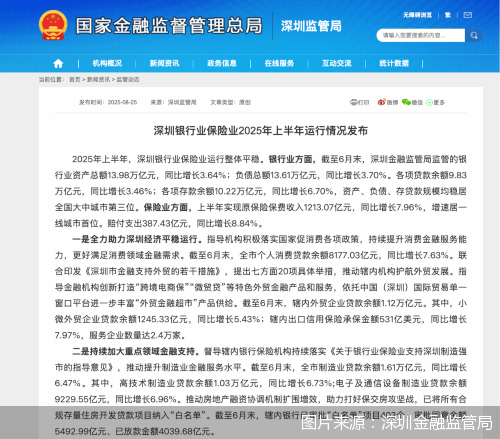
深圳保险业上半年原保险保费收入1213.07亿元,增速居一线城市首位
Bei Jing Shang Bao· 2025-08-25 09:21
Group 1 - The Shenzhen insurance industry achieved original insurance premium income of 121.307 billion yuan in the first half of the year, with a year-on-year growth of 7.96%, ranking first among first-tier cities [1] - Compensation expenditures amounted to 38.743 billion yuan, reflecting a year-on-year increase of 8.84% [1] - The insured amount of export credit insurance reached 531 billion USD, with a year-on-year growth of 7.97%, serving 24,000 enterprises [1] Group 2 - The "Shenzhen Huijia Bao" inclusive family property insurance, launched on July 28, has underwritten 34,800 policies, generating premium income of 2.2758 million yuan [1] - Insurance institutions have cumulatively compensated over 10 million yuan in response to multiple rounds of severe rainfall and typhoons this year [1] - The upgraded "Shenzhen Huimin Bao" for 2025 will expand insurance coverage while keeping premiums unchanged, including coverage for relocated elderly and students studying in other places, with 6.15 million insured individuals [1] Group 3 - The industry is steadily advancing the innovation of pension financial products to support the construction of the third pillar of pension insurance [1]