深海鱼

Search documents
从五个维度入手识别早期信号
Xin Lang Cai Jing· 2026-02-07 07:22
Core Insights - The article highlights the increasing prevalence of Alzheimer's disease in China, with approximately 16.99 million affected individuals in 2021, accounting for nearly 30% of the global cases. Early detection rates remain low, leading to missed intervention opportunities for many families [2]. Group 1: Identification of Alzheimer's Disease - Distinguishing normal aging from early Alzheimer's can be done through five key dimensions: memory content, executive function, spatial orientation, visual-spatial ability, and language/character changes [3][4][6][9]. - Normal forgetfulness involves losing details but retaining the main event, while warning signs include complete memory loss of recent events, indicating potential hippocampal damage [3]. - A decline in the ability to execute familiar multi-step tasks, such as operating a washing machine, may signal executive function impairment linked to frontal and parietal lobe dysfunction [3]. Group 2: Warning Signs and Traditional Chinese Medicine (TCM) Approaches - Significant confusion regarding time and place, such as getting lost in familiar areas, may indicate severe cognitive decline associated with posterior brain function deterioration [4]. - Visual processing issues, like difficulty judging distances or recognizing faces, suggest potential dysfunction in the visual cortex and parietal lobe [6]. - TCM views Alzheimer's as a form of "forgetfulness," attributing it to kidney essence deficiency and suggesting dietary and lifestyle adjustments to improve cognitive health, such as consuming walnuts and practicing Tai Chi [6][7][8][9].


科普|高压脑力劳动者如何科学饮食?如何建立“代谢灵活性”?
Xin Lang Cai Jing· 2026-01-24 14:28
Core Viewpoint - The article discusses the dietary management strategies for high-pressure cognitive workers, particularly emergency and critical care physicians, emphasizing the benefits of intermittent fasting over the traditional "small meals" approach to enhance metabolic flexibility and cognitive function [1][34]. Group 1: Dietary Strategies for High-Pressure Cognitive Workers - The traditional "small meals" approach is considered a metabolic trap for high-pressure cognitive workers due to the effects of chronic stress and insulin resistance [2]. - High cortisol levels in emergency and critical care physicians lead to insulin resistance, which can result in central obesity and systemic inflammation, contributing to professional burnout [2]. - Post-meal reactive hypoglycemia can impair cognitive functions, posing safety risks in critical decision-making scenarios [3]. - Frequent eating diverts blood flow from the brain to the digestive system, reducing cognitive performance during critical tasks [4]. Group 2: Benefits of Intermittent Fasting - Intermittent fasting (e.g., 16:8 or 14:10) shows greater adaptability in enhancing cognitive functions compared to the "small meals" approach [5]. - After 12-14 hours of fasting, the body shifts to using ketones as brain fuel, which enhances cognitive clarity and resilience under stress [6]. - Time-restricted eating helps recalibrate circadian rhythms, improving sleep quality for shift workers [8]. - Intermittent fasting activates autophagy and reduces chronic low-grade inflammation, which is crucial for clinicians exposed to high-stress environments [9]. Group 3: Functional Dietary Principles - High-pressure cognitive workers are advised to adopt time-restricted eating, specifically a 14:10 model, to align with their busy schedules [10]. - Maintaining stable blood sugar levels is essential, which involves eliminating refined carbohydrates and increasing quality fats and dietary fiber [11]. - Nutritional supplementation should focus on Omega-3 fatty acids, magnesium, and B vitamins to support cognitive function and mitigate stress [11]. Group 4: Practical Energy Management Plan - A structured energy management dietary schedule is proposed for emergency and critical care physicians, optimizing cortisol levels and preventing afternoon fatigue [12]. - The plan includes hydration upon waking, a balanced breakfast with high protein and quality fats, and strategic meal timing to maintain energy levels throughout the day [13][15][20]. - Specific recommendations for night shift workers include consuming low glycemic index carbohydrates before shifts and avoiding high-carb foods during late-night hours to prevent disruptions in circadian rhythms [30][32]. Group 5: Conclusion - The article concludes that adopting a flexible metabolic approach through scientific eating rhythms can help high-pressure cognitive workers maintain calmness, sharpness, and resilience in critical situations [34].
请收藏!小雪节气,这些养生知识要知道
Xin Hua She· 2025-11-22 07:46
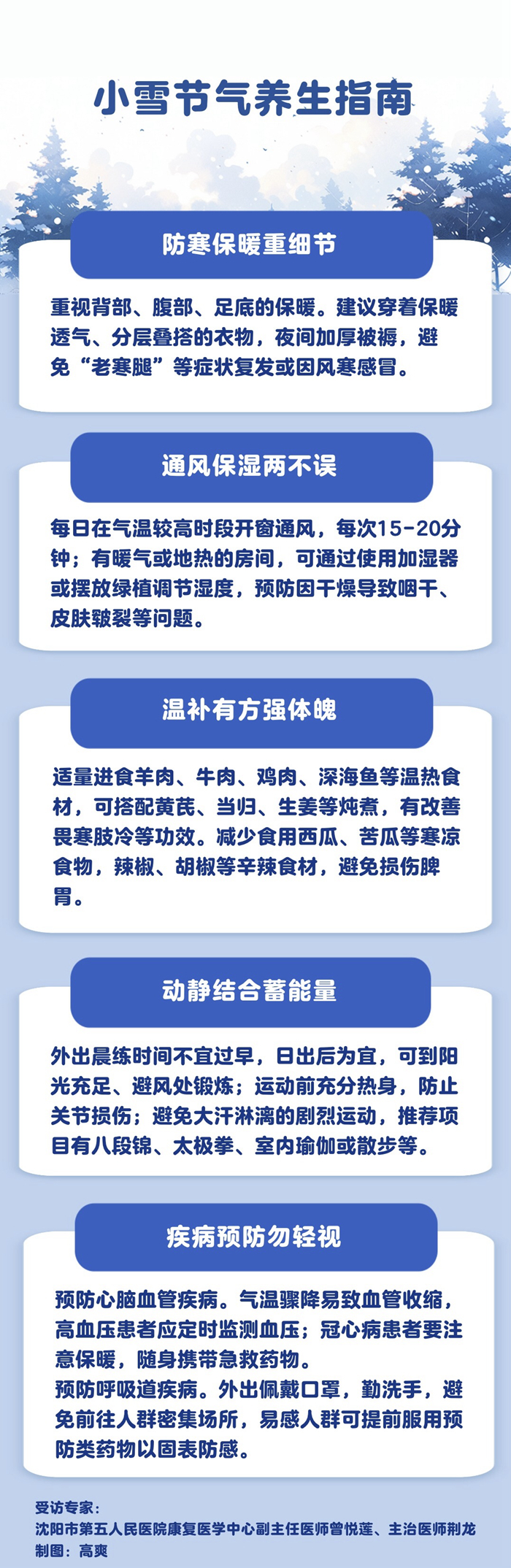
Group 1 - The article discusses dietary recommendations for the "Minor Snow" solar term, emphasizing the consumption of warming foods such as lamb, beef, chicken, and deep-sea fish, which can be paired with herbs like astragalus, angelica, and ginger to improve cold sensitivity [6][10] - It advises against consuming cold foods like watermelon and bitter melon, as well as spicy ingredients like chili and pepper, to avoid damaging the spleen [6] Group 2 - The article highlights the importance of combining movement and rest to build energy during this season [7] - It recommends outdoor morning exercises after sunrise in sunny, wind-sheltered areas, with a focus on warming up to prevent joint injuries, suggesting activities like Baduanjin, Tai Chi, indoor yoga, or walking [8] Group 3 - The article emphasizes the need for disease prevention, particularly for cardiovascular and respiratory diseases, as temperature drops can lead to blood vessel contraction [9][10] - It advises hypertension patients to monitor their blood pressure regularly and for coronary heart disease patients to keep warm and carry emergency medication [10] - For respiratory disease prevention, it suggests wearing masks outdoors, frequent hand washing, and avoiding crowded places, with recommendations for at-risk individuals to take preventive medications [10]
一个缺觉的人,全身炎症水平都在升高!缓解方法→
Yang Shi Xin Wen· 2025-08-13 13:50
Core Viewpoint - Sleep deprivation activates the body's inflammatory response, leading to cognitive impairment and increased risk of various diseases [2][3][6]. Group 1: Impact of Sleep Deprivation - A study involving 2,641 participants found that sleeping less than 6 hours triggers systemic inflammation and increases the risk of cognitive impairment [3]. - Sleep deprivation causes a series of inflammatory responses in the brain, releasing pro-inflammatory factors that adversely affect neurons and cognitive functions [3]. - Chronic sleep deprivation leads to oxidative stress and cellular damage, further exacerbating cognitive decline [3][6]. Group 2: Health Risks Associated with Sleep Deprivation - Insufficient sleep and chronic inflammation are linked to various diseases, including metabolic disorders, cancer, and mental health issues [6]. - Research indicates that sleeping less than 6 hours per night for a week can negatively impact metabolism, inflammation, immunity, and stress response [6]. - Prolonged sleep deprivation keeps the body in a state of stress, lowering immune function and increasing disease risk [6]. Group 3: Recommendations for Mitigating Damage - Adults typically need 7-8 hours of sleep per night, while older adults may require 5-7 hours [11]. - To combat sleep deprivation, lifestyle adjustments and medical interventions are recommended, such as increasing sunlight exposure and regular exercise [13]. - A balanced diet rich in anti-inflammatory foods, such as whole grains, deep-sea fish, cruciferous vegetables, and berries, can help reduce inflammation [14][15].