港股通红利低波ETF(159118)

Search documents
最近72小时内,交通银行等1家港股上市公司公告分红预案!
Mei Ri Jing Ji Xin Wen· 2025-12-15 07:53
Group 1 - The China Securities Central State-Owned Enterprises Dividend Index (931233.CSI) includes 50 stable dividend-paying stocks controlled by central enterprises, with a one-year dividend yield of 6.67%, surpassing the 10-year government bond yield of 4.83% as of December 12 [1] - The Hang Seng China Mainland Enterprises High Dividend Yield Index (HSMCHYI.HI) consists of high dividend stocks listed in Hong Kong from mainland companies, with a one-year dividend yield of 6.11%, also higher than the 10-year government bond yield of 4.26% as of December 12 [1] - The Non-S&P Hong Kong Stock Connect Low Volatility Dividend Hong Kong Dollar Index (SPAHLVHP.SPI) includes 50 high dividend low volatility stocks listed in Hong Kong, with the Hong Kong Stock Connect Dividend Low Volatility ETF (159118) being the ETF with the lowest comprehensive fee tracking this index [1] Group 2 - The Bank of Communications announced a dividend of RMB 0.1563 per share, with an ex-dividend date of December 17, 2025, and a payment date of January 28, 2026 [2] - The Bank of Communications is a constituent of the China Securities Central State-Owned Enterprises Dividend Index (931233.CSI), the Hang Seng China Mainland Enterprises High Dividend Yield Index (HSMCHYI.HI), and the Non-S&P Hong Kong Stock Connect Low Volatility Dividend Hong Kong Dollar Index (SPAHLVHP.SPI) [2]

最近24小时内,上海医药再发公告分红预案!
Mei Ri Jing Ji Xin Wen· 2025-12-11 05:28
Group 1 - The China Securities Central Enterprises Dividend Index (931233.CSI) includes 50 stocks of central enterprises with stable dividend levels and high dividend yields, achieving a 1-year dividend yield of 6.75% as of December 10, which is higher than the 10-year government bond yield of 4.88% [1] - The Hang Seng High Dividend Yield Index (HSMCHYI.HI) consists of high dividend stocks from mainland companies listed in Hong Kong, with a 1-year dividend yield of 6.21% as of December 10, surpassing the 10-year government bond yield of 4.34% [1] - The Non-Standard Poor's Hong Kong Stock Connect Low Volatility Dividend Index (SPAHLVHP.SPI) includes 50 high dividend low volatility stocks listed in Hong Kong, with the Hong Kong Stock Connect Low Volatility Dividend ETF (159118) being the ETF with the lowest comprehensive fee tracking this index [1] Group 2 - Shanghai Pharmaceuticals (601607) announced a dividend of HKD 0.13215 per share, with an ex-dividend date of December 29, 2025, and a payment date of February 6, 2026 [2] - Shanghai Pharmaceuticals is not a component of the China Securities Central Enterprises Dividend Index (931233.CSI), the Hang Seng High Dividend Yield Index (HSMCHYI.HI), or the Non-Standard Poor's Hong Kong Stock Connect Low Volatility Dividend Index (SPAHLVHP.SPI) [2]

香港中资公募怎么挑?一篇看懂6家“国家队”隐藏技能
Sou Hu Cai Jing· 2025-12-02 01:13
Core Viewpoint - The article highlights the rapid development of Chinese public fund institutions in Hong Kong, leveraging their strong research capabilities, cross-border business synergies, and unique advantages in the offshore RMB market to build competitive strengths that combine local depth and international breadth [1]. Group 1: Overview of Chinese Public Fund Institutions - Chinese public fund institutions are significant players in the Hong Kong capital market, benefiting from the city's status as the largest offshore RMB center, handling approximately 80% of global RMB payment business [1]. - These institutions utilize various policy tools such as QFII, RQFII, and Bond Connect to create an efficient two-way flow mechanism for funds, clients, and assets between the mainland and Hong Kong [1]. Group 2: Individual Fund Institutions - **Bank of China International Asset Management (BOCI AM)**: - Largest bank-affiliated asset manager in Hong Kong with a market share of 35% in RMB clearing [2]. - Offers over 80 public funds with a closed-loop product line across currencies, achieving a 102% return since 2025 for its flagship medical fund [3]. - **CSOP**: - Dominates the ETF market with a 99% average daily trading market share on the Hong Kong Stock Exchange [4]. - Plans to launch Asia's first zero-interest Chinese government bond ETF in August 2025, attracting significant initial investment [5]. - **China Asset Management (Hua Xia Fund)**: - Known for its low fee rates and strong performance in ETFs, with a management fee of 0.5% for its Hong Kong products [7]. - Collaborating with HashKey to launch a tokenized short bond fund in Q4 2025, aiming to attract Web3 investors [9]. - **TK AMC**: - Leading in offshore USD short bond funds with a volatility of only 0.17%, significantly lower than peers [10]. - Partnering with a major Thai hospital group to offer a cash management product linked to healthcare services [11]. - **Harvest Global**: - A pioneer in ESG investments, with a flagship fund targeting an annual excess return of 8-10% [12]. - Recently secured a $1.2 billion mandate from a Middle Eastern sovereign fund, marking a significant milestone in ESG investments [12]. - **Bosera International**: - Established a strong presence in offshore bond markets with a flagship fund consistently ranking in the top three for returns [13]. - Launched a USD money market fund during the Fed's rate hike cycle, achieving significant market penetration [13]. Group 3: Competitive Advantages - Chinese public fund institutions in Hong Kong demonstrate systemic advantages through cross-border collaboration, RMB business, and localized services, enhancing their competitiveness beyond just product quantity and scale [13]. - Investors are encouraged to consider their investment goals, risk preferences, currency needs, and liquidity arrangements when selecting fund products, taking into account product strategies, fee structures, and management backgrounds [13]. Group 4: Future Outlook - As the internationalization of the RMB accelerates and cross-border investment policies continue to improve, Chinese public fund institutions are expected to play an increasingly important role in the Hong Kong market [14]. - Understanding the product logic and mechanism advantages of these institutions will help investors better seize cross-border asset allocation opportunities [14].
南向资金近期动向探究
Mei Ri Jing Ji Xin Wen· 2025-11-25 12:44
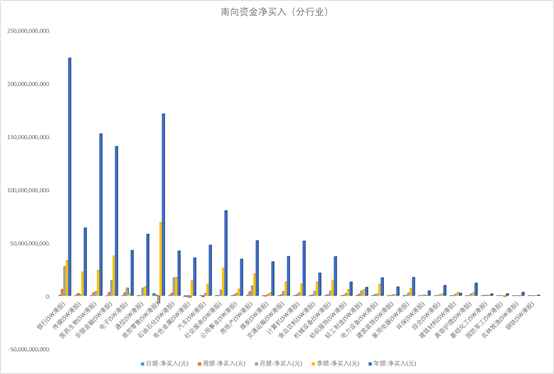
Group 1 - The core concept of "Southbound Capital" refers to mainland investors using the Stock Connect mechanisms to invest in stocks listed on the Hong Kong Stock Exchange, serving as a key source of liquidity for the Hong Kong market [1] Group 2 - As of November 20, 2023, the cumulative net inflow of Southbound capital has exceeded HKD 1.36 trillion, representing a growth of over 68% compared to the total inflow of HKD 807.8 billion for the entire year of 2024, and is 1.7 times the net buying amount for 2024 [2] - The cumulative trading volume of Southbound capital has surpassed HKD 26.37 trillion, which is an increase of over 135% compared to the cumulative trading volume of HKD 11.22 billion for the entire year of 2024, making it 2.35 times the total for 2024 [2] - Since the launch of the Stock Connect, the cumulative net inflow has exceeded HKD 5 trillion, setting a historical record since the mechanism's inception [2] Group 3 - As of November 19, 2023, the top five sectors for Southbound capital holdings are: banking, retail, non-bank financials, pharmaceuticals, and media, with the banking sector receiving the most significant net buying across various time frames [3] - The monthly frequency of net buying in the banking sector accounts for 1.54% of the total market capitalization, indicating a substantial increase in investment in this sector [3] - Other sectors that have seen significant increases in investment over the past month include non-bank financials, real estate, oil and petrochemicals, and transportation [3] Group 4 - The primary drivers for the recent Southbound capital flows are institutional funds such as insurance capital and public funds, attracted by the high dividend yield of Hong Kong stocks (average yield of 5.57%) in a low-interest-rate environment [5] - The banking, non-bank financials, real estate, oil and petrochemicals, and transportation sectors have seen increased investment due to their valuation advantages, particularly in the context of Hong Kong's market being perceived as undervalued globally [6] - The price-to-book ratio (PB) of the Hong Kong banking sector is currently at 0.52, representing a discount of over 40% compared to similar sectors in A-shares, which attracts funds seeking value [6] Group 5 - For individual investors, participating directly in Hong Kong stocks may involve risks such as exchange rate fluctuations and differences in trading rules, making ETFs a preferable option for exposure [6] - Recent trends indicate that Southbound capital is increasingly focused on high-dividend, low-volatility ETFs, which cater to investors with moderate risk preferences [6] - The Hong Kong Central State-Owned Enterprises Dividend ETF and other similar products allow investors to benefit from the inflow of Southbound capital while diversifying their investment risks [6]