
国内流动性

Search documents
外汇结汇潮,如何影响国内流动性?
Hua Er Jie Jian Wen· 2026-01-26 06:45
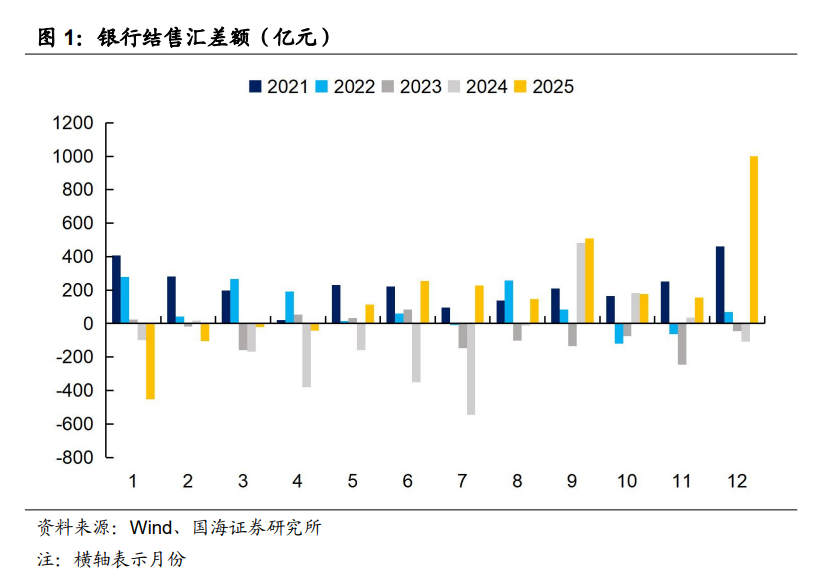
Core Viewpoint - The surge in foreign exchange settlement since 2025 is not indicative of "liquidity injection" into the banking system, but rather a consumption of excess reserves, leading to a temporary liquidity squeeze [1][7][9]. Group 1: Foreign Exchange Settlement Trends - Since 2025, there has been a significant increase in corporate willingness to settle foreign exchange, with the bank's settlement surplus reaching approximately 100 billion yuan at the end of the year, a historical high [3][12]. - The increase in foreign exchange settlement has a certain "money creation" effect, as companies selling foreign exchange to banks increase their RMB deposits, which are counted in M1 [6][12]. Group 2: Impact on Banking Liquidity - Despite the increase in foreign exchange settlement, the overall liquidity in the banking system remains manageable, with the excess reserve ratio in December 2025 being approximately 1.6%, lower than the historical average [7][12]. - The central bank is not expected to passively inject liquidity through foreign exchange reserves to counteract settlement pressures, as this mechanism has been significantly weakened since the 2017 reforms [9][17]. Group 3: Central Bank's Policy Stance - The central bank's recent policy indicates that exchange rates are no longer the primary variable in decision-making, with a focus on domestic economic and financial conditions [17]. - Historical data shows that previous surges in foreign exchange settlement did not lead to monetary policy easing, suggesting that current trends may not trigger similar responses [14][17].

高频数据扫描:外部政策扰动与国内流动性
Bank of China Securities· 2026-01-25 08:51
Report Industry Investment Rating - The report does not provide a specific industry investment rating [1][3] Core Viewpoints of the Report - The US government still regards trade friction as an important bargaining chip, and the disturbance to the financial market may repeat. However, the external policy disturbance is objectively beneficial for China to maintain abundant liquidity [1][3] - The recent stable rise in the RMB exchange rate against the US dollar, combined with historical experience, indicates that the central bank has more conditions to release liquidity by increasing the supply of base money [3] Summary by Relevant Catalogs External Policy Disturbance and Domestic Liquidity - The dispute over Greenland has escalated to a tariff threat, causing market concerns about the escalation of trade friction between the US and the EU. Two Nordic pension funds have announced the reduction of US debt holdings [3] - In October last year, the year-on-year decline in US commodity imports widened, but the cumulative imports still increased year-on-year due to "stockpiling" at the beginning of the year. The US government still has a tendency to use trade friction as an important bargaining chip [3] - The US Supreme Court's tariff ruling is important for the US government's tariff policy. If the ruling is unfavorable, it may limit the US government's ability to initiate similar tariff frictions, but the US government still has alternative tools [3] - The external policy disturbance is conducive to maintaining abundant liquidity in the domestic market. The RMB exchange rate against the US dollar has risen steadily, and the central bank has more conditions to release liquidity [3] High-Frequency Data Scanning - This week, the average wholesale price of pork increased by 2.69% week-on-week and decreased by 18.93% year-on-year; the average wholesale price of 28 key monitored vegetables increased by 2.36% week-on-week and 6.09% year-on-year [3] - This week, the domestic cement price index decreased by 0.66% week-on-week; the South China Iron Ore Index decreased by 3.40% on average week-on-week; the operating rate of coking enterprises with a production capacity of over 2 million tons remained unchanged week-on-week; the rebar inventory index increased by 2.62% week-on-week, and the rebar price index decreased by 0.84% week-on-week; the blast furnace operating rate of 247 domestic steel mills decreased by 0.20% week-on-week [3] - This week, the average prices of Brent and WTI crude oil futures increased by 0.09% and decreased by 0.21% week-on-week respectively. The average price of LME copper spot decreased by 2.49% week-on-week, the average price of aluminum spot decreased by 1.47% week-on-week, and the copper-gold ratio decreased by 6.48% week-on-week [3] - From January 1 - 21, 2026, the average daily trading area of commercial housing in 30 large and medium-sized cities tracked by Wind was about 161,000 square meters; in January 2025, the average daily trading area in 30 cities was about 222,000 square meters [3]
如何看待年底的港股红利行情?
Sou Hu Cai Jing· 2025-12-01 00:17
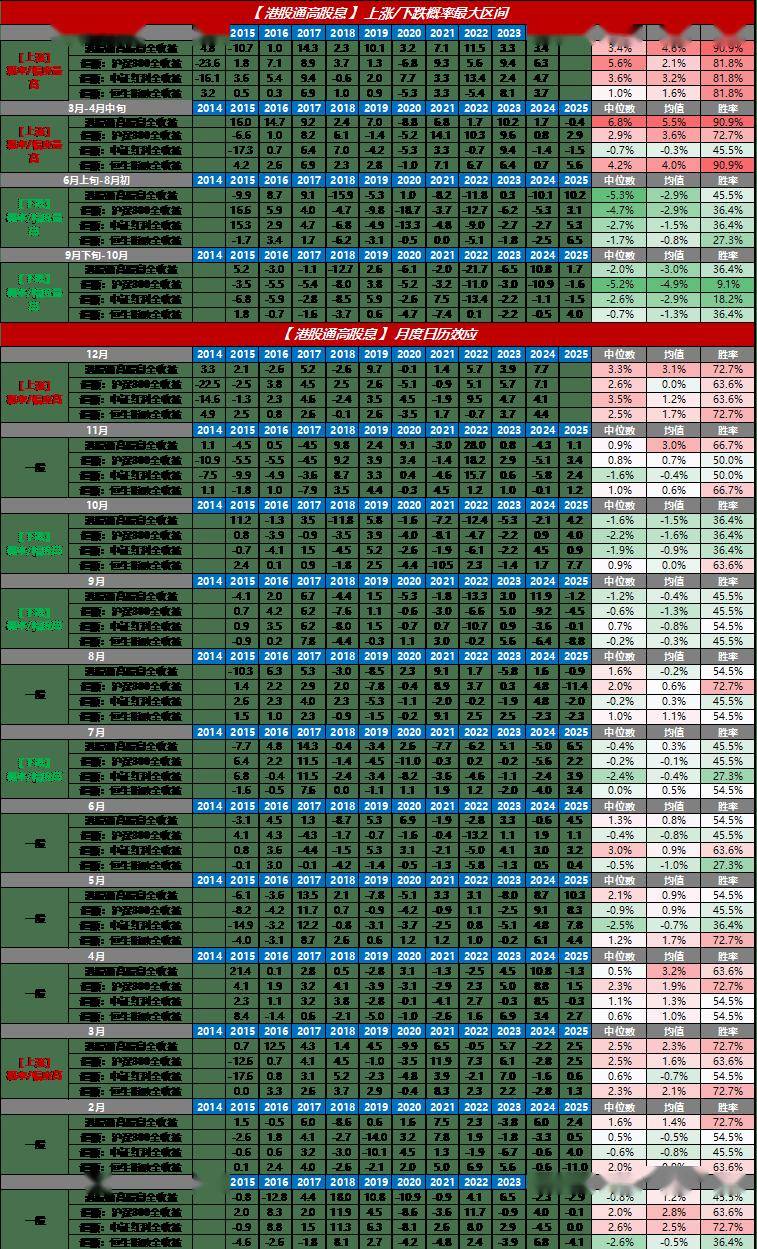
Core Viewpoint - The Hong Kong Stock Connect High Dividend Total Return Index is expected to experience its strongest calendar effect from December to mid-January, with a high probability of absolute and excess returns during this period [1]. Group 1: Performance Metrics - The absolute return probability is 90.9%, with median and average gains of 3.4% and 4.6% respectively [3][19]. - The probability of excess returns compared to the CSI 300 Total Return Index is 81.8%, with median and average excess returns of 5.6% and 2.1% respectively [3][19]. - The probability of excess returns compared to the CSI Dividend Total Return Index is also 81.8%, with median and average excess returns of 3.6% and 3.2% respectively [3][19]. - The probability of excess returns compared to the Hang Seng Index Total Return is 81.8%, with median and average excess returns of 1.0% and 1.6% respectively [3][19]. Group 2: Reasons for Calendar Effect - A key reason for the strong year-end effect is the rebalancing of assets by public funds seeking relative returns, leading to a shift from high-valuation growth stocks to high-dividend, high-safety Hong Kong stocks [4]. - December to January is a peak period for insurance premiums, prompting some insurance funds to quickly build positions in high-dividend assets to match liability costs, creating a rigid buying pressure [4]. - Year-end policy catalysts or announcements may also stimulate the Hong Kong dividend market, especially if supportive dividend policies are implemented or if growth stabilization policies fall short of expectations [4]. Group 3: Historical Context - The Hong Kong Stock Connect High Dividend Total Return Index has shown strong performance from December to mid-January since 2014, with a win rate of 82% compared to the CSI 300 Total Return, CSI Dividend Total Return, and Hang Seng Index Total Return [15][19]. - The index's trading volume currently represents only 6.1% of the market, indicating a relatively low level of crowding and potential for reallocation [15].
收盘丨沪指涨1.04%,科创50大涨3.23%,逾百股涨停
Di Yi Cai Jing Zi Xun· 2025-08-20 07:29
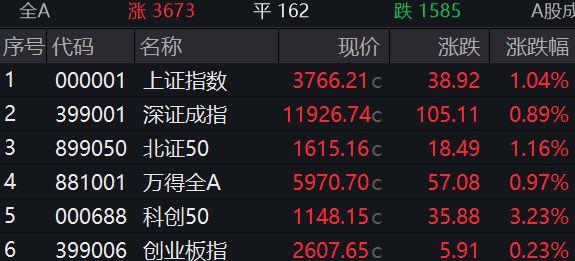
Market Performance - The Shanghai Composite Index rose by 1.04% to close at 3766.21, marking a ten-year high [1][2] - The Shenzhen Component Index increased by 0.89% to 11926.74, while the ChiNext Index saw a smaller gain of 0.23% [1][2] - The STAR Market 50 Index surged by 3.23%, reaching a two-and-a-half-year high [1] Trading Volume - The total trading volume in the Shanghai and Shenzhen markets was 2.41 trillion yuan, a decrease of over 100 billion yuan compared to the previous trading day [4] Sector Performance - Sectors such as liquor, semiconductors, automotive, AI glasses, and insurance showed significant gains, while sectors like film and television, medical services, diversified finance, and software development experienced declines [6] - Notable performances included liquor stocks, with Wuliangye and Shede Liquor hitting the daily limit, and semiconductor stocks like Cambrian Technology rising over 8% [6] Fund Flow - Main funds saw net inflows into sectors like electronics, automotive, non-ferrous metals, and food and beverage, while there was a net outflow from the pharmaceutical and biotechnology sectors [8] - Specific stocks with net inflows included Inspur Information, ZTE Corporation, and Haiguang Information, attracting 2.12 billion yuan, 1.47 billion yuan, and 1.10 billion yuan respectively [9] - Conversely, stocks like Sichuan Changhong, Dongfang Wealth, and Huasheng Tiancheng faced net outflows of 1.54 billion yuan, 1.45 billion yuan, and 1.38 billion yuan respectively [10] Institutional Insights - Dongfang Securities noted signs of upward revision in overseas inflation data, raising concerns about potential hawkish remarks from Powell at the Jackson Hole central bank meeting, while domestic liquidity remains ample [11] - CITIC Securities highlighted that the liquor industry is rapidly bottoming out, with leading companies likely to benefit from channel adjustments and market expansion opportunities as consumption gradually improves [12]
惠誉评级:充足的国内流动性降低亚太新兴市场非银行金融机构的再融资风险。
news flash· 2025-06-16 07:44
Group 1 - The core viewpoint of the article is that sufficient domestic liquidity is reducing refinancing risks for non-bank financial institutions in emerging markets in the Asia-Pacific region [1] Group 2 - The article highlights that the availability of domestic liquidity is a key factor in stabilizing the financial environment for these institutions [1] - It notes that this liquidity support is crucial for maintaining investor confidence and ensuring smooth operations within the sector [1] - The report suggests that the current economic conditions are favorable for non-bank financial institutions, allowing them to navigate refinancing challenges more effectively [1]