
煤沥青

Search documents
【行情】煤焦油价格变动 炭黑盘整观望
Xin Lang Cai Jing· 2026-02-11 10:16
Group 1: Coal Tar Supply and Demand - After the previous price increase, coking enterprises have seen profit recovery, leading to a reduced willingness for winter storage compared to previous years, with the coking market expected to remain stable before the holiday [4][8] - Deep processing enterprises still have stocking demands; however, the sentiment in the industry chain has shifted from bearish to cautious observation due to price fluctuations and reduced operating rates in deep processing [4][8] - Current prices for deep processing products are stable, with coal tar pitch priced between 4600-4650 yuan/ton and anthracene oil in Shandong at 3650 yuan/ton [4][8] Group 2: Carbon Black Supply and Demand - As the year-end approaches, logistics are gradually halting, and both full-steel and semi-steel tire enterprises have begun their holidays, resulting in a decline in the overall operating rate of the tire industry [5][8] - The current demand for carbon black from downstream has weakened, with manufacturers primarily executing previous orders and new market transactions slowing down [5][8] - Despite the reduced demand, major carbon black manufacturers maintain low inventory levels, with the operating rate still around 60%, as they need to fulfill existing orders and some are also responsible for winter heating tasks [5][9]

【行情】原料油整体下行 炭黑盘整观望
Xin Lang Cai Jing· 2026-02-06 11:26
Group 1 - The core viewpoint of the article indicates that carbon black prices are stabilizing within a range, with limited market transactions and a continuation of cost pressures affecting supply and demand dynamics [2][6][10] - Carbon black companies still have pending orders, and overall pricing remains stable, with some companies adjusting prices slightly in line with raw oil price fluctuations [7][9] - Demand for carbon black is characterized by scattered orders that do not represent the broader market, leading to a focus on actual sales negotiations [3][7] Group 2 - The supply and demand for coal tar is imbalanced, with expectations of weak performance; the main transaction prices range from 3650 to 3760 yuan per ton, reflecting a decline of 40 to 200 yuan per ton, particularly in Inner Mongolia [9][10] - Increased output from coking enterprises coincides with the end of downstream inventory buildup, contributing to a more negative market outlook [9][11] - Predictions suggest that coal tar prices will continue to exhibit weak trends, while carbon black prices are expected to stabilize within a range as demand orders decrease [10][11]
【行情】煤焦油价格回调 炭黑高位盘整
Xin Lang Cai Jing· 2026-01-28 10:13
Core Viewpoint - The coal tar price has experienced a downward adjustment this week, with significant declines in various regions, leading to a loss of market confidence [1][6]. Group 1: Price Trends - Coal tar prices have dropped to 3960 yuan/ton in Anhui, with Shandong and Hebei experiencing auction failures, and Shanxi seeing a decrease of 180 yuan/ton [1][6]. - The price of anthracene oil has fallen to 3850 yuan/ton (ex-factory), with noticeable pressure on shipments, while prices of industrial naphthalene and other minor oil products are also trending downward [2][7]. Group 2: Market Sentiment - The market is currently in a state of contention, with uncertain future price trends due to stable supply, high operating rates in deep processing, and pre-holiday stocking expectations [4][9]. - The profitability of the industry is constrained as deep processing products have not kept pace with the rise in raw oil prices, leading to a situation where anthracene oil prices are lower than coal tar prices [4][9]. Group 3: Demand and Production - Deep processing enterprises are operating at the breakeven point, resulting in reduced enthusiasm for high-priced raw materials [3][8]. - The demand for carbon black remains weak, with major downstream tire companies beginning to take holidays, and the overall performance of rubber products and color masterbatches is also lackluster [5][10].
【行情】煤焦油区域价差拉平 炭黑亏损面扩大
Xin Lang Cai Jing· 2026-01-21 12:42
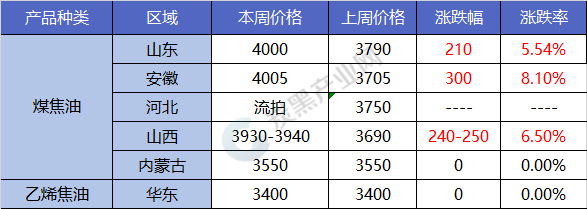
Group 1 - The core viewpoint of the articles indicates a significant increase in coal tar prices across various regions, with Shandong reaching 4000 yuan per ton and Shanxi at 3930-3940 yuan per ton, reflecting a rise of 210-250 yuan [1][4] - The fluctuation in raw oil prices has exceeded market expectations, driven by strong demand from downstream processing and active procurement, particularly in Shandong and Hebei [2][5] - The coal tar auction prices have shown a notable increase, with Shandong's price rising by 210 yuan (5.54%) from the previous week, and Anhui's price increasing by 300 yuan (8.10%) [3][6] Group 2 - The coal tar market is experiencing a tightening of prices, with the intention to raise prices for coal pitch following the increase in raw material costs, although the acceptance and actual orders from downstream remain to be observed [3][6] - The carbon black market is facing challenges, as major factories have not yet announced new prices, and the industry is experiencing an expanding loss margin due to the ongoing rise in raw material prices while still fulfilling previous low-price orders [7]
煤焦油市场年末为何降温?
Zhong Guo Hua Gong Bao· 2025-12-23 10:11
Core Insights - The domestic coal tar market experienced a recovery phase since mid-November, peaking at a transaction price of 3460 yuan per ton in early December, reflecting a 14% increase month-on-month. However, by mid-December, prices softened to around 3300 yuan due to various factors, including a decline in downstream market prices and increased production capacity utilization [2][3]. Group 1: Market Trends - The decline in the coal tar market is attributed to the weakening of the downstream processing industry, with significant price drops observed in products such as carbon black and coal pitch. For instance, as of December 18, prices for these products fell by 1.7% to 5.5% week-on-week [3]. - The core product, coal pitch, has seen a price drop, which has weakened the market's only support point, leading to a broader decline in coal tar prices across regions [3]. Group 2: Supply and Production - The supply side remains loose, with the capacity utilization rate of domestic coking enterprises exceeding 73%, a 2% increase from November. This stability in production levels contributes to a steady output of coal tar [4]. - The concentration in the coal tar industry has increased, with leading companies achieving significant economies of scale, with some facilities reaching annual production capacities of over 950,000 tons [4]. Group 3: Trade Dynamics - Traders' actions are significantly influencing market volatility, with a growing wait-and-see attitude among them. This has led to a notable decrease in auction participation and a downward adjustment in transaction prices [6]. - Despite the current bearish market sentiment, the overall supply of coal tar is expected to remain stable, with downstream processing enterprises maintaining relatively high operational rates [6].

煤焦油市场年末降温
Zhong Guo Neng Yuan Wang· 2025-12-23 06:34
Core Viewpoint - The domestic coal tar market has experienced a one-month recovery since mid-November, peaking at a transaction price of 3460 yuan per ton in early December, but has since softened due to various factors, including a decline in downstream market prices and increased production capacity utilization [1] Group 1: Downstream Industry Weakness - The decline in the coal tar market is attributed to the weakening of the downstream deep processing industry, with prices for key products like carbon black and coal pitch showing a downward trend starting from early December [2] - As of December 18, prices for various downstream products have decreased, with notable weekly declines, indicating a broader market downturn [2] - The drop in coal pitch prices, a core product of coal tar processing, has further weakened market support, leading to price reductions in regions like Shanxi and Shandong [2] Group 2: Increased Production Capacity Utilization - The production capacity utilization rate of domestic coking enterprises has increased to over 73%, up by about 2% from November, contributing to stable coal tar output [3] - Despite recent price reductions in coke, the decrease in raw material costs has improved profits for coking enterprises, maintaining stable production levels [3] - The concentration of the coal tar industry has increased, with leading companies achieving significant economies of scale, which amplifies the impact of supply and demand changes in the market [3] Group 3: Trade Dynamics - The trading atmosphere has become increasingly cautious, with traders' actions significantly influencing market volatility [5] - Traders have reduced their participation in auctions due to a prevailing bearish sentiment, leading to lower final transaction prices in recent auctions [5][6] - Despite the potential for further downward price adjustments, the overall supply of coal tar is expected to remain stable, with downstream processing enterprises maintaining relatively high operating rates [6]
董秘说|方大炭素董秘庄晓茹:炭素行业培育新质生产力需聚焦五个突破口
Xin Lang Cai Jing· 2025-07-24 07:31
Core Viewpoint - The interview with the Secretary of the Board of Directors of Fangda Carbon emphasizes the company's commitment to technological innovation, green low-carbon practices, and intelligent transformation to drive the carbon industry towards high efficiency, high added value, and sustainability [4][8]. Company Overview - Fangda Carbon has been a leader in the carbon industry for 60 years, with an annual production capacity of 260,000 tons of carbon products and 354,000 tons of raw materials, positioning itself as a top-quality carbon product production and supply base globally [6]. - The company produces a variety of products including graphite electrodes, carbon bricks, isostatic graphite, nuclear graphite materials, graphene materials, and various raw materials [6]. Financial Performance - In the first half of 2025, the company experienced a decline in revenue and net profit due to macroeconomic conditions, reduced downstream market demand, and intensified market competition [6]. - Despite the challenges, the company maintains a competitive advantage through a well-structured industrial layout, resource sharing, centralized R&D, and a complete product system [6]. Strategic Initiatives - The company focuses on "stabilizing traditional business, expanding emerging business, and strengthening collaboration" to ensure a balanced and synergistic development between traditional and new businesses [10]. - Fangda Carbon aims to leverage cash flow from traditional businesses to support the incubation of new businesses while using technological innovation to upgrade traditional industries [10]. Innovation and R&D - Fangda Carbon invests significantly in R&D, with ongoing projects including three national-level major science and technology projects and six provincial-level projects, holding 77 patents [12]. - The company has achieved 40 technological achievements and new products, including advanced graphite electrodes and graphene products, which are being promoted in various markets [13][14]. Environmental Commitment - The company has invested over 200 million yuan in environmental upgrades, earning recognition as a "green factory" and a "waste-free enterprise" [14]. - Fangda Carbon is advancing its digital transformation with a nearly 100 million yuan investment to establish the industry's first "5G + Carbon Intelligent Manufacturing Fully Connected Factory" [14].


石油与化工指数涨跌互现(4月28日—30日)
Zhong Guo Hua Gong Bao· 2025-05-07 02:22
Group 1: Industry Overview - The oil and chemical indices experienced mixed performance during the trading days from April 28 to April 30, with the chemical raw materials index down by 0.55% and the chemical machinery index up by 0.75% [1] - International crude oil prices showed a downward trend, with WTI settling at $58.29 per barrel, down 7.51% from April 25, and Brent at $61.29 per barrel, down 8.34% [1] - The top five rising petrochemical products included liquid chlorine up by 54.19% and PTA up by 5.68%, while the top five declining products included coal tar pitch down by 8.95% and WTI down by 7.51% [1] Group 2: Capital Market Performance - The top five performing listed chemical companies in the Shanghai and Shenzhen markets included United Chemical up by 36.56% and Yuzhong Three Gorges A up by 33.16% [2] - The worst-performing listed chemical companies included Xinjin Road down by 26.55% and ST Youfu down by 23.32% [2]
化工指数强过石油指数
Zhong Guo Hua Gong Bao· 2025-04-29 01:59
Group 1 - The chemical index outperformed the oil index during the week of April 21-25, with the chemical raw materials index rising by 2.26%, chemical machinery index by 3.18%, pharmaceutical index by 3.29%, and pesticide and fertilizer index by 2.78% [1] - In contrast, the oil processing index fell by 0.48%, while the oil extraction index saw a slight increase of 0.01%, and the oil trading index dropped by 2.87% [1] - International crude oil prices experienced narrow fluctuations, with WTI settling at $63.02 per barrel, down 2.57% from April 17, and Brent at $66.87 per barrel, down 1.60% [1] Group 2 - The top five performing listed chemical companies in the Shanghai and Shenzhen markets included XianDa Co. with a rise of 49.54%, Zhongxin Fluorine Materials up by 40.89%, Weike Technology up by 33.65%, Zhenhua Co. up by 33.55%, and Xinhang New Materials up by 31.20% [2] - Conversely, the five companies with the largest declines were Jinlitai down by 43.85%, Guoli Technology down by 30.11%, ST Haiyue down by 21.88%, Fanli Technology down by 21.81%, and Yida Co. down by 21.64% [2]
煤焦油市场加速探底
Zhong Guo Hua Gong Bao· 2025-04-28 01:55
Core Viewpoint - The domestic coal tar market has experienced a significant decline after reaching a peak in early March, with prices dropping by approximately 24% by April 22, leading to a cautious atmosphere in the industry [1] Demand Weakening - The demand for coal tar has shifted from strong to weak as the peak consumption season comes to an end, resulting in lower purchasing enthusiasm from downstream companies [2] - Inventory digestion in the tire industry has been slow, contributing to a bearish outlook on future coal tar prices, with companies adopting a just-in-time purchasing strategy [2] - The decline in demand has also affected the prices of downstream products like carbon black and anthracene oil, leading to increased losses for carbon black manufacturers [2] Supply Expectations Increasing - As of April 17, the capacity utilization rate of independent coking enterprises in China was 73.51%, reflecting a 5% increase, with stable growth in coal tar production expected [3] - The profitability of coking plants has improved due to the first round of coking coal price increases, maintaining strong procurement demand from steel mills [3] - Companies are adopting a just-in-time sales strategy, with low-priced inventory clearance policies accelerating market adjustments [3] Downstream Inventory Accumulation - In the context of weak terminal demand, deep processing products like anthracene oil and washing oil are facing sales difficulties, leading to increased inventories [4] - The operating rate of coal tar deep processing increased to 46% as of April 17, but losses in the carbon black industry have led to a decrease in its operating rate to 61.79% [4] - The significant decline in the coal tar market has caused traders to adopt a wait-and-see approach, further negatively impacting the market as it enters the consumption off-season [4]