片仔癀系列

Search documents
西部证券晨会纪要-20251121
Western Securities· 2025-11-21 02:24
Group 1: Fund Performance and Trends - The report analyzes the evolution and current status of performance benchmarks for public funds in China and the US, highlighting the divergence in performance of active equity funds from their benchmarks and potential causes [1][7][10] - It notes that the number of active equity funds in both markets is primarily based on broad indices, with a trend towards diversification observed in the last two years. Approximately 7.24% (239 funds) of China's active equity funds have benchmarks not included in the benchmark library, which may face adjustment pressures [10][11] - The report concludes that the deviation of active equity funds in China is significantly higher than in the US, attributing this to differences in fund sales models and the diversity of ETF products [10][11] Group 2: Securities Industry Insights - The report discusses the merger of CICC with Dongxing Securities and Xinda Securities, indicating a continuation of supply-side reforms in the securities industry. This merger is expected to optimize the industry structure and enhance CICC's competitive position [12][13] - Following the merger, CICC's total asset scale is projected to reach 1 trillion yuan, elevating its ranking among listed securities firms. The merger is anticipated to improve CICC's brokerage and asset management capabilities significantly [14] - The report highlights a mismatch between the profitability and valuation of the securities sector, suggesting substantial room for valuation recovery, with recommendations for investing in large, undervalued securities firms [15] Group 3: Pharmaceutical Sector Analysis - The report tracks the performance of Pizhou Pharmaceutical, noting a revenue decline of 11.93% year-on-year for the first three quarters of 2025, with a significant drop in net profit. However, it anticipates a potential improvement in gross margin due to falling raw material prices [17][18] - Pizhou's product strategy focuses on core products while expanding into cosmetics, with notable sales growth in its flagship beauty product. The company is also advancing its R&D pipeline with new drug developments [18][19] - The investment recommendation suggests an EPS forecast of 4.04, 4.40, and 4.82 yuan for 2025, 2026, and 2027, respectively, maintaining a "buy" rating due to the unique attributes of its core products [18][19] Group 4: Express Delivery Sector Overview - The report reviews Shentong Express's operational data for October 2025, indicating a year-on-year revenue increase of 11.84% and a positive growth trend in express delivery volume [20][21] - The average service price per delivery has risen, contributing to the overall revenue growth, with expectations for continued strong performance in 2025 [20][21] - The forecast for Shentong's EPS for 2025-2027 is set at 0.89, 1.22, and 1.48 yuan, respectively, with a "buy" rating based on the anticipated growth trajectory [21]


一代“神药”,也卖不动了!
Feng Huang Wang Cai Jing· 2025-10-24 14:18
Core Viewpoint - The company Pianzaihuang has ended its decade-long growth story, reporting significant declines in revenue and net profit for the first three quarters of 2025, indicating challenges to its previously successful growth model based on scarcity and price increases [1][2][3] Financial Performance - For the first three quarters of 2025, Pianzaihuang reported revenue of 7.442 billion yuan, a year-on-year decrease of 11.93%, and a net profit of 2.129 billion yuan, down 20.74% [1][2] - In Q3 2025, revenue was 2.064 billion yuan, down 26.28% year-on-year, with net profit at 687 million yuan, a decline of 28.82% [1][2] - The company's core business, pharmaceutical manufacturing, saw revenue of 4.016 billion yuan, accounting for 54.09% of total revenue, but experienced a 12.93% decline in revenue and a 7.51 percentage point drop in gross margin to 59.38% [2][3] Product Performance - The core product, Pianzaihuang liver disease medication, generated revenue of 3.880 billion yuan, down 9.41% year-on-year, with a gross margin decrease of 9.68 percentage points to 61.11% [3] - The newly acquired product, Angong Niuhuang Wan, faced a significant decline, with revenue of 93.44 million yuan, down 65.20% year-on-year [3] Market Sentiment - Following the release of the Q3 report, Pianzaihuang's stock price fell by 5.78% on the first trading day, closing down 4.71% at 187.09 yuan per share [4] - The company's inventory has risen to over 6.16 billion yuan, up from 4.97 billion yuan at the end of the previous year, indicating weak sales [4] Historical Context - Pianzaihuang was once celebrated as the "Moutai of medicine," with a market capitalization that peaked above 290 billion yuan, but has since lost nearly 180 billion yuan in value [1][2] - The company had previously enjoyed a high price-to-earnings ratio of 160 times and a market cap nearing 300 billion yuan during its peak [3] Supply Chain and Cost Issues - The cost structure of Pianzaihuang is heavily reliant on rare raw materials, which account for over 90% of total costs, making it vulnerable to price fluctuations [7][8] - The price of natural cow bile, a key ingredient, has surged from approximately 350,000 yuan per kilogram in 2019 to around 1.7 million yuan per kilogram in 2025, significantly impacting profit margins [7][8] Strategic Shifts - The company plans to explore new market channels, including traditional medicine, medical aesthetics, and high-end elderly care, in an attempt to revitalize demand [12]
一代“神药”,也卖不动了
投中网· 2025-10-23 06:30
Core Viewpoint - The article discusses the significant decline in the performance of Pizhou Huang, a company once celebrated for its rapid growth and high market valuation, highlighting its recent financial struggles and the challenges it faces in maintaining its previous growth model [5][9][24]. Financial Performance - In the third quarter of 2025, Pizhou Huang reported a revenue of 20.64 billion yuan, a year-on-year decrease of 26.28%, and a net profit of 6.87 billion yuan, down 28.82% [5][10]. - For the first three quarters of 2025, total revenue was 74.42 billion yuan, representing an 11.93% decline, while net profit fell by 20.74% to 21.29 billion yuan [5][10]. - The company's core pharmaceutical manufacturing segment saw a revenue drop of 12.93%, with a gross margin decrease of 7.51 percentage points to 59.38% [10][11]. Market Dynamics - Pizhou Huang's market value has decreased significantly, from a peak of 290 billion yuan to 111.8 billion yuan, losing nearly 180 billion yuan in market capitalization [5][9]. - The company is experiencing a shift in consumer behavior, with reduced demand for its products as middle-class consumers tighten their spending [7][24]. Product Performance - The core product, a liver disease medication, generated 38.80 billion yuan in revenue, down 9.41% year-on-year, while another key product, the Angong Niuhuang Wan, saw a dramatic revenue drop of 65.20% to 934.36 million yuan [13][24]. - The company has faced challenges in maintaining its pricing strategy, with actual market prices for its products falling below official retail prices, indicating a disconnect between supply and demand [24][25]. Cost Structure - The rising costs of raw materials, particularly natural ingredients like cow bile and musk, have significantly impacted profit margins, with cow bile prices soaring from approximately 350,000 yuan per kilogram in 2019 to around 1.7 million yuan per kilogram in 2025 [22][23]. - The company has historically relied on price increases to offset rising costs, having raised prices over 20 times since its listing in 2003, but this strategy has begun to falter [23][24]. Strategic Response - In response to declining sales, Pizhou Huang plans to explore new market channels, including traditional medicine, aesthetic medicine, and high-end elderly care, to create new consumption scenarios [25].


一代“神药”,也卖不动了
凤凰网财经· 2025-10-22 02:18
Core Viewpoint - The company Pianzaihuang has ended its decade-long growth story, reporting significant declines in revenue and net profit in its Q3 2025 financial results, indicating a severe challenge to its previously successful growth model based on scarcity and price increases [1][2][5] Financial Performance - In the first three quarters of 2025, Pianzaihuang reported revenue of 7.442 billion yuan, a year-on-year decrease of 11.93%, and a net profit of 2.129 billion yuan, down 20.74% [1][6] - Q3 alone saw revenue drop to 2.064 billion yuan, a decline of 26.28%, and net profit fell to 687 million yuan, down 28.82% [1][6] - This marks the worst performance in nearly a decade, breaking a trend of continuous growth from 2015 to 2024 [5] Market Position and Valuation - Once valued at over 290 billion yuan, the company's market capitalization has now evaporated by nearly 180 billion yuan, leaving it at 111.8 billion yuan [2] - The company was once celebrated as the "Moutai of medicine," but the current market sentiment has shifted, with consumers tightening their spending [4][5] Business Segments Performance - The pharmaceutical manufacturing segment generated 4.016 billion yuan, accounting for 54.09% of total revenue, but saw a year-on-year decline of 12.93% with a gross margin decrease of 7.51 percentage points to 59.38% [6][7] - The pharmaceutical distribution segment reported revenue of 2.887 billion yuan, down 8.45%, while the cosmetics segment fell to 400 million yuan, a decrease of 23.82% [7] Key Products and Sales Trends - The core product, the liver disease medication series, generated 3.880 billion yuan, down 9.41%, with a gross margin reduction of 9.68 percentage points to 61.11% [9] - The anticipated Angong Niuhuang Wan product faced a significant decline, with revenue plummeting 65.20% to 93.44 million yuan [9] - The company's inventory has surged to over 6.16 billion yuan, up from 4.97 billion yuan at the end of the previous year, highlighting sales difficulties [11] Cost and Pricing Strategy - The rising costs of key raw materials, such as natural musk and cow bile, have significantly impacted profit margins, with cow bile prices soaring from approximately 350,000 yuan per kilogram in 2019 to around 1.7 million yuan in 2025 [19][20] - The company has historically relied on price increases to offset rising costs, having raised prices over 20 times since its listing in 2003, but this strategy has begun to falter [20][23] - Despite maintaining a retail price of 760 yuan per piece, actual market prices have dropped below 500 yuan, indicating a disconnect between perceived value and market demand [25] Market Sentiment and Future Outlook - Following the release of the Q3 report, the stock price fell by 5.78% on the first trading day, closing down 4.71% at 187.09 yuan per share [12] - The company is exploring new market channels, including traditional medicine, medical aesthetics, and high-end elderly care, but the effectiveness of these efforts remains uncertain as the previous growth model has stalled [27]
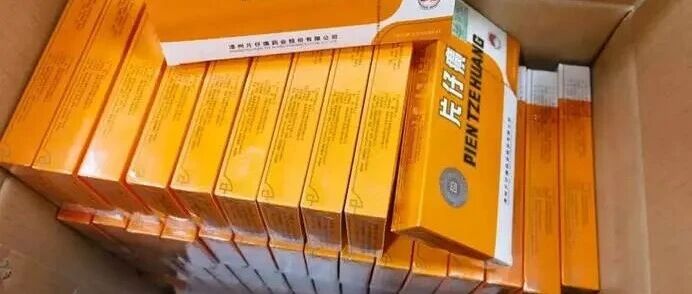
片仔癀三季报营收净利双降:十年增长神话终结
2 1 Shi Ji Jing Ji Bao Dao· 2025-10-20 10:37
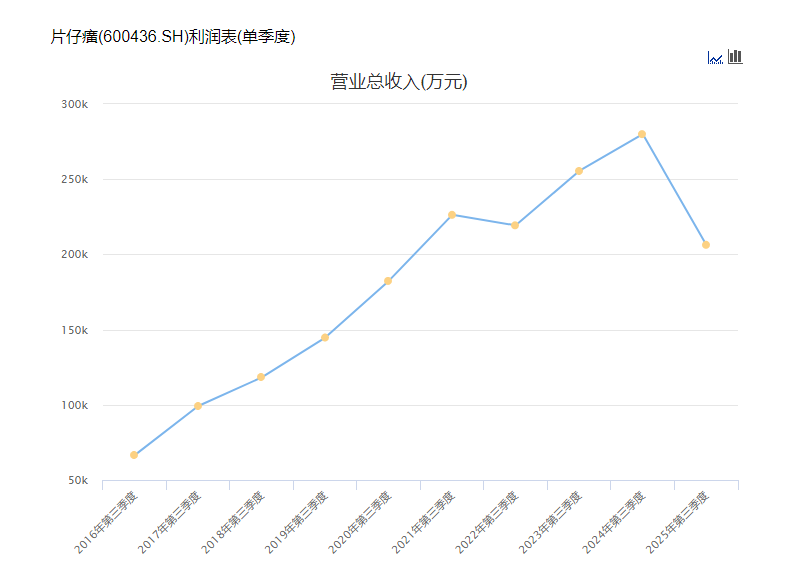
Core Viewpoint - The performance of Pian Zai Huang, a traditional Chinese medicine company, has significantly declined, marking the end of a decade-long growth period, raising concerns about its core business resilience and future development path [1][3]. Financial Performance - For the first three quarters, the company reported revenue of 7.442 billion yuan, a year-on-year decrease of 11.93%, and a net profit of 2.129 billion yuan, down 20.74%, with the profit decline outpacing revenue decline [3]. - In Q3 alone, revenue was 2.063 billion yuan, down 26.12%, and net profit was 687 million yuan, down 28.83%, indicating increasing pressure on core business metrics [3]. - The pharmaceutical manufacturing segment, which is crucial for the company, generated revenue of 4.016 billion yuan, accounting for 54.09% of total revenue, but saw a revenue decline of 12.93% and a gross margin drop of 7.51 percentage points to 59.38% [3][4]. Core Product Performance - The core product line, particularly liver disease medications, generated revenue of 3.880 billion yuan, down 9.41%, with a gross margin decrease to 61.11%, a drop of 9.68 percentage points [4]. - This product line has historically been a key driver of growth, contributing over 95% of the pharmaceutical manufacturing segment's revenue, making its decline critical to the company's overall performance [4]. Other Business Segments - The pharmaceutical distribution segment reported revenue of 2.887 billion yuan, down 8.45%, with a gross margin decrease to 8.64% [5]. - The cosmetics segment generated revenue of 400 million yuan, with a significant decline of 23.82% and a gross margin decrease to 61.79%, indicating challenges in the high-end beauty market due to weak consumer demand and brand recognition [5]. Cost and Pricing Challenges - The company's performance decline is attributed to rising cost pressures and ineffective pricing strategies, particularly due to the high cost of key raw materials, which account for over 90% of production costs [7]. - The price of natural cow bile, a critical ingredient, has surged from 650,000 yuan per kilogram in January 2023 to a peak of 1.65 million yuan in 2024, reflecting a price increase of over 150% [7]. - Despite a price increase in May 2023, the company's pricing strategy has become ineffective, with actual market prices falling below official prices, exacerbating gross margin declines [8]. Market Dynamics - The company's reliance on non-essential consumer products has faced significant challenges in a tightening macroeconomic environment, leading to reduced consumer spending on non-essential items [9]. - The decline in demand for Pian Zai Huang's products mirrors broader trends in the high-end non-essential consumer market, as seen with other luxury brands facing similar pressures [9]. Future Outlook - Investors are concerned about the lack of new growth engines for the company, as the pharmaceutical distribution segment has low profitability and the cosmetics segment is not expected to compensate for the decline in core business [10]. - The ability to resolve pricing issues and develop new growth opportunities will be crucial for the company's recovery [10].
片仔癀药业亮相纽约 “出海”提档增速
Zhong Guo Jin Rong Xin Xi Wang· 2025-09-06 12:22
Core Viewpoint - The collaboration between Zhangzhou Pien Tze Huang Pharmaceutical Co., Ltd. and JD Health marks a significant step in the internationalization of traditional Chinese medicine, enhancing the brand's global presence and recognition [1][2]. Group 1: International Expansion - Pien Tze Huang has been actively expanding its international footprint, recently participating in events like the "2025 (China) Eurasian Commodity Trade Expo" and the "Fourth China-Africa Economic and Trade Expo" to showcase Chinese medicine culture [1][2]. - The company has established a strong reputation in the overseas Chinese community and ranks among the top exporters of traditional Chinese medicine products [1]. Group 2: Product and Market Development - Pien Tze Huang is focusing on integrating traditional Chinese medicine with modern health concepts to attract the Z generation consumer group [2]. - The company is diversifying its product lines into cosmetics, daily chemicals, and health foods, aiming to combine traditional Chinese medicine culture with modern wellness and beauty trends [2]. Group 3: Research and Development - The company is enhancing its research and development capabilities, with plans to advance two new drug projects and 18 ongoing research initiatives in the first half of the year [2]. - Pien Tze Huang aims to modernize and internationalize the traditional Chinese medicine industry, leveraging innovative development strategies to upgrade its brand value [2].
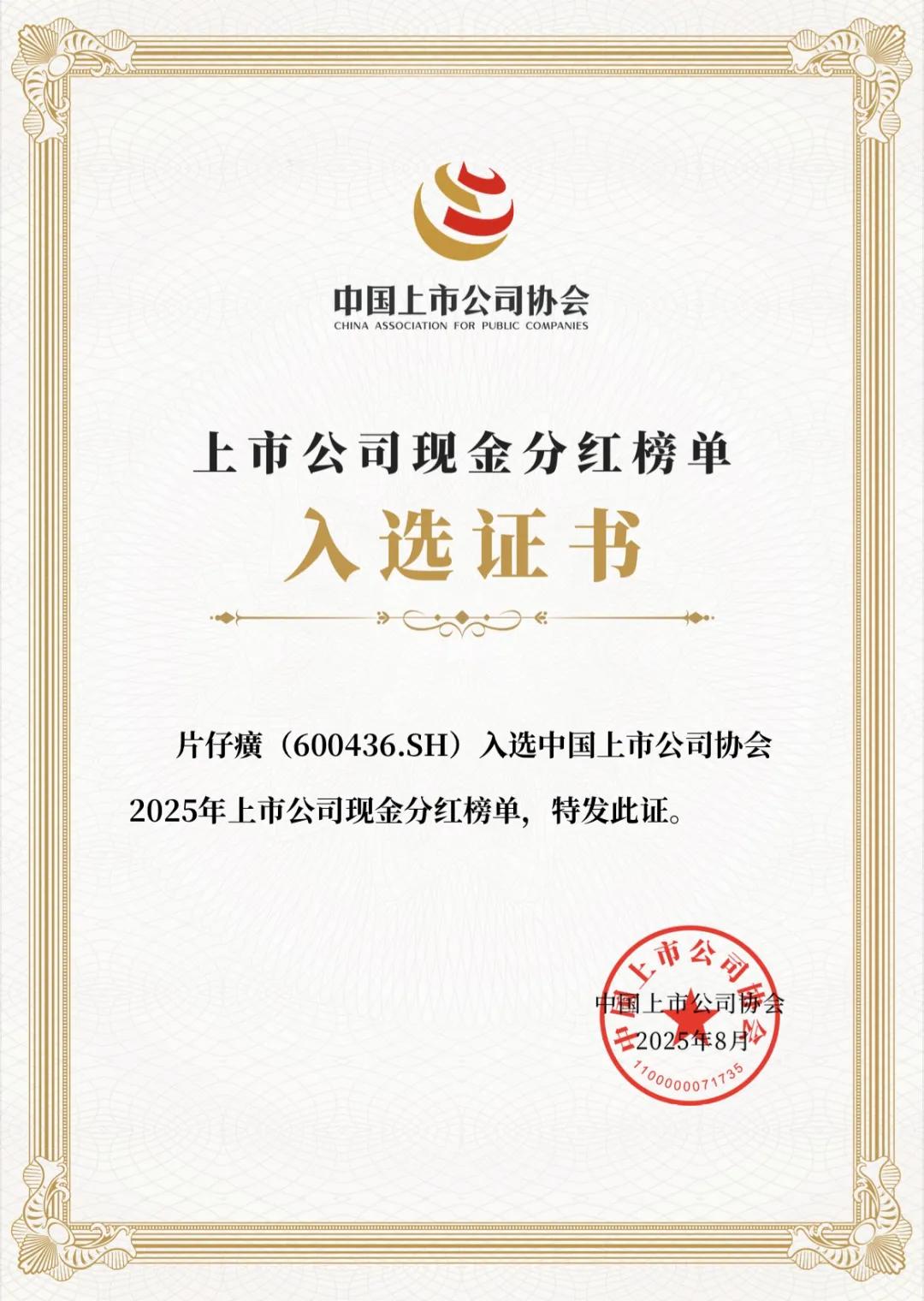
片仔癀入选 2025年上市公司现金分红榜单
Zheng Quan Shi Bao Wang· 2025-08-25 03:35
Core Points - The China Listed Companies Association has officially released the 2025 cash dividend ranking, with Zhangzhou Pien Tze Huang Pharmaceutical Co., Ltd. making the list due to its long-standing commitment to sharing development results with investors [1][4] - Pien Tze Huang has maintained a consistent cash dividend policy since its A-share market debut in 2003, with a total dividend payout exceeding 7.7 billion yuan over 22 years [4] - For 2024, the company plans to distribute a total cash dividend of 1.792 billion yuan, representing 60.19% of the annual net profit attributable to shareholders, reflecting a strong financial foundation and operational stability [4] Company Performance - In 2024, despite a complex market environment, Pien Tze Huang achieved steady growth, with increasing revenue and an expanded market share for its core Pien Tze Huang product series [4] - The company has been optimizing its industrial layout by increasing investments in traditional Chinese medicine research and smart manufacturing, significantly enhancing its overall competitiveness [4] Future Outlook - Pien Tze Huang aims to continue its long-term win-win philosophy with investors, adhering to regulatory requirements for cash dividends and enhancing the stability, sustainability, and predictability of its dividend planning [4]