
理想Livis

Search documents
国泰海通|轻工:智能眼镜产品力系列深度一:AR的崛起,不是偶然
国泰海通证券研究· 2026-01-21 13:50
Core Insights - The smart glasses industry is expected to enter a rapid growth phase, with related companies poised to benefit from an upturn in market conditions [1] Group 1: Product Launches and Innovations - Meta and EssilorLuxottica launched the new smart glasses, Ray-Ban Meta, featuring improved audio-visual quality and integration with Meta's Llama3 model [1] - Ray-Ban Meta includes live streaming capabilities and seamless connectivity with Meta's social platforms like Facebook and Instagram, expanding its application scenarios [1] Group 2: Supply Chain and Market Dynamics - The supply chain for AI glasses is more extensive than traditional eyewear, involving numerous hardware and software suppliers, including chip manufacturers and ODM/OEM firms [2] - The entry of various players into the AI glasses market includes mobile manufacturers, internet companies, XR firms, traditional eyewear brands, and 3C companies, with XR startups collaborating closely with traditional eyewear manufacturers [2] Group 3: Sales Growth and Market Trends - Domestic sales of AI glasses are projected to reach 210,000 units by Q3 2025, reflecting a quarter-on-quarter growth of approximately 200%, driven by brands like Xiaomi and Ray-Ban Meta [3] - Xiaomi's AI glasses are expected to surpass total sales of 300,000 units by the end of 2025, with ongoing software optimizations enhancing user experience [3] - The high pricing of Alibaba's Quark AI glasses has led to strong demand, with initial pre-sales exceeding 5,000 units and a significant increase in secondary market prices [3] - Ray-Ban Meta's global sales are projected to reach 1.12 million units by Q3 2025, with a nearly 50% quarter-on-quarter growth [3]


“百镜大战”渐入深水区——智能眼镜产业一线观察
Xin Hua Cai Jing· 2025-12-31 02:33
Market Overview - The smart glasses market is expected to transition from concept to reality in 2025, with competition intensifying in 2026 as multiple companies enter the "hundred glasses battle" [1] - Following the launch of Google Glass in 2013, the market has seen fluctuations, but recent advancements in AI have reignited interest in smart glasses [2] Key Players and Production Capacity - Meta and EssilorLuxottica have set market benchmarks with their products, Ray-Ban Meta and Meta Ray-Ban Display, with over 2 million units sold by February 2025 and plans to increase annual production capacity to 10 million units by the end of 2026 [2] - Domestic manufacturers like Rokid aim for a shipment target of 1 million units in 2025, supported by strategic partnerships for automation and production efficiency [2][3] - Companies like Luxshare Precision and Goertek are also expanding their presence in the smart glasses market, with Luxshare being the manufacturer of Quark AI glasses [3] Product Development and Features - Rokid is focusing on refining product details, including nose pad iterations and power optimization, to prepare for large-scale shipments [3] - Smart glasses are being integrated into various use cases, such as business communication and smart home applications, enhancing their practicality [4] - The market is witnessing a trend towards building offline retail channels to improve consumer experience and reduce return rates, which are a concern due to comfort and aesthetic factors [5][6] Technological Advancements - The competition is driving rapid technological advancements, particularly in optical technologies like waveguide technology and the use of silicon carbide materials for better product performance [7][8] - Waveguide technology is becoming the mainstream solution due to its advantages in size, weight, and image quality, with different manufacturers adopting various approaches [8] - Meta is leading in color display technology, with a roadmap for product iterations from monochrome to dual-color displays, while domestic brands are exploring similar advancements [8] Future Outlook - The smart glasses industry is at a critical juncture, evolving from "voice companions" to "augmented reality (AR) terminals," with major players like Google and Apple expected to launch new products by the end of 2026 [9] - The success of the "hundred glasses battle" will depend on balancing technology, cost, and user experience, as consumer demand and price sensitivity remain significant factors [9]
我们准备好让AI“看”世界了吗?
Xin Lang Cai Jing· 2025-12-19 12:14
Core Insights - In 2025, AI glasses have emerged as a significant trend in the tech industry, with major companies like Meta, Google, and Apple making substantial advancements and product launches in this space [1][3] - Domestic companies in China, including Huawei, Xiaomi, Alibaba, and ByteDance, are also actively developing AI glasses, with notable products like Alibaba's Quark AI glasses experiencing high demand [1][3] - The competition landscape is diverse, with various types of AI glasses categorized into AI audio glasses, AI photography glasses, and AI+AR glasses, each with distinct functionalities [3][7] Industry Overview - The AI glasses market is driven by advancements in large model technology, with companies recognizing the necessity to invest in AI glasses to avoid falling behind in the AI race [3][21] - Meta's Ray-Ban smart glasses have set a successful precedent, selling over 1 million units and demonstrating the feasibility of integrating AI capabilities into eyewear [3][21] - The market is expected to see significant sales growth, with projections indicating that AI glasses could reach 7 million units sold, with Meta accounting for 5 million of that total [9] Competitive Landscape - Major competitors in the AI glasses market include: - Internet platform companies like Alibaba, Baidu, and ByteDance, leveraging their ecosystem advantages [8] - Hardware manufacturers such as Xiaomi and Huawei, utilizing their supply chain and user base [9] - New automotive entrants like Li Auto, which are creating niche products tailored to specific use cases [9] - Specialized XR/AR companies like Rokid and Thunderbird, focusing on optical display technology and lightweight designs [9] Market Dynamics - The pricing of AI glasses varies widely, from hundreds to thousands of yuan, reflecting the differentiation in product features and target markets [12] - The current market is characterized by a mix of established tech giants and agile startups, each pursuing different strategies to capture market share [10][20] - The demand for AI glasses is still being evaluated, with concerns about whether consumers truly need such devices compared to existing technologies like smartphones [13][19] Future Outlook - The AI glasses market is anticipated to evolve, with companies needing to address privacy concerns and enhance user experience to transition from novelty items to essential tools [17][24] - The exploration of AI glasses is seen as a stepping stone towards more advanced human-machine interactions, potentially leading to future innovations like implantable devices or brain-computer interfaces [24][22] - As the market matures, companies are expected to focus on validating the value of AI glasses in B2B applications while nurturing consumer interest in C2C scenarios [20][22]






AI眼镜:我们准备好让AI“看”世界了吗?
3 6 Ke· 2025-12-19 08:46
Core Insights - In 2025, AI glasses have emerged as a significant trend in the tech industry, with Meta's Ray-Ban smart glasses selling over 2 million units by February and projected to reach 4-5 million units for the year [1][3] - Major companies like Google, Samsung, and Apple are re-entering the AI glasses market, while domestic firms such as Huawei, Xiaomi, Alibaba, and ByteDance are also making significant moves in this space [1][3] - The competition is driven by the need for companies to stay relevant in the AI race, with hardware becoming a new frontier for user engagement and data collection [3][20] Market Dynamics - AI glasses are categorized into three types: AI audio glasses, AI shooting glasses, and AI+AR glasses, with the latter being seen as an advanced form that integrates AR technology [4][6] - The market features a wide range of AI glasses with prices varying from hundreds to thousands of yuan, reflecting the differentiation in product positioning [6][10] - Key competitors in the domestic market include internet platform companies (Alibaba, Baidu, ByteDance), hardware manufacturers (Xiaomi, Huawei, OPPO), automotive newcomers (Li Auto), XR/AR specialists (Thunderbird Innovation, Rokid), and AI hardware startups [6][7][10] Competitive Landscape - Xiaomi is leveraging its supply chain and channel advantages to capture market share, with its AI glasses priced as low as 1,630 yuan [7][10] - Li Auto's AI glasses, Livis, are priced starting at 1,999 yuan and are designed to integrate with vehicle systems, targeting a specific user base [8][10] - Companies like Rokid and Thunderbird Innovation focus on optical display technology and have experience in specialized applications, although they face challenges in expanding to consumer markets [9][10] User Demand and Experience - The current AI glasses market is characterized by a lack of clear consumer demand, as many features offered are already available on smartphones [11][12] - Privacy concerns are significant, as AI glasses can record and capture data, raising issues similar to those faced by Google Glass [12][13][14] - For AI glasses to transition from novelty items to essential tools, they must address real-world needs and provide seamless integration into daily life [15][16][19] Future Outlook - The potential for AI glasses to become mainstream hinges on their ability to solve specific problems in B2B scenarios, such as in industries like energy and healthcare [16][18] - The evolution of AI glasses may lead to more advanced forms of human-computer interaction, with future devices potentially being embedded or non-intrusive [25][26] - The market for AI glasses is expected to grow significantly, with investments in related technologies and components reaching nearly 4 billion yuan [22][23]

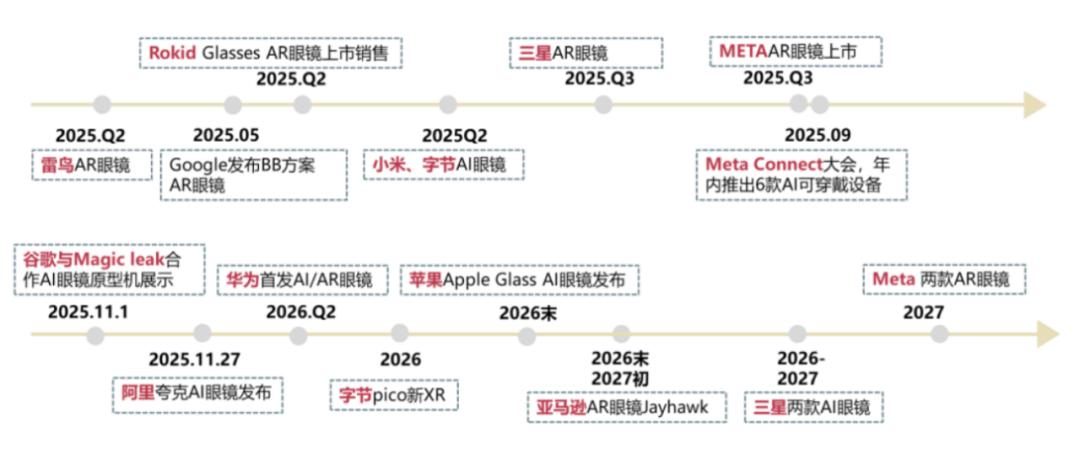
3C设备周观点:理想发布AI眼镜,消费电子与AI深度融合打造新增长点-20251207
Huafu Securities· 2025-12-07 10:47
Investment Rating - The industry rating is "Outperform the Market" [8] Core Insights - The report highlights the launch of the first generation AI glasses by Li Auto, marking its entry into the wearable smart device market, alongside major players like Baidu and Alibaba [2][3] - Major companies are actively investing in the AI glasses sector, with Google, Vivo, and Apple also developing their own products, indicating a competitive landscape [3] - The smart glasses market is expected to see significant growth, with global sales projected to reach 14.5 million units by 2025, and a compound annual growth rate (CAGR) exceeding 50% from 2025 to 2029 [4] - The integration of AI into consumer electronics is creating new growth opportunities, with companies like ByteDance and ZTE collaborating on AI smartphones [5] Summary by Relevant Sections AI Glasses Market - Li Auto has launched its AI glasses, which support wireless fast charging, promising "never-ending power" [2] - Google is in the POC stage for two AI glasses products, collaborating with Qualcomm, Samsung, and Foxconn [3] - The smart glasses market is heating up, with a forecast of 6 million units sold by 2029 [4] Consumer Electronics and AI Integration - The report notes a trend among major smartphone manufacturers to release flagship models with AI features, positioning smartphones as key devices for AI technology implementation [5] - The collaboration between ByteDance and ZTE on AI smartphones is expected to yield a product release soon [5] Investment Opportunities - The report suggests focusing on companies involved in foldable screens, smart glasses, silicon-based OLED screens, automation equipment, and 3D printing applications [6]