阿里夸克AI眼镜

Search documents
康耐特光学(2276.HK)2025业绩预告点评:业绩预增30% 智能眼镜景气持续
Ge Long Hui· 2026-01-22 06:04
Group 1 - The company expects a net profit attributable to shareholders in 2025 to increase by no less than 30% compared to 2024, driven by the growth of the smart glasses industry and continuous business prosperity [1] - The forecasted net profit for 2025-2027 has been revised to 5.6 billion, 7.0 billion, and 8.6 billion RMB respectively, reflecting growth rates of 31%, 26%, and 23% [1] - The company has achieved a net profit growth of 30.3% and 30.7% for the second half of 2024 and the first half of 2025 respectively, with a projected growth rate of no less than 29.3% for the second half of 2025 [2] Group 2 - The company has become the exclusive lens supplier for Alibaba's Quark AI glasses, indicating a strategic partnership that enhances its market position [2] - The company is actively expanding its XR business and accelerating its layout in the smart glasses sector, supported by favorable government policies and collaborations with major tech firms [2] - The company maintains a strong market presence as a leading lens manufacturer, with a diverse product range and competitive pricing, which is expected to enhance profitability and market share [2]
国泰海通|轻工:智能眼镜产品力系列深度一:AR的崛起,不是偶然
国泰海通证券研究· 2026-01-21 13:50
Core Insights - The smart glasses industry is expected to enter a rapid growth phase, with related companies poised to benefit from an upturn in market conditions [1] Group 1: Product Launches and Innovations - Meta and EssilorLuxottica launched the new smart glasses, Ray-Ban Meta, featuring improved audio-visual quality and integration with Meta's Llama3 model [1] - Ray-Ban Meta includes live streaming capabilities and seamless connectivity with Meta's social platforms like Facebook and Instagram, expanding its application scenarios [1] Group 2: Supply Chain and Market Dynamics - The supply chain for AI glasses is more extensive than traditional eyewear, involving numerous hardware and software suppliers, including chip manufacturers and ODM/OEM firms [2] - The entry of various players into the AI glasses market includes mobile manufacturers, internet companies, XR firms, traditional eyewear brands, and 3C companies, with XR startups collaborating closely with traditional eyewear manufacturers [2] Group 3: Sales Growth and Market Trends - Domestic sales of AI glasses are projected to reach 210,000 units by Q3 2025, reflecting a quarter-on-quarter growth of approximately 200%, driven by brands like Xiaomi and Ray-Ban Meta [3] - Xiaomi's AI glasses are expected to surpass total sales of 300,000 units by the end of 2025, with ongoing software optimizations enhancing user experience [3] - The high pricing of Alibaba's Quark AI glasses has led to strong demand, with initial pre-sales exceeding 5,000 units and a significant increase in secondary market prices [3] - Ray-Ban Meta's global sales are projected to reach 1.12 million units by Q3 2025, with a nearly 50% quarter-on-quarter growth [3]


国泰海通:智能眼镜产业链有望步入快速成长期 推荐明月镜片(301101.SZ)等
智通财经网· 2026-01-21 07:21
Core Viewpoint - The AI glasses industry is expected to enter a rapid growth phase, driven by technological breakthroughs and new product launches, benefiting companies within the supply chain [1][2]. Group 1: Industry Overview - The AI glasses supply chain is larger and more complex than traditional eyewear, incorporating various electronic components and a wider range of participating manufacturers [2]. - Key players in the AI glasses market include smartphone manufacturers, internet companies, XR firms, traditional eyewear brands, and 3C companies, with XR startups collaborating with traditional eyewear manufacturers [2]. Group 2: Sales Growth - Domestic AI glasses sales are projected to reach 210,000 units by Q3 2025, reflecting a quarter-on-quarter growth of approximately 200%, primarily driven by brands like Xiaomi and Ray-Ban Meta [3]. - Notable product launches include Xiaomi AI glasses, which are expected to surpass total sales of 300,000 units by the end of 2025, and Alibaba's Quark AI glasses, which have seen strong pre-sale demand [3]. - Ray-Ban Meta's global sales are anticipated to reach 1.12 million units by Q3 2025, with a quarter-on-quarter growth of nearly 50% [3].

国泰海通:智能眼镜产业链有望步入快速成长期 推荐明月镜片等
Zhi Tong Cai Jing· 2026-01-21 07:21
Group 1 - The core viewpoint is that the AI glasses industry is entering a rapid growth phase, driven by technological breakthroughs and new product launches, leading to an upturn in the industry cycle for related companies [1][4] - The supply chain for AI glasses is more extensive than traditional eyewear, involving a larger number of participants, including hardware suppliers (chips, sensors, audio, Bluetooth), software providers, and ODM/OEM manufacturers [3] - XR startups typically collaborate with traditional eyewear manufacturers, with wearable device-related companies making up 45% of the entrants in the AI glasses market [3] Group 2 - The launch of Ray-Ban Meta smart glasses marks a new product cycle, featuring improved audio and video quality, and integration with Meta's social platforms [2] - Domestic AI glasses sales are rapidly increasing, with a reported 210,000 units sold in Q3 2025, a 200% quarter-on-quarter growth, driven by brands like Xiaomi and Ray-Ban Meta [4] - Xiaomi's AI glasses are projected to sell over 300,000 units by the end of 2025, while Alibaba's Quark AI glasses have seen strong pre-sale demand, with initial batches selling out quickly [4]

国泰海通证券:维持康耐特光学(02276)“增持”评级 2025业绩预增30% 智能眼镜景气持续
智通财经网· 2026-01-21 03:17
Core Viewpoint - The report from Guotai Junan Securities maintains an "overweight" rating for Conant Optical (02276), highlighting its position as a global leader in lens manufacturing with a diverse SKU range, strong cost-performance ratio, optimized product structure, and efficient C2M model, which enhance profitability and market share [1] Group 1 - The company has issued a positive profit forecast, expecting a net profit attributable to shareholders of no less than 557 million yuan in 2025, representing a year-on-year increase of no less than 30% [1] - The significant profit growth in 2025 is attributed to increased sales of 1.74 refractive index lenses and other multifunctional products, ongoing scale effects, improved automation levels, and optimized financing structure [1] - For the fourth quarter of 2025, the company anticipates a net profit attributable to shareholders of no less than 283 million yuan, reflecting a year-on-year growth of no less than 29.3% [1] Group 2 - The company achieved a net profit growth of 30.3% in the second half of 2024 and 30.7% in the first half of 2025, with a projected growth rate of no less than 29.3% in the second half of 2025, indicating stable profit growth [2] - The 2025 annual target for net profit (excluding share incentive costs) is set to grow by no less than 21%, exceeding the profit target [2] - Recent developments in the smart glasses business include the announcement of a national subsidy policy for digital products, discussions with Meta Platforms and EssilorLuxottica to increase AI glasses production capacity, and becoming the exclusive lens supplier for Alibaba's Quark AI glasses [2]

康耐特光学(02276.HK):预计2025年业绩高增 智能眼镜产业催化密集
Ge Long Hui· 2026-01-20 14:02
Core Viewpoint - The company has issued a positive profit forecast, expecting a year-on-year growth of no less than 30% in net profit attributable to shareholders for the year 2025, driven by increased sales of high-refractive index lenses and other multifunctional products, ongoing scale effects, and improved financing structure [1] Group 1: Company Performance and Forecast - The company anticipates significant growth in net profit for 2025, with a projected increase of at least 30% year-on-year [1] - Key drivers for this growth include increased sales of 1.74 refractive index lenses and other multifunctional products, continued scale effects, and enhanced automation levels [1] - The company has received approximately RMB 10 million in revenue from its XR business as of August 31, 2025, with expectations for further growth in the latter half of 2025 and into 2026 [1] Group 2: Industry Trends and Collaborations - The company is the exclusive lens supplier for Alibaba's Quark AI glasses, indicating strong collaboration with major domestic clients [2] - The inclusion of smart glasses in the new consumer upgrade policy is expected to lower consumer thresholds and enhance market penetration [2] - Internationally, Meta Platforms and Essilor Luxottica are discussing plans to double AI glasses production capacity by the end of 2026, reflecting a growing interest in the smart glasses market [2] Group 3: Production and Capacity Expansion - The company is actively expanding its overseas production capacity, with a new automated facility in Japan focusing on progressive lenses and youth vision health products [3] - The Thai production base is also progressing steadily, which is expected to enhance the company's market share and brand premium in overseas markets [3] Group 4: Financial Adjustments and Ratings - The company has adjusted its profit forecasts, now expecting net profits of RMB 561 million, 682 million, and 821 million for 2025-2027, respectively [3] - The corresponding price-to-earnings ratios are projected to be 47X, 38X, and 32X for the same period [3]
「e公司观察」争夺AI入口 软件巨头向硬件进军
Zheng Quan Shi Bao Wang· 2026-01-12 14:27
Group 1 - ByteDance and Alibaba are making significant progress in the AI glasses sector, with ByteDance collaborating with Longqi Technology for the development of Doubao AI glasses [1] - The AI glasses market is rapidly expanding, becoming a focal point for technology companies, as evidenced by Alibaba's Quark AI glasses experiencing a surge in demand shortly after launch [1] - The AI glasses industry is still in its growth phase, unlike the smartphone market, which is dominated by established players, allowing new entrants to have substantial opportunities [1] Group 2 - Software companies like ByteDance have unique advantages in hardware integration, such as a strong focus on user needs and the ability to innovate product offerings [2] - The primary goal for software giants entering hardware is to create a distribution network centered around their applications, effectively locking in user traffic within their ecosystem [2] - Historical examples of similar competitive strategies include Amazon's Kindle and the proliferation of smart speakers during the smart home boom [2] Group 3 - The industry is witnessing a shift in focus towards AI, with companies like Meta and Ray-Ban launching smart glasses, highlighting the importance of hardware in delivering AI services [3] - Software firms can adopt a business model that prioritizes software profitability over hardware profits, as demonstrated by Amazon's Echo smart speaker [3] - However, challenges exist for software companies entering the hardware space, with notable failures in past attempts, such as Microsoft's mobile ventures and Google's early smart glasses project [3]
炸,百款新品狂轰,百亿资金疯涌,十位创始人万字综述2025智能眼镜史
3 6 Ke· 2026-01-06 12:19
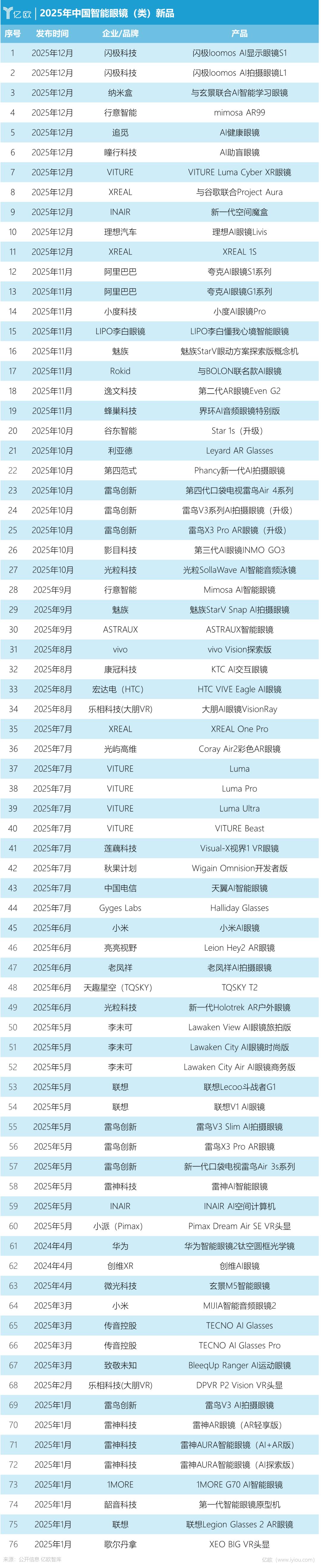
Group 1 - The year 2025 is marked by significant advancements in the AI hardware market, particularly in the smart glasses sector, with a notable increase in new product launches and investments [1][4][5] - A total of 76 new smart glasses products were introduced in China in 2025, representing a 40% increase compared to 2024 [5][6] - The industry is experiencing a shift from product and marketing competition to a focus on technology and innovation [3][5] Group 2 - The number of listed companies entering the smart glasses market has expanded to 176, doubling from the previous year [2][42] - Major players in the industry include both startups and established companies from various sectors, including technology, automotive, and consumer electronics [29][43] - The market is transitioning from a technology-driven approach to a value-driven one, with consumers becoming more experience-sensitive [26][27] Group 3 - Significant funding has flowed into the smart glasses sector, with nearly 10 billion yuan invested [3] - The industry is witnessing a trend towards vertical integration, with products increasingly tailored to specific use cases such as sports, health, and office environments [27][28] - Companies are focusing on creating a complete user experience by integrating perception, decision-making, and interaction capabilities [28] Group 4 - The competitive landscape is intensifying, with major companies like ByteDance, Xiaomi, and Alibaba entering the market, bringing substantial traffic and visibility [22][23] - Innovations in product design and functionality are crucial for gaining consumer acceptance, as evidenced by the success of products like the BleeqUp Ranger smart glasses [15][17] - The industry is facing challenges such as feature homogeneity and the need to balance lightweight design with high performance and battery life [34][36]
AI消费电子:智能生活的新引擎
Sou Hu Cai Jing· 2025-12-25 08:21
Core Insights - The integration of artificial intelligence (AI) with consumer electronics is transforming daily interactions with technology, leading to a projected market size of 19,772 billion yuan in China by 2024, reflecting a 6% year-on-year growth driven by AI applications [1][2] Group 1: Current State and Scale of AI in Consumer Electronics - The consumer electronics industry is experiencing a new industrialization trend characterized by "demand-driven technology and technology reshaping industries" [2] - By Q3 2025, global smartphone shipments are expected to reach approximately 323 million units, marking a 2.6% year-on-year increase, with AI and foldable screen innovations driving high-end upgrades [2] Group 2: Product Forms and Application Scenarios of AI Consumer Electronics - AI smartphones are evolving from traditional communication tools to intelligent assistants, with predictions indicating that global shipments of generative AI smartphones could reach 369 million units by 2025 [5] - The AI glasses market in China is projected to see explosive growth, with Q1 2025 shipments expected to reach 494,000 units, a 116.1% increase year-on-year, and total annual shipments forecasted at 2.907 million units [5] - Wearable devices are transitioning from simple notification tools to comprehensive health management platforms, with global smartwatch shipments expected to grow by 3% year-on-year by Q3 2025, alongside a 9% increase in average selling prices [5] Group 3: Core Technologies Driving AI Consumer Electronics - The advancement of dedicated AI chips, such as Neural Processing Units (NPUs), is crucial for enhancing device intelligence and operational efficiency [7] - The trend of edge AI is becoming more prominent, allowing AI processing to shift from the cloud to local devices, which enhances user privacy and reduces cloud computing costs [7] Group 4: Challenges and Issues Facing AI Consumer Electronics - The industry faces significant challenges, including technological bottlenecks where international tech giants dominate foundational software and cloud computing services [9] - Supply chain stability is a concern, influenced by global economic complexities and trade restrictions affecting upstream industries [11] - Compatibility issues among different brands' smart devices hinder user experience, necessitating multiple apps for control [11] Group 5: Future Trends and Outlook - The integration of AI with consumer electronics is expected to deepen, with AI becoming a core value that actively perceives user needs and provides multi-dimensional responses [13] - Global spending on generative AI is projected to grow from $225 billion in 2023 to $699 billion by 2030, with a compound annual growth rate of 21% [13] - The way humans interact with technology will undergo revolutionary changes, with natural language interactions gradually replacing touch controls [13] - Personalization and adaptability will become key competitive advantages, with AI systems learning user habits to provide tailored experiences [15]

2026年中国资本市场展望:A股怎么看?怎么配?|资本市场
清华金融评论· 2025-12-21 09:38
Core Viewpoint - The A-share market is expected to continue its bull market, driven by strong macroeconomic policies, industrial transformation, capital market reforms, and sustained inflow of funds, despite potential short-term fluctuations [10][15]. Group 1: A-share Market Performance - In 2025, the A-share market experienced a significant bull market, with the Shanghai Composite Index rising from approximately 3200 points at the beginning of the year to around 3900 points by year-end, reflecting a robust upward trend [7]. - The market saw an 8.5% increase in the first quarter, followed by a strong rebound after a brief panic due to a tariff war, with the index reaching 3350-3400 points [7]. - By the third quarter, the index surged from 3400 points to over 3900 points, marking a cumulative increase of 12.7% [7]. Group 2: Supporting Factors for the Bull Market - Macroeconomic policies are expected to remain supportive, with a focus on stabilizing the economy through proactive fiscal policies and moderately loose monetary policies [10]. - The ongoing industrial transformation is anticipated to release new growth momentum, with emerging sectors such as AI, renewable energy, and advanced manufacturing becoming increasingly prominent in the A-share market [11]. - Capital market reforms are deepening, enhancing resource allocation efficiency and improving investor returns through measures like regularized delisting and increased dividend payouts [12]. Group 3: Sector Opportunities - The technology growth sector, particularly AI, energy storage, and aerospace, is highlighted as a key investment focus, with AI expected to be the leading investment theme in 2026 [22]. - The energy storage sector is projected to experience significant growth, driven by increasing demand from AI data centers and improvements in supply chain dynamics [29]. - The commercial aerospace industry is entering a rapid development phase, supported by favorable policies and growing market demand for satellite internet and other applications [30]. Group 4: Metal Sector Insights - The performance of the non-ferrous metal sector is closely linked to metal prices, with significant price increases observed in copper, aluminum, and rare earth metals due to strong demand and supply constraints [33]. - Copper demand is expected to rise due to its critical role in AI infrastructure and energy transition, while supply remains constrained due to slow new capacity additions and geopolitical factors [34]. - The small metals sector, including rare earths and lithium, is anticipated to benefit from supply-demand tightness and increasing applications in various industries [36].