
电子围栏

Search documents
科技驱动城市治理升级
Jing Ji Ri Bao· 2026-02-12 00:37
Group 1 - The core idea of the articles emphasizes the significant improvement in urban governance through the application of digital tools, particularly in managing shared bicycle parking issues, showcasing a shift from chaotic to orderly management [1][2] - The enhancement of urban governance is primarily attributed to improved sensing capabilities, where traditional manual inspections have been replaced by smart monitoring systems, reducing location errors from several meters to within 1.5 meters [1] - The establishment of a complete governance loop in cities like Lanzhou is highlighted, featuring a "monitoring-warning-disposal-feedback" mechanism that mandates a response within 5 minutes, arrival on-site within 30 minutes, and resolution within 1 hour [1] Group 2 - The articles discuss the collaborative approach to urban governance, which involves government leadership, corporate responsibility, third-party collaboration, and public participation, effectively enhancing governance capabilities [2] - The introduction of platforms like WeChat's "随手拍" allows citizens to report issues of improper parking, fostering a sense of community involvement and support for modern urban governance [2] - The transition in urban development in China is noted, with the urbanization rate exceeding 65%, moving from large-scale expansion to a focus on quality improvement and efficiency in existing urban structures [2]
山西对高危作业全过程视频监控
Ren Min Ri Bao· 2026-01-23 00:47
Core Viewpoint - Shanxi province is advancing the construction of "no operation without monitoring" and "electronic fencing" to enhance the intrinsic safety level of coal mines [1] Group 1: Monitoring and Safety Measures - A total of 96,000 video surveillance systems have been installed in coal mines across Shanxi [1] - Intelligent AI recognition video monitoring has been implemented at 16,700 locations [1] - Electronic fencing has been set up in 24,000 hazardous areas, such as the face of underground excavation [1] Group 2: Regulatory Requirements - Shanxi mandates that all coal mines enhance video monitoring in critical operational areas to prevent violations of command, operations, and labor discipline [1] - The goal is to achieve comprehensive video monitoring of high-risk operations, creating a supervised and visualized production environment [1] - This initiative aims to ensure that coal mine workers adhere to standard positions and perform standard tasks, thereby minimizing accidents [1]
山西累计在煤矿安装视频监控9.6万路
Xin Hua She· 2026-01-19 07:24
Core Viewpoint - Shanxi province is advancing the construction of "no operation without monitoring" and "electronic fences" to enhance the intrinsic safety level of coal mines, with significant investments in video surveillance and AI technology [1] Group 1: Surveillance Implementation - A total of 96,000 video surveillance units have been installed in coal mines across Shanxi [1] - Intelligent AI recognition video monitoring has been implemented at 16,700 locations [1] - 24,000 electronic fences have been set up in high-risk areas such as underground excavation faces [1] Group 2: Safety Regulations - Shanxi mandates the installation of comprehensive video monitoring in important operational areas to prevent violations of command, operations, and labor discipline [1] - The goal is to create a supervised working environment and promote standardized operations among coal mine workers, thereby minimizing accidents [1]
中国智慧养老行业研究报告
艾瑞咨询· 2026-01-18 00:06
Core Viewpoint - The Chinese smart elderly care industry is transitioning from "partial pilot" to "full penetration" and from "technology stacking" to "ecological integration" due to the intersection of population aging and digital transformation [1][2][3] Industry Background - By the end of 2024, the population aged 60 and above in China will exceed 310 million, accounting for 22.0% of the total population, highlighting the challenges faced by traditional elderly care models [3][5] - Factors such as changes in family structure, upgrading consumption among the elderly, and increased acceptance of digital technology are driving the development of the smart elderly care industry [5][22] - Technological innovations are reshaping the elderly care service ecosystem, pushing the industry towards precision, personalization, and efficiency [5][24] Industry Status - Smart elderly care has developed technical solutions covering home, community, and institutional settings, with a competitive landscape featuring comprehensive solution providers, vertical technology companies, and traditional elderly care enterprises [5][34] - Challenges such as data silos, insufficient technology adaptation for the elderly, and immature business models remain significant pain points for the industry [5][39] Research Content - The report systematically analyzes the overall picture of the Chinese smart elderly care industry from two dimensions: industry background and current status [5] - The demand side is shifting from survival-type elderly care to quality-type elderly care, while the supply side is evolving from single technology applications to a full-cycle service ecosystem [2][6] Research Outlook - Demand for smart elderly care is progressing from basic survival needs to value realization, indicating a tiered advancement in elderly care demands [6][42] - The supply side is expected to see a three-dimensional push from technology, resources, and scenarios, leading to large-scale development of smart elderly care services [6][45] Policy Emphasis - The Chinese government has introduced a series of policies to support smart elderly care, emphasizing the strategic importance of this sector [19][21] Social Demand - The smart elderly care industry is accelerating due to multiple demand-side drivers, including changes in family structure and a growing demand for quality life among the elderly [22][24] Technological Application - The integration of AI, IoT, big data, and cloud computing is reconstructing the elderly care service model, transitioning from passive care to proactive prevention [24][25] Major Players and Business Models - The industry features three types of players: comprehensive solution providers, vertical technology companies, and traditional elderly care enterprises, each with distinct competitive advantages [34][36]


山西煤矿事故起数和遇难人数连续四年下降
Xin Lang Cai Jing· 2026-01-17 13:34
Group 1 - The core viewpoint of the articles highlights the significant improvements in coal mining safety and production efficiency in Shanxi province during the "14th Five-Year Plan" period, with coal production increasing by 1.9 billion tons compared to the previous five-year period, and a notable decline in coal mining accidents and fatalities [1][2] - Shanxi's coal mines have seen a rise in single well production capacity from 1.5 million tons per year to 1.66 million tons, while the number of non-coal mines has decreased by 37.1% and tailings stockpiles have reduced by 13.4% [1] - The province has implemented advanced technologies, establishing 400 intelligent coal mines, with 83% of coal production capacity being advanced, and has installed 96,000 video surveillance systems to enhance safety monitoring [1][2] Group 2 - The transition towards a proactive safety governance model is emphasized as a critical phase during the "15th Five-Year Plan," with a focus on large-scale and deep mining operations, which may increase risks and uncertainties [2] - By 2030, Shanxi aims to effectively curb major mining accidents, and by 2035, to modernize its mining safety governance system and capabilities [2] - The province plans to implement AI technologies in mining operations, enhance green mining techniques, and develop a comprehensive risk monitoring and prevention model [2][3]
中国智慧养老行业研究报告
3 6 Ke· 2025-11-26 00:57
Core Insights - The Chinese smart elderly care industry is transitioning from "pilot projects" to "full-scale penetration" and from "technology stacking" to "ecosystem integration" due to the intersection of population aging and digital transformation [1][3][24] - By the end of 2024, the population aged 60 and above in China is expected to exceed 310 million, accounting for 22% of the total population, highlighting the urgent need for smart elderly care solutions [1][3][19] Industry Background - Continuous policy support is enhancing the strategic position of smart elderly care, driven by changes in family structure, consumption upgrades among the elderly, and increased digital acceptance [4][17] - The industry is evolving towards precision, personalization, and efficiency, with technological innovations reshaping the elderly care service ecosystem [4][21] Current Industry Status - Smart elderly care has developed comprehensive solutions covering home, community, and institutional settings, with three main types of players: comprehensive solution providers, vertical technology companies, and traditional elderly care enterprises [4][30] - Challenges such as data silos, insufficient technology adaptation for the elderly, and immature business models remain significant barriers to industry development [4][30][37] Research Outlook - Demand for smart elderly care is progressing from survival assurance to value realization, indicating a shift towards quality-oriented services [5][40] - The supply side is expected to evolve through technological, resource, and scenario advancements, leading to large-scale development of smart elderly care services [5][43] Technological Empowerment - The integration of AI, IoT, big data, and cloud computing is driving the transformation of elderly care services from passive care to proactive prevention, enhancing the quality of life for the elderly while reducing social care costs [21][43] Market Dynamics - The smart elderly care market is characterized by a shift from fragmented services to a comprehensive ecosystem, with a focus on both technological innovation and humanistic care [2][24][47] - The industry is witnessing a trend towards ecological collaboration, where the core ecosystem involves government support, enterprise delivery, and feedback from families and the elderly [47][49] Regional Development - The smart elderly care industry shows a pattern of stronger development in eastern regions compared to western areas, with each region leveraging its unique resources to shape its development path [33][37] Challenges and Opportunities - Despite the growth potential, the industry faces challenges such as data isolation, technological adaptation issues, and a lack of mature business models, which need to be addressed for sustainable development [37][38]
中国智慧养老行业研究报告
艾瑞咨询· 2025-11-26 00:06
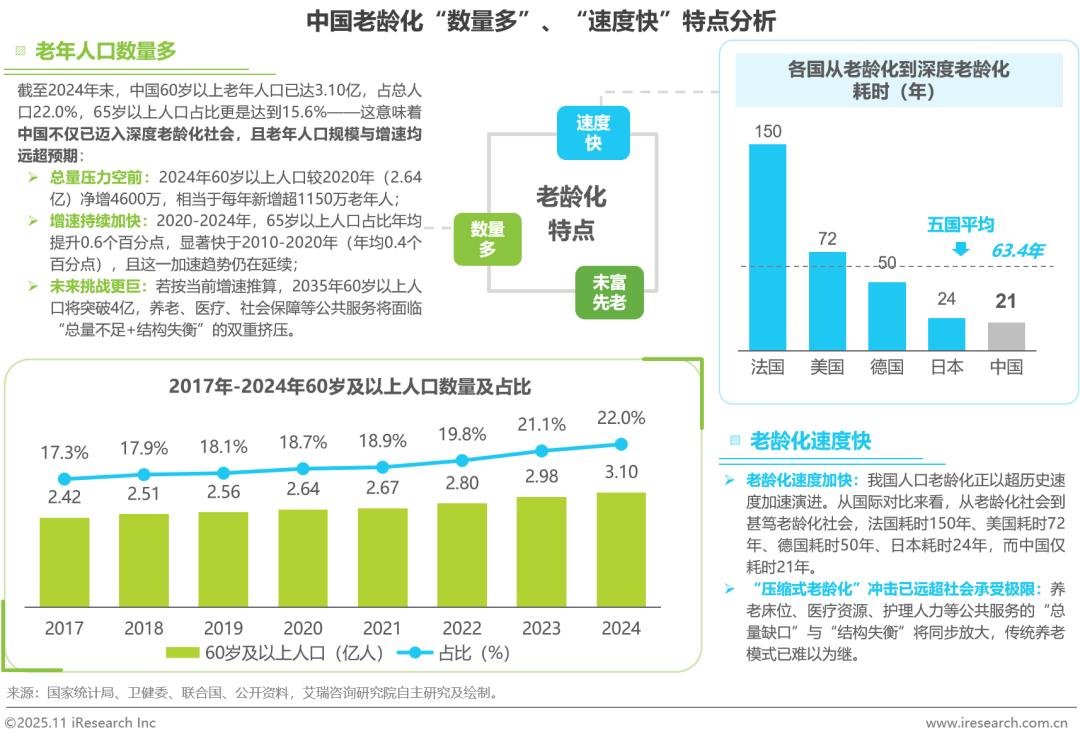
Core Viewpoint - The Chinese smart elderly care industry is transitioning from "pilot projects" to "full-scale penetration" and from "technology stacking" to "ecological integration" due to the intersection of population aging and digital transformation [1][2][3] Industry Background - By the end of 2024, the population aged 60 and above in China will exceed 310 million, accounting for 22.0% of the total population, posing severe challenges to traditional elderly care models [3][5] - Factors such as changes in family structure, consumption upgrades among the elderly, and increased acceptance of digital technology are driving the development of the industry [5][22] - The technological revolution is reshaping the elderly care service ecosystem, pushing the industry towards precision, personalization, and efficiency [5][24] Industry Status - Smart elderly care has formed technical solutions covering three major scenarios: home, community, and institutions [5][34] - The industry exhibits a competitive landscape with three main types of players: comprehensive solution providers, vertical technology companies, and traditional elderly care enterprises [5][34] - Challenges such as data silos, insufficient technology adaptation for the elderly, and immature business models remain significant pain points for industry development [5][39] Research Significance - The integration of technology and services in smart elderly care not only meets the multi-layered needs of the elderly but also opens new pathways for the development of the silver economy [3][4] Research Content - The report systematically analyzes the overall picture of the Chinese smart elderly care industry from the dimensions of industry background and current status [5] Research Outlook - Demand-side trends indicate a shift from survival-oriented elderly care to quality-oriented elderly care [6] - Supply-side developments will focus on technology, resources, and scenarios to lead smart elderly care services towards large-scale development [6] - The ecological aspect will emphasize value closure and multi-dimensional collaboration, outlining a new development landscape for the smart elderly care ecosystem [6] Policy Emphasis - A series of policies have been introduced to support smart elderly care, highlighting its strategic importance [19][21] Social Demand - The demand for smart elderly care is driven by significant changes in family structure, an increase in solitary and empty-nest households, and a growing elderly population with varying needs [22] Technological Application - The integration of AI, IoT, big data, and cloud computing is reconstructing the elderly care service model, transitioning from passive care to proactive prevention [24][25] Market Dynamics - The smart elderly care industry is characterized by a shift from fragmented services to a comprehensive ecosystem, driven by technological innovation and humanistic care [2][4][42] Future Trends - The demand for smart elderly care is evolving from basic survival needs to a focus on quality and value realization, reflecting a societal shift in values [42] - The supply side is moving towards large-scale development, with technology, resources, and scenarios driving the evolution of services [45] - The industry is expected to see increased ecological collaboration, enhancing the synergy between policies, markets, and technologies [48]

潞安化工集团以数字赋能蹚出管理新路
Xin Hua Cai Jing· 2025-06-04 07:39
Group 1: Digital Empowerment and Management Transformation - The company is committed to "lean management + digitalization" to lead industry transformation and enhance internal development momentum through data-driven decision-making [2][3] - The digital comprehensive control platform has been developed with 17 system modules, enabling real-time feedback and self-analysis, thus integrating digital governance with production management [2][3] - Over 20,000 team leaders and safety management personnel are utilizing the digital platform for grid-based safety management, enhancing transparency and traceability in safety inspections [2] Group 2: Technological Innovation and Automation - The introduction of clearing robots at coal storage facilities has improved efficiency and safety, significantly reducing manual intervention and associated risks [4] - The company has undertaken multiple national and provincial research projects, resulting in over 1,600 patent authorizations and numerous awards, including two National Science and Technology Progress Awards [4] Group 3: Mechanism Innovation and Value Creation - The company has implemented various incentive mechanisms to encourage grassroots innovation and micro-reforms, ensuring resources are effectively utilized [5][6] - A new "team package system" has been explored to enhance attendance rates and operational efficiency, consolidating production and maintenance teams to improve productivity [5][6] - The integration of smart technology and flexible mechanisms is aimed at revitalizing organizational potential and exploring new paths for traditional energy enterprises [6]