
电生理电极导管

Search documents
惠泰医疗(688617):PFA放量,心血管平台加速上行
Hua Yuan Zheng Quan· 2026-02-10 04:36
Investment Rating - The report assigns a "Buy" rating for the company, indicating a positive outlook based on the rapid growth of its PFA products and increasing competitiveness in the electrophysiology and vascular intervention sectors [5][9]. Core Insights - The company is expected to achieve total revenues of RMB 25.78 billion, RMB 32.40 billion, and RMB 40.60 billion for the years 2025 to 2027, with growth rates of 24.78%, 25.70%, and 25.31% respectively. The net profit attributable to shareholders is projected to be RMB 8.34 billion, RMB 10.57 billion, and RMB 13.40 billion for the same years, with growth rates of 23.95%, 26.73%, and 26.70% respectively [6][9]. - The company has a strong position in the cardiovascular intervention field, with a comprehensive product layout that includes electrophysiology and vascular intervention devices. The introduction of new PFA products is expected to drive significant revenue growth [11][15]. Summary by Sections Market Performance - The closing price of the company's stock is RMB 229.38, with a market capitalization of RMB 32,349.47 million. The stock has seen a yearly high of RMB 466.07 and a low of RMB 223.48 [3]. Financial Forecasts - The company anticipates revenue growth from RMB 1,650 million in 2023 to RMB 4,060 million in 2027, with a compound annual growth rate (CAGR) of 35.71% from 2023 to 2024 and 25.31% from 2025 to 2027. Net profit is expected to grow from RMB 534 million in 2023 to RMB 1,340 million in 2027, with a CAGR of 49.13% from 2023 to 2024 and 26.70% from 2025 to 2027 [7][9]. Business Overview - The company has established itself as a leading manufacturer in the domestic electrophysiology and vascular intervention market, focusing on coronary access and cardiac electrophysiology. The introduction of PFA products is expected to enhance its competitive edge [8][15]. - The company has successfully participated in domestic alliance procurement, securing a significant market share in coronary access products, which now account for nearly 90% of its offerings [8][11]. Growth Drivers - The increasing prevalence of atrial fibrillation due to an aging population is expected to drive demand for PFA devices, with the market projected to reach RMB 163.15 billion by 2032, growing at a CAGR of 43.73% from 2025 to 2032 [8][59]. - The company has completed over 2,000 PFA procedures by August 2025, indicating strong market acceptance and growth potential for its new products [78]. Competitive Landscape - The domestic electrophysiology market is currently dominated by foreign brands, but the company is positioned to capture market share through competitive pricing and product quality improvements following recent procurement agreements [63][70].

整合提效筑根基 惠泰医疗积极探索全球化竞争新范式
Zhong Guo Zheng Quan Bao· 2025-11-20 22:09
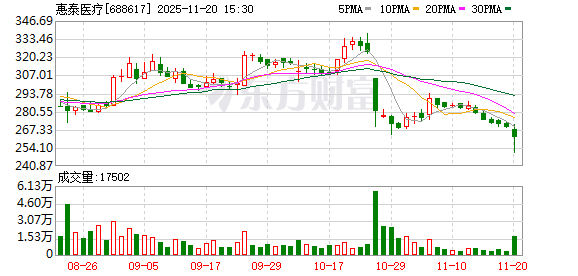
Core Viewpoint - The merger between Mindray Medical and Huatai Medical is a landmark event in the STAR Market, showcasing the integration of quality resources and accelerating technological iteration in the medical device industry [2][3]. Group 1: Strategic Alignment and Integration - The successful integration of Mindray Medical and Huatai Medical is attributed to strategic alignment and natural synergy in technology and products, which serves as a foundation for deep collaboration [3]. - The merger established a clear business development strategy, with Mindray sending a dedicated team to Huatai for in-depth collaboration, creating a strategic development blueprint that leverages each company's strengths [3][4]. - The focus on resource investment is crucial for achieving synergy, with the integration process requiring the deployment of elite teams to ensure high-quality value creation [3][4]. Group 2: Performance and Growth - In the nearly 19 months since the merger, both companies have concentrated on the high-growth, high-barrier, and low domestic penetration market of three-dimensional atrial fibrillation systems, leveraging Huatai's strengths in consumables and Mindray's advantages in complex system development [4]. - Huatai Medical reported revenue of 1.867 billion yuan, a year-on-year increase of 22.47%, and a net profit of 623 million yuan, up 18.02% year-on-year for the first three quarters of 2025, indicating the effectiveness of the merger [5]. - The company plans to continue increasing R&D investment, focusing on core areas to achieve higher quality growth, as there remains a gap compared to leading international competitors [5]. Group 3: R&D and Innovation - The core of the merger's success lies in R&D collaboration and technological upgrades in the electrophysiology field, with Huatai Medical significantly increasing its R&D investment [5][6]. - Huatai Medical has established itself as a pioneer in the domestic market for electrophysiology products, with multiple core technologies under development [6]. - The company aims to balance rapid iteration with risk control by creating a reusable general technology platform, which will lower innovation costs and ensure risk management [6]. Group 4: Globalization Strategy - The deepening of industry integration necessitates Huatai Medical's global expansion, with a focus on building a standardized operational system that aligns with international market rules [8][9]. - The company emphasizes the importance of understanding local market demands and developing products that meet these needs, rather than simply reusing Mindray's global channels [8][9]. - Huatai Medical's future international strategy includes enhancing product competitiveness and establishing localized supply chain capabilities to penetrate developed markets [10].


红宝书20250615
2025-06-16 03:16
Summary of Key Points from Conference Call Records Industry or Company Involved - **Oil and Gas Industry**: Focus on Iran-Israel conflict and its impact on oil and gas resources [1][2] - **Mining Industry**: Mention of Iran's mineral resources, including copper and zinc [2] - **Solid-State Battery Industry**: Development and market potential of solid-state batteries [3][16] - **Pharmaceutical Industry**: AI in drug development and optimization of drug procurement [6][17] - **Military and Defense Industry**: Impact of geopolitical tensions on military supplies and equipment [10][17] Core Points and Arguments Oil and Gas - The Iran-Israel conflict may disrupt oil and gas supplies, potentially increasing oil prices by 25% if the Strait of Hormuz is blocked [1] - Iran is a significant supplier of crude oil and LNG to China, with 1.5 million barrels per day exported in Q1 2025, accounting for 13% of China's total crude imports [1] - Iran's sulfur supply is crucial, with 66,600 tons exported to China in 2024, representing 6.7% of total imports [2] Mining - Iran ranks third globally in copper reserves and accounts for 12% of global zinc exports, with Chinese companies heavily reliant on Iranian zinc [2] - Lithium carbonate production in Iran is significant, with 24.3% of China's consumption sourced from Iranian materials [2] Solid-State Batteries - The solid-state battery market is expected to grow significantly, with major companies ramping up production lines [3][16] - Key materials like lithium sulfide are critical, with a projected market share of 65% by 2030 [16] - Companies like Hai Chen Pharmaceutical and Guanghua Technology are leading in the development of solid-state battery materials and equipment [3][16] Pharmaceuticals - The optimization of drug procurement is underway, with new rules expected to be implemented soon [6][17] - Strategic partnerships in AI drug development, such as the collaboration between Stone Pharmaceutical and AstraZeneca, highlight the shift towards AI in pharmaceuticals [17] Military and Defense - The demand for military supplies, particularly nitrocellulose, is increasing due to global tensions, with a significant drop in global production capacity [10][17] - Companies involved in military equipment are seeing growth due to increased defense spending and geopolitical instability [10][17] Other Important but Possibly Overlooked Content - The potential for increased demand for methanol due to disruptions in Iranian production, with China being a major importer [17] - The impact of geopolitical events on the supply chain for various industries, including pharmaceuticals and military supplies, indicating a broader market risk [17] - The upcoming Paris Air Show will showcase significant military and aerospace advancements, reflecting the ongoing investment in defense technologies [18] This summary encapsulates the critical insights from the conference call records, highlighting the interconnectedness of geopolitical events and various industries, particularly oil and gas, mining, solid-state batteries, pharmaceuticals, and military defense.