化学原料及化学制品制造

Search documents
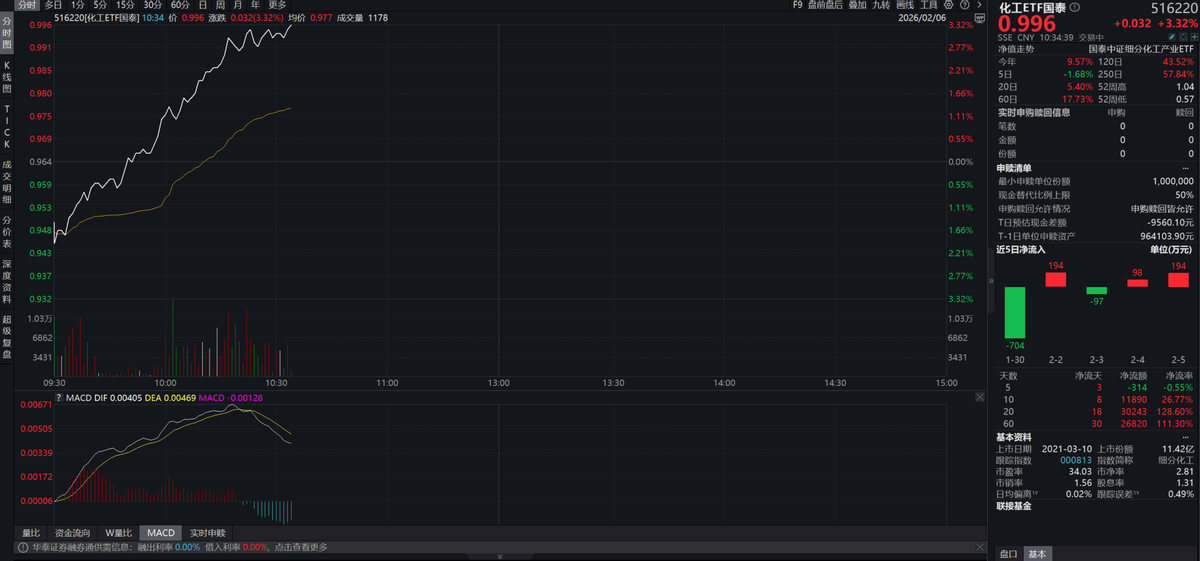
周期反转与新兴需求共振,化工板块直线拉升!
Sou Hu Cai Jing· 2026-02-06 03:08
Core Viewpoint - The chemical industry is at the bottom of a long-term down cycle, with signs of a potential turning point as supply-demand dynamics improve and capital expenditure contracts [3][5]. Group 1: Industry Positioning - Multiple macro and industry indicators suggest that the chemical industry is in the bottom region of a long-term down cycle, with positive changes in supply-demand dynamics accumulating to lay the groundwork for a turning point [3]. - The price index for the chemical raw materials and chemical products manufacturing industry shows a narrowing year-on-year decline in PPI, indicating a preliminary improvement in product price pressures [3]. - The continuous decline in finished goods inventory indicates that after a prolonged period of active destocking, inventory levels have reached a low point, allowing for potential replenishment [3]. Group 2: Supply Changes - The contraction in capital expenditure is significant, with fixed asset investment growth in the domestic chemical raw materials and chemical products manufacturing industry turning negative, signaling the end of large-scale capacity expansion [5]. - The structural clearing of supply, driven by both domestic and international factors, is a key difference in this cycle compared to previous ones [9]. - Domestic policies aimed at "anti-involution" are leading to the elimination of outdated capacity, while industry leaders are optimizing competition to avoid price wars and promote profit recovery [9]. Group 3: Demand Drivers - The demand side is characterized by a dual engine of traditional recovery and emerging growth, with marginal recovery in traditional downstream sectors and strong demand from new industries like semiconductors and renewable energy [10]. - Traditional demand is expected to improve marginally, supported by policies driving demand in sectors like automotive and home appliances, despite long-term pressures in real estate [10]. - Emerging demand from sectors such as semiconductors and new energy is becoming a strong growth engine, contributing to a more diversified and healthy demand structure in the chemical industry [13]. Group 4: Investment Mapping - Investment strategies should focus on two main lines: benefiting from supply-side reforms and stable profitability in cyclical leaders, and identifying chemical new material companies with technological barriers and growth potential in emerging demand sectors [14][15]. - The chemical ETF Guotai (516220) offers an efficient tool for investors looking to capture the overall recovery trend in the chemical industry while mitigating risks associated with specific sectors and stocks [15].

生产、需求继续分化
CAITONG SECURITIES· 2026-01-20 03:10
Economic Overview - In December, the total retail sales of consumer goods increased by 0.9% year-on-year, down from 1.3% in the previous month[3] - The GDP growth rate for Q4 was 4.5%, a decrease of 0.3 percentage points from Q3, achieving the annual GDP growth target[4] Production and Investment - December's industrial added value rose by 5.2% year-on-year, compared to 4.8% in the previous month, aligning with the PMI trends[6] - Fixed asset investment in December fell by 15.0% year-on-year, widening by 3.0 percentage points from the previous month, with manufacturing, broad infrastructure, and real estate investments decreasing by 10.5%, 16.0%, and 35.8% respectively[29] Sector Performance - The downstream industrial growth was relatively strong, while the midstream sector saw a decline from 5.1% in July to 3.5% in December, a drop of nearly 1.6 percentage points[4] - In December, the retail sales of communication equipment and cultural office supplies grew by 14.0% and 9.1% year-on-year, continuing a double-digit growth trend[27] Real Estate Insights - Real estate investment in December decreased by 35.8% year-on-year, compared to a 30.1% decline in the previous month, indicating ongoing pressure in the sector[36] - The area of completed housing in December saw a year-on-year decline of 18.4%, but this was an improvement of 7.0 percentage points from the previous month[38] Consumer Behavior - The retail sales of gold and silver jewelry fell by 1.0% year-on-year in December, a decline of 9.5 percentage points compared to the previous month, marking one of the largest drops among categories[27] - Service sector production index in December rose by 5.0% year-on-year, showing stronger resilience compared to goods consumption[23]
知名“大V”,操纵市场!监管出手了
Zhong Guo Zheng Quan Bao - Zhong Zheng Wang· 2026-01-19 14:34
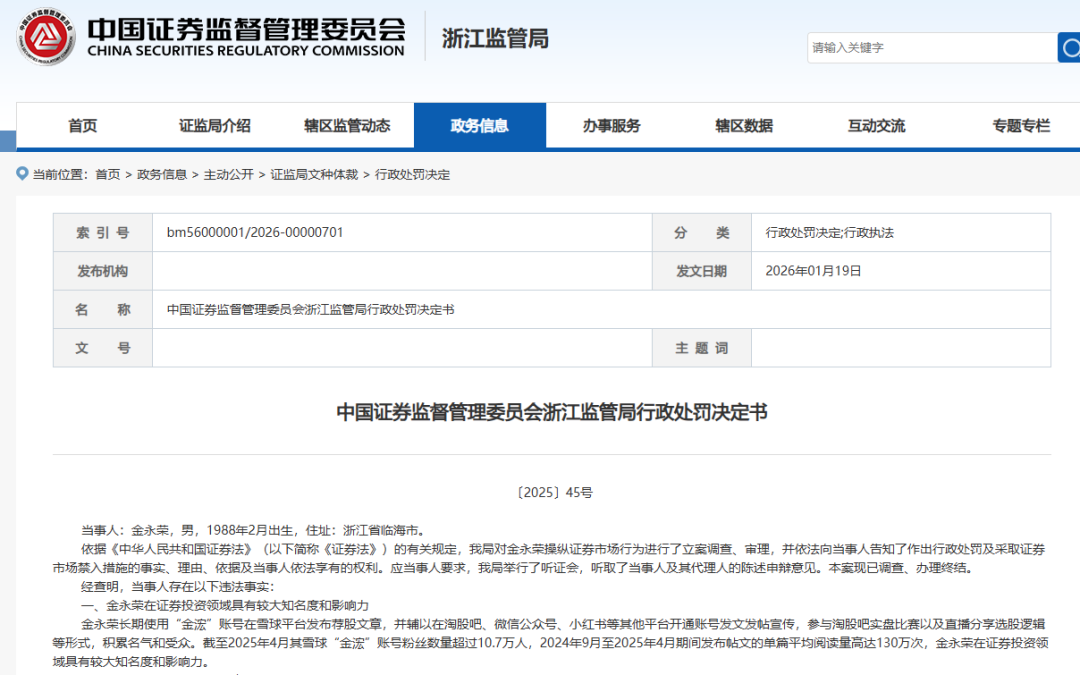
Core Viewpoint - The Zhejiang Securities Regulatory Commission has imposed penalties on Jin Yongrong for manipulating the securities market through stock recommendations and subsequent sell-offs, resulting in a total illegal gain of 41.62 million yuan and a three-year market ban [1][9]. Group 1: Regulatory Findings - Jin Yongrong was found to have manipulated the market by publicly recommending 32 stocks, including "Qidi Environment," "Luwei Optoelectronics," and "Guanghua Technology," while simultaneously executing large reverse sell transactions on the same day or the next day after the recommendations, totaling 631 million yuan in trading volume [1][5][8]. - The illegal gains from these activities amounted to 41.62 million yuan, which the regulatory body has decided to confiscate along with an equal amount in fines [1][9]. Group 2: Influence and Reach - Jin Yongrong operated under the "Jin Huo" account on the Xueqiu platform, amassing over 107,000 followers by April 2025, with an average post reading of 1.3 million times during the period from September 2024 to April 2025 [5][7]. - The account's influence was further evidenced by its high engagement, with the most popular posts reaching up to 8.08 million views, indicating significant market impact [7]. Group 3: Nature of Violations - The regulatory body characterized Jin Yongrong's trading behavior as typical of "hat manipulation," where the timing of stock recommendations closely aligned with subsequent sell transactions, undermining market integrity [6][8]. - Despite Jin Yongrong's claims of lacking market influence and intent to manipulate, the evidence presented confirmed the existence of subjective intent to manipulate the market [6][9].
中银国际:供应端扩产高峰已过 “反内卷”助力化工业景气度回升
智通财经网· 2025-12-16 09:11
Core Viewpoint - The chemical industry is currently at the bottom of the cycle, with the "anti-involution" trend expected to accelerate the optimization of the competitive landscape, leading to an increase in both profitability and valuation for leading companies [1] Group 1: Industry Performance - Chemical product prices are at historical lows, with the chemical industrial PPI showing negative year-on-year growth for 37 consecutive months as of October 2025 [1] - Among 119 tracked chemical products, 26.89% are in the bottom 10% price percentile, and 60.50% are in the bottom 30% [1] - The basic chemical industry is expected to see a stabilization in net profit after three consecutive years of decline from 2022 to 2024 [1] Group 2: Supply Side Dynamics - Fixed asset investment in the chemical raw materials and products manufacturing industry has turned negative year-on-year for the first time in nearly five years as of June 2025 [2] - As of Q3 2025, the value of fixed assets in the basic chemical industry reached 1,462.858 billion yuan, a year-on-year increase of 15.56% [2] - The ongoing construction projects have seen a decline, with a year-on-year decrease of 15.11% as of Q3 2025 [2] Group 3: Demand Side Insights - The demand for chemical products is expected to grow due to stimulus policies and the continuous increase in exports [3] - The real estate sector is under pressure, while demand from the automotive and chemical fiber sectors remains strong [3] - As of September 2025, the export quantity index for chemical raw materials and products manufacturing was 122.40, indicating robust export performance [3] Group 4: Global Competitive Landscape - In 2023, China's chemical sales reached 22,381 billion euros, accounting for 43.1% of the global market, marking a 111.55% increase since 2013 [4] - China's chemical exports are projected to reach 254.96 billion USD in 2024, positioning it as the second-largest exporter globally [4] - The competitiveness of Chinese chemical companies has been enhanced due to the exit of overseas production capacities [4] Group 5: Future Outlook - The "14th Five-Year Plan" emphasizes the need to enhance the quality and competitiveness of key industries, including chemicals [5] - The industry is moving towards a model of "anti-involution" through self-discipline and policy collaboration, which is expected to facilitate a transition from scale expansion to high-quality growth [5] - Initiatives such as joint production cuts and policy support are anticipated to help restore product prices and profits in various sub-industries [5]
*ST宁科:实际控制人变更为刘喜荣
Mei Ri Jing Ji Xin Wen· 2025-12-15 12:27
Group 1 - The core point of the article is that *ST Ningke has completed the transfer of capital reserve to stock, with Hunan Xinhongxin becoming the controlling shareholder holding 357,142,857 shares, representing 22.10% of the total share capital [1] - As of the announcement, *ST Ningke's market capitalization is 5.3 billion yuan [1] - The revenue composition for *ST Ningke in 2024 is as follows: 64.0% from chemical raw materials and chemical products manufacturing, 35.26% from bio-based and starch-based new materials manufacturing, and 0.74% from other businesses [1]

11月消费投资低于预期
Ge Lin Qi Huo· 2025-12-15 08:25
1. Report Industry Investment Rating - Not provided in the content 2. Core Viewpoints of the Report - In November, the growth rates of fixed - asset investment and social consumer goods retail总额 were lower than market expectations, while the export growth rate exceeded expectations [4][23]. - The year - on - year decline of real estate sales volume and price continued in November, and the data in early December also showed the same trend [4][23]. - As of the end of October, 5000 billion yuan of new policy - based financial instruments had been fully invested, but the investment data in October and November did not show obvious improvement [4][23]. - The relatively stable international environment after the China - US summit at the end of October is beneficial to China's exports, and stable export confidence is conducive to the growth of private investment [4][23]. - The Central Economic Work Conference in December proposed to implement a more proactive fiscal policy and a moderately loose monetary policy next year to promote investment to stop falling and rebound and boost consumption [23]. 3. Summary by Relevant Catalogs 3.1 Fixed - Asset Investment - From January to November, the national fixed - asset investment decreased by 2.6% year - on - year, worse than the market expectation of a 2.2% decline [1][5]. - From January to November, the broad infrastructure investment (including electricity) increased by 0.1% year - on - year, lower than the market expectation of 1.5% [1][5]. - From January to November, the manufacturing investment increased by 1.9% year - on - year, higher than the market expectation of 0.6% [1][5]. - From January to November, the national real estate development investment decreased by 15.9% year - on - year, worse than the market expectation of a 15.4% decline [1][5]. - From January to November, private fixed - asset investment decreased by 5.3% year - on - year [5]. - In November, manufacturing investment decreased by 4.5% year - on - year, and narrow - sense infrastructure investment (excluding electricity) decreased by 9.7% year - on - year [5]. - In November, the national fixed - asset investment decreased by 1.03% month - on - month, showing a continuous decline for ten consecutive months [5]. 3.2 Real Estate - From January to November, the sales area of new commercial housing decreased by 7.8% year - on - year, and the sales volume decreased by 11.1% year - on - year [2][9]. - In the fourth quarter, the daily average transaction area of commercial housing in 30 large and medium - sized cities decreased significantly year - on - year, and the national real estate sales were still at the bottom [10]. - In November, the second - hand housing prices in first - tier cities decreased by 1.1% month - on - month, with the decline expanding [2][10]. - In November, the real estate development enterprise's available funds decreased by 32.6% year - on - year [11]. - In November, the new housing start - up area decreased by 28% year - on - year, and the housing completion area decreased by 25% year - on - year [11]. 3.3 Industrial Added Value - In November, the value - added of industrial enterprises above designated size increased by 4.8% year - on - year, lower than the market expectation of 5.0% [2][12]. - In November, the value - added of high - tech manufacturing increased by 8.4% year - on - year, maintaining rapid growth [2][12]. 3.4 Foreign Trade - In November, China's exports denominated in US dollars increased by 5.9% year - on - year, exceeding expectations, and imports increased by 1.9% year - on - year [2][14]. - From January to November, China's cumulative export amount increased by 5.4% year - on - year, and the cumulative import amount decreased by 0.6% year - on - year [14]. 3.5 Consumption - In November, the total retail sales of social consumer goods increased by 1.3% year - on - year, lower than the market expectation of 2.9% [3][18]. - In November, among the retail sales of consumer goods by units above the quota, categories with relatively fast year - on - year growth included communication equipment, cultural and office supplies, etc. Categories with relatively fast year - on - year decline included household appliances and audio - visual equipment, building and decoration materials, etc. [19]. 3.6 Service Industry and Employment - In November, the national service industry production index increased by 4.2% year - on - year, hitting a new low for the year [3][21]. - In November, the national urban surveyed unemployment rate was 5.1%, remaining the same as the previous month and 0.1 percentage point higher than the same month of the previous year [3][21].
赛恩斯20251214
2025-12-15 01:55
Summary of the Conference Call Company and Industry Overview - **Company**: Sains - **Industry**: Rhenium and New Materials Key Points and Arguments 1. **Rhenium Demand and Supply**: Rhenium is a critical high-temperature alloy element widely used in aerospace, catalysts, and industrial gas turbines. 80% of global rhenium demand comes from aerospace, driven by the aerospace industry and AI data centers' demand for industrial gas turbines. Demand is expected to continue growing in the coming years [2][7]. 2. **Limited Rhenium Supply**: Global proven rhenium reserves are only 2,600 tons, with China holding just 200 tons. This limited supply may lead to a rapid expansion of the supply-demand gap, driving rhenium prices up. Current prices have risen from 15,000 to 20,000 per kilogram before 2025 to 30,000 [2][7]. 3. **Partnerships and Production Capacity**: Sains has partnered with Zijin Mining to establish the first rhenium recovery capacity, achieving an annual production capacity of two tons of high-purity rhenium ammonium by mid-2025. Further plans include refining pure rhenium and expanding production through new projects with Zijin Mining [2][5][6]. 4. **Transition to New Materials**: Sains is transitioning from traditional heavy metal pollution control to the new materials sector, focusing on copper extractants, efficient flotation agents, and high-purity sodium sulfide projects. The acquisition of Longli Chemical has expanded copper extractant capacity to 7,000 tons per year [2][8][9]. 5. **Profit Contribution from New Materials**: New materials projects are expected to contribute tens of millions to over a hundred million in profits once fully operational, providing stable support for Sains' long-term development [3][8]. 6. **Revenue Structure Changes**: The gross profit margin from heavy metal pollution solutions is decreasing, while the share of operational and reagent sales is increasing, indicating initial success in the company's diversification strategy [3][10]. 7. **Stock Performance**: Sains' strong stock performance is attributed to breakthroughs in strategic metals, particularly rhenium applications, which significantly enhance the performance of high-temperature alloys used in aerospace engines [4][10]. Additional Important Information - **Future Market Outlook**: The demand for rhenium is expected to grow due to advancements in aerospace and commercial space industries, as well as the increasing need for industrial gas turbines driven by AI data centers. The anticipated supply-demand gap may lead to significant price increases for rhenium, enhancing profitability for Sains [7][10]. - **Strategic Focus**: The company is successfully transitioning to a new materials company, with a diversified business model that enhances stability and growth potential [10].

*ST宁科:公司股票12月10日停牌一个交易日
Mei Ri Jing Ji Xin Wen· 2025-12-09 11:07
Group 1 - The core point of the announcement is that *ST Ningke will implement a capital reserve transfer to increase its share capital, leading to a one-day suspension of trading on December 10, 2025, with resumption on December 11, 2025 [1] - As of the latest report, *ST Ningke has a market capitalization of 2.8 billion yuan [2] - The revenue composition for *ST Ningke in 2024 is as follows: 64.0% from the manufacturing of chemical raw materials and chemical products, 35.26% from the manufacturing of bio-based and starch-based new materials, and 0.74% from other businesses [1]
芳烃橡胶早报-20251126
Yong An Qi Huo· 2025-11-26 01:06
Report Summary 1. Report Industry Investment Rating No relevant information provided. 2. Core Views - For PTA, with some near - end TA devices under maintenance,开工 decreasing, polyester load rising, inventory decreasing, basis strengthening slightly, and spot processing fees improving. PX domestic operation rate increases while some overseas devices reduce load. TA is expected to maintain high maintenance, downstream shows no obvious pressure, and with India's revocation of BIS certification, TA inventory accumulation slope is not high. There are opportunities for positive spread at low prices and expanding processing fees [2]. - For MEG, near - end domestic oil - based production increases load, coal - based production has some maintenance and load reduction, overall operation rate drops, overseas device restart is postponed, port inventory accumulates. In the future, inventory accumulation speed is expected to slow down, and there are short - term opportunities for selling put options, but the long - term pattern is expected to be weak [2]. - For polyester staple fiber, near - end device operation is stable, production and sales improve slightly, inventory is basically flat. In the future, demand remains stable, short - term inventory pressure is limited, but the pattern may weaken in the long - term, and attention should be paid to the situation of warehouse receipts [2]. - For natural rubber and 20 - grade rubber, the national explicit inventory is stable and at a relatively low level, Thai cup - lump rubber price is stable, and rainfall affects tapping. The strategy is to wait and see [5]. 3. Summary by Product PTA - **Data Changes**: From 2025/11/19 to 2025/11/25, crude oil decreased by 0.9, PTA spot price remained unchanged, polyester price decreased by 45, PTA processing fee increased by 12, and inventory increased by 3606. The basis increased by 5, and production and sales increased by 0.95 [2]. - **Device Changes**: Honggang's 2.5 million - ton device restarted [2]. - **Outlook**: TA maintains high maintenance, downstream has no obvious pressure, and there are opportunities for positive spread at low prices and expanding processing fees [2]. MEG - **Data Changes**: From 2025/11/19 to 2025/11/25, MEG outer - market price increased by 4, inner - market price increased by 30, coal - based profit increased by 30, and overall load remained unchanged [2]. - **Device Changes**: Hongsifang's 300,000 - ton device and Huayi's 200,000 - ton device were under maintenance, and Zhenhai's 800,000 - ton device restarted [2]. - **Outlook**: Inventory accumulation speed is expected to slow down, short - term put - selling opportunities exist, and the long - term pattern is weak [2]. Polyester Staple Fiber - **Data Changes**: On 2025/11/25 compared with the previous day, the price of 1.4D cotton - type increased by 35, short - fiber profit increased by 25, and pure - polyester yarn profit decreased by 35 [2]. - **Device Changes**: No device maintenance information [2]. - **Outlook**: Short - term inventory pressure is limited, but the long - term pattern may weaken, and attention should be paid to warehouse receipts [2]. Natural Rubber and 20 - grade Rubber - **Data Changes**: From 2025/11/19 to 2025/11/25, RU main contract decreased by 195, NR main contract decreased by 125. Weekly, RU main contract decreased by 170, NR main contract decreased by 195 [5]. - **Key Factors**: National explicit inventory is stable and at a low level, Thai cup - lump rubber price is stable, and rainfall affects tapping [5]. - **Strategy**: Wait and see [5]. Styrene - **Data Changes**: From 2025/11/19 to 2025/11/25, styrene (CFR China) remained unchanged, styrene (Jiangsu) increased by 10, and styrene domestic profit increased by 5 [8]. - **Outlook**: No outlook information provided [8].
刚刚,利好来了!A股公司,密集公告!
券商中国· 2025-10-20 13:17
Core Viewpoint - The article highlights significant earnings growth reported by several A-share companies in their Q3 financial disclosures, indicating a positive trend in various sectors, particularly in technology and manufacturing [1][2]. Group 1: Earnings Growth - Dazhu CNC reported a 142.19% year-on-year increase in net profit for the first three quarters, with revenue reaching 3.902 billion yuan, a 66.53% increase [3][4]. - Yonghe Co. achieved a net profit growth of 220.39% year-on-year, with Q3 revenue of 1.34 billion yuan, up 11.42% [4]. - Jinli Permanent Magnet's net profit surged by 161.81% year-on-year, with total revenue of 5.373 billion yuan, a 7.16% increase [3][4]. - Keda Xunfei reported a Q3 net profit increase of 202.4%, with total revenue for the first three quarters at 16.989 billion yuan, a 14.41% increase [5][6]. Group 2: Sector Performance - Jinli Permanent Magnet's sales in the new energy vehicle sector reached 2.615 billion yuan, a 23.46% increase, while sales in energy-saving variable frequency air conditioning also grew by 18.48% [3]. - Dazhu CNC capitalized on the growing demand for high-tech PCB equipment, particularly in AI applications, leading to a significant increase in sales and customer recognition [4]. - Yonghe Co. attributed its performance to rising product prices due to third-generation refrigerant quotas and improved production efficiency [4]. Group 3: Strategic Developments - Ningde Times reported a revenue of 283.072 billion yuan for the first three quarters, a 9.28% increase, with a net profit of 49.034 billion yuan, up 36.20% [8]. - The company has engaged in strategic partnerships with JD Group and Dongfeng Commercial Vehicle to enhance its market position and expand its electric vehicle offerings [9].