
百度智能云SaaS信控平台

Search documents
百度智能云SaaS信控平台核心优势与功能详解
Xin Lang Cai Jing· 2025-12-29 13:39
Core Insights - The report presented by Baidu's Intelligent Cloud Traffic Management Industry Solution Director highlights the launch of the SaaS traffic control platform based on Baidu's traffic large model and the "Baidu Famu" intelligent agent, showcasing its evolution from version 1.0 to 3.0 and its core advantages of being "multi, fast, good, and economical" [2][23] - The platform aims to address significant pain points in traffic control, such as insufficient external perception and data shortages, while also emphasizing the urgent need for intelligent tools in many cities [4][26] Product Development and Industry Pain Points - Baidu's new intelligent agent "Baidu Famu," launched on November 13, 2025, focuses on algorithm self-evolution to find global optimal solutions, achieving over 23% efficiency improvement in AI training and inference [24][26] - The current traffic control scenarios face challenges like long deployment cycles and reliance on manual operations, highlighting the need for intelligent tools [4][26] Core Advantages and Features of the SaaS Traffic Control Platform - The SaaS traffic control platform offers four core advantages: - "Multi" refers to diverse capabilities in platforms, data, and services - "Fast" indicates a lightweight, plug-and-play product that can be deployed in 2-3 weeks - "Good" emphasizes user-friendly tools for traffic engineers and significant practical effects, with average vehicle delays reduced by over 8% - "Economical" allows for deployment without external perception investment [6][28] Key Functionalities of the SaaS Traffic Control Platform - The platform includes six core functionalities: - Countdown data for traffic lights based on Baidu navigation maps - Traffic flow restoration with over 75% accuracy - Traffic problem diagnosis capabilities - Regional signal optimization recommendation tools - Optimization effect evaluation - Automatic report generation leveraging large model capabilities [10][32] Product Iteration and Collaboration Models - The SaaS traffic control platform has undergone continuous iterations, with version 1.0 focusing on background scheme learning and traffic flow restoration, while version 2.0 integrates local sample data for improved accuracy [33][34] - The collaboration model includes four approaches tailored to different client needs, from providing full services with on-site engineers to offering platform services for cities with existing traffic engineers [36] Nationwide Implementation and Diverse Application Practices - The SaaS traffic control platform has been successfully implemented in over 40 cities, with notable results such as a more than 20% reduction in average vehicle delays in Ordos [14][36] - A case study in Beijing demonstrated the platform's value beyond traffic control optimization, achieving a 90% reduction in overall costs and significantly shortening design times [37] New Data Element Cooperation Model and Core Product Goals - The focus is on creating a high-quality traffic management industry dataset, which will support local traffic large model training and enhance internal workflows while providing real-time information to traffic participants [40][41] - The ultimate goal of the SaaS traffic control platform is to ensure every intersection receives attention and service, improving travel efficiency and user satisfaction [43]



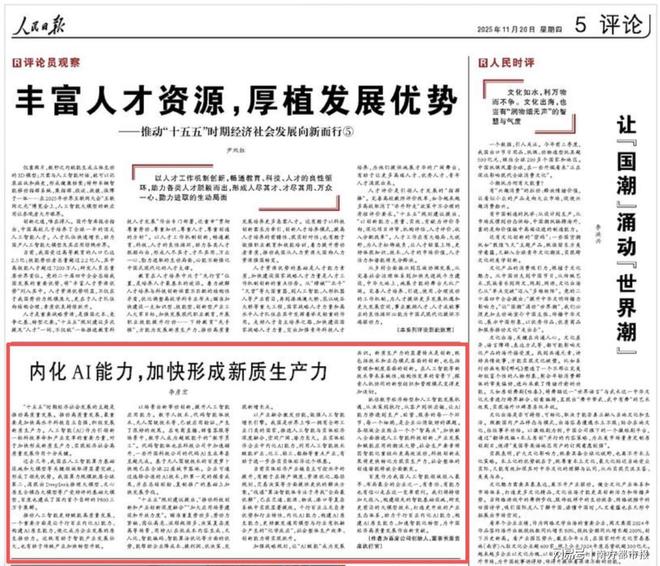
李彦宏《人民日报》撰文,提出内化AI能力“三步走”
Nan Fang Du Shi Bao· 2025-11-20 02:07
Core Viewpoint - The article emphasizes the importance of internalizing AI capabilities across various industries to enhance productivity and drive high-quality development [1][3]. Group 1: Internalizing AI Capabilities - Companies face the challenge of internalizing AI capabilities, which can be addressed by driving innovation through new scenarios and enhancing AI application capabilities [3][4]. - Specific AI technologies such as digital human technology, code intelligence, and autonomous driving have shown effective results in various applications [3][4]. - AI can help companies reduce costs, increase profits, optimize decision-making, and discover new growth points, particularly in scenarios with repetitive labor, labor shortages, high-risk jobs, bottlenecks, and complex decision-making [4][5]. Group 2: Industry Integration and AI Growth Engine - Internalizing AI capabilities in key industries like mining, chemicals, light industry, and shipping can strengthen the foundation of the real economy [5][6]. - The example of Baidu's algorithmic intelligence tool "Famu" demonstrates significant efficiency improvements in complex systems such as traffic and logistics [5]. - The integration of AI capabilities tailored to industry characteristics can enhance overall productivity and innovation capacity across sectors [5][6]. Group 3: Strategic Planning for AI Empowerment - There is an urgent need to explore new organizational and management models that facilitate human-machine collaboration in the context of systemic and structural changes brought by AI [6]. - Companies must ensure that AI capabilities permeate every aspect of production, operation, and service, from decision-making to execution [6]. - Baidu plans to increase investment in building advanced intelligent infrastructure and developing cutting-edge large model technologies to support the internalization of AI capabilities across industries [6].
从路口信号灯到重大工程 百度AI基础设施为千行百业注入新动能
Ren Min Ri Bao· 2025-11-16 22:00
Core Insights - The introduction of Baidu's intelligent cloud SaaS traffic control platform has significantly reduced average vehicle delays by 13%, with an additional 5% reduction achieved through the self-evolving super intelligent agent "Baidu Famo" [1][2] - Baidu officially launched the commercially viable self-evolving super intelligent agent "Baidu Famo" at the Baidu World 2025 Conference, marking a shift in AI from a supportive tool to a primary productivity driver [1][2] - The company aims to enhance productivity by internalizing AI capabilities, viewing them as a fundamental asset rather than a cost [1][2] AI Infrastructure Development - Baidu is developing a new AI infrastructure, including AI Infra and Agent Infra, to support the internalization of AI capabilities within enterprises [3] - The new generation of Kunlun chips, designed for large-scale inference and multimodal model training, is set to be released between 2026 and 2027, enhancing AI performance [4] - Baidu's AI cloud has achieved a breakthrough with a 30,000-card Kunlun chip cluster, capable of supporting multiple trillion-parameter model trainings [5] Intelligent Agent Ecosystem - Baidu has upgraded its Agent Infra, with over 460,000 enterprise users and more than 1.3 million intelligent agents developed, facilitating the large-scale application of AI [6] - Collaborations in various sectors, such as finance and energy, have demonstrated the effectiveness of intelligent agents in improving operational efficiency and decision-making [6][7] - The integration of AI Infra and Agent Infra is positioned as a catalyst for transforming industries and enhancing productivity [7] Future Outlook - Baidu is committed to continuous investment in AI infrastructure, aiming to elevate the capabilities of AI and expand its application across various industries [7] - The company's strategy focuses on deep integration of technology, infrastructure, and industry scenarios to drive high-quality economic development [7]
百度:中国正参与定义全球AI应用竞争“新赛场”
Huan Qiu Shi Bao· 2025-11-14 04:43
Core Insights - The core viewpoint of the articles emphasizes the transformation of AI from a cost to a productivity driver as companies internalize AI capabilities, with three main application directions: replacing repetitive labor, providing unlimited productivity, and surpassing human cognition [1] Group 1: AI Development and Applications - Baidu's recent conference highlighted the theme of "emergent effects" in AI, showcasing the company's latest advancements and positioning China as a key player in defining AI application competition [1] - The AI industry structure is shifting from an unhealthy "pyramid" model, where chip manufacturers capture most value, to a "reverse pyramid" where models and applications generate significantly higher value [2] - Baidu introduced the new Kunlun chip and the Tianchi super node product, along with the Wenxin 5.0 model, which supports multi-modal understanding and generation across various data types [3] Group 2: Intelligent Agents and Decision-Making - The newly launched intelligent agent "Famu" is designed to automate complex decision-making processes, enhancing efficiency in various sectors such as traffic management and financial risk control [4] - Famu has demonstrated its capabilities by reducing average vehicle delay rates in traffic management by 18% through real-time adjustments [4] Group 3: Global Expansion and Market Impact - Baidu announced the global rollout of its digital human technology, "Huibo Star," which has shown a 91% year-on-year increase in GMV during the recent "Double Eleven" shopping festival [5] - The autonomous driving initiative "Luo Bo Kuaipao" is addressing commercialization challenges in the sector, with predictions of a significant increase in the number of autonomous taxis globally [6] - Baidu's focus on leveraging China's vast market demand and complex industrial ecosystem aims to transition from "catching up" to "leading" in technology innovation, contributing unique "Chinese solutions" to the global economy [7]