
伐谋

Search documents
百度AI进入“兑现期”:从成本中心到利润中心,全栈能力重构增长天花板
Mei Ri Jing Ji Xin Wen· 2026-02-26 14:43
Core Insights - Baidu's total revenue for 2025 reached 129.1 billion yuan, with AI business revenue at 40 billion yuan, indicating a significant shift in revenue structure as AI becomes a core cash flow engine [1][2] - The disclosure of AI revenue exceeding 43% marks a critical step in Baidu's business restructuring, transforming AI from a foundational tool to a direct revenue generator [2][5] Financial Performance - In Q4 2025, Baidu's total revenue was 32.7 billion yuan, with AI business income accounting for 43% of general business revenue, surpassing market expectations [1] - Baidu's AI cloud revenue grew by 34% year-on-year, with the AI cloud market in China reaching 28.09 billion yuan, a 195.7% increase [3] Market Position - Baidu's AI cloud holds a 40.2% market share, leading the industry, and has been recognized as a leader in AI platforms by Forrester [3][5] - The company has become the top cloud vendor in terms of project wins and amounts in the AI cloud sector for two consecutive years [3] Technological Advancements - Baidu's Kunlun chip is designed for AI, providing high-performance computing power, with new products set to launch annually over the next five years [4] - The release of the self-evolving super intelligent agent "Famu" demonstrates Baidu's commitment to advancing AI capabilities, achieving significant efficiency improvements in various applications [4] User Engagement - Baidu's AI applications generated over 10 billion yuan in revenue, with a 301% year-on-year increase in AI-native marketing services [6] - The monthly active users of the Wenxin Assistant reached 202 million, indicating strong user engagement and willingness to pay for advanced features [6][7] Strategic Outlook - Baidu's approach mirrors that of tech giants like Microsoft and Apple, focusing on stable returns and clear AI profitability paths to enhance market valuation [11][12] - The shift from traditional PE valuation to a more forward-looking segment valuation reflects a growing recognition of Baidu's AI asset value [12]


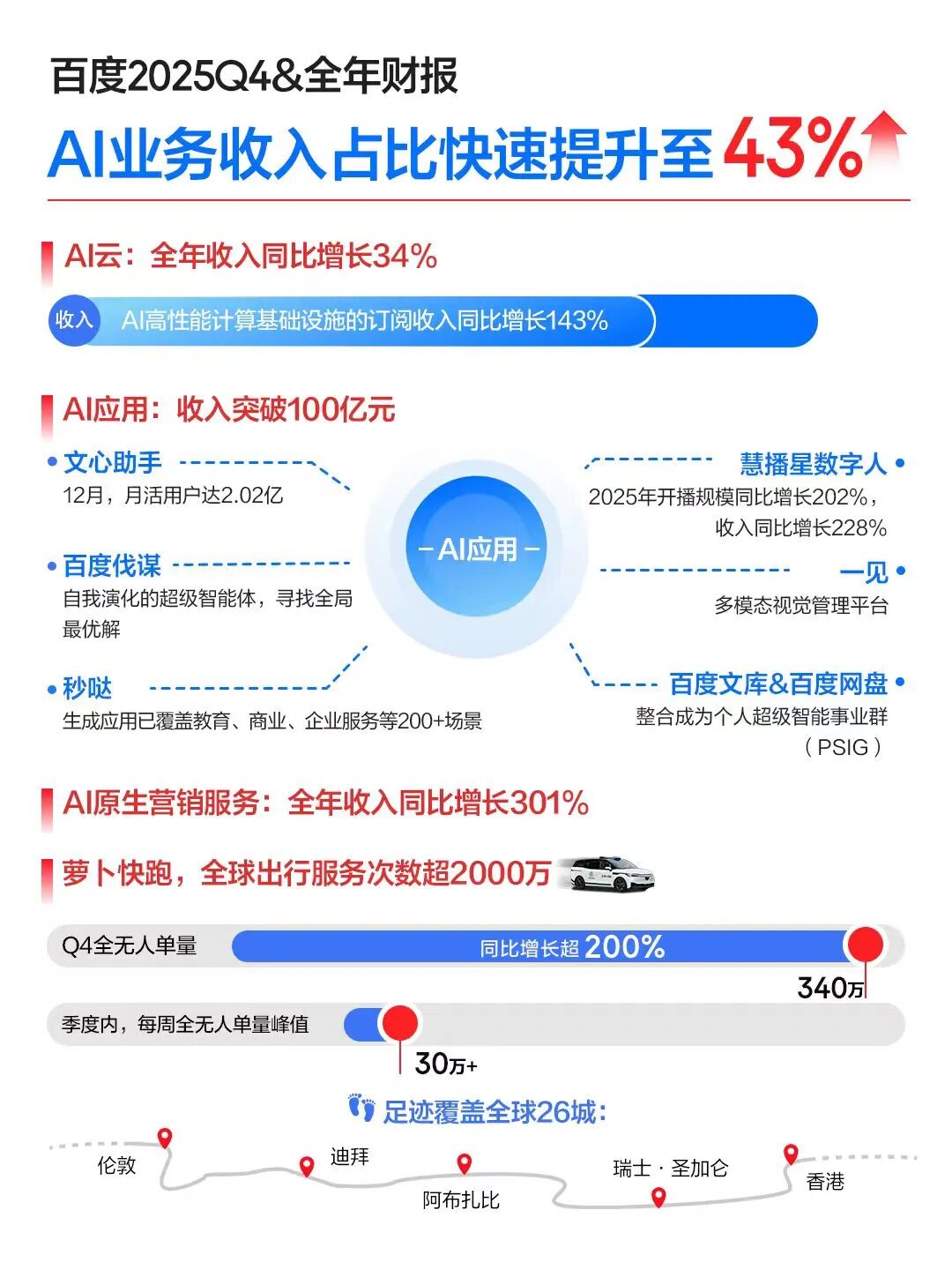
百度2025年Q4 AI业务收入占比超4成 AI能干活也能赚钱
Jing Ji Guan Cha Wang· 2026-02-26 12:32
Core Insights - Baidu's 2025 financial report reveals a significant shift, with AI business revenue becoming a core growth driver after over a decade of strategic investment [1][6] - The company reported total revenue of 129.1 billion yuan for 2025, with AI business revenue reaching 40 billion yuan, and AI revenue accounting for 43% of total revenue in Q4 [1][4] Financial Performance - In 2025, AI cloud revenue grew by 34% year-on-year, AI applications revenue surpassed 10 billion yuan, and AI-native marketing service revenue increased by 301% [4][6] - Baidu announced a stock buyback of approximately 5 billion USD, representing 10% of its market value, and plans to distribute dividends for the first time in 2026 [4][5] AI Business Development - The disclosure of AI revenue share indicates that the AI business has reached a level of risk resilience and certainty, transitioning from a cost center to a profit center [6] - Baidu's AI capabilities are being utilized across various sectors, leading to reduced marginal costs and establishing a sustainable revenue stream [6][9] AI Infrastructure and Applications - Baidu has positioned itself as a leader in AI infrastructure, with its self-developed Kunlun chip serving as a foundation for AI applications [8] - The introduction of the self-evolving super-intelligent agent "Famu" demonstrates Baidu's commitment to enhancing application efficiency in various industries [9] Consumer Engagement - Baidu's strategy focuses on integrating AI into its 700 million monthly active users through practical applications rather than entertainment, enhancing user retention [10][11] - The "Wenxin Assistant" within the Baidu app has seen a significant increase in active users, driven by practical features and services [11][12] Global Expansion - Baidu's autonomous driving service "Luobo Kuaipao" is expanding globally, with successful operations in Abu Dhabi and plans for further deployment in Europe and Hong Kong [14][15] Market Valuation and Future Outlook - The independent disclosure of AI business performance is leading to a systematic re-evaluation of Baidu's market value, with analysts adjusting target prices upward [17] - The anticipated spin-off of Kunlun chip assets is expected to catalyze further valuation reassessment, marking a new phase for Baidu's long-term AI strategy [17]
21独家|百度智能云上调AI相关收入增速目标至200%,全力冲刺抢AI云第一
2 1 Shi Ji Jing Ji Bao Dao· 2026-01-27 00:35
Core Insights - Baidu Intelligent Cloud is signaling an aggressive growth strategy, aiming for a 200% increase in AI-related revenue by 2026, up from a previous target of 100% [1] - The global AI cloud market is projected to exceed $400 billion by 2030, indicating significant growth potential [1] - Baidu has established a complete industrial chain from AI chips to cloud infrastructure and applications, positioning itself as a leader in the AI cloud market [1][4] Group 1: Strategic Positioning - Baidu's strategy of integrating cloud computing, big data, and artificial intelligence from the outset has set it apart from competitors [3] - The company has developed its own AI chips, such as the Kunlun series, which are crucial for supporting its cloud services and applications [4][6] - Baidu's full-stack capabilities, including hardware and software integration, are essential for maintaining a competitive edge in the AI cloud market [8] Group 2: Market Performance - In 2025, Baidu Intelligent Cloud secured 109 projects in the large model sector, with a total bid amount of approximately 900 million yuan, leading the market in both project count and value [12][13] - The trend indicates that clients are moving from initial trials to deeper integration of AI into core business processes, which Baidu is well-positioned to support [14] - Baidu's client base includes 65% of central enterprises and all systemically important banks, showcasing its strong foothold in the B2B market [14] Group 3: Technological Advancements - The Kunlun chip has evolved to support large-scale AI model training, with capabilities to handle multiple billion-parameter models simultaneously [4] - Baidu's AI infrastructure, including the Baidu Hundred Boats AI Computing Platform, enhances the efficiency of chip utilization and overall system performance [8] - The company is focused on creating a synergistic ecosystem that integrates chips, cloud infrastructure, and AI models to optimize performance and reduce costs [8][9] Group 4: Application and Impact - Baidu's AI agents, such as "Miao Da" and "Fa Mo," are designed to simplify application development and optimize complex processes across various industries [9][10] - Successful implementations of these agents have demonstrated significant improvements in operational efficiency and business outcomes for clients [10][15] - The company's approach emphasizes the importance of providing comprehensive solutions rather than just model APIs, aligning with the evolving needs of enterprises [15][16]

百度智能云上调AI相关收入增速目标至200%,全力冲刺抢AI云第一
2 1 Shi Ji Jing Ji Bao Dao· 2026-01-27 00:16
Core Insights - Baidu Intelligent Cloud is signaling an aggressive growth strategy, aiming for a 200% increase in AI-related revenue by 2026, up from a previous target of 100% [1] - The global AI cloud market is projected to exceed $400 billion by 2030, indicating significant growth potential [1] - Baidu has established a complete industry chain from AI chips to cloud infrastructure and applications, positioning itself as a leader in the AI cloud market [1] Group 1: Strategic Positioning - Baidu's strategy of integrating cloud computing, big data, and artificial intelligence from the outset has set it apart from competitors [2] - The development of the Kunlun chip was initially aimed at addressing internal computational needs, but has now become a key asset in the AI cloud space [2] - Baidu's full-stack infrastructure allows it to effectively compete in the AI cloud market, leveraging its unique position built over the past decade [2][3] Group 2: Technological Advancements - The Kunlun chip's capabilities enable Baidu to support large-scale model training and provide significant computational power, distinguishing it from software-only or integration-focused cloud providers [3] - The introduction of the next-generation Kunlun chips (M100 and M300) demonstrates Baidu's commitment to continuous technological investment [5] - Baidu's AI Infra, combining Kunlun chips with the Baidu AI computing platform, maximizes chip potential and enhances operational efficiency [6] Group 3: Application and Market Performance - Baidu's AI cloud has successfully secured 109 projects in the bidding market, totaling approximately 900 million yuan, leading in both project count and value for two consecutive years [9][10] - The company's B-end clients include 65% of state-owned enterprises and major financial institutions, showcasing its strong market presence [12] - Baidu's AI solutions have proven effective in various sectors, including energy and finance, significantly improving operational efficiency and business outcomes [12][8] Group 4: Competitive Landscape - The AI cloud market is evolving from an experimental phase to one focused on deep integration into core business processes, with clients seeking comprehensive solutions rather than standalone models [12][13] - Baidu's emphasis on a full-stack service model contrasts with competitors focusing on lighter, model-as-a-service approaches, positioning it well for future market demands [13] - The company's strategy aligns with the increasing need for integrated systems in AI applications, validating its approach through successful project acquisitions [13][14]
21独家|百度智能云上调AI相关收入增速目标至200%,全力冲刺抢AI云第一
21世纪经济报道· 2026-01-27 00:15
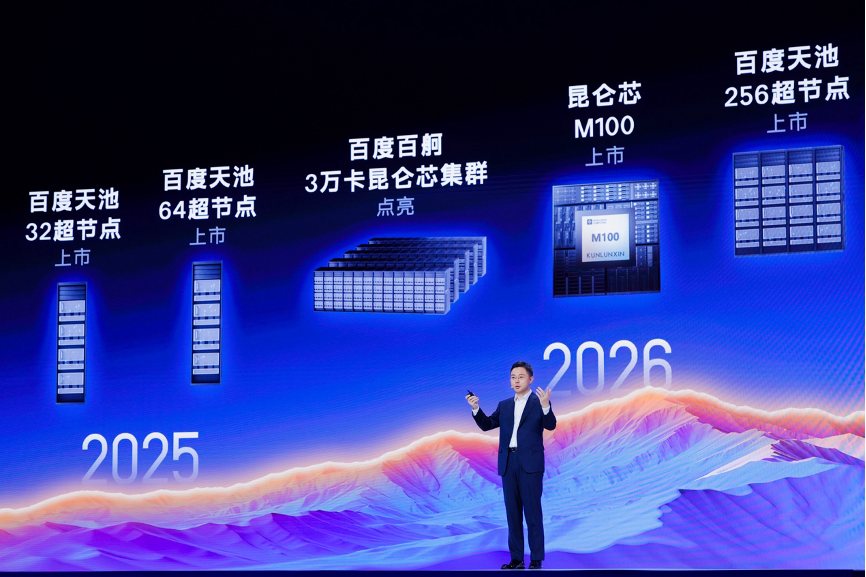
Core Viewpoint - Baidu Intelligent Cloud is signaling an aggressive strategy shift, aiming for a 200% growth in AI-related revenue by 2026, up from a previous target of 100%, as it seeks to dominate the AI cloud market [2]. Group 1: Market Position and Strategy - The global AI cloud market is projected to exceed $400 billion by 2030, indicating significant growth potential [2]. - Baidu has established a complete industrial chain from AI chips to cloud infrastructure and applications, positioning itself uniquely in the AI cloud market [2]. - The shift from traditional cloud to AI cloud is emphasized, with a focus on "soft and hard integration" as a key competitive advantage [2]. Group 2: Historical Context and Development - Baidu's strategy of integrating cloud computing, big data, and artificial intelligence began in 2015, which was considered ahead of its time [3]. - The development of the Kunlun chip was initially aimed at solving internal computational bottlenecks, laying the groundwork for Baidu's future in AI cloud [3]. - Baidu's current capabilities in AI cloud are a result of ten years of strategic investment and development [3]. Group 3: Technological Advancements - In 2025, Baidu successfully activated a 30,000-card cluster capable of training large models, marking a significant milestone in its engineering capabilities [4]. - The Kunlun chip's evolution continues, with new generations being introduced to enhance performance and cost-effectiveness [6]. - Baidu's "百舸AI计算平台" optimizes the use of its chips, achieving a 98% effective training duration, showcasing the importance of software-hardware synergy [8]. Group 4: Application and Market Impact - Baidu's AI models, such as Wenxin 5.0, have reached a parameter scale of 2.4 trillion, providing robust support for complex applications [9]. - The "秒哒" application has generated over 400,000 applications by the end of 2025, demonstrating the practical utility of Baidu's technology [10]. - Baidu's AI solutions have been successfully implemented in various sectors, including finance and logistics, enhancing operational efficiency [10]. Group 5: Competitive Landscape - In 2025, Baidu led the bidding market for AI-related projects, securing 109 projects worth approximately 900 million yuan, outperforming competitors [12][13]. - Baidu's client base includes a significant portion of state-owned enterprises and major financial institutions, indicating strong market trust [14]. - The shift in client expectations from basic AI interactions to deeper integration into core business processes highlights Baidu's competitive edge [14]. Group 6: Future Outlook - The competition in the AI cloud market is evolving into a "system war," where comprehensive integration of hardware and software is crucial for success [16]. - Baidu's goal for 2026 reflects a culmination of its decade-long technological journey and aims to validate its strategic direction [16].

百度智能云上调AI相关收入增速目标至200%
2 1 Shi Ji Jing Ji Bao Dao· 2026-01-27 00:10
Core Insights - Baidu Intelligent Cloud is signaling an aggressive growth strategy, aiming for a 200% increase in AI-related revenue by 2026, up from a previous target of 100% [1] - The global AI cloud market is projected to exceed $400 billion by 2030, indicating significant growth potential [1] - Baidu has established a complete industrial chain from AI chips to cloud infrastructure and applications, positioning itself as a leader in the AI cloud market [1][2] Group 1: Strategic Positioning - Baidu's strategy of integrating cloud computing, big data, and artificial intelligence from the outset has set it apart from competitors [2] - The company has developed its own AI chips, such as the Kunlun chip, to address computational bottlenecks, which has become a key asset in the AI cloud space [2][3] - Baidu's AI cloud has reached a scale where it can support multiple large models simultaneously, marking a transition to a more engineering-focused supply phase [3] Group 2: Technological Advancements - Baidu's AI infrastructure, combining Kunlun chips with the Baidu AI computing platform, allows for efficient utilization of chip capabilities [4] - The platform has achieved a 98% effective training duration for its Kunlun chip clusters, showcasing its operational efficiency [4] - The introduction of new Kunlun chip generations (M100 and M300) demonstrates Baidu's commitment to continuous technological advancement [3] Group 3: Market Performance - In 2025, Baidu Intelligent Cloud secured 109 projects in the bidding market, totaling approximately 900 million yuan, leading in both project count and monetary value for two consecutive years [7][8] - The trend indicates a shift from initial adoption of AI models to deeper integration into core business processes, with Baidu's clients including major state-owned enterprises and top financial institutions [9][10] - Baidu's comprehensive service model, from chips to applications, positions it favorably against competitors focusing solely on model-as-a-service (MaaS) [10][11] Group 4: Application and Impact - Baidu's intelligent agents have been successfully applied in various sectors, including finance, energy, and logistics, translating technological potential into real-world efficiency [6] - The company's solutions have significantly improved operational efficiency, as evidenced by case studies in sectors like automotive design and scientific research [5][9] - Baidu's approach emphasizes the importance of a complete system rather than isolated model APIs, aligning with the industry's demand for integrated solutions [10][11]
21独家|百度智能云上调AI相关收入增速目标至200%
2 1 Shi Ji Jing Ji Bao Dao· 2026-01-27 00:04
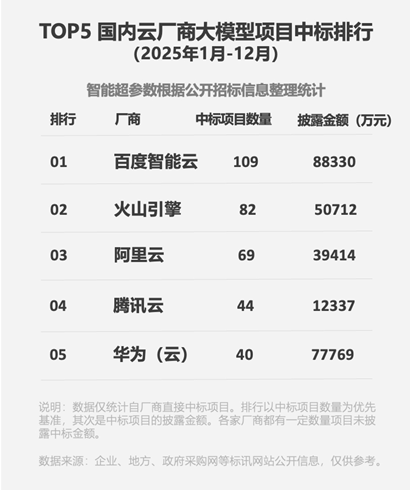
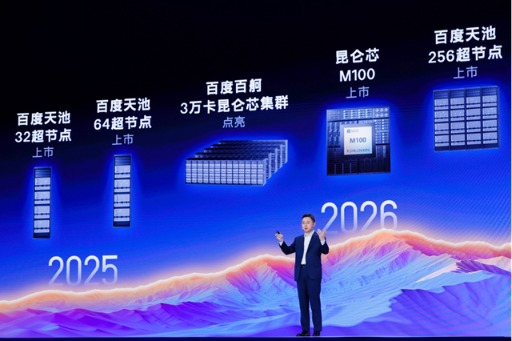
Core Insights - Baidu Intelligent Cloud has set an aggressive target to increase AI-related revenue growth from 100% to 200% by 2026, aiming to dominate the AI cloud market [1][3] - The global AI cloud market is projected to exceed $400 billion by 2030, indicating significant growth potential [2] - Baidu has developed a complete industry chain from AI chips to cloud infrastructure and applications, positioning itself uniquely in the AI cloud sector [3][6] Group 1: Strategic Positioning - Baidu's strategy emphasizes a three-pronged approach of cloud computing, big data, and artificial intelligence, which was considered ahead of its time in 2015 [5][6] - The company has invested in proprietary AI chips, such as the Kunlun chip, to address computational bottlenecks, establishing a strong foundation for its AI cloud services [5][6] - Baidu's "cloud-intelligence integration" strategy has been a long-term commitment, with the 2026 growth target serving as a test of its decade-long efforts [3][16] Group 2: Technological Advancements - The Kunlun chip has evolved, with new generations like M100 and M300 being introduced to enhance performance and cost-effectiveness [8][10] - Baidu's AI infrastructure, powered by the Kunlun chip and the Baidu AI Computing Platform, allows for efficient utilization of computational resources, achieving a 98% effective training duration [10] - The integration of hardware and software is crucial for optimizing performance and reducing total cost of ownership (TCO) in the AI cloud market [10][11] Group 3: Market Performance - In 2025, Baidu Intelligent Cloud secured 109 projects in the large model sector, with a total bid amount of approximately 900 million yuan, leading the market in both project count and value [12][13] - The trend indicates a shift from initial experimentation with AI models to deeper integration into core business processes, with Baidu serving a significant portion of major enterprises and banks [14][15] - Baidu's comprehensive service model, which includes everything from chips to applications, positions it favorably against competitors focusing solely on model-as-a-service (MaaS) [15][16]
中信百信银行大数据部总经理周北春: AI在银行的落地场景已从新技术尝鲜步入业务流程重塑阶段
Sou Hu Cai Jing· 2025-12-30 04:34
Group 1 - The "2025 Banking Industry High-Quality Development Conference" was successfully held in Beijing, focusing on themes such as serving the real economy, digital transformation, AI+financial innovation, and risk prevention [1] - The conference gathered regulatory experts, academic elites, industry leaders, and representatives from technology companies to discuss strategies for high-quality development in the banking sector [1] Group 2 - The General Manager of the Big Data Department at Citic Baixin Bank, Zhou Beichun, shared insights on the application of AI in intelligent risk control during a roundtable forum [3] - Citic Baixin Bank aims to leverage financial technology to break physical boundaries in banking services, providing simple and convenient online financial services to a broader customer base [3] - The bank has developed a four-layer digital risk control system, which includes data, risk feature mining, model construction, and real-time risk operation, achieving a commendable industry standard [3] Group 3 - Zhou Beichun emphasized that AI has transitioned from being a new technology to a new productive force in banking, indicating that it is likely to replace junior employees [4] - Two main challenges in AI application within banks were identified: computational power and the need for a fundamental change in AI training models [4] - AI is viewed as a highly intelligent and capable junior employee, and it should be assigned appropriate tasks for continuous development, particularly in intelligent risk control [4]

百度伐谋AI DAY发布生态计划,超2000家企业已“入局”
Sou Hu Cai Jing· 2025-12-25 18:57
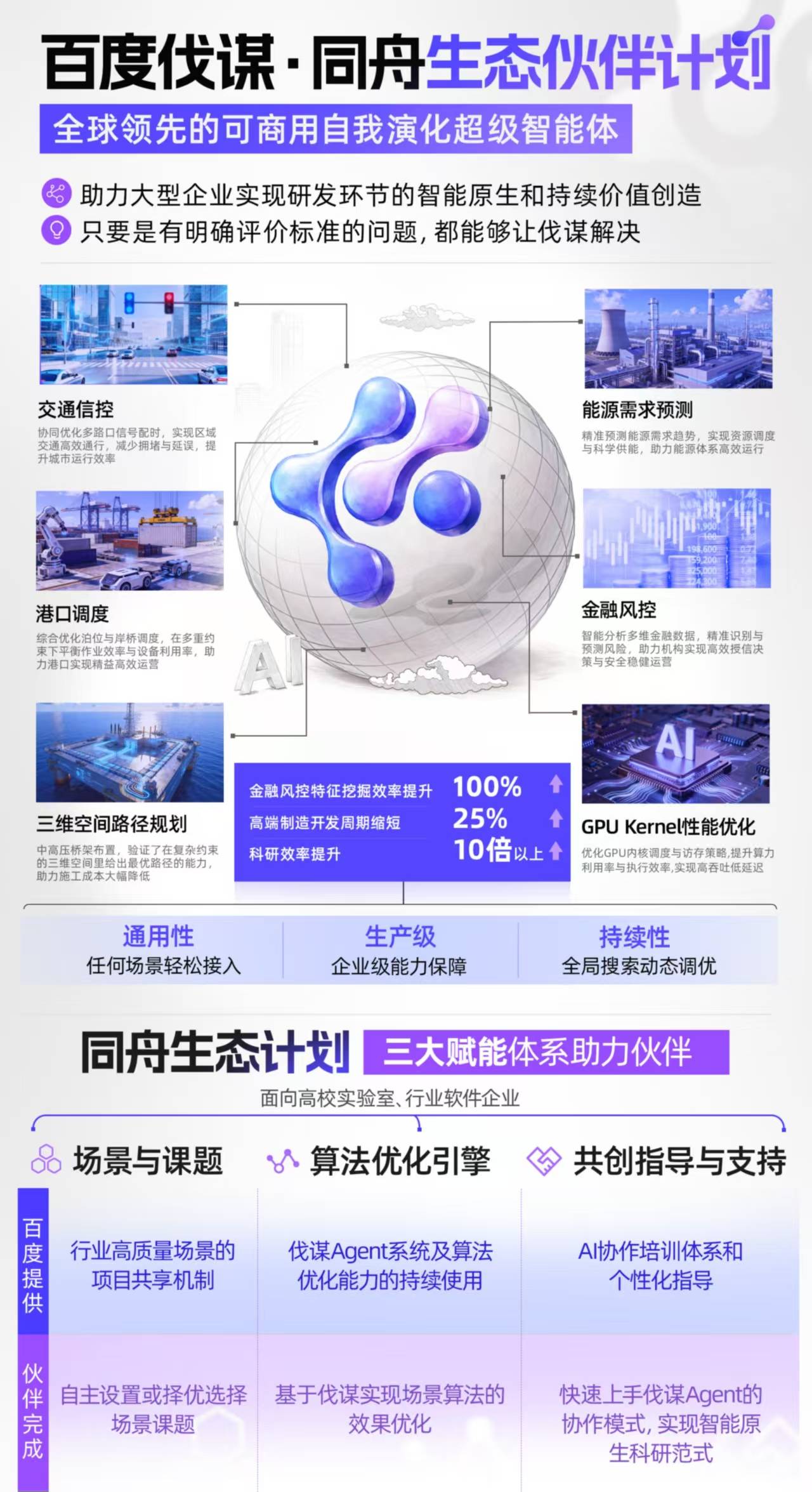
Core Insights - Baidu's "Tongzhou Ecosystem Partner Program" was officially launched at the AI DAY, aiming to empower over 2000 enterprises by sharing advanced AI capabilities and fostering collaboration in various industries [1][3] Group 1: Ecosystem Development - The "Tongzhou Ecosystem Partner Program" is designed to open high-quality industry scenarios and topics to universities and software companies, facilitating the internalization of top algorithm optimization capabilities [2] - Baidu's self-evolving super-intelligent agent, "Famo," can now be utilized by ecosystem partners, enhancing productivity and efficiency across various sectors [1][3] Group 2: Technological Advancements - Famo has demonstrated significant improvements in risk control for the financial sector, achieving a 100% increase in risk feature mining efficiency and a 2.41% enhancement in risk differentiation of core models [1] - The program includes three major upgrades: multiple low-threshold access methods, a cloud-based algorithm generation architecture that ensures data security, and enhanced dynamic tuning capabilities for long-term adaptability [2] Group 3: Industry Impact - Baidu's founder, Robin Li, emphasized the potential of AI to significantly enhance efficiency across China's diverse industrial sectors, contributing to economic growth [3] - The initiative aims to transform technological potential into a driving force for intelligent upgrades across various industries, as evidenced by the active participation of over 2000 enterprises [3]
百度「伐谋」智能体超2000家企业申请试用
Sou Hu Cai Jing· 2025-12-25 16:11
Core Viewpoint - Baidu's self-developed intelligent system "Famo" has demonstrated scalable application capabilities across various industries, including transportation, manufacturing, energy, and research, following successful real-world validations [1][9]. Group 1: System Overview - "Famo" was first introduced on November 13 and is designed as a self-evolving algorithm system for complex engineering and research scenarios [1]. - Over 2,000 companies have applied for trials of "Famo," covering sectors such as agricultural supply chains, AI research in universities, manufacturing scheduling, and key operator development [1]. Group 2: Technical Mechanism - Unlike traditional algorithms that rely on human experience and iterative tuning, "Famo" operates on an "automatic generation-evaluation-evolution" mechanism, enabling autonomous algorithm design, optimization, and iteration under defined constraints [3]. - The core philosophy of "Famo" is to systematize and program the thought processes, problem decomposition logic, and engineering experience of human experts, allowing the algorithm to continuously evolve and seek global optimal solutions in complex, high-dimensional, and constrained problem spaces [3]. Group 3: Performance and Applications - "Famo" employs multi-agent collaboration and evolutionary search mechanisms to automatically generate algorithm structures, parameter combinations, and optimization paths based on given evaluation metrics [5]. - In public evaluations, "Famo" has shown strong performance advantages, achieving leading results in CUDA Kernel optimization, machine learning engineering benchmarks (MLE-Bench), and algorithm engineering evaluations (ALE-Bench) [5]. - In practical applications, "Famo" has been validated in various industries, such as: - In smart manufacturing, it is used by Alt Automotive for vehicle aerodynamics design, significantly reducing wind resistance analysis time from hours to minutes while maintaining near-physical simulation accuracy [5]. - In the energy and infrastructure sector, "Famo" optimizes offshore wind power and energy pipeline layout, enhancing design efficiency and reducing trial-and-error costs [7]. - In financial risk control, "Famo" improves risk identification and model stability compared to traditional methods, shortening model development cycles [7]. - In research, "Famo" assists universities and research institutions in solving complex engineering problems, such as optimizing structural parameters for space station equipment design and aiding in disaster prediction and engineering safety [7]. Group 4: Strategic Value and Future Plans - The core value of "Famo" lies in transforming the paradigm of algorithm development from expert-dependent manual tuning to a sustainable self-evolving automated system [9]. - "Famo" has initiated collaborations across multiple fields, including transportation, energy, finance, and manufacturing, gradually forming a reusable methodological framework [9]. - Baidu has launched the "Famo·Tongzhou Ecological Partner Program," aiming to expand the system's application to more complex industrial scenarios and explore collaborations with additional research institutions and enterprises [9].
