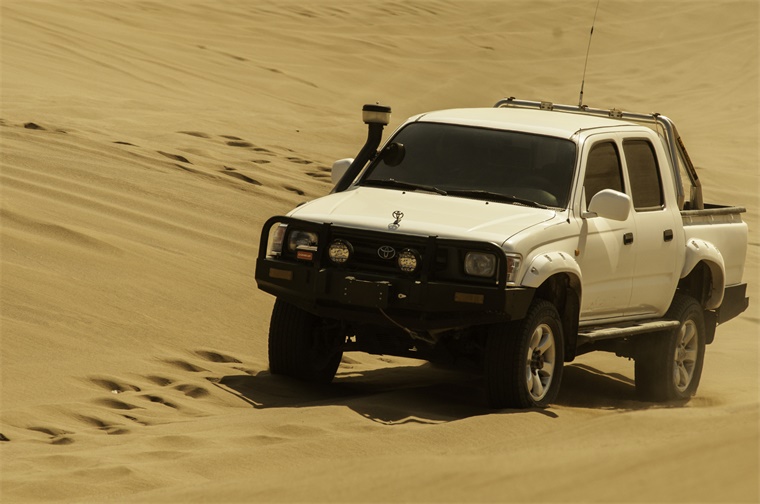
福特Ranger

Search documents
承认中国皮卡存在竞争力!福特CEO法利:我们把比亚迪皮卡拆开之后,还是不知道他们怎么赚钱【附皮卡行业市场分析】
Qian Zhan Wang· 2026-03-17 08:32
Core Insights - Ford's CEO Jim Farley recently tested two Chinese plug-in hybrid pickups, BYD Shark 6 and Great Wall Cannon Alpha, acknowledging their significant market competitiveness while emphasizing their distinct nature compared to traditional fuel pickups [2][3] Group 1: Market Competitiveness - Chinese pickups, such as BYD Shark 6 and Great Wall Cannon, showcase advanced plug-in hybrid technology, combining powerful performance and cargo capacity with energy efficiency and smart technology [2] - Farley noted that these vehicles cater to consumers who need pickups but prefer electric attributes without high-frequency heavy loading or towing requirements [2] - Great Wall Cannon is viewed as a strong competitor in this niche market, indicating a shift in consumer preferences towards more modern and stylish designs [2] Group 2: Traditional Automaker Advantages - Traditional automakers like Ford and Toyota maintain significant advantages due to decades of experience in work-oriented pickups, particularly in chassis technology, towing performance, and load adaptability [2] - Farley humorously remarked on the challenges of understanding the profitability of Chinese pickups, highlighting the unique advantages of Chinese automakers in supply chain integration and cost optimization [3] Group 3: Chinese Pickup Market Evolution - The Chinese pickup market has experienced a revival due to gradual policy relaxations and diverse consumer demands, with exports showing explosive growth [10] - Data from the China Passenger Car Association indicates that by December 2025, national pickup exports are projected to reach 28,000 units, marking a 12% year-on-year increase [10] - The importance of pickups in the Chinese market is underscored by the fact that while passenger vehicles account for 85% of the market, commercial vehicles, including pickups, represent only 15%, indicating significant growth potential [10]




彭博:中国汽车即将进入美国市场,不管你喜欢与否
美股IPO· 2026-02-11 04:01
Core Viewpoint - Chinese automotive manufacturers are increasingly looking to enter the U.S. market despite significant barriers such as high tariffs and software restrictions, with indications that this entry may soon become a reality [3][4][5]. Group 1: Market Dynamics - The U.S. remains one of the highest revenue automotive markets globally, making it a prime target for Chinese automakers seeking profitable opportunities [3]. - Recent comments from President Trump suggest a potential openness to Chinese manufacturers establishing factories in the U.S., indicating a shift in the political landscape [4]. - The National Automobile Dealers Association's mixed stance on accepting Chinese brands reflects a growing ambivalence among U.S. dealers towards the potential of Chinese vehicles [5]. Group 2: Competitive Landscape - Over the past five years, Chinese automotive exports have surged nearly eightfold, surpassing Japan as a leading exporter [5]. - Industry experts believe that the entry of Chinese brands into the U.S. market could pose a significant threat to Japanese and Korean automakers, particularly in the entry-level vehicle segment [6][9]. - The potential for collaboration between U.S. automakers and Chinese firms in electric and hybrid systems could reshape competitive dynamics in the market [5][9]. Group 3: Pricing and Market Segmentation - The U.S. automotive market is increasingly becoming exclusive to high-income consumers, creating a demand for affordable yet high-quality vehicles, which Chinese manufacturers could fulfill [6]. - Analysis of the top ten U.S. automakers indicates that many affordable models are dominated by Asian manufacturers, suggesting a vulnerability for smaller Japanese and Korean brands if Chinese companies target this segment [7]. - The entry of Chinese automakers may initially focus on lower-priced models, which could alleviate competitive pressure on U.S. manufacturers in higher-end segments [9]. Group 4: Strategic Considerations - The historical approach of Japanese automakers entering the U.S. market by establishing local production facilities may serve as a model for Chinese companies [6][9]. - The competitive advantages held by established brands like Toyota, built over decades, may provide a buffer against the influx of Chinese vehicles, despite the latter's lower breakeven costs [8]. - The evolving landscape suggests that U.S. automakers must adapt to the increasing presence of Chinese brands, potentially leading to strategic partnerships to enhance their capabilities in electric vehicles [9].
中国跃升澳大利亚第二大新车来源国,市占率突破20%
Guan Cha Zhe Wang· 2026-01-12 10:21
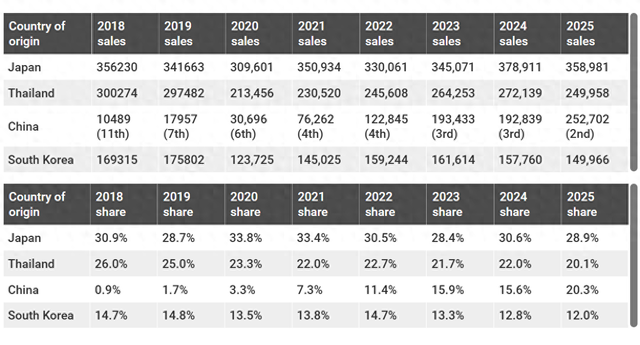
Core Insights - In the past year, Chinese-made cars have surpassed 250,000 units sold in Australia, making China the second-largest source of new cars in the country [1] - The Australian Federal Chamber of Automotive Industries (FCAI) reported that total new car sales in Australia reached 1.209 million units in 2025, with Chinese car sales accounting for 252,702 units, representing a growth rate of over 31% and a market share of 20.4% [1][2] Sales Data - In 2025, the sales figures for cars from various countries are as follows: Japan (358,981 units), Thailand (249,958 units), China (252,702 units), and South Korea (149,966 units) [2] - The market share for Chinese cars has increased from 0.9% in 2018 to 20.3% in 2025, indicating significant growth in the Australian automotive market [2] Brand Performance - Chinese brands such as Great Wall, BYD, and MG have entered the top ten best-selling brands in Australia, with Chery expected to join the ranks by 2026 [3] - BYD's Shark plug-in hybrid electric vehicle (PHEV) has shown strong market performance, contributing to a trend of electric pickups replacing traditional fuel pickups [5] Electric Vehicle Trends - In 2025, plug-in hybrid electric vehicle sales in Australia reached 53,000 units, a 130.9% increase from 2024, while hybrid electric vehicle (HEV) sales totaled 199,000 units, growing by 15.3% [7] - Battery electric vehicle (BEV) sales grew at a slower pace, reaching 103,000 units, a mere 1.1% increase, accounting for 8.3% of total passenger car sales [7] - The top ten electric vehicle models sold in Australia in 2025 were predominantly from Chinese manufacturers, with new entrants including Deep Blue, Leap Motor, and Zeekr [7]

4000余万人口有1500万辆汽车!这一地的汽车产业是如何实现逆袭的?
Zhong Guo Qi Che Bao Wang· 2025-10-11 08:10
Core Viewpoint - Argentina's automotive industry is experiencing significant growth driven by a combination of unique environmental factors, government policies, and foreign investment, positioning the country as a key player in the Latin American automotive market [4][6][12]. Group 1: Market Characteristics - Argentina has a population of over 40 million and an automobile ownership rate of approximately 15 million vehicles, averaging one car for every three people, which is relatively high globally [4]. - The automotive market is characterized by a strong presence of imported brands, with a historical foundation established by multinational companies like Ford and General Motors [6]. - The average age of vehicles in Argentina is around 12 years, indicating a robust second-hand car market, with many classic models still in use [5]. Group 2: Historical Development - The automotive industry in Argentina has evolved from simple assembly to more complex manufacturing processes, with production peaking at over 300,000 vehicles annually by the 1970s [6]. - Economic crises in the 1990s led to a decline in production and investment, but recovery began in 2003, attracting foreign companies back to the market [7]. - By 2006, a treaty with Brazil significantly boosted Argentina's automotive exports, leading to a 40% increase in production that year [7]. Group 3: Recent Trends and Investments - Despite the pandemic's impact, major automotive companies like Volkswagen and PSA have accelerated their investments in Argentina, with Fiat investing $50 million to restart a factory [8]. - Chinese automotive brands are entering the market, leveraging advantages in new energy technology and cost control, thereby reshaping the competitive landscape [8]. Group 4: Future Prospects - The Argentine government plans to allow the import of 50,000 electric and hybrid vehicles starting in 2026, exempting them from import duties, which is expected to enhance the adoption of electric vehicles [10]. - Argentina is projected to become a significant player in lithium production, with forecasts indicating a 77% increase in lithium carbonate output by 2025, supporting the electric vehicle supply chain [11]. - The automotive industry's growth is attributed to a combination of policy support, geographical advantages, and market resilience, providing valuable lessons for emerging markets [12].

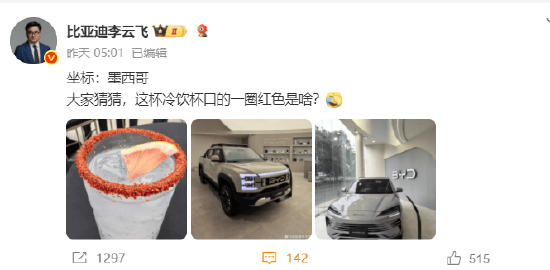
比亚迪李云飞:比亚迪新能源SHARK皮卡迟早在国内上市!海外对标福特 Ranger、丰田 Hilux 等传统燃油皮卡
Sou Hu Cai Jing· 2025-10-09 03:22
Group 1 - The core message is that BYD's SHARK pickup is planned for domestic launch in China, as confirmed by the brand and public relations manager Li Yunfei [1] - The SHARK pickup is set to debut in Mexico in May 2024, with a starting price of 969,800 Mexican pesos (approximately 416,000 RMB) [3] - The SHARK has already entered markets such as Thailand, South Africa, and Australia, with plans for further expansion [3] Group 2 - The SHARK will compete with traditional fuel pickups like Ford Ranger and Toyota Hilux in overseas markets [3] - If launched in China, it will directly compete with new energy pickups such as Great Wall's Shanhai Pao Hi4-T [3]