科创AI

Search documents
博时基金副总王德英被降职
Xin Lang Cai Jing· 2026-01-16 09:12
Core Viewpoint - The recent executive changes at Bosera Asset Management reflect the challenges faced by traditional public fund institutions amid ongoing industry reforms and competitive pressures. Group 1: Executive Changes - Wang Deying, the Deputy General Manager and CIO of Bosera Fund, has been unexpectedly demoted to a regular employee after over 25 years with the company, reportedly due to regulatory penalties related to customized fund business [1][2] - The company has undergone a stable leadership transition in 2025, with the resignation of Chairman Jiang Xiangyang and the appointment of new General Manager Chen Yu, who brings cross-industry experience [3] Group 2: Financial Performance - Bosera Fund reported a revenue of 2.356 billion yuan for the first half of 2025, a year-on-year increase of 6.37%, while net profit was 763 million yuan, nearly flat with a 0.13% increase [1][2] - The ongoing fee reform in the public fund industry is expected to result in over 50 billion yuan in annual savings for investors, significantly impacting traditional profit models [1][2] Group 3: Business Challenges - The company has seen a notable differentiation in profitability, highlighting the pressure to transform amid deepening industry reforms [1][2] - Bosera's fixed income sector remains a core support, with a total scale of over 100 billion yuan for five bond ETFs as of August 21, 2025, but faced challenges with 12 products being liquidated in 2025 due to low scale or insufficient investors [3] - The company has not yet established a differentiated service system for retail and institutional clients, remaining at a basic customization level [3]
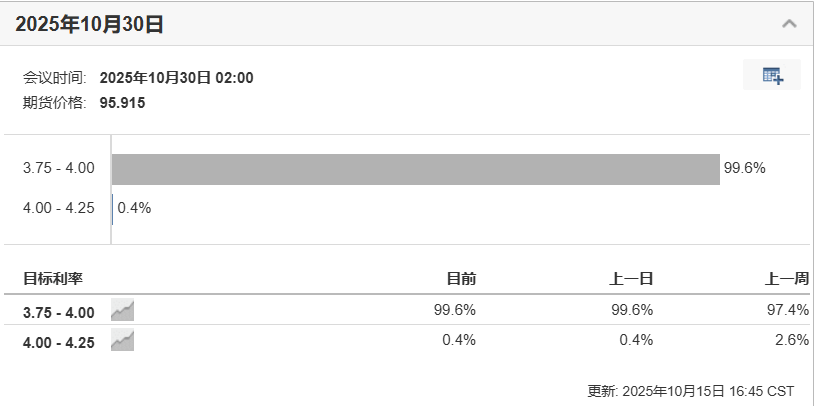
美联储开始松口!10月份降息概率会有多高
Sou Hu Cai Jing· 2025-10-15 13:40
Core Viewpoint - Federal Reserve Chairman Powell indicated a potential end to the balance sheet reduction process in the coming months to prevent liquidity tightening in short-term funding markets [1][3]. Group 1: Federal Reserve Actions - The Federal Reserve expanded its balance sheet during the pandemic and began raising interest rates in March 2022, followed by balance sheet reduction starting in June 2022 [2]. - The first interest rate cut is expected in September 2024, while the balance sheet reduction has continued until now [2]. Group 2: Market Reactions - The expectation of interest rate cuts and the cessation of balance sheet reduction are likely to lead to increased liquidity, which historically correlates with better market performance in A-shares and Hong Kong stocks [5]. - Following Powell's remarks, the Hang Seng Index rose by 1.84%, and the Hang Seng Tech Index increased by 2.57%, indicating signs of stabilization [5]. - Despite the positive market reaction, there has been a net outflow of 5.4 billion from southbound funds, suggesting that foreign capital is not necessarily buying into the perceived benefits of rate cuts [5]. Group 3: A-share Market Dynamics - The A-share market showed weakness in early trading, primarily due to the previous day's decline [6]. - However, the surge in shares of Sanhua Intelligent Control led to a recovery in the broader technology sector, improving market sentiment [7]. Group 4: Investment Strategies - The current market environment is characterized by volatility, with frequent changes in trend signals, particularly in sectors like AI and chips [12]. - Investors are advised to be patient and wait for clear signals, as the market's oscillating nature can lead to increased trading frequency and potential losses [12].

牛市中场!存款市值比最新 1.56
雪球· 2025-09-24 07:58
Core Viewpoint - The article discusses the optimistic sentiment in the market driven by favorable news in the semiconductor sector and expectations from a meeting scheduled at 3 PM on Monday, highlighting the performance of bank stocks and the overall market dynamics [3][4]. Market Performance - Bank stocks showed early signs of upward movement but faced downward pressure shortly after the market opened. The Shanghai Composite Index fluctuated, eventually closing up 0.22% after a brief decline [4]. - Small-cap stocks, such as those in the CSI 1000 index, experienced significant gains, reaching new highs in the last hour of trading [6]. Sector Performance - The semiconductor and communication sectors performed well, with notable contributions from robotics and battery industries. However, the photovoltaic industry showed weakness [8]. - Specific sector performance data includes: - Sci-tech chips: 62.77% year-to-date increase - Consumer electronics: 52.99% year-to-date increase - Sci-tech AI: 63.77% year-to-date increase - CSI All Index Semiconductor: 45.71% year-to-date increase [9]. Economic Indicators - The latest data from the central bank indicates that household deposits amount to 161.02 trillion yuan, with a market value ratio of 1.56 compared to the total market capitalization of 103.29 billion yuan at the end of August [14]. - The rolling 12-month increase in household deposits has stabilized around 14 trillion yuan, significantly lower than the nearly 24 trillion yuan at the beginning of 2023 [16]. Market Cycle Insights - Analyst Zhang Xia suggests that the Chinese economy and stock market follow a five-year cycle, predicting a "main rising wave" phase in the next 2-3 years post-2024 [17]. - The current market is considered to be in the second phase of a bull market, characterized by self-reinforcing incremental capital [21][22]. - Zhang emphasizes that the transition to a low-valuation, pro-cyclical market is likely to occur in the following year, driven by economic improvements and inflation [23].