
移动数据

Search documents
中国思考-加税不太可能
2026-02-05 02:22
Summary of Key Points from the Conference Call Industry Overview - The discussion primarily revolves around the **telecommunications industry** in China, particularly focusing on the implications of a potential increase in the value-added tax (VAT) for this sector and its broader economic impact [1][10]. Core Insights and Arguments - **Tax Increase Concerns**: There are market concerns regarding a potential broad increase in VAT, which could affect various service industries. However, it is believed that the decision-makers are unlikely to implement such a broad tax increase as it would hinder efforts to combat deflation and does not align with macroeconomic consistency evaluations [1][10]. - **Targeted Tax Adjustment**: The recent VAT adjustment for the telecommunications sector, where the rate for traditional value-added services was raised from 6% to 9%, is viewed as a targeted structural adjustment rather than a precursor to widespread tax hikes [10]. - **Economic Policy Outlook**: The fiscal policy for 2026 is expected to remain similar to that of the previous year, with a focus on maintaining stability in fiscal deficits and spending ratios. If economic growth slows, there may be an additional fiscal stimulus of 0.5% of GDP introduced mid-year [13]. - **Impact on Consumer Confidence**: A broad increase in VAT would counteract efforts made over the past year to rebuild confidence in the private sector, making such a move unlikely [13]. Additional Important Content - **Sector-Specific Taxation Risks**: While a broad tax increase is deemed unlikely, certain sectors may face stricter tax enforcement and a tightening of preferential policies, although these changes are expected to be gradual and administrative rather than resulting in an overall increase in statutory tax rates [10]. - **Macroeconomic Implications**: Raising VAT in a weak demand environment could suppress consumption and investment, exacerbating deflationary pressures. Academic research indicates that using tax increases to support fiscal spending often diminishes the effectiveness of such policies [10]. - **Policy Communication**: The decision-makers are likely to ensure clarity and predictability in policy communication to avoid undermining confidence in the private sector [13]. This summary encapsulates the key points discussed in the conference call, highlighting the telecommunications industry's current challenges and the anticipated fiscal policy direction in China.
资金动向 | 北水大幅加仓腾讯,连续7日抛售中芯国际
Ge Long Hui A P P· 2026-02-03 10:35
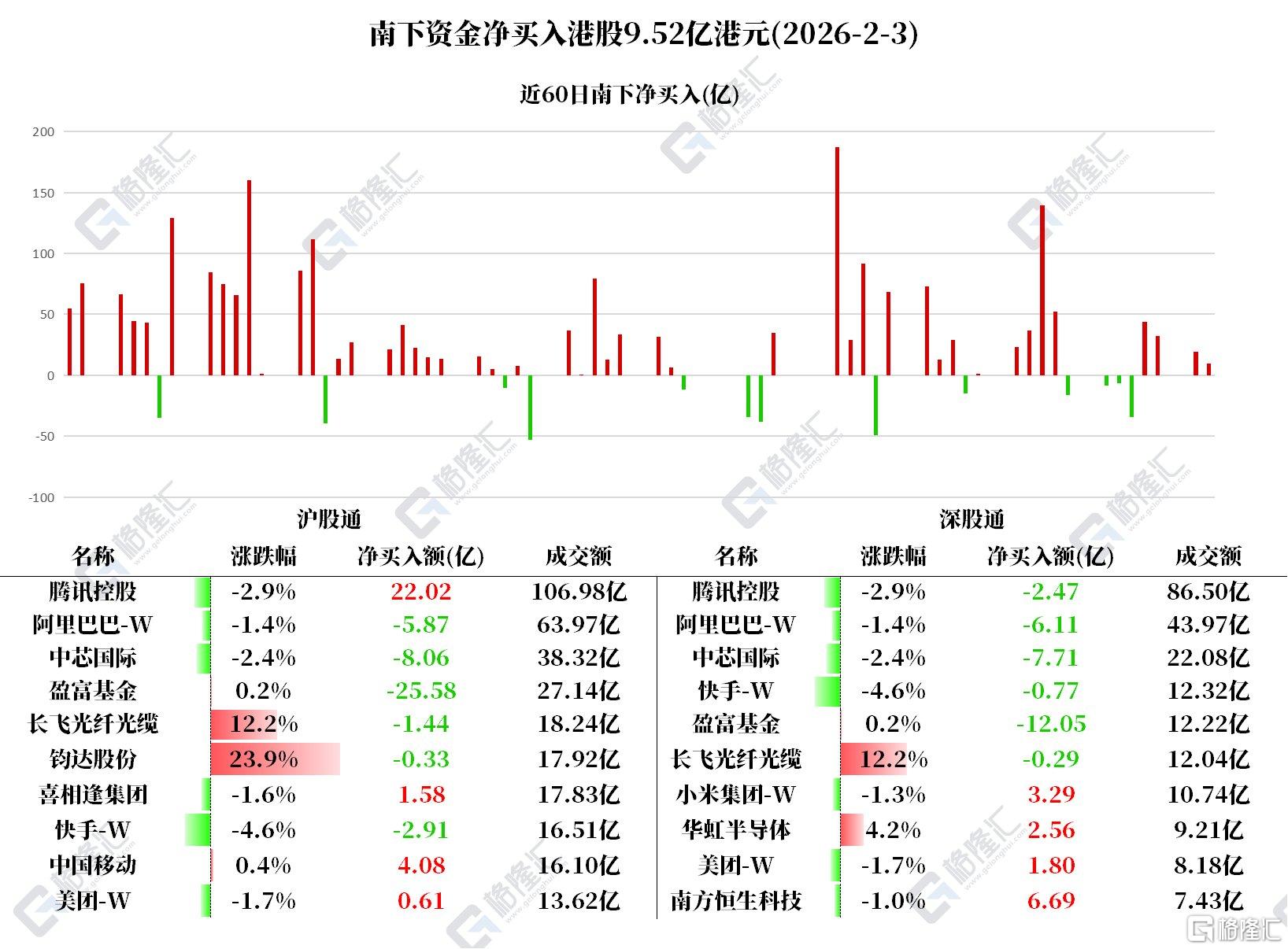
Group 1: Stock Movements - Tencent Holdings saw a net buy of 19.55 billion, while the net sell for the Yingfu Fund was 37.63 billion [1] - Southbound funds have continuously net bought Xiaomi for four days, totaling 21.6392 billion HKD, while net selling for SMIC has lasted for seven days, totaling 29.6606 billion HKD [4] Group 2: Tax Adjustments and Impacts - Concerns arise regarding potential VAT increases for internet service companies following the adjustment for telecom companies, although some institutions believe this concern is overstated [5] - Morgan Stanley's report indicates that the VAT adjustment for telecom services will impact net profits of China Mobile, China Telecom, and Unicom by 7.1%, 12.6%, and 11.9% respectively, with China Mobile facing the least impact due to its higher gross margins [5] Group 3: Semiconductor Industry Trends - Domestic chip manufacturers, including Guokai Micro, Zhongwei Semiconductor, and Yingjixin, have announced price increases of up to 80% across key sectors such as storage and MCU [5] - The trend of rising prices in the domestic chip market is expected to continue into the first half of 2026, with more companies likely to follow suit [5] Group 4: Optical Fiber Industry Insights - The optical fiber industry is experiencing a clear upward price trend, driven by increased demand from telecom operators and seasonal stocking ahead of the Spring Festival [6] - Recent price increases in fiber optics are expected to persist, with major domestic clients likely to accept these price hikes [6]


小摩:内地电讯商增值税调高 料中国移动受影响最小
Xin Lang Cai Jing· 2026-02-03 09:56
Core Viewpoint - Morgan Stanley reports that the three major telecom operators in mainland China have announced an adjustment in value-added tax, increasing the tax rate on mobile data, SMS/MMS, and internet broadband services from 6% to 9% [1][2] Group 1: Impact on Companies - The tax adjustment is expected to impact the net profits of China Mobile (00941), China Telecom (00728), and China Unicom (00762) in 2026 by 7.1%, 12.6%, and 11.9% respectively [1] - Among the three operators, the impact on China Mobile is estimated to be the smallest due to its higher gross margin [1] Group 2: Mitigation Measures - The actual profit impact may be milder than estimated, as the telecom operators are undergoing state-owned enterprise reforms, with authorities setting financial KPIs for profit growth, return on equity improvement, and healthy cash flow [2] - Telecom operators are expected to offset the impact of the VAT adjustment through various measures, including optimizing operating expenses, increasing prices, and controlling capital expenditures [2]



小摩:内地电讯商增值税调高 料中国移动(00941)受影响最小
智通财经网· 2026-02-03 08:30
Core Viewpoint - Morgan Stanley reports that the three major telecom operators in mainland China have announced an increase in value-added tax from 6% to 9% on mobile data, SMS/MMS, and internet broadband services, which will impact their net profits in 2026 [1] Group 1: Impact on Telecom Operators - The expected impact on net profits for China Mobile (00941), China Telecom (00728), and China Unicom (00762) is projected to be 7.1%, 12.6%, and 11.9% respectively [1] - China Mobile is anticipated to experience the smallest impact among the three operators due to its higher gross margins [1] Group 2: Mitigation Strategies - The actual profit impact may be milder than estimated as the telecom operators are undergoing state-owned enterprise reforms, with financial KPIs set by authorities including profit growth, return on equity improvement, and healthy cash flow [1] - Telecom operators are expected to offset the impact of the VAT adjustment through various measures such as optimizing operating expenses, increasing prices, and controlling capital expenditures [1]
大行评级丨小摩:维持三大电信运营商“增持”评级,预计中国移动受增值税调整影响最小
Ge Long Hui A P P· 2026-02-03 04:00
Core Viewpoint - Morgan Stanley's report indicates that the three major telecom operators in mainland China will adjust their value-added tax rates from 6% to 9%, which is expected to impact net profits for China Mobile, China Telecom, and China Unicom by 7.1%, 12.6%, and 11.9% respectively [1] Group 1: Tax Adjustment Impact - The tax adjustment will affect mobile data, SMS/MMS, and internet broadband services [1] - China Mobile is expected to experience the smallest impact among the three operators due to its higher gross margins [1] - The actual profit impact may be milder than estimated, as the telecom operators are undergoing state-owned enterprise reforms with financial KPIs set by authorities [1] Group 2: Mitigation Measures - Telecom operators are expected to offset the impact of the tax adjustment through various measures, including optimizing operating expenses, price increases, and controlling capital expenditures [1] Group 3: Market Performance and Dividend Yield - The stock prices of the three major telecom operators have significantly declined since the fourth quarter of last year, primarily due to capital rotation towards AI-themed stocks and concerns over slowing growth in traditional telecom services [1] - Expected dividend yields for China Mobile, China Telecom, and China Unicom in 2026 are 7%, 5.7%, and 6.8% respectively, which remain attractive compared to the Hang Seng Index [1] - The report maintains an "overweight" rating for all three telecom operators [1]
瑞银:内地电讯商增值税调高 料中国移动、中国电信及中国联通盈利受9%、18%及逾18%影响
Zhi Tong Cai Jing· 2026-02-03 03:58
Core Viewpoint - UBS reports that the recent VAT adjustment by China's three major telecom operators will have a significant negative impact on their profitability, as the affected services account for 45% to 60% of their projected service revenue for 2025 [1] Group 1: VAT Adjustment Impact - The VAT rate for mobile data, SMS/MMS, and internet broadband services will increase from 6% to 9% starting January 1 of this year [1] - The service revenue of telecom operators is expected to be impacted by approximately 1.5% to 2% due to this VAT adjustment [1] Group 2: Profitability Forecast - Assuming a corporate income tax rate of 25% and not considering other costs or tax deductions, the net profit impact for China Mobile, China Telecom, and China Unicom is estimated to be around 9%, 17.9%, and 18.2% respectively for 2025 [1] Group 3: Strategic Response - The three major telecom operators will continue to enhance operational efficiency, focus on high-quality development, and accelerate their transformation towards emerging fields such as artificial intelligence and cloud services to mitigate the impact of the tax rate increase [1]

瑞银:内地电讯商增值税调高 料中国移动(00941)、中国电信(00728)及中国联通(00762)盈利受9%、18%及逾18%影响
智通财经网· 2026-02-03 03:49
Core Viewpoint - UBS reports that the recent VAT adjustment announced by China's three major telecom operators will have a significant negative impact on their profitability, as the affected services account for 45% to 60% of their projected service revenue for 2025 [1] Group 1: VAT Adjustment Impact - The VAT rate for mobile data, SMS/MMS, and internet broadband services will increase from 6% to 9% starting January 1 of this year [1] - The adjustment is expected to reduce service revenue for telecom operators by approximately 1.5% to 2% [1] Group 2: Profitability Forecast - Assuming a corporate income tax rate of 25% and not considering other costs or tax deductions, the net profit impact for the three major telecom operators by 2025 is estimated to be around 9% for China Mobile, 17.9% for China Telecom, and 18.2% for China Unicom [1] Group 3: Strategic Response - The three major telecom operators plan to enhance operational efficiency, focus on high-quality development, and accelerate transformation into emerging fields such as artificial intelligence and cloud services to mitigate the impact of the tax rate increase [1]
瑞银:内地电讯商增值税调高,预计中国移动、中国电信及联通盈利受9%、18%及逾18%影响
Ge Long Hui A P P· 2026-02-02 07:23
Core Viewpoint - UBS reports that the recent VAT adjustment by China's three major telecom operators will have a significant negative impact on their profitability, as the affected services account for 45% to 60% of their projected service revenue for 2025 [1] Group 1: VAT Adjustment Impact - The VAT rate for mobile data, SMS/MMS, and internet broadband services will increase from 6% to 9% starting January 1, 2023 [1] - The adjustment is expected to reduce service revenue for telecom operators by approximately 1.5% to 2% [1] Group 2: Profitability Forecast - Assuming a corporate income tax rate of 25% and not considering other costs or tax deductions, the net profit impact for China Mobile, China Telecom, and China Unicom is estimated to be around 9%, 17.9%, and 18.2% respectively for 2025 [1] Group 3: Strategic Response - The three major telecom operators plan to enhance operational efficiency, focus on high-quality development, and accelerate transformation into emerging fields such as artificial intelligence and cloud services to mitigate the impact of the tax rate increase [1]
PLDT(PHI) - 2025 Q1 - Earnings Call Transcript
2025-05-15 08:32
Financial Data and Key Metrics Changes - Net service revenue increased slightly year on year, with gross revenue reaching $27.9 billion, up 2% from last year [4] - EBITDA grew by 2% to $7.9 billion, driven by strength in fiber and ICT segments, along with prudent cost management [4][11] - Telco core income was recorded at $8.8 billion, down 6% year on year due to increased depreciation linked to strategic investments [4][12] - Core income remained steady year on year, supported by Maya's positive contribution, which turned profitable this quarter [12][13] Business Line Data and Key Metrics Changes - Home segment revenue rose by 4% year on year to $15.2 billion, with fiber now accounting for 97% of home revenues, up from 92% in 2024 [5][8] - Enterprise segment total revenue remained steady at $11.9 billion, with corporate data and ICT revenues slightly up by 1% [5][9] - ICT revenue grew by 16% year on year, now accounting for over 22% of enterprise revenues, up from 19% a year ago [6][9] - Mobile revenues decreased slightly due to lower packet Wi-Fi usage, but 5G adoption and data traffic are on the rise, indicating potential for future growth [6][11] Market Data and Key Metrics Changes - Mobile data, fiber, corporate data, and ICT now account for 89% of total revenues, up from 88% in 2024 [7] - 5G data traffic surged by 81% year on year, with 5G device adoption growing by 60% quarter on quarter [11] - The churn rate remains below 2%, one of the lowest in the industry, reflecting effective customer retention strategies [8][59] Company Strategy and Development Direction - The company aims to pursue steady revenue growth, disciplined expense management, asset monetization, and prudent capital allocation [5] - PLDT is focusing on expanding its fiber footprint and enhancing its digital infrastructure, including the launch of the Asia Direct Cable to improve international connectivity [22][24] - Maya, the fintech driver, is positioned for sustainable growth with its all-in-one ecosystem combining payment, banking, and lending services [25][26] Management's Comments on Operating Environment and Future Outlook - Management expressed confidence in the company's market position despite near-term challenges, supported by strong operational fundamentals and strategic investments [33] - The company anticipates continued growth in the home segment and is optimistic about the enterprise segment recovering as new capacities come online [36][40] - Management highlighted the importance of maintaining a strong focus on customer experience and product innovation to drive future growth [72] Other Important Information - PLDT's net debt stood at $270.7 billion, with a net debt to EBITDA ratio of 2.48 times, slightly improved from the previous year [15] - The company retains investment-grade credit ratings, underscoring investor confidence in its financial health [17] - PLDT is committed to generating positive free cash flow by 2026 and reducing leverage to around a 2.0x net debt to EBITDA ratio over the medium term [17] Q&A Session Summary Question: What is the outlook for the enterprise segment regarding Pogo-related revenue pressures? - Management indicated that the impact from Pogo cancellations is expected to continue until at least Q3, but efforts are being made to mitigate revenue loss [38] Question: Can you provide updates on VITRO's capacity take-up and profitability contributions? - A significant hyperscale customer has already signed for 4 megawatts of capacity, with ongoing discussions for further capacity fill [40] Question: What is the profit momentum expected for Maya for the rest of the year? - Management expects steady and gradual margin improvement rather than a sharp increase, as operating leverage continues to strengthen [42] Question: How is the mobile business expected to perform in the second quarter? - Management noted that while the market has softened, they continue to see growth in traffic, which is expected to help monetize demand [44] Question: What is the current water usage rate for VITRO Santa Rosa? - Water usage is currently at normal levels, with expectations for an increase as AI workloads ramp up [47] Question: What is the target loan to deposit ratio for Maya? - There is no specific target, but the company aims to maintain a conservative loan to deposit ratio compared to traditional banks [50] Question: How does the company plan to improve working capital efficiency? - Strategies include asset monetization, consolidation of central offices, and seeking strategic partners in data centers [82]
