
空间能源系统

Search documents
建筑并购重组系列 2:深度探索建筑民企转型方向
Changjiang Securities· 2026-01-30 10:48
Investment Rating - The report maintains a "Positive" investment rating for the construction and engineering industry [10]. Core Insights - The construction industry is experiencing accelerated concentration, with state-owned enterprises leveraging scale, industrial chain advantages, and policy support to squeeze the survival space of small and medium-sized private enterprises [2][4]. - Sub-sectors like landscaping engineering are under dual pressure from declining demand and intensified competition, leading to weakened revenues, profit pressures, and deteriorating financial structures [2][4]. - Some companies are leveraging low-efficiency asset restructuring, financial endowments, and business associations to strategically transition towards new infrastructure sectors, guided by policy directions [2][4]. Summary by Sections Industry Concentration and Challenges - The concentration of the construction industry is continuously increasing, with the market share of state-owned construction enterprises rising from 46.9% in 2020 to 51.7% in 2024, while their output value share increased from 36.3% to 43.1% [4][15]. - The growth rate of infrastructure and fixed asset investment is declining, with a projected year-on-year decrease of -1.48% for infrastructure investment in 2025 [4][15]. - State-owned enterprises benefit from lower financing costs due to policy advantages and credit ratings, while private enterprises face high leverage and liquidity issues, necessitating a transformation [4][23]. Sub-sector Analysis and Transformation Factors - The report identifies sub-sectors with poor financial performance, particularly landscaping, building decoration, and engineering consulting, as having strong transformation needs [5][28]. - Landscaping and decoration sectors are experiencing declining revenues and high operational leverage, while the engineering consulting sector, despite slight revenue growth, shows high overall valuations indicating significant internal differentiation [5][28]. Transformation Directions and Methods - To achieve effective transformation, companies should align with national strategic directions, focusing on "hard technology" sectors like AI and blockchain, and "new consumption" sectors that cater to public demand [6][46]. - Common transformation methods include mergers and acquisitions, establishing subsidiaries for independent R&D, expanding existing qualifications and businesses, and forming strategic alliances [7][51]. Potential Transformation Targets - Companies with abundant cash flow, sufficient credit limits, and underperforming main businesses are identified as potential transformation targets, particularly in landscaping, building decoration, and engineering consulting sectors [8][46]. Key Support Factors for Transformation - Sufficient cash flow and credit limits are crucial for enabling potential transformations, allowing companies to quickly capture policy opportunities and reduce reliance on high-interest external financing [46][47]. Revitalizing Inefficient Assets - Inefficient assets can serve as low-cost entry points into new infrastructure sectors, with many old factories and idle warehouses meeting the requirements for transformation into data centers or energy storage bases [48][49]. New Shareholder Involvement - The introduction of new major shareholders is a focal point in the transformation of the construction industry, with examples of companies optimizing their ownership structures to leverage state resources and accelerate transitions into new sectors [51][52].

明阳智能的芯片回购局:父女资产左手倒右手装入上市公司,9年前1700万元卖掉,如今亏损也要买回
Xin Lang Zheng Quan· 2026-01-28 08:39
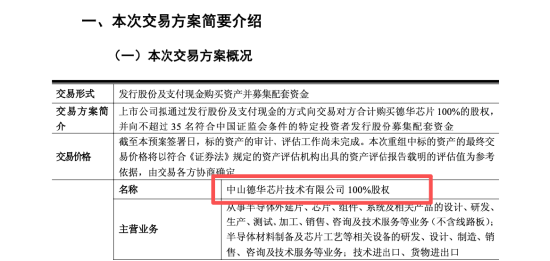
Core Viewpoint - The company Mingyang Smart Energy plans to acquire 100% of Zhongshan Dehua Chip Technology Co., Ltd. through a combination of issuing shares and cash payments, while also raising supporting funds for the transaction and other financial needs [3][5]. Group 1: Transaction Details - The acquisition involves purchasing the entire equity of Dehua Chip, which is engaged in semiconductor design, production, and related services [3][6]. - The final transaction price is yet to be determined, pending the completion of asset audits and evaluations [3][5]. - The controlling shareholder of Dehua Chip is Guangdong Mingyang Ruide Venture Capital Co., Ltd., which is fully owned by Zhang Chuanwei's daughter, Zhang Chao, who is also a director and vice president of Mingyang Smart Energy [3][5]. Group 2: Financial Performance - Dehua Chip has shown a challenging financial status, with projected revenues of 84.74 million yuan and 52.98 million yuan for 2023 and 2024 respectively, and a net profit of 2.16 million yuan in 2023, followed by a loss of 42.58 million yuan in 2024 [7][8]. - Mingyang Smart Energy's revenue has decreased from 30.75 billion yuan in 2022 to 27.16 billion yuan in 2024, with a significant drop in net profit from 3.45 billion yuan to 346 million yuan during the same period [9][10]. Group 3: Market Reaction - Following the announcement of the acquisition, Mingyang Smart Energy's stock price experienced significant volatility, including a 33.60% increase over five trading days prior to the announcement [4][8]. - The acquisition has been associated with the growing enthusiasm in the capital market for aerospace and space photovoltaic concepts, which has contributed to the stock's performance [8][10]. Group 4: Regulatory Scrutiny - The Shanghai Stock Exchange issued an inquiry to Mingyang Smart Energy regarding the necessity and rationale behind acquiring a loss-making entity and the significant stock price fluctuations surrounding the announcement [5][6]. - The company is required to conduct a thorough self-examination of insider trading activities related to the stock [5].


上海港湾跌7.80%,成交额4.55亿元,近5日主力净流入-7572.42万
Xin Lang Cai Jing· 2025-11-14 07:50
Core Viewpoint - Shanghai Port Bay experienced a significant decline of 7.80% in stock price, with a trading volume of 455 million yuan and a market capitalization of 9.512 billion yuan [1] Group 1: Company Performance - In the first nine months of 2025, Shanghai Port Bay achieved a revenue of 1.13 billion yuan, representing a year-on-year growth of 19.64%, while the net profit attributable to shareholders decreased by 27.25% to 79.203 million yuan [9] - The company has a total market capitalization of 9.512 billion yuan, with a trading turnover rate of 4.76% [1] - The average trading cost of the stock is 32.77 yuan, with the stock price fluctuating between resistance at 45.35 yuan and support at 34.82 yuan [8] Group 2: Business Strategy and Innovations - The company is actively implementing its "going out" strategy, focusing on soil remediation and foundation treatment projects in countries along the Belt and Road Initiative, contributing to local sustainable development [2] - Shanghai Port Bay's subsidiary, Fuxi Xinkong, specializes in providing lightweight, cost-effective, and efficient space energy systems, having successfully supported the launch of 15 satellites [4] - The company has developed high-efficiency perovskite solar cells, achieving a certification efficiency of 18.06% for 30×30 cm modules, positioning itself in the leading tier of the industry [3] Group 3: Market and Financial Insights - The company's overseas revenue accounted for 83.01% of total revenue, benefiting from the depreciation of the yuan [5] - The stock has seen a net outflow of 21.2855 million yuan from major investors, indicating a reduction in holdings over the past two days [6][7]
