外延片

Search documents
三安光电,跌停!
是说芯语· 2026-03-23 04:38
Core Viewpoint - Sanan Optoelectronics (600703.SH) is facing significant challenges due to the detention and investigation of its actual controller, Lin Xiucheng, which has led to a sharp decline in its stock price and market capitalization [2][3]. Group 1: Company Situation - On March 23, 2023, Sanan Optoelectronics' stock price dropped by 9.98% to 14.89 CNY per share, reducing its market value from over 80 billion CNY to 74.29 billion CNY [2]. - The company announced that its production and operational management remain normal, and the investigation of its parent company, Sanan Group, does not significantly impact its operations [3]. - Lin Xiucheng has not held any position in the company since July 2017, and the current management is led by his son, Lin Zhiqiang [4]. Group 2: Historical Context - Lin Xiucheng has a diverse entrepreneurial background, transitioning from steel to LED chips and then to compound semiconductors, with a notable history of overcoming challenges [4]. - In 2017, Sanan Group faced scrutiny over financial irregularities, leading Lin Xiucheng to resign from his positions in the listed company to mitigate risks [5]. - The current controlling shareholder is Xiamen Sanan Electronics Co., Ltd., with Lin Xiucheng retaining a 10.72% stake, while his family continues to hold significant positions within the company [5]. Group 3: Financial Performance - Sanan Optoelectronics is projected to incur a net loss of 200 million to 400 million CNY for 2025, with a non-recurring net profit loss estimated between 750 million to 850 million CNY [6]. - The company attributes its anticipated losses to increased R&D expenses, reduced government subsidies, and challenges in its integrated circuit business, particularly in the silicon carbide sector [6]. - Despite these challenges, the company is expanding its compound semiconductor business and has signed a collaboration agreement with STMicroelectronics for silicon carbide projects, aiming for significant product shipments by 2025 [6].



上海合晶硅材料股份有限公司2025年度业绩快报公告
Shang Hai Zheng Quan Bao· 2026-02-27 21:21
Financial Performance - In 2025, the company achieved total operating revenue of 1,311.34 million RMB, representing a year-on-year increase of 18.27% [3] - The net profit attributable to the parent company was 125.35 million RMB, up 3.78% year-on-year [3] - The net profit attributable to the parent company after deducting non-recurring gains and losses was 116.69 million RMB, reflecting an 8.53% year-on-year growth [3] Financial Position - As of the end of 2025, the company's total assets amounted to 4,913.25 million RMB, an increase of 7.48% compared to the previous year [3] - The equity attributable to the parent company was 4,129.55 million RMB, with a net asset value per share of 6.21 RMB [3]
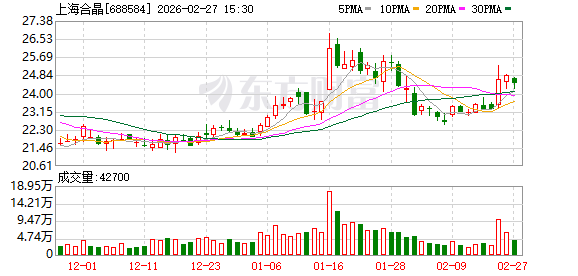
上海合晶2025年净利润同比增长3.78%
Zheng Quan Ri Bao· 2026-02-27 12:45
Group 1 - The core viewpoint of the article highlights the significant recovery signs in the global semiconductor market, which positively impacts Shanghai Hojin's performance [1] - The company reported a total operating revenue of 1.311 billion yuan for the year 2025, representing a year-on-year increase of 18.27% [3] - The net profit attributable to the parent company reached 125 million yuan, showing a year-on-year growth of 3.78% [3] Group 2 - The demand for epitaxial wafers has increased due to the gradual recovery of the power device and analog chip markets [1] - Downstream customer inventory levels have returned to reasonable levels, contributing to increased product sales [1] - The company's capacity utilization rate remains high, further driving revenue and net profit growth [1]
上海合晶2025年度归母净利润1.25亿元,同比增长3.78%
Zhi Tong Cai Jing· 2026-02-27 11:21
Core Viewpoint - Shanghai Hejing (688584.SH) reported a significant increase in revenue and net profit for the fiscal year 2025, reflecting a recovery in the global semiconductor market and improved demand for power devices and analog chips [1] Financial Performance - The company achieved total operating revenue of 1.311 billion yuan in 2025, representing a year-on-year growth of 18.27% [1] - The net profit attributable to the parent company was 125 million yuan, marking a year-on-year increase of 3.78% [1] Market Conditions - The global semiconductor market shows notable signs of recovery, contributing to the growth in demand for the company's products [1] - The demand for epitaxial wafers has increased as downstream customer inventory levels have returned to reasonable levels, leading to higher product sales [1] - The company's production capacity utilization remains high, further supporting revenue and profit growth [1]
上海合晶(688584.SH)2025年度归母净利润1.25亿元,同比增长3.78%
智通财经网· 2026-02-27 10:58
Core Viewpoint - Shanghai Hejing (688584.SH) reported a significant increase in revenue and net profit for the fiscal year 2025, reflecting a recovery in the global semiconductor market and improved demand for power devices and analog chips [1] Financial Performance - The company achieved total operating revenue of 1.311 billion yuan in 2025, representing a year-on-year growth of 18.27% [1] - The net profit attributable to the parent company was 125 million yuan, showing a year-on-year increase of 3.78% [1] Market Conditions - There are notable signs of recovery in the global semiconductor market, which positively impacted the company's performance [1] - The demand for epitaxial wafers increased due to the gradual recovery in the downstream power device and analog chip markets [1] - Downstream customer inventory levels have returned to reasonable levels, contributing to increased product sales [1] - The company's production capacity utilization remains high, further driving revenue and net profit growth [1]
上海合晶(688584.SH):2025年净利润1.25亿元,同比增长3.78%
Ge Long Hui A P P· 2026-02-27 08:31
Core Viewpoint - The global semiconductor market shows significant signs of recovery, positively impacting the company's performance in 2025 [1] Financial Performance - The company achieved total operating revenue of 1.311 billion yuan, representing a year-on-year increase of 18.27% [1] - The net profit attributable to the parent company was 125 million yuan, reflecting a year-on-year growth of 3.78% [1] - The net profit attributable to the parent company after deducting non-recurring gains and losses was 117 million yuan, with a year-on-year increase of 8.53% [1] Market Conditions - The recovery in the power device and analog chip markets has led to increased demand for epitaxial wafers [1] - Downstream customer inventory levels have returned to reasonable levels, contributing to increased product sales [1] - The company's production capacity utilization remains high, further driving revenue and net profit growth [1]
太空能源-砷化镓专家交流
2026-02-04 02:27
Summary of Key Points from the Conference Call on Gallium Arsenide Solar Cells Industry Overview - Gallium arsenide (GaAs) solar cells play a crucial role in the commercial aerospace sector, particularly in high-reliability space environments, outperforming silicon-based and perovskite cells, thus becoming the mainstream choice [1][4] - Major companies in this field include Gan Zhao Company, which previously held an 80% market share in the commercial aerospace sector [2] Core Insights and Arguments - The actual conversion efficiency of GaAs rigid and flexible solar cells can reach over 43.5%, significantly higher than the approximately 38% efficiency for ground applications [1][5] - Future development directions include simulating full-spectrum light and developing corresponding epitaxial structures to enhance absorption range and conversion efficiency, with theoretical efficiency limits potentially reaching 60%-70% [1][9] - Multi-junction GaAs solar cells can achieve around 43% light absorption conversion rate by targeting more wavelengths, with ongoing efforts to expand absorption into blue and infrared regions [1][8] Cost Structure and Reduction Strategies - The cost structure of GaAs solar cells consists mainly of substrates, epitaxial layers, and devices, with substrate costs decreasing due to domestic production of MO sources [2] - Key cost reduction strategies include increasing the domestic production ratio of equipment and materials, enhancing overall technology levels, and improving automation, which could lower graphite component costs by 50%, labor costs by 30%, and material costs by 30% [1][14] - Current chip prices range from 2,000 to 3,000 yuan, with potential reductions to around 1,500 yuan as commercial aerospace develops, indicating a 30%-50% decrease [3][17] Technological Developments and Challenges - The current mature product in the industry is the triple-junction GaAs solar cell, with future iterations focusing on expanding the design to cover more wavelengths for improved performance [7] - The production process from substrate to chip involves complex steps, including the procurement of substrates and the growth of epitaxial structures [6] - Domestic suppliers like Beifang Huachuang and Jing Sheng Jidian are working on MOCVD equipment, but challenges remain in high-end applications requiring rare metals [12] Market Dynamics and Competitive Landscape - The market is characterized by significant competition, with domestic companies like Qian Zhao, Kai Xun, and Dehua leading in GaAs solar cell research and development [27] - The integration of downstream processes poses challenges due to the aging verification cycle of chips, which can take 2-3 years [19] Additional Important Insights - GaAs solar cells exhibit superior radiation resistance compared to silicon-based cells, making them suitable for high-altitude applications [25] - Flexible GaAs solar wings are seen as a necessary trend for future applications requiring high power output, with designs allowing for increased flexibility and power density [26] - The use of X-ray and Vico equipment in production varies significantly, impacting the choice of technology based on the specific requirements of solar cell production [24]
未知机构:国内唯一实现从外延片到芯片再到电源系统全产业链布-20260203
未知机构· 2026-02-03 01:45
Company and Industry Summary Company Overview - The company is the only private enterprise in China that has achieved a full industrial chain layout from epitaxial wafers to chips and power systems, holding over 80% market share in epitaxial wafers and 35% in the industry [1][1]. Key Technological Advancements - The company has mastered key technological breakthroughs, improving energy conversion efficiency compared to traditional solutions. It has achieved mass production and received 80 orders, with 29 orders already delivered. The first satellite verification was completed in August 2025 [1][1]. - The company is deeply involved with major institutions like Zhongxing and Zhongke, serving as the exclusive supplier for certain models, and is currently in the sample delivery phase with aerospace institutions [1][1]. Production Capacity and Expansion Plans - Zhongke Dianzhi owns 15 MOCVD production lines, with plans to expand to 40 lines. A new base is expected to be operational by August 2028, with an initial annual production capacity of 100 units and a long-term plan for 1,000 units [1][1]. Revenue Projections - If military orders are secured in 2026, the company expects to deliver 100 units, which will correspond to significant revenue. The sales revenue is projected to reach substantial levels in 2027, with power system revenue expected to surpass chip revenue by 2027-2028 [2][2]. Industry Dynamics - Mingyang Smart Energy has acquired 100% of Dehua's equity, gaining core space energy technology and forming a closed-loop technology route. Mingyang currently leads in domestic neodymium-iron-boron production with over 34% market share and plans to increase annual production capacity to 260 tons [3][3]. Market Position and Financial Performance - The company holds the top market share in offshore wind turbines, with a 8% increase in order volume in the first three quarters of 2025, outpacing industry growth. The gross margin for Q3 2025 is approaching breakeven, with expectations of a 3-5 percentage point increase in wind turbine gross margin due to low-price order deliveries and a reduction in self-research cost rates [4][4]. - The company plans to establish localized production bases overseas, with the UK base still ramping up. The first batch of offshore wind turbines is expected to be offline by the end of 2028, in collaboration with a strategic partner [4][4]. Financial Forecasts - The main business profit is expected to reach 2.4 billion in 2026, with a projected PE ratio of 15-20 times [5][5]. - Assuming the launch of 10,000 satellites, the gallium arsenide chip segment could yield a profit of 1.2 billion, with a corresponding PE ratio of 30 times. The total potential profit from the main business, satellite energy, and offshore wind export options could reach significant levels [6][6].

明阳智能的芯片回购局:父女资产左手倒右手装入上市公司,9年前1700万元卖掉,如今亏损也要买回
Xin Lang Zheng Quan· 2026-01-28 08:39
Core Viewpoint - The company Mingyang Smart Energy plans to acquire 100% of Zhongshan Dehua Chip Technology Co., Ltd. through a combination of issuing shares and cash payments, while also raising supporting funds for the transaction and other financial needs [3][5]. Group 1: Transaction Details - The acquisition involves purchasing the entire equity of Dehua Chip, which is engaged in semiconductor design, production, and related services [3][6]. - The final transaction price is yet to be determined, pending the completion of asset audits and evaluations [3][5]. - The controlling shareholder of Dehua Chip is Guangdong Mingyang Ruide Venture Capital Co., Ltd., which is fully owned by Zhang Chuanwei's daughter, Zhang Chao, who is also a director and vice president of Mingyang Smart Energy [3][5]. Group 2: Financial Performance - Dehua Chip has shown a challenging financial status, with projected revenues of 84.74 million yuan and 52.98 million yuan for 2023 and 2024 respectively, and a net profit of 2.16 million yuan in 2023, followed by a loss of 42.58 million yuan in 2024 [7][8]. - Mingyang Smart Energy's revenue has decreased from 30.75 billion yuan in 2022 to 27.16 billion yuan in 2024, with a significant drop in net profit from 3.45 billion yuan to 346 million yuan during the same period [9][10]. Group 3: Market Reaction - Following the announcement of the acquisition, Mingyang Smart Energy's stock price experienced significant volatility, including a 33.60% increase over five trading days prior to the announcement [4][8]. - The acquisition has been associated with the growing enthusiasm in the capital market for aerospace and space photovoltaic concepts, which has contributed to the stock's performance [8][10]. Group 4: Regulatory Scrutiny - The Shanghai Stock Exchange issued an inquiry to Mingyang Smart Energy regarding the necessity and rationale behind acquiring a loss-making entity and the significant stock price fluctuations surrounding the announcement [5][6]. - The company is required to conduct a thorough self-examination of insider trading activities related to the stock [5].
定制报告:全球半导体硅片产业“十五五”市场发展趋势研究及投资建议评估预测报告(2026版)
Sou Hu Cai Jing· 2026-01-07 01:37
Core Insights - The semiconductor silicon wafer industry is a critical component of the semiconductor supply chain, with applications in various sectors including mobile devices, IoT, automotive electronics, AI, and aerospace [2][5][6]. Industry Overview - The semiconductor silicon wafer market is experiencing a shift towards larger wafer sizes, with 12-inch wafers becoming the dominant product, accounting for 76.39% of the market share by 2024 [11][12]. - The demand for 8-inch wafers is projected to decline to 2,366 million square inches by 2024, but is expected to recover to 2,412 million square inches by 2025 [10]. Market Dynamics - The global semiconductor silicon wafer market size is forecasted to decrease by 7.50% to $11.5 billion in 2024 due to weak end-user demand and macroeconomic factors, but is expected to rebound in 2025 driven by sectors like new energy vehicles and 5G [12][15]. - The market for silicon epitaxial wafers is also growing, with a compound annual growth rate of 7.39% from $3.68 billion in 2015 to $6.06 billion in 2022 [16]. Product Classification - Silicon wafers can be classified by size (2-inch to 12-inch), manufacturing process (polished, epitaxial, annealed, SOI), doping type (P-type and N-type), and doping concentration (lightly doped and heavily doped) [5][7][8][9]. Future Trends - The industry is expected to see continued growth in the 8-inch and 12-inch wafer segments, which together will account for approximately 96.29% of the market by 2025 [11][12]. - The transition to larger wafer sizes is anticipated to enhance production efficiency and reduce costs, although it requires significant investment in technology and equipment [11][12].