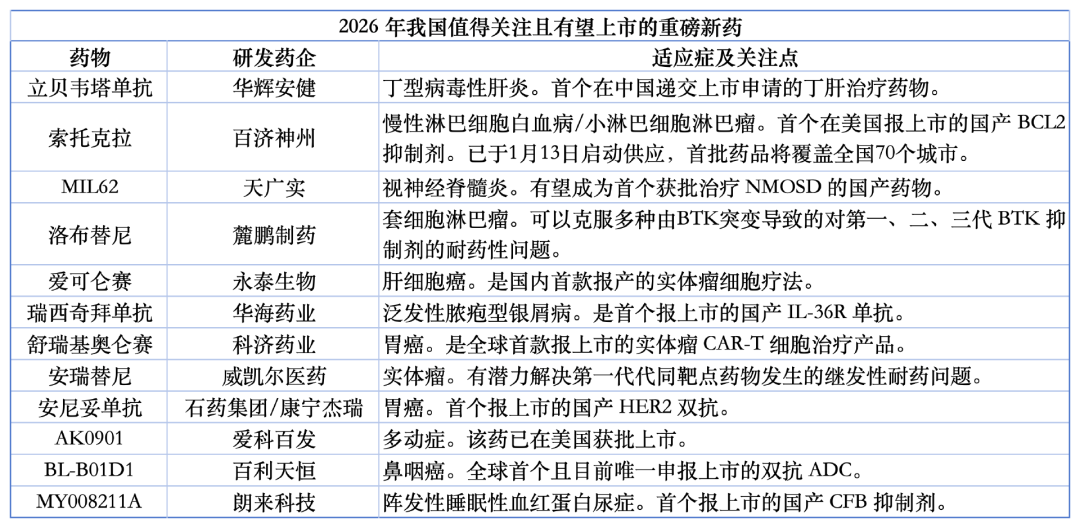
立贝韦塔单抗

Search documents
医药生物行业周报:医药生物行业双周报2026年第2期总第151期2026年JPM大会圆满落幕
Great Wall Glory Securities· 2026-01-26 06:24
Investment Rating - The investment rating for the pharmaceutical and biotechnology industry is "Positive" and the rating has been maintained [2] Core Insights - The pharmaceutical and biotechnology industry index experienced a decline of 1.07%, ranking 26th among 31 primary industries, outperforming the CSI 300 index which fell by 1.19% [4][15] - The valuation of the pharmaceutical and biotechnology industry as of January 23, 2026, is a PE (TTM overall method, excluding negative values) of 30.31x, down from 30.56x in the previous period, indicating a downward trend below the average [4][19] - The top three sub-industries by PE are vaccines (47.34x), hospitals (44.94x), and other medical services (40.38x), while the lowest valuation is in pharmaceutical circulation (15.31x) [4][19] - During the reporting period, 34 listed companies in the pharmaceutical and biotechnology sector saw a net reduction of 2.125 billion yuan in shareholder holdings, with 2 companies increasing holdings by 63 million yuan and 32 companies reducing holdings by 2.189 billion yuan [4] Industry Review - The report highlights significant developments in the pharmaceutical retail sector, emphasizing the need for transformation from traditional drug sales to comprehensive health services [24][25] - The Ministry of Commerce and other departments issued opinions to promote high-quality development in the pharmaceutical retail industry, projecting a market size increase from 2.41 trillion yuan in 2020 to 2.95 trillion yuan by 2024, a growth of 22.4% [24][25] - The report also discusses the approval of new drugs and treatments, including the PD-1/VEGF bispecific antibody RC148 by Rongchang Biopharmaceuticals, which has a potential total payment of up to 4.95 billion USD [7][50] Investment Recommendations - The report suggests focusing on innovative pharmaceutical companies with differentiated pipelines that have received validation from high-quality collaborations with multinational pharmaceutical companies, particularly in key areas such as ADC, bispecific antibodies, and siRNA therapies [7]


华创医药周观点:医药行业ETF研究系列二之医药ETF2026年场景化配置框架 2026/01/25
华创医药组公众平台· 2026-01-24 16:13
Core Viewpoint - The article discusses the investment framework for the pharmaceutical industry ETF in 2026, emphasizing a dual-driven approach of demand and innovation to navigate the market recovery and differentiation after a prolonged bear market since 2021 [29]. Market Review - The CITIC Pharmaceutical Index decreased by 0.38%, outperforming the CSI 300 Index by 0.24 percentage points, ranking 25th among 30 primary industries [9]. - The top ten stocks by increase this week included ST Changyao, Hualan Biological Engineering, and Kangzhong Medical, with gains ranging from 6% to 70.38% [9]. - The bottom ten stocks by decrease included Kain Technology and Aidi Pharmaceutical, with declines of up to 45% [9]. Industry and Stock Events - The article highlights a shift in funding from active to passive management in the pharmaceutical sector, with passive funds becoming a significant part of the long-term funding structure [18]. - The article notes that the innovation drug sector is expected to see a transition from quantity to quality, focusing on differentiated products and internationalization by 2025 [12]. - The medical device sector is experiencing a recovery in bidding volumes, particularly in imaging equipment, and is benefiting from policies promoting home medical devices and accelerated overseas expansion [12]. - The article discusses the favorable conditions for the blood products industry, with relaxed approval for plasma stations and a clear growth path for the industry during the 14th Five-Year Plan period [13]. Investment Strategy - The article proposes a dynamic ETF configuration framework for the pharmaceutical sector, categorized into three layers: a core base of broad-based ETFs, a dual-driven layer focusing on innovative drugs and medical devices, and a defensive layer using traditional Chinese medicine and overseas biotech [22]. - The article emphasizes the importance of a systematic approach to ETF selection, considering liquidity, tracking quality, and cost [24]. - It suggests that the pharmaceutical sector is entering a new growth cycle driven by rigid demand and continuous innovation, necessitating a more structured and rhythmic ETF combination strategy [22].

中国原创肝病新药 填补丁肝治疗空白
Xin Lang Cai Jing· 2026-01-24 03:07
Core Viewpoint - The approval of the innovative drug Libeweibeta monoclonal antibody for the treatment of chronic hepatitis D virus (HDV) infection marks a significant advancement in addressing the treatment gap for HDV in China, being the first monoclonal antibody approved globally for viral hepatitis [2][4]. Group 1: Drug Development and Approval - Libeweibeta monoclonal antibody was developed by a team led by Li Wenhui at the Beijing Institute of Life Sciences, representing a complete process of independent innovation from discovery to drug development [2][4]. - The drug targets the sodium-taurocholate co-transporting polypeptide (NTCP), identified as the common receptor for both hepatitis B virus (HBV) and HDV, which is crucial for the infection process [3][4]. - Clinical trials involving over 100 patients from China, Pakistan, and Mongolia demonstrated significant efficacy in viral response and liver function improvement, particularly in patients with liver cirrhosis [4][5]. Group 2: Future Directions and Goals - The company aims to expand its research pipeline beyond HDV and HBV to include cancer and other liver diseases, indicating a comprehensive drug development strategy [5]. - The ongoing clinical trials for a candidate drug (code HH-006) targeting hepatitis B are part of the broader goal to achieve a cure for hepatitis B, which remains a significant global health challenge [5].
最高447%!这些药企净利润翻倍,药明康德、康辰药业…
Xin Lang Cai Jing· 2026-01-14 11:44
Group 1 - The pharmaceutical industry in A-shares is showing a recovery trend, with some companies exceeding performance expectations for 2025 [1][14] - WuXi AppTec expects revenue of approximately 45.456 billion yuan for 2025, a year-on-year increase of about 15.84%, and a net profit of approximately 19.151 billion yuan, a year-on-year increase of about 102.65% [1][15] - WuXi AppTec's performance is driven by stable growth in its main business and the sale of equity in three companies, generating nearly 5.6 billion yuan in revenue [1][15] Group 2 - WoHua Pharmaceutical anticipates a net profit between 80 million and 115 million yuan for 2025, representing a year-on-year increase of 119.76% to 215.90% [2][16] - The growth in WoHua's performance is attributed to the price-volume trade-off trend after the entry of its product into centralized procurement and the extension to outpatient markets [3][17] Group 3 - Kangchen Pharmaceutical expects a net profit between 14.5 million and 17.5 million yuan for 2025, a year-on-year increase of 243% to 315% [4][19] - The company attributes its performance to the absence of goodwill impairment provisions for 2025, following a decline in revenue from a previously acquired business [5][19] Group 4 - Baiaosaitu is projected to achieve a net profit growth of 249.5% in 2025, with expected revenue of 1.31 billion yuan, a year-on-year increase of 37.75% [6][20] - The company began to achieve commercial profitability in 2024, successfully turning around its financial performance [6][20] Group 5 - The Chinese pharmaceutical market is expected to see significant developments in 2026, with a focus on innovative drug research and business development (BD) [7][21] - China has become the second-largest market for innovative drug launches globally, with leading pharmaceutical companies showing R&D intensities close to global averages [7][21] Group 6 - The total value of innovative drug licensing transactions from China is expected to exceed 130 billion USD in 2025, indicating strong recognition of Chinese pipelines by overseas buyers [9][23] - The CXO service industry is recovering, with predictions that the market size will approach 100 billion USD in 2026, driven by increased demand from innovative drug development [9][23] Group 7 - The AI pharmaceutical sector is becoming increasingly active, with significant transactions and the listing of AI companies on stock exchanges [11][25] - The global market for AI solutions in healthcare is projected to grow from 13.7 billion USD in 2022 to 155.3 billion USD by 2030, highlighting the potential for companies in this space [13][27]