
米诺地尔酊

Search documents
2025年中国毛发医疗行业竞争格局分析 雍禾植发、三生曼迪等企业在细分领域领先【组图】
Qian Zhan Wang· 2026-01-04 04:13
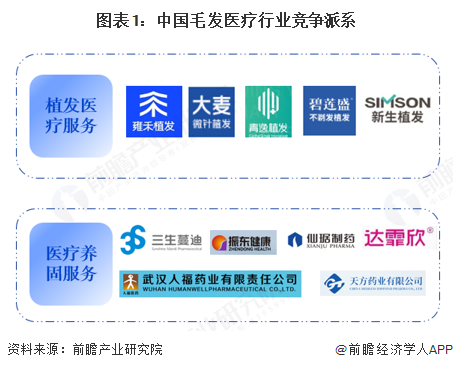
Core Insights - The article discusses the competitive landscape of the hair medical industry in China, highlighting key players and market dynamics [1][5]. Group 1: Competitive Landscape - The Chinese hair medical industry features various competitive factions, with companies like Yonghe Medical, Damaik, and Qingyi focusing on hair transplant medical services, while SanSheng Pharmaceutical, Zhendong Pharmaceutical, and Xianju Pharmaceutical are involved in medical nurturing services [1]. - In the hair transplant sector, the first tier consists of leading national chain brands such as Yonghe Medical, Bilian Sheng, and Damaik, which collectively hold a significant market share and possess nationwide direct chain layouts, mature technology systems, and strong brand recognition [1]. Group 2: Hair Growth Pharmaceuticals - In the hair growth pharmaceuticals market, the first tier includes SanSheng Pharmaceutical, Zhendong Pharmaceutical, and Merck, with the former two holding major shares in the minoxidil market, while Merck is recognized as the original manufacturer of finasteride [5]. - The second tier comprises Xianju Pharmaceutical, Kang En Bei, and Xiamen Meishang Pharmaceutical, which have accelerated the launch of minoxidil and finasteride products in recent years, gaining notable market recognition [5]. Group 3: Sales Performance - In the online pharmacy sector, Zhejiang SanSheng's minoxidil tincture product achieved sales exceeding 1 billion yuan, while Zhendong Anxin's minoxidil lotion surpassed 300 million yuan in sales, and SanSheng's minoxidil foam also exceeded 100 million yuan [9]. - In the offline market during the first quarter of 2025, Zhejiang SanSheng's minoxidil tincture and Zhendong Anxin's minoxidil lotion both recorded sales above 20 million yuan, with market shares of 50.61% and 38.82%, respectively [10]. - The sales ranking for minoxidil products shows Zhejiang SanSheng's minoxidil tincture leading with over 34 million yuan in sales (50.61% market share), followed by Zhendong Anxin's minoxidil lotion with over 26 million yuan (38.82% market share) [11].



3.4亿脱发人,养肥东北富豪家族
创业家· 2025-12-20 11:08
Core Insights - The article highlights the growing concern of hair loss among young people in China, with approximately 340 million individuals affected, leading to a burgeoning market for hair health management, projected to reach 52.7 billion yuan by 2024, up from 19.8 billion yuan in 2018 [4][9][12]. Group 1: Market Dynamics - The topic of hair loss has garnered over 2.86 billion views on Xiaohongshu, indicating significant consumer interest and anxiety [4]. - The hair health management market in China is expected to grow to 171.4 billion yuan by 2035, with the hair loss treatment market alone projected to increase from 500 million yuan in 2018 to 3.5 billion yuan in 2024, marking a sevenfold growth over seven years [12][18]. Group 2: Company Overview - Mandi International, a leading player in the hair loss treatment sector, has submitted its IPO application to the Hong Kong Stock Exchange, aiming to become the first public company focused on hair loss prevention [5][6]. - The company has a strong market presence, holding a 71% market share in the minoxidil segment, with a compound annual growth rate (CAGR) of 21.9% in revenue from 2022 to 2024 [18][20]. Group 3: Financial Performance - Mandi International's revenue reached 982 million yuan in 2022, 1.23 billion yuan in 2023, and is projected to be 1.46 billion yuan in 2024, with net profits of 202 million yuan, 341 million yuan, and 390 million yuan respectively during the same period [20]. - The company's gross margin has consistently remained above 80%, while net margins are between 20% and 30%, indicating strong profitability comparable to high-margin industries like liquor [21]. Group 4: Challenges and Risks - Mandi International faces significant risks, including a heavy reliance on its main product line, which accounted for approximately 92% of total revenue from 2022 to mid-2025 [23][24]. - The company has experienced a decline in research and development spending, which fell to 2.62% of revenue in the first half of 2025, down from 8.15% in 2022, raising concerns about its long-term innovation capabilities [25]. - The concentration of suppliers and customers poses additional risks, with the top five suppliers accounting for 75.6% of total purchases and the top five customers contributing 62.6% of revenue [26].
3.4亿脱发人,捧出一个东北富豪家族
创业邦· 2025-12-11 10:15
Core Viewpoint - Hair loss anxiety has become a significant concern for approximately 340 million people in China, leading to a burgeoning market for hair health management products, projected to reach 52.7 billion yuan by 2024, up from 19.8 billion yuan in 2018, marking a 2.6-fold increase [6][9]. Group 1: Market Dynamics - The topic of hair loss has garnered over 2.86 billion views on social media platforms, indicating a strong consumer interest and anxiety surrounding the issue [6]. - The number of hair loss patients in China has surged from 270 million in 2018 to 340 million in 2024, with a compound annual growth rate of 3.8%, and over 60% of this demographic is under 35 years old [9][10]. - The hair health management market is expected to expand to 171.4 billion yuan by 2035, with the hair loss treatment segment growing from 500 million yuan in 2018 to 3.5 billion yuan in 2024, a sevenfold increase over seven years [13]. Group 2: Company Overview - Mandi International, a leading player in the hair loss treatment sector, has submitted its IPO application to the Hong Kong Stock Exchange, aiming to become the first public company focused on hair loss prevention [6][8]. - The company has maintained a dominant market share, with its products accounting for approximately 92% of total revenue from 2022 to the first half of 2025 [22]. - Mandi's revenue has shown significant growth, with figures reaching 982 million yuan in 2022, 1.228 billion yuan in 2023, and 1.455 billion yuan in 2024, alongside a net profit of 202 million yuan, 341 million yuan, and 390 million yuan respectively [18][20]. Group 3: Financial Performance - Mandi International's gross margin has consistently remained above 80%, with net profit margins between 20% and 30%, comparable to high-margin industries like liquor [18]. - The company has engaged in a "clearance dividend" strategy, distributing 1.42 billion yuan in dividends from 2022 to the first half of 2025, which has significantly reduced its cash reserves from 1.127 billion yuan at the end of 2024 to 110 million yuan in the first half of 2025 [24][25]. - The company's financial ratios indicate potential liquidity issues, with the current ratio dropping from 4.3 in 2024 to 1.0 in the first half of 2025, and the quick ratio falling below 1.0 to 0.8 [26]. Group 4: Competitive Landscape - Mandi International faces increasing competition as several companies are entering the hair loss treatment market, leveraging lower prices and aggressive marketing strategies [26]. - The concentration of suppliers and customers poses risks, with the top five suppliers accounting for 75.6% of total purchases and the top five customers contributing 62.6% of revenue [24]. - The company’s reliance on a single product line, particularly the minoxidil series, raises concerns about revenue stability in the face of market competition and potential patent expirations [22][24]. Group 5: Future Outlook - Mandi International's journey from launching its first minoxidil product in 2001 to its upcoming IPO reflects the growth of the hair loss treatment market driven by consumer anxiety [27][29]. - The company must demonstrate its long-term value beyond just strong sales of its hair loss products to succeed in the capital market [29].
3.4亿脱发人,养肥东北富豪家族
盐财经· 2025-12-04 11:02
Core Insights - The article highlights the growing concern of hair loss among young people in China, with approximately 340 million individuals affected by hair loss anxiety, leading to a burgeoning market for hair health management products [3][7][8]. - The company Mandi International, which produces Minoxidil solutions, is positioned to benefit from this trend and has filed for an IPO to become the "first stock in anti-hair loss" [5][6]. Market Overview - The hair health management market in China is projected to reach 52.7 billion yuan by 2024, a 2.6-fold increase from 19.8 billion yuan in 2018 [4]. - The number of individuals suffering from hair loss in China has increased from 270 million in 2018 to 340 million in 2024, with a compound annual growth rate of 3.8% [7]. Consumer Behavior - Over 60% of the hair loss population is under 35 years old, indicating a shift in demographics where hair loss is no longer just a middle-aged concern [8]. - Young consumers are increasingly investing in hair care products, with significant discussions on platforms like Xiaohongshu, where topics related to hair care have garnered billions of views [12]. Company Profile: Mandi International - Mandi International has maintained a leading market share in the anti-hair loss sector for ten consecutive years, with a systematic approach to product and channel development [22]. - The company has achieved a revenue compound annual growth rate of 21.9% from 2022 to 2024, with revenues of 982 million yuan, 1.228 billion yuan, and 1.455 billion yuan respectively [26][25]. Financial Performance - Mandi's gross margin has consistently remained above 80%, with net profit margins between 20% and 30%, comparable to high-margin industries like liquor [26]. - The company has declared a total dividend of 1.42 billion yuan from 2022 to mid-2025, which has significantly reduced its cash reserves from 1.127 billion yuan at the end of 2024 to 110 million yuan by mid-2025 [33][34]. Risks and Challenges - Mandi International faces a "single product dependency" issue, with approximately 92% of its revenue coming from Minoxidil products, raising concerns about future revenue stability amid increasing competition [29]. - The company has seen a decline in research and development spending, which fell to 2.62% of revenue in mid-2025, down from 8.15% in 2022, indicating a potential risk in maintaining competitive advantage through innovation [31]. Competitive Landscape - The market for Minoxidil is becoming increasingly competitive, with several companies entering the space, potentially eroding Mandi's market share as patents expire [36]. - Mandi's distribution network has shrunk, with the number of distributors decreasing from 173 in 2022 to 106 in mid-2025, which could impact its market reach and stability [32]. Future Outlook - The article concludes that while Mandi International has capitalized on the market for hair loss solutions, it must address its reliance on a single product and improve its R&D efforts to sustain long-term growth and market relevance [39][40].
秋冬防脱发避坑指南
Ke Ji Ri Bao· 2025-12-03 01:04
Group 1 - The effectiveness of popular home remedies for hair loss, such as ginger application, is questioned, with claims lacking scientific support and potential harm to hair follicles [1] - Ginger's active component, gingerol, may temporarily stimulate blood circulation but can lead to irreversible damage to the scalp with prolonged use [1] - Black sesame seeds are believed to help with hair growth based on traditional Chinese medicine, but their benefits are limited to hair loss caused by nutritional deficiencies, not androgenetic alopecia [2] Group 2 - Popular hair growth products containing minoxidil are less effective than prescribed medications, as many over-the-counter versions lack sufficient concentration and purity [3] - Minoxidil is FDA-approved for treating androgenetic alopecia and requires continuous use for 3-6 months to show results [3] - Saw palmetto, a natural extract, is suggested to inhibit 5α-reductase, but there is no formal scientific evidence supporting its effectiveness against hair loss, and many products containing it lack proper certification [3]
毛发医疗概念持续拉升 八大概念股盘点(名单)
Zheng Quan Zhi Xing· 2025-06-10 07:21
Industry Overview - The hair medical sector has shown significant activity recently, with the sector index reaching a new high as of June 10, 2023, driven by active stock performances from companies like Aoyang Health and Kanghui Medical [1] - The hair medical services can be divided into hair transplant services and medical hair care services, with hair transplant services currently dominating the market [1] - The growing trend of beauty economy and self-consumption is leading consumers to invest more time and money in hair health and aesthetics, which is expected to drive continuous growth in the hair medical industry [1] - According to Frost & Sullivan, the market size of hair medical services in China is projected to reach 138.1 billion yuan by 2030, with a CAGR of 22.3% from 2020 to 2030 [1] Market Dynamics - The medical hair care market is expected to grow rapidly due to the high frequency and repurchase characteristics of hair care services, with the "hair transplant and care" integration trend driving this growth [2] - By 2030, the medical hair care services are anticipated to account for 45.3% of the total hair medical services market in China, becoming a significant driver of industry development [2] Key Companies - Zhendong Pharmaceutical (300158): The company's main product, Dafeixin Minoxidil Solution, is the only topical medication approved by both the FDA and NMPA for treating hair loss [2] - Huilong Co., Ltd. (002556): The company offers hair growth and hair loss treatment products, including Zhi Zhi Hair Growth Tablets and Compound Ginseng Phenol Solution, which have national drug approval [2] - Kanghui Pharmaceutical (603139): The company has several drugs listed in the national medical insurance directory, including hair loss treatment tablets [3] - Aoyang Health: The company's subsidiary, Weien Medical Beauty, includes hair transplant services [4] - Tainkang (301263): The company is applying for a one-time import of raw materials for Baricitinib, which is under research for hair growth indications [4] - Kangyuan Pharmaceutical: The new hair loss treatment drug Minoxidil Tincture has completed registration verification and GMP compliance checks [4] - Langzi Co., Ltd. (002612): The company has medical beauty institutions that offer hair transplant-related services [5] - Huabang Health (002004): The company has a hair transplant center under Maan Skin, utilizing MN-FUE hair transplant technology for patient treatment [6]


