
经济型车

Search documents
租车出行马力全开
Xin Lang Cai Jing· 2026-02-26 21:46
Core Insights - The 2026 Spring Festival saw a significant increase in car rental demand, with platforms reporting over 50% growth in order volume and user scale compared to the 2025 Spring Festival, marking a record high for the holiday season [1][2] - The rental market experienced a dual peak in order volume, with the highest demand on the first day of the holiday and mid-festival, indicating a shift in consumer behavior towards longer and more diverse travel plans [1][2] Group 1: Market Trends - The rental market for the 2026 Spring Festival showed strong activity, with orders for rentals exceeding 9 days and driving distances over 800 kilometers achieving double-digit growth [2] - Cross-city travel demand surged, with orders for drop-off at different locations increasing nearly twofold, indicating a trend towards segmented travel experiences [2] - Popular routes included intercity travel in regions like Hainan, Yunnan, and Guangxi, reflecting a growing preference for exploring multiple destinations during the holiday [2] Group 2: User Demographics - Both new and existing users of rental platforms saw double-digit growth, with a notable increase in the proportion of high-activity users, particularly among gold-level members [3] - The demographic distribution showed that "post-80s" and "post-90s" generations formed the core of family travel, while "post-00s" emerged as a dynamic force in the rental market, emphasizing flexibility and experience [3] Group 3: Vehicle Preferences - Users increasingly favored practical, intelligent, and high-quality vehicles, with economy cars, electric vehicles, and SUVs making up over 80% of the rental market [4] - Electric vehicles experienced a remarkable fivefold increase in order volume, highlighting a growing acceptance of green travel options during long-distance trips [4] - The trend indicates that car rental is becoming a vital mode of transportation for family gatherings, travel, and cross-city living, with sustained interest expected to continue beyond the Spring Festival [4]
崔東樹:11月車市劇烈分化特徵明顯 C級車型走勢較強
智通财经网· 2026-01-06 09:31
Core Insights - The article discusses the structural changes in the regional automotive market in China, driven by economic development and government policies aimed at boosting domestic consumption and diversifying exports. It predicts a unique growth trend in the passenger car market for 2025, characterized by strong retail performance from January to September, followed by adjustments in October and November [1]. Group 1: Market Trends - The automotive market is experiencing significant differentiation, with regions that have resumed subsidies showing substantial growth compared to those that have paused them [1]. - The subsidy policies are favoring mid to low-end vehicles, particularly economic models, reflecting a fair distribution of benefits across the market [1]. - The performance of A00 and A0 class electric vehicles is notably strong in regions like North China and Northeast China, indicating a positive impact of the "two new" subsidy policies [1]. Group 2: Regional Market Analysis - The overall growth pattern of the automotive market is shifting towards a "strong North, weak South" dynamic, with Northern regions, especially Northeast and Central Yangtze areas, showing relatively strong performance [2][3]. - In November, the market share of Northern regions decreased by 3.7 percentage points compared to the previous year, while it increased by 5.4 percentage points compared to 2022 [3]. - The Northeast and Northwest regions are identified as the fastest-growing areas in the Chinese automotive market, while Southern regions are underperforming [3]. Group 3: Policy Impact - The article highlights the significant role of government policies in shaping regional market structures, particularly through subsidy adjustments that influence consumer behavior and vehicle sales [4]. - The changes in subsidy policies have led to complex market structure variations across different regions, with Northern markets showing stronger annual performance despite some monthly fluctuations [3]. Group 4: Vehicle Type Market Structure - The demand for SUVs is particularly strong in the Central and Western regions, driven by geographical factors, while Eastern regions show weaker performance in this category [7]. - The growth of new energy vehicles, especially pure electric and plug-in hybrids, is notable, with traditional fuel vehicles still holding a significant market share in Northern and Central regions [8]. - The penetration rate of new energy vehicles is over 50% in Eastern regions, while Northern regions are experiencing rapid growth in pure electric vehicle adoption [8].

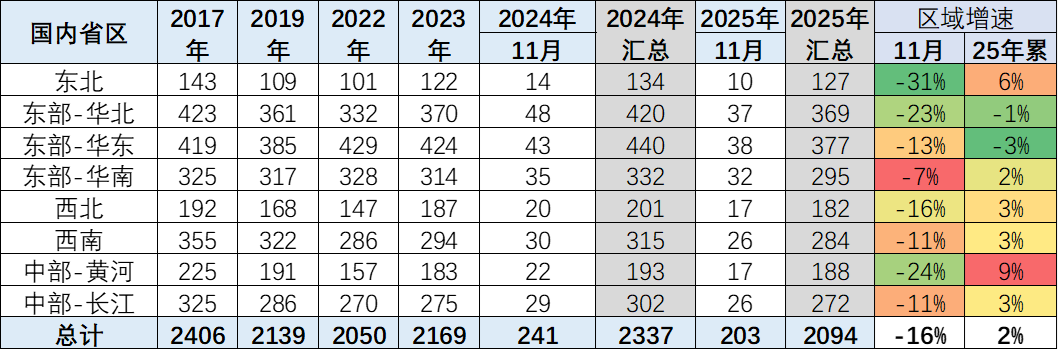
【乘联分会论坛】2025年11月乘用车区域市场流向分析
乘联分会· 2026-01-06 09:07
Core Viewpoint - The article discusses the structural changes in the Chinese automotive market driven by economic development, policy incentives, and regional performance variations, highlighting a significant shift towards the northern regions and the impact of subsidy policies on vehicle sales [2][4]. Regional Market Trends Analysis - The automotive market is experiencing a pronounced divergence, with northern regions, particularly Northeast and Northwest, showing strong growth, while southern regions lag behind [4][5]. - In November 2025, the northern market's share decreased by 3.7 percentage points compared to the previous year, but it increased by 5.4 percentage points compared to 2022 [3]. - The overall market growth is characterized by a "strong north, weak south" pattern, with northern regions outperforming southern ones in recent years [3][4]. Policy Impact on Regional Structure - The "Two New" subsidy policies have significantly encouraged the sales of low-end and economic vehicles, particularly benefiting A00 and A0 class electric vehicles in northern regions [2][5]. - The market structure is complex due to varying subsidy policies across regions, with some areas experiencing strong monthly performance despite weaker annual trends [4][5]. - The central region's market share increased by 1.2 percentage points year-on-year in 2025, indicating a recovery in the Yangtze River area [5] . Vehicle Class Market Structure Changes - The SUV segment is experiencing robust growth, particularly in the central and western regions, driven by geographical demand and the popularity of new energy SUVs [7][8]. - The demand for traditional fuel vehicles remains significant in northern and central regions, while eastern regions are seeing a higher penetration of new energy vehicles [8][9]. New Energy Power Structure Analysis - In November 2025, the penetration rate of new energy vehicles is notably high in regions like Hainan and Guangxi, exceeding 60%, while other areas are approaching 50% [8][9]. - The growth of pure electric vehicles is particularly strong in northern regions, reflecting a shift in consumer preferences and policy support for new energy vehicles [8][9].

乘联分会:补贴政策鼓励中低端,经济型车回暖
Cai Jing Wang· 2025-12-02 07:16
Core Insights - The report from the Passenger Car Association highlights that the "two new" subsidy policies this year have effectively supported poverty alleviation and fairness across most regions, benefiting economic vehicles significantly [1] - The promotion of subsidies for scrapping and replacing old vehicles has provided a greater advantage for new energy vehicles compared to traditional fuel vehicles [1] - The relatively lower prices of mid-to-low-end new energy vehicles, combined with equitable subsidies, have positively stimulated consumer purchasing enthusiasm [1]