
结婚消费券

Search documents
每对1000元!宁波发放专项消费券,这类人可领
Xin Lang Cai Jing· 2026-02-28 03:44
Group 1 - The core initiative is the issuance of wedding consumption vouchers worth 1000 yuan for newlyweds registering in Ningbo from March 2 to March 31, 2026 [2][3] - Each couple can receive one set of vouchers, with a limited number available on a first-come, first-served basis [3] - The vouchers consist of 8 coupons, each providing a discount of 125 yuan on purchases over 500 yuan, applicable to various wedding-related services [4] Group 2 - The eligible services for the vouchers include wedding photography, wedding planning, marriage counseling, leisure travel, hotel accommodations, cultural and creative wedding products, and retail dining [4] - The vouchers are valid for 10 days from the date of issuance and must be used within this period; expired vouchers will be reclaimed by the issuing platform [4] - Couples can claim the vouchers by completing real-name authentication on the Cloud Flash payment platform and filling out a voucher issuance form at the marriage registration office [5] Group 3 - To redeem the vouchers, users must present a UnionPay standard "payment code" or use the Cloud Flash app to scan and complete the payment [6] - Multiple vouchers can be used together, allowing a maximum of 8 vouchers to be combined for a single transaction [6] - The final interpretation rights of the activity are reserved by the organizer, with specific rules governed by the Cloud Flash platform [6]

给甜蜜经济添把火,多地向新婚夫妇发放结婚消费券
Sou Hu Cai Jing· 2025-11-03 04:38
Group 1 - The Ningbo civil affairs department is issuing 1,000 yuan wedding consumption vouchers to newlyweds, which is part of a broader initiative in Zhejiang to support marriage and childbirth [2] - The wedding consumption vouchers are seen as a positive attempt to enhance the birth support policy system and stimulate the "sweet economy" [2] - The initiative aims to create a favorable environment for a birth-friendly society, interacting positively with other policies like childcare subsidies [2] Group 2 - The declining birth rate across the country is a pressing issue, impacting labor resources and ultimately affecting industrial development and urban vitality [2][3] - The "sweet economy," encompassing services from wedding photography to honeymoon travel, is gaining traction in various cities, prompting exploration of new development models that integrate marriage, industry, and tourism [2] - To maximize the effectiveness of the wedding consumption vouchers, there is a need to improve public awareness, streamline the process of obtaining them, enhance user experience, and expand usage scenarios [3]

多地向新婚夫妇发放结婚消费券 经济日报:给甜蜜经济添把火
Jing Ji Ri Bao· 2025-11-03 00:09
Core Insights - Ningbo's civil affairs department is issuing 1,000 yuan wedding consumption vouchers to newlyweds, following similar initiatives in various regions of Zhejiang, aimed at enhancing the birth support policy system and stimulating the "sweet economy" [1][2] - The wedding consumption vouchers, while modest in amount, represent a beneficial attempt to interact positively with other policies like childcare subsidies, contributing to the establishment of a birth-friendly society [1] - The declining birth rate across the country has become a pressing issue, impacting labor resources and ultimately affecting industrial development and urban vitality [1][2] Group 1: Economic Impact - The "sweet economy" is gaining traction nationwide, with various cities exploring new models that integrate marriage, industry, and cultural tourism, thereby broadening and deepening the consumer market [1] - The wedding consumption vouchers can be utilized across multiple sectors such as wedding photography, hotel accommodations, and clothing, effectively stimulating market consumption [1] - For newlyweds, these vouchers alleviate some financial burdens associated with wedding preparations, while businesses benefit from expanded market share [1] Group 2: Policy Implementation - Despite the introduction of financial incentives, there remains a challenge in ensuring that the target demographic understands how to access and utilize the wedding consumption vouchers, which can diminish the effectiveness of the policy [2] - To maximize the impact of the wedding consumption vouchers, there is a need to enhance policy awareness, streamline the application process, improve user experience, and expand usage scenarios [2]
城市24小时 | 增速倒数 能源大省再提“转型”
Mei Ri Jing Ji Xin Wen· 2025-10-30 16:10
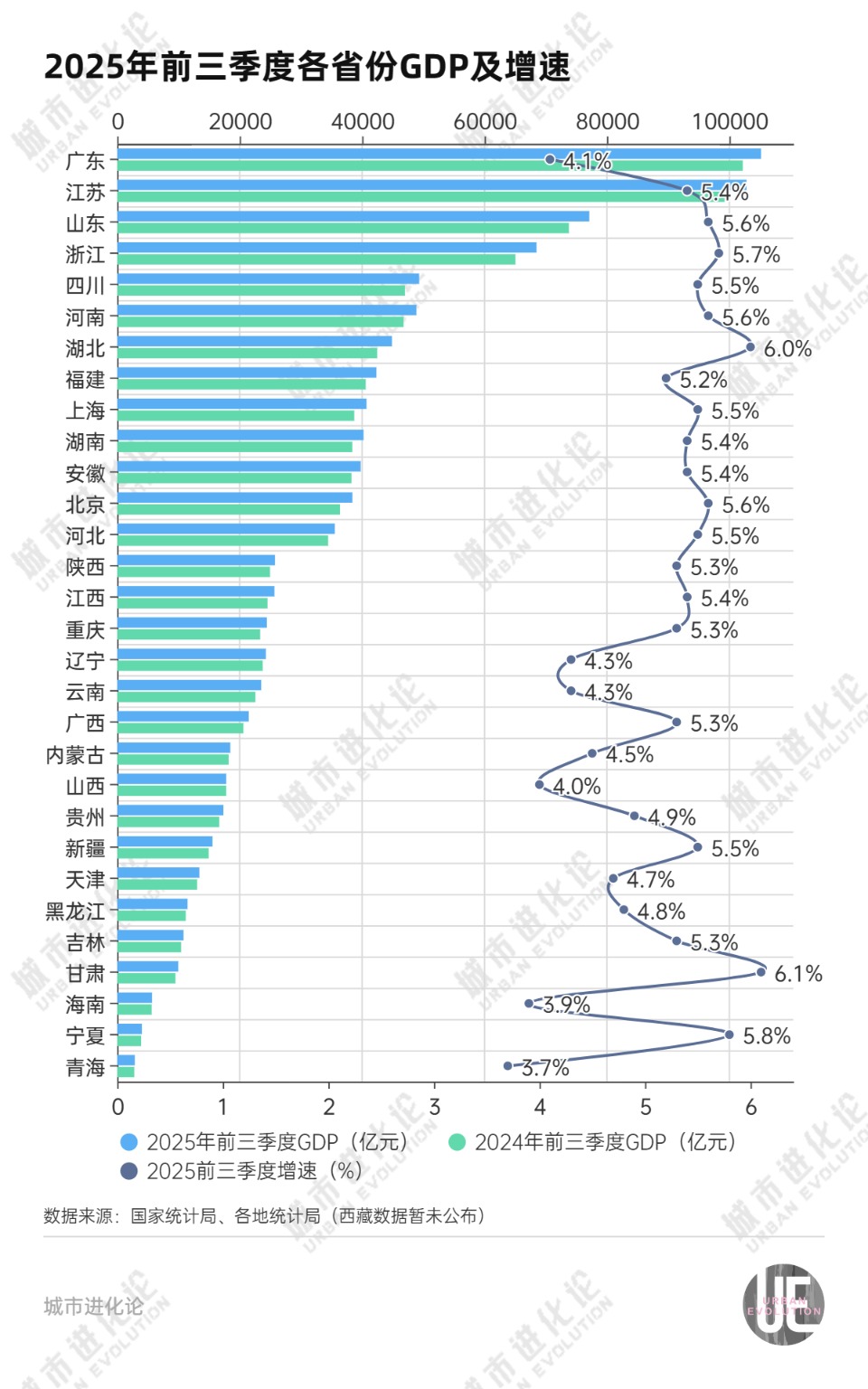
Economic Data Overview - As of now, 30 provinces in China have released their GDP data for the first three quarters, with only Tibet not reporting [1] - 19 provinces outperformed the national average GDP growth rate of 5.2%, with Gansu leading at 6.1% and Fujian matching the national rate [1] - 10 provinces lagged behind the national average, with Qinghai, Hainan, and Shanxi having the lowest growth rates at 3.7%, 3.9%, and 4.0% respectively [1] Shanxi Province Economic Performance - Shanxi's GDP growth remains weak, with a mere 1.8% growth in the same period last year, ranking it at the bottom nationally [4] - The province's GDP growth for the first three quarters of this year is reported at 4.0%, which is an increase of 0.2 percentage points from the first half of the year [4] - The industrial sector, particularly the secondary industry, is a significant drag on growth, with a reported increase of 3.5% in value added for the secondary industry [4] Coal Industry Impact - Shanxi, being a major energy province, has over 30% of its GDP and 50% of its fiscal revenue coming from the coal industry, making its economy highly sensitive to coal market fluctuations [5] - From January to September, the coal mining and washing industry saw a 20% decline in revenue and a 51% drop in total profits, despite a 13% decrease in operating costs [5] - The value added of the coal industry in Shanxi grew by 5.6% in the first three quarters, but this represents a decline of 1.5 percentage points from the first half of the year [5] Transition and Development Initiatives - Shanxi has been recognized as a national pilot for energy revolution reforms since 2019, focusing on transitioning from coal to smarter and higher-value products, including investments in wind, solar, and hydrogen energy [6] - The province's government emphasized the need for a robust transition strategy, highlighting the challenges of insufficient technological innovation and the small scale of emerging industries [6] - Notable growth in emerging sectors includes a 6.9% increase in the value added of equipment manufacturing, with renewable energy equipment manufacturing growing by 160% [6] - Investments in high-tech services, new energy vehicles, and renewable energy generation have also seen significant increases of 13.2%, 36.5%, and 26.4% respectively [6]
供需发力做大消费“蛋糕” 政策协同做强国内大循环
Shang Hai Zheng Quan Bao· 2025-05-29 18:59
Group 1 - The article highlights the resurgence of consumer activities in China, driven by various festivals and local government initiatives aimed at boosting consumption and enhancing domestic circulation [1] - Local governments in provinces like Henan, Fujian, and Guangdong have introduced special action plans to stimulate consumption, including measures for job stability, income promotion, and the issuance of consumption vouchers [1][2] - New types of consumption vouchers, such as childcare and wedding vouchers, are gaining attention, with Guangdong launching a "2025 Childcare Voucher" program to support parents financially [2][3] Group 2 - There is a focus on expanding service consumption, particularly in areas like childcare and elderly care, which are expected to drive consumption growth due to increasing demand in urbanization [2][4] - Local initiatives are also aimed at enhancing cultural and tourism consumption, with events designed to promote travel and related spending [3][4] - Collaborative policies across various sectors, including finance and taxation, are being implemented to support consumption, with Guangdong offering interest subsidies for personal loans in the service sector [4][5] Group 3 - The article notes that the "Two New" policies have significantly contributed to expanding domestic demand, with substantial sales growth in digital products and home appliances [5][6] - The National Development and Reform Commission plans to accelerate funding distribution and implement policies to reduce financing costs for equipment updates, aiming to enhance the quality of economic circulation [6] - Experts emphasize the importance of aligning consumption promotion with industrial upgrades and public service investments to improve living standards and stimulate new consumption growth points [6]