网易天音

Search documents
不卷通用大模型,网易AI的“错位”生存法则
Sou Hu Cai Jing· 2026-02-12 20:08
Core Viewpoint - The article discusses how NetEase has chosen a pragmatic approach in the AI era, avoiding the costly competition of developing general-purpose AI models while focusing on application-level innovations and maintaining a strong R&D investment [3][20]. Group 1: Market Context - During the recent Spring Festival, major tech companies like Alibaba, Tencent, ByteDance, and Baidu spent over 4.5 billion yuan on "red envelopes," marking one of the most expensive tech competitions in history [2]. - NetEase, however, did not participate in this "red envelope war" or the race for large AI models, leading to questions about whether it is falling behind in the AI era [2][3]. Group 2: Business Strategy - NetEase's strategy is characterized by a focus on practical applications rather than competing in the foundational AI model space, which is seen as a more sustainable approach for most companies [3][20]. - The company has maintained a consistent R&D expenditure of over 15% of its revenue, with a projected R&D budget of 17.7 billion yuan for 2025, focusing on application layers rather than general model training [4][20]. Group 3: AI Integration in Products - NetEase has developed thousands of AI production pipelines that enhance various aspects of game development, achieving significant efficiency improvements, such as a 70% increase in design efficiency and a 50% boost in development efficiency through AI tools [6][8]. - The company has also applied AI in its educational and music platforms, enhancing user experience and operational efficiency without pursuing a general-purpose model [6][8]. Group 4: Financial Performance - In 2025, NetEase's total revenue is expected to reach 112.6 billion yuan, with operating profit at 35.8 billion yuan, driven primarily by its gaming segment, which saw a net revenue increase of 11% year-on-year [13][20]. Group 5: Future Growth Potential - The potential for growth in the gaming industry is seen in AI-native games, which are expected to generate over 30 billion yuan by 2027, contributing to a 10% market increase [13][20]. - NetEase's focus on integrating AI into its gaming products positions it well to capitalize on this emerging market, as it transitions from traditional gaming to AI-driven experiences [13][20].


AI“入侵”、“汽水音乐”崛起:2025音乐行业“变天了”?
3 6 Ke· 2026-02-06 02:38
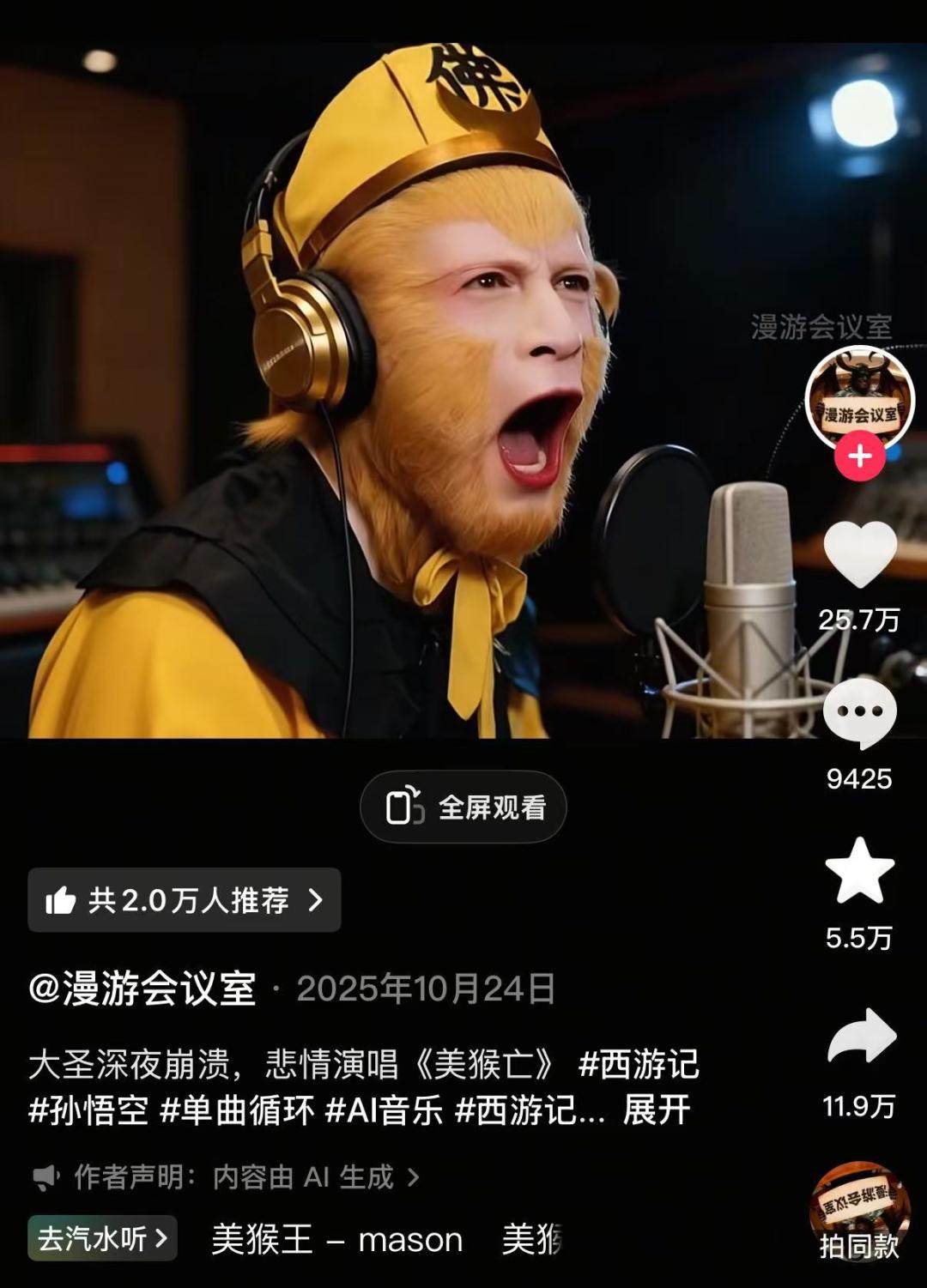
Core Insights - The music industry is undergoing significant transformation by 2025, driven by the integration of AI technology into various aspects of music creation, performance, and consumption [1][2] - AI-generated music has become mainstream, with notable examples such as the AI singer "Daitoujin" gaining popularity and being mistaken for a real artist [10][11] - The live performance market is experiencing a surge in cross-genre collaborations, with actors and idols making their music debut, enhancing audience engagement [16][18] AI Music Integration - By 2025, AI music has evolved from a niche topic to a central element in the music industry, influencing creation, distribution, and audience interaction [1][2] - AI-generated songs, characterized as "AI canned music," are produced at scale, leading to a new wave of content that blurs the lines between real and virtual artists [6][11] - Major platforms like Tencent and NetEase have launched AI-assisted music products, indicating a shift towards AI as a content producer rather than just a tool [12] Live Performance Market - The live performance sector in 2025 is marked by a trend of "cross-border debuts," where actors and celebrities perform music, creating a unique blend of entertainment [16][20] - The number of commercial performances reached 640,400, with a box office revenue of 61.655 billion yuan, reflecting a growth of 6.39% from the previous year [20] - This trend not only attracts large audiences but also enhances the overall experience by combining music with emotional connections and event-like atmospheres [20] Music Variety Shows - The music variety show landscape in 2025 is characterized by a focus on the "talent show" model, which continues to evolve and adapt to audience preferences [21][23] - Despite the popularity of talent shows, there is a growing demand for innovative and emotionally resonant content, leading to a more complex viewing experience [23] - The evolution of talent shows reflects the industry's struggle to capture attention in a fragmented entertainment landscape, emphasizing the need for engaging narratives and audience participation [23]
AI观察|AI艺术品“攻占”佳士得,背后是艺术与科技的碰撞
Huan Qiu Wang· 2025-03-24 07:36
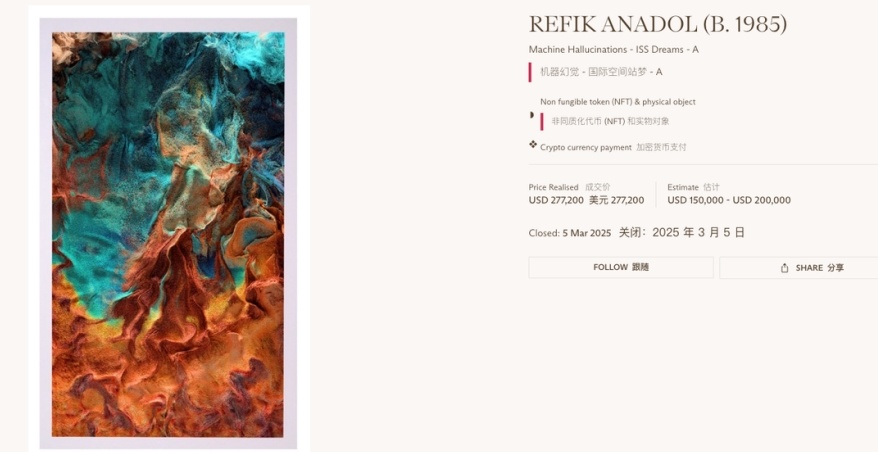
Core Insights - The auction held by Christie's featured exclusively AI-generated artworks, marking a significant event in the intersection of art and technology [1] - The total revenue from the auction reached $792,000, exceeding the initial target by 20%, with the highest piece selling for $277,000 [1] - The event sparked considerable debate and controversy within the art community, highlighting the ongoing tensions between traditional artists and AI-generated content [4] Group 1: Auction Details - Christie's organized the first auction dedicated solely to AI-generated artworks, showcasing 20 to 30 pieces [1] - The auction's total revenue was $792,000, which was 20% higher than the expected target [1] - The most expensive artwork sold for $277,000, indicating a strong market interest in AI art [1] Group 2: Community Response - A public letter circulated on social media, signed by 6,500 artists, urged Christie's to cancel the auction, citing concerns over copyright infringement and exploitation of human artists [4] - The letter emphasized the lack of authorization and fair compensation for the use of copyrighted works in training AI models [4] - The controversy reflects broader discussions about the role of AI in creative fields traditionally dominated by human artists [4] Group 3: AI in Art and Music - AI is increasingly being utilized in various artistic domains, including painting and music, with platforms like Douyin's Sponge Music allowing users to create songs easily [5] - The Shanghai Conservatory of Music established a key laboratory focused on AI in music therapy, indicating a growing trend of interdisciplinary collaboration between technology and the arts [6][7] - The application of AI in art is evolving rapidly, prompting a reevaluation of traditional artistic concepts and opening up new possibilities for creativity [7]