老年旅游

Search documents
国常会最新部署,这样推进银发经济和养老服务
Jing Ji Guan Cha Wang· 2026-02-25 11:37
Core Viewpoint - The State Council meeting emphasizes the significant potential of the silver economy in China, highlighting the need for improved support measures and policy implementation to promote the development of elderly care services and industries, addressing the challenges of an aging population [1][2] Group 1: Silver Economy Potential - The silver economy is projected to exceed 30 trillion yuan, with the elderly population aged 60 and above expected to reach 320 million by the end of 2025 and over 400 million by 2035 [1][3] - There is a structural imbalance in the consumption of the elderly, with a potential demand of trillions of yuan not fully realized due to limitations in consumption capacity, scenarios, and perceptions [2][3] Group 2: Enhancing Consumption Capacity - A "policy toolbox" is needed to enhance consumption capacity, focusing on three areas: improving the multi-tiered pension insurance system, innovating consumption subsidy mechanisms, and optimizing consumption time arrangements [2][3] - Specific measures include expanding long-term care insurance coverage, providing targeted subsidies for rehabilitation aids and smart elderly care devices, and encouraging flexible retirement systems [2] Group 3: Improving Elderly Care Services - The meeting calls for the enhancement of the elderly care service system, aiming to address the structural contradiction of insufficient supply [3][4] - By the end of 2025, the goal is to have 394,000 elderly care institutions and 7.68 million beds, with various subsidies benefiting over 52.86 million people [3] Group 4: Service System Development - A tiered service system is essential, promoting a network that integrates home-based care, community support, and institutional care, with a focus on quality improvement [4][5] - The development of nursing beds and professional care capabilities is prioritized to meet the needs of disabled and semi-disabled elderly individuals [4] Group 5: Safety and Ethical Considerations - Strengthening safety management in elderly care institutions is crucial, with a focus on combating fraud and protecting the rights of the elderly [4][5] - The principle of "technology for good" should guide the introduction of smart products in elderly care, ensuring safety and ethical considerations are prioritized [5]
供需协同发力,扩容服务消费
Guo Ji Jin Rong Bao· 2026-01-17 12:52
Core Insights - The "14th Five-Year Plan" emphasizes the expansion of service consumption as a key focus, aiming for significant growth and quality improvement in this sector over the next five years [1] Group 1: Enhancing Resident Income Levels - Measures to improve overall resident income levels should include not only job creation but also stabilizing asset prices and strengthening social security systems [2] - Policies should aim to reverse the downward trend in urban housing prices and upgrade management strategies from stabilizing to promoting the stock market [2] - Increasing fiscal support for social security, particularly in pension systems, is essential to enhance consumer confidence in service consumption [2] Group 2: Policy Innovation for High-Quality Service Supply - The government should utilize various funding channels to support the construction of service facilities in sectors like culture, tourism, and healthcare [3] - There is a need to relax market access for the service industry and eliminate discriminatory regulations against different ownership types [3] - Attracting foreign capital into domestic service sectors, especially in telecommunications, education, and healthcare, is crucial for service consumption growth [3] Group 3: Expanding New Service Consumption Scenarios - Funding should be directed towards cultural heritage sites and urban renewal projects to create new consumption scenarios [4] - The integration of digital services and traditional consumption should be promoted to enhance service accessibility and quality [4] - Collaboration between various cultural sectors and the development of new consumption models are essential for fostering innovative service experiences [4] Group 4: Systematic Development of Service Consumption Standards - Establishing a collaborative standard-setting system involving government and market entities is necessary for service quality improvement [5] - Encouraging service enterprises to shift focus from merely selling services to selling brands and experiences can help rebuild consumer trust [5] - Implementing efficient dispute resolution mechanisms and enhancing consumer protection in high-risk service areas is vital [5] Group 5: Adapting to Demographic Changes - The aging population and changing birth policies will create significant opportunities in the "silver economy" and "child-rearing economy" [6] - Developing industries that cater to the elderly, such as education and healthcare, is essential for meeting their needs [6] - New childcare models and improved parental leave policies are necessary to support families and alleviate childcare pressures [6]
新民环球年终特刊⑩
Xin Lang Cai Jing· 2025-12-30 04:37
Core Viewpoint - Global population aging exhibits significant regional differentiation, with developed countries entering super-aged societies first, while developing countries face the challenge of "aging before becoming rich" [3] Group 1: Governance Models - Germany has established a multi-level collaborative governance structure and pioneered a universal long-term care insurance system to disperse risks through institutional design [3] - Nordic countries combine universal welfare systems with active aging policies, forming a network governance model involving government, market, and social participation [3] - Brazil focuses on the silver economy, exploring new economic growth drivers through industries like senior tourism and health management [3] - India leverages information technology and community resources to explore low-cost elderly care services through a combination of technology empowerment, community support, and volunteer services [3] - Countries like Singapore and Switzerland provide beneficial examples for cross-border elderly care and service standardization through flexible and efficient governance ideas such as smart elderly care and time banks [3] Group 2: East Asia's Aging Response - Japan, as the first country to enter a super-aged society, has developed a comprehensive system combining legal guarantees and diverse policies, including a long-term care insurance system covering all individuals aged 65 and above [5] - South Korea, facing the world's fastest aging speed, focuses on addressing low birth rates and aging simultaneously, implementing cash subsidies and expanding childcare facilities while considering raising the age standard for elderly benefits [5] - China explores a governance model of "government-led + social participation + all-age coverage," integrating aging governance into national mid- to long-term planning and building a multi-tiered pension security system [5] Group 3: Regional Cooperation - East Asian countries can deepen cooperation in five areas: establishing policy coordination and information sharing mechanisms for sustainable experience exchange [5] - Constructing a health and elderly care technology case database to promote mutual learning of best practices [5] - Promoting mutual recognition of medical and care standards and fostering partnerships between institutions [5] - Integrating the silver economy industry chain by combining market advantages, technological strengths, and innovative vitality to form cross-border industry alliances [5] - Cultivating new regional elderly care business models and jointly developing new sectors such as elderly cultural tourism and health management [5]


研判2025!中国老年旅游行业发展背景、市场现状及未来趋势分析:老年人口数量不断增加,老年旅游市场需求持续攀升[图]
Chan Ye Xin Xi Wang· 2025-06-13 01:19
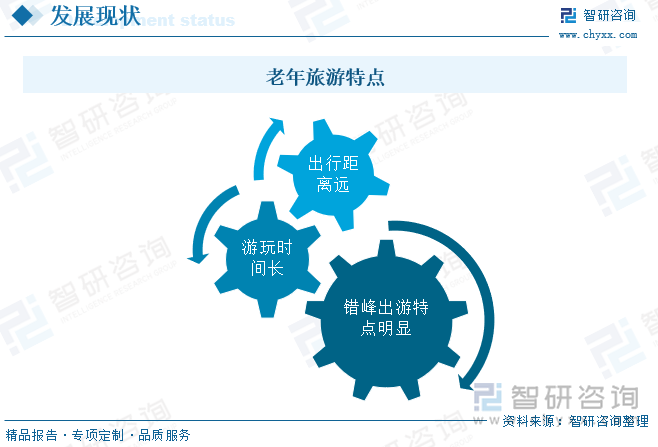
Core Insights - The elderly tourism market in China is experiencing significant growth due to the increasing elderly population, with projections indicating that by the end of 2024, the population aged 60 and above will exceed 300 million, accounting for 22% of the total population [1][6][9] - The market size for elderly tourism is expected to reach 1.67 trillion yuan in 2024, reflecting a year-on-year growth of 18.8% [22] - Government policies are actively supporting the development of elderly tourism, including financial subsidies and tax incentives for tourism companies to create products and services tailored for the elderly [9][11] Industry Overview - Elderly tourism refers to the tourism industry targeting consumers aged 60 and above, characterized by a preference for in-depth travel experiences and longer trips [2][4] - The elderly tourism industry has developed a comprehensive supply chain encompassing accommodation, transportation, attractions, entertainment, and shopping [4] Market Demand - The increasing number of elderly individuals is driving demand for tourism services, with the elderly population's consumption patterns shifting from basic necessities to diverse areas such as cultural entertainment and health management [8][20] - In the consumption structure of the elderly demographic, leisure travel activities dominate, accounting for 57% of their spending [20] Policy Support - The Chinese government has introduced various policies to promote elderly tourism, including the launch of special tourism trains and the development of tourism products that cater to the elderly [9][11][12] - Local governments are also implementing initiatives to enhance elderly tourism, such as improving facilities for elderly travelers and promoting cultural and health tourism [12][13] Current Trends - The elderly tourism market is transitioning from a niche to a mainstream market, with elderly travelers now representing over 20% of the total tourism population [18] - The rise of the "self-care economy" is leading to increased willingness to spend on travel, with per capita domestic tourism expenditure reaching a historical high in 2024 [16][22] Future Outlook - The elderly tourism industry is expected to evolve towards diversification, high-end offerings, and personalized experiences, with a growing preference for slow-paced and experiential travel [24] - Technological advancements will play a crucial role in enhancing the travel experience for elderly consumers, with applications of AI and other technologies in monitoring safety and health during travel [24]