
至强6系列处理器

Search documents
MTS2026集邦咨询存储产业趋势研讨会演讲精华汇总
Sou Hu Cai Jing· 2025-11-28 13:36
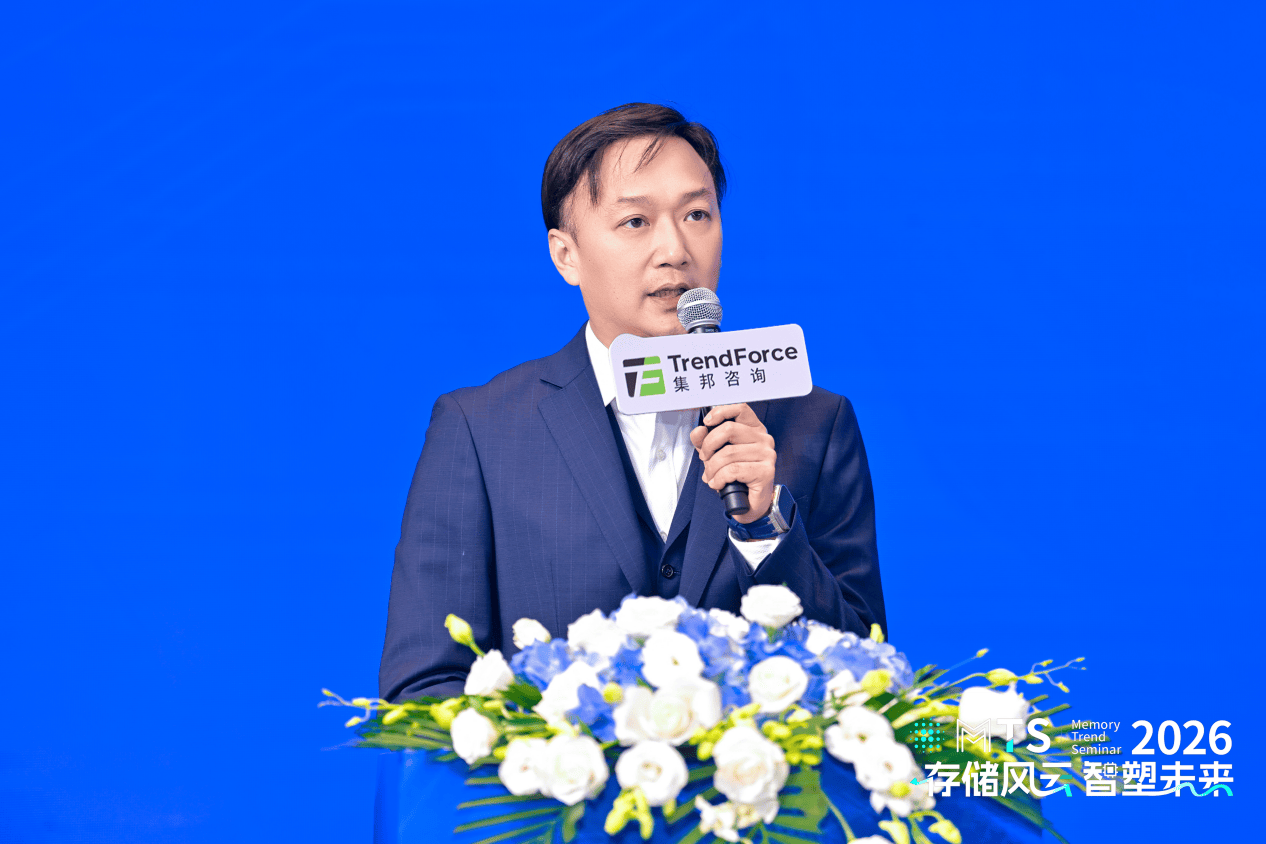
Core Insights - The "MTS2026 Storage Industry Trend Seminar" and the release of the "2026 Top Technology Market Trends Forecast" were successfully held in Shenzhen, gathering over a thousand industry elites and analysts, highlighting the industry's keen interest in future trends [1][37] - The impact of AI on the storage industry was emphasized, with a focus on real demand and significant changes in the high-tech manufacturing supply chain [1] Group 1: Industry Growth and Trends - TrendForce forecasts a 19% annual growth in the wafer foundry industry for 2026, with AI-related demand driving advanced process markets to a remarkable 28% growth [5] - The global data volume is expected to grow at a compound annual growth rate of approximately 40%, necessitating higher performance from data centers [7] - AI servers and general servers are driving a new super cycle in memory, with AI and server-related applications projected to account for 66% of DRAM total capacity by 2026 [17] Group 2: Technological Innovations - Intel's new Xeon 6 series processors are positioned as the preferred choice for global AI servers, featuring performance enhancements and innovative architectures to support AI workloads [7][8] - Solidigm is leading the QLC product market and has introduced high-performance PCIe 5.0 SSDs to meet the demands of AI workloads, enhancing storage efficiency and performance [20] - The introduction of HBF (High Bandwidth Flash) and AI SSDs is expected to reshape the NAND industry value, addressing storage bottlenecks caused by the explosion of LLM parameters [34] Group 3: Market Dynamics and Competitive Landscape - The competition in the AI server market is intensifying, with major players like NVIDIA and AMD leading the GPU AI market, while Chinese companies are increasingly focusing on self-developed ASICs [29] - The memory market is anticipated to face severe shortages, with DRAM ASP expected to rise by 36% in 2026, leading to a projected 56% increase in DRAM revenue [17] - The demand for advanced packaging technologies is growing, with companies like 时创意 adopting innovative processes to meet the requirements of AI-driven applications [13][14]

迎在华四十周年节点 英特尔详阐Intel 18A最新进程
Zhong Guo Jing Ying Bao· 2025-11-28 00:04
Core Insights - The global semiconductor industry is entering a critical phase with the countdown to the mass production of 2nm technology, intensifying competition among major players like Intel, TSMC, and Samsung [1][7] - Intel has unveiled its Intel 18A advanced process technology, which is positioned to compete with TSMC and Samsung's 2nm offerings, aiming to regain its leadership in process technology [1][4] Group 1: Intel 18A Technology - Intel 18A, equivalent to 1.8nm, will be utilized in the next-generation AI PC platform, Panther Lake, leveraging two key technologies: RibbonFET and PowerVia [1][2] - RibbonFET technology enhances control over current flow, significantly reducing leakage, while PowerVia addresses internal chip congestion by relocating power delivery to the back of the chip [2][3] - Intel 18A demonstrates impressive efficiency metrics, with over 15% performance improvement at the same power consumption, and over 25% power reduction for the same performance, alongside a 30% increase in transistor density [3] Group 2: Panther Lake and Future Developments - Panther Lake, based on Intel 18A, is set to enhance multi-core performance by 50% and graphics performance by over 40%, with an AI computing power of 180 TOPS [4][5] - The first Panther Lake processors are currently in production, with an official launch planned for January at CES [5] Group 3: Competitive Landscape - The competition in advanced semiconductor processes is primarily among TSMC, Samsung, and Intel, with TSMC currently leading in 2nm technology with a yield rate of 60%-65% [7][8] - Samsung faces challenges with its 3nm process yield, which is between 20%-40%, impacting its ability to secure major clients [7][8] - Intel's 18A process, while not yet matching TSMC's capacity, has a potential advantage in power efficiency due to its unique PowerVia technology, which could attract high-performance computing and mobile device markets [8] Group 4: AI Ecosystem Development - Intel aims to build a comprehensive AI ecosystem leveraging the Intel 18A process, transitioning PCs from AI-enhanced to AI-native platforms [9] - The Panther Lake platform integrates CPU, GPU, and NPU architectures, supporting advanced AI models and enhancing performance metrics significantly [9] - Intel emphasizes collaboration with local Chinese software ecosystems to optimize AI applications and improve performance across various use cases [10]

英特尔(INTC):营收超市场预期,盈利遇持续挑战
Waton Financial· 2025-08-15 10:42
Investment Rating - Investment Rating: Hold [2] Core Views - Intel's Q2 2025 revenue reached $12.9 billion, flat year-over-year and up 1.8% quarter-over-quarter, exceeding market expectations of $11.9 billion, but profitability metrics declined across the board [3][10] - The company is undergoing significant restructuring, including a 15% reduction in workforce, aiming to streamline operations and improve efficiency [4][12] - Intel faces intense competition from rivals like NVIDIA and AMD, and is in a critical transformation phase, with future performance hinging on successful execution of its advanced process technologies [15] Financial Performance - Q2 2025 GAAP net loss was $2.9 billion, widening 81% year-over-year, marking the sixth consecutive quarter of losses; GAAP loss per share was $0.67, while Non-GAAP loss per share was $0.10 [3][10] - Gross margin fell significantly from 35.4% in the same quarter last year to 27.5%, a decline of 7.9 percentage points, primarily due to cost control issues and competitive pricing pressures [10] - For Q3 2025, Intel expects revenue between $12.6 billion and $13.6 billion, with a GAAP loss per share of $0.24 and Non-GAAP earnings expected to be zero, indicating a potential narrowing of losses [4][15] Business Development - Intel's Client Computing Group (CCG) revenue was $7.9 billion, down 3% year-over-year, while the Data Center and AI Group (DCAI) revenue was $3.9 billion, up 4% year-over-year, showcasing growth in competitive segments [11] - The company is optimizing its global manufacturing footprint, halting projects in Germany and Poland, and consolidating operations in Costa Rica to Vietnam and Malaysia [4][13] - The launch of new Xeon processors and advancements in the 18A process node are seen as significant technological achievements for Intel [11][13] Financial Forecast - Projected revenues for Intel are expected to grow from $53.1 billion in 2024 to $75.2 billion by 2027, with a notable recovery in operating profit anticipated by 2026 [4][7] - The operating profit margin is expected to improve from -8.87% in 2024 to 7.00% by 2027, reflecting a turnaround in profitability [7][8] - The net profit is forecasted to shift from a loss of $11.8 billion in 2024 to a profit of $4.4 billion by 2027, indicating a significant recovery trajectory [7][8]
英特尔大跳水
21世纪经济报道· 2025-07-25 14:58
Core Viewpoint - Intel is undergoing significant organizational restructuring and strategic realignment to enhance competitiveness and address financial challenges, with a focus on AI transformation and cost reduction [4][5][9]. Financial Performance - In Q2 2025, Intel reported revenue of $12.9 billion, slightly exceeding market expectations, but net loss widened to $2.9 billion from a loss of $1.6 billion in the same period last year [2][8]. - Restructuring costs amounted to $1.9 billion, impacting earnings per share significantly [2][3]. Organizational Restructuring - Intel plans to reduce its workforce by approximately 15%, aiming to lower the total employee count to about 75,000 by the end of the year [2][3]. - The company has completed significant management-level reductions and is integrating operations in Costa Rica into larger facilities in Vietnam and Malaysia [3][4]. Strategic Focus - The new CEO, Pat Gelsinger, emphasizes eliminating bureaucratic processes and empowering engineers for faster innovation while cutting costs to invest in future growth [5][6]. - Intel is concentrating resources on three key areas: establishing a disciplined foundry business, revitalizing the x86 ecosystem, and optimizing AI strategy [6][7]. Product and Market Position - Despite a decline in PC chip revenue, growth was observed in AI and foundry segments, indicating initial success of the new strategy [5][8]. - Intel's upcoming products include the Panther Lake processor, which will utilize the new Intel 18A process technology, marking a critical milestone for the company [7][8]. Competitive Landscape - Intel faces intense competition from companies like NVIDIA and AMD, with NVIDIA's market capitalization surpassing $4 trillion, highlighting the challenges Intel must overcome [7][8]. - The company’s current market capitalization is approximately $99 billion, indicating a widening gap with its competitors [7][8].

英特尔二季度财报:收入超预期亏损扩大,CEO大刀阔斧精简
2 1 Shi Ji Jing Ji Bao Dao· 2025-07-25 12:29
Core Insights - Intel's Q2 FY2025 revenue reached $12.9 billion, slightly exceeding market expectations, but net loss widened to $2.9 billion due to restructuring costs and asset impairment [1][2] - The company is undergoing significant organizational restructuring, aiming to reduce its workforce by approximately 15%, with plans to cut down to around 75,000 employees by year-end [1][2] - New CEO Pat Gelsinger is implementing a strategic overhaul, focusing on efficiency, accountability, and innovation to enhance competitiveness [3][4] Financial Performance - Revenue for the Client Computing Group (CCG) was $7.9 billion, down 3%, while the Data Center and AI Group (DCAI) revenue increased by 4% to $3.9 billion [3][4] - Intel's foundry revenue grew by 3% to $4.4 billion, and other business revenue rose by 20% to $1.1 billion [3][4] - The company expects Q3 FY2025 revenue to be between $12.6 billion and $13.6 billion, with GAAP EPS projected to be a loss of $0.24 [6][7] Strategic Initiatives - Intel is discontinuing projects in Germany and Poland and consolidating its packaging and testing operations in Costa Rica to larger facilities in Vietnam and Malaysia [2][3] - The company is prioritizing the development of its Intel 18A process technology, which is crucial for future wafer production [5][6] - Focus areas include building a disciplined foundry business, revitalizing the x86 ecosystem, and optimizing AI strategy [4][5] Competitive Landscape - Intel faces intense competition from AMD and NVIDIA, with the latter achieving a market capitalization exceeding $4 trillion due to its AI chip offerings [6][7] - The company is attempting to bridge the gap in market valuation, currently around $99 billion, through aggressive reforms and strategic focus [6][7]
英特尔公布Q2财报:营收129亿美元,毛利率同比下降7.9个百分点
Feng Huang Wang· 2025-07-25 03:46
Core Insights - Intel reported Q2 2025 revenue of $12.9 billion, flat year-over-year, with a GAAP loss per share of $0.67 and a non-GAAP loss per share of $0.10 [1] - The gross margin for the quarter was 27.5%, down 7.9 percentage points from 35.4% in the same period last year, indicating significant margin pressure [1] - The company incurred $1.9 billion in restructuring costs, negatively impacting earnings by $0.45 per share, alongside $800 million in asset impairment and $200 million in one-time expenses [1] Financial Performance - Client Computing Division revenue was $7.9 billion, a 3% decline year-over-year; Data Center and AI Division revenue was $3.9 billion, a 4% increase; Foundry revenue was $4.4 billion, a 3% increase [2] - The operating loss margin worsened to 24.7% from a loss of 15.3% in the previous year, reflecting ongoing operational challenges [1] Business Restructuring - Intel has reduced its workforce by approximately 15%, aiming to have around 75,000 employees by year-end, and is optimizing its global manufacturing footprint by halting projects in Germany and Poland [1] - The company is integrating its packaging and testing operations in Costa Rica into its facilities in Vietnam and Malaysia [1] Technological Advancements - Intel launched three new Xeon 6 series processors, with the Xeon 6776P being utilized in NVIDIA's latest AI acceleration system, showcasing Intel's capabilities in the AI sector [2] - The production of wafers using Intel's 18A process node has commenced in Arizona, marking a significant advancement in the company's cutting-edge manufacturing technology [2] Future Outlook - For Q3, Intel expects revenue to be in the range of $12.6 billion to $13.6 billion, with a GAAP loss per share of $0.24 and a non-GAAP earnings per share of zero, indicating continued pressure on performance but potential narrowing of losses [2] - The CEO emphasized initial progress in enhancing execution and efficiency, focusing on strengthening core product lines and AI roadmap [2] Strategic Positioning - Intel is undergoing a critical transformation to regain competitive advantage against rivals like AMD and NVIDIA through significant restructuring and business optimization [3] - Despite short-term performance challenges, Intel's investments in AI and advanced manufacturing technologies are laying the groundwork for future growth [3]