
荣耀数字系列

Search documents
2026,荣耀会不会跑出Others?
3 6 Ke· 2026-01-26 11:34
Core Insights - The Chinese smartphone market is projected to ship 284 million units in 2025, reflecting a slight year-over-year decline of 0.6% [3][8] - Huawei regained the top position with a shipment of 46.7 million units and a market share of 16.4%, while Honor fell out of the top five [3][8] - Honor's overseas market performance is strong, with over 50% of its shipments coming from international sales, and a 47% growth rate in overseas markets [15][20] Market Overview - The top five smartphone manufacturers in China for 2025 are Huawei, Apple, Vivo, Xiaomi, and OPPO, with shipments ranging from 43.4 million to 46.7 million units [8][18] - The market is characterized by intense competition, with small differences in market share among the top players [9][14] - Honor's domestic market share is estimated to be around 12.5%, significantly lower than its previous standing [11][12] Company Developments - Honor underwent significant leadership changes in early 2025, with CEO Zhao Ming stepping down and Li Jian taking over, leading to a restructuring of key management positions [5][21] - The company launched 16 new products in the last six months, covering various price ranges and market segments [6][7] Strategic Initiatives - Honor is shifting its focus towards becoming an "AI terminal ecosystem company," with plans to invest $10 billion over the next five years to build its AI ecosystem [21][24] - The introduction of the "ROBOT PHONE" aims to redefine the smartphone experience by integrating AI capabilities [24] Challenges and Opportunities - The competitive landscape is challenging, with Huawei and Apple dominating the high-end market, capturing nearly 80% of the profits in the segment [14] - Honor's growth in overseas markets is promising, but it faces challenges in scaling its operations and maintaining profitability due to rising component costs [20][21]


荣耀设计之夜:从海外全球增速第一到AI生态引领,一场全球化突围新战事
Cai Jing Wang· 2026-01-20 11:53
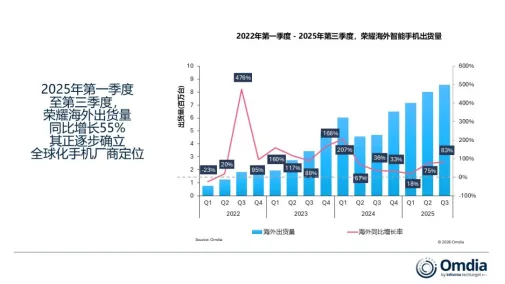
Core Insights - The consumer electronics industry is witnessing a significant transformation, with Honor achieving a historic milestone in overseas market growth, marking a shift from survival to proactive expansion through its "Alpha Strategy" [1][3][12] Group 1: Market Performance - Honor's overseas smartphone shipment volume reached a historic high, with a growth rate of approximately 55% year-on-year in the first three quarters of 2025, positioning it as the top brand in global overseas growth [3][5] - The overseas shipment proportion increased from less than 10% in early 2021 to nearly 50% by Q3 2025, indicating a fundamental shift in Honor's global business structure [3][5] Group 2: Product Strategy - Honor launched three new products during the "Honor Design Night," showcasing its commitment to expanding product, technology, ecosystem, and brand boundaries, leading to significant sales growth and brand elevation [2][12] - The flagship Magic series, including the Magic V5 and Magic8 series, has set industry benchmarks with innovative designs and AI capabilities, contributing to a global shipment of over 71 million units in 2025 [6][7] Group 3: Technological Advancements - Honor's investment in technology is evident, with innovations like the Qinghai Lake battery technology and the Oasis eye protection screen, enhancing user experience and health [8] - The introduction of the world's first "robot phone" and advancements in AI capabilities demonstrate Honor's commitment to leading in AI and robotics [8][10] Group 4: Strategic Expansion - Under new management, Honor is broadening its boundaries by integrating cultural and artistic expressions into its products, exemplified by collaborations with brands like Porsche Design and Jimmy Choo [9][10] - The "1X3XN" ecological strategy aims to transform Honor into a leading AI terminal ecosystem company, enhancing collaboration with partners like BYD and Alibaba [10][11] Group 5: Future Outlook - Honor's strategy for 2026 focuses on three main axes: high-end flagship market expansion, emotional connections with younger consumers, and establishing a brand presence at the intersection of luxury and technology [12][13] - The shift from product-centric competition to an integrated experience encompassing hardware, software, services, and ecosystem collaboration marks a new competitive dimension for Honor [13]
iPhone Air卖不动,库克挥泪砍产线…这也就刚卖了一个月
Sou Hu Cai Jing· 2025-11-11 04:45
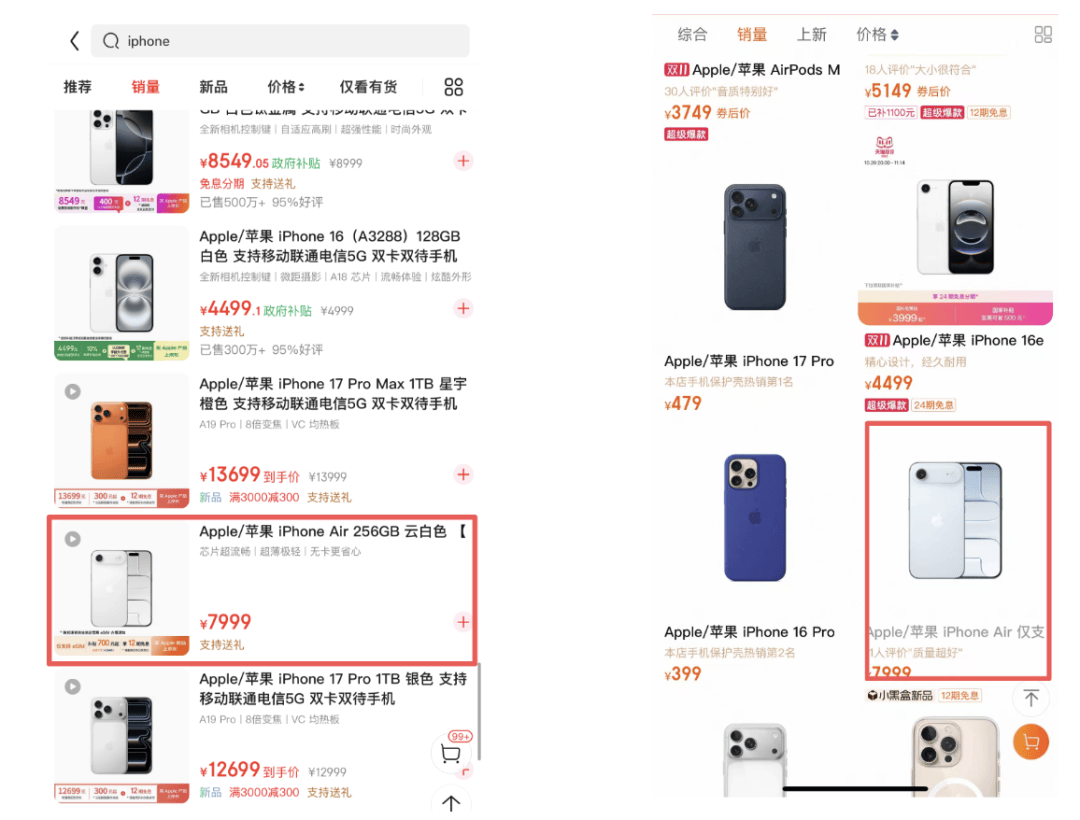
Core Insights - The iPhone Air has faced significant challenges since its launch, leading to the decision by Apple to halt production due to poor sales performance and market reception [1][2][4] Sales Performance - iPhone Air's initial sales were disappointing, with activation numbers in the first week exceeding only 50,000 units, which is less than one-tenth of the iPhone 17 Pro Max's performance [1] - In major online sales channels like JD.com and Tmall, iPhone Air's sales lagged behind both the iPhone 17 series and the older iPhone 16 models, failing to make it into the top ten small-screen sales rankings [2] Product Features and Consumer Reception - The iPhone Air was designed as a "non-Pro flagship," aiming to reduce features while maintaining essential components like the A-series chip and main camera, but this strategy did not resonate with consumers [6] - Key features were stripped down, including the removal of high-refresh screens, titanium alloy, and multiple camera options, leading to a perception of the device as outdated [6][11] - User feedback highlighted significant issues with battery life and performance, with many reviews criticizing the device's value proposition compared to the Pro Max [5][8] Market Dynamics - The iPhone Air's inability to leverage Apple's ecosystem effectively contributed to its lack of traction, as it did not stimulate accessory sales or developer interest [11][12] - The exit of the iPhone Air from the market has created an opportunity for domestic brands to fill the gap in the lightweight flagship segment, which they have already capitalized on with competitive offerings [13][14] Future Prospects - Although the iPhone Air 2 project has been removed from the main production schedule, internal development of prototypes is ongoing, indicating that Apple may revisit this product line in the future [17]

荣耀换帅:四年孵化,饱和式投入,重做一个全球品牌
晚点LatePost· 2025-01-21 13:45
任正非曾说:"荣耀要做华为全球最强的竞争对手,超越华为"。 上市前夕,荣耀巨变。 1 月 17 日,荣耀 CEO 赵明因个人原因,向该公司提出辞去 CEO 等相关职务,由副董事长李健接任。 自 2015 年接任荣耀总裁起,赵明与这个品牌一起走过了 10 年。在离职信中,赵明说,"感谢大家对我 4 年乃至 10 年荣耀工作的评价,成绩是团队和所有荣耀小伙伴做出的。过去 10 年的每一刻我都是战战兢 兢、如履薄冰,很少有成功的喜悦,一直都思考怎么带着团队活下去、杀出来。" 赵明带领荣耀走过了两个阶段:作为华为子品牌,以及 2020 年 11 月分拆后的独立公司。 分拆后,华为不再持有新荣耀公司的任何股份。华为在当时发声明说:在产业技术要素不可持续获得、消 费者业务受到巨大压力的艰难时刻,为让荣耀渠道和供应商能够得以延续,华为投资控股有限公司决定整 体出售荣耀业务资产。 荣耀独立不是计划内的调整,没有充足的准备期。对于行业和荣耀来说,这都是一个突然的决定。8000 多 名荣耀员工要在短时间内从华为坂田总部搬出,在仓促和捉襟见肘的办公条件下开启全新的创业之路。 2021 年是荣耀最难熬的一段时间:没有产品、没有工厂、 ...