
蝉翼钢

Search documents
河北唐山把握京津冀协同发展机遇:来得了 留得下 发展好
Jing Ji Ri Bao· 2026-02-02 06:16
Group 1: Transportation and Infrastructure - The G6747 train from Beijing to Tangshan highlights the improved transportation connectivity, facilitating daily commutes for many residents [1] - The Beijing-Tangshan intercity railway is set to be fully operational by December 30, 2025, integrating Tangshan into a one-hour transportation and logistics circle with Beijing [1] - The development of convenient transportation is a key aspect of Tangshan's favorable business environment, ranking 4th among cities with GDP over 500 billion in a national business environment evaluation [1] Group 2: Industrial Development - The Caofeidian area has become a significant hub for industrial transfer, with 308 projects from Beijing totaling an investment of 270.198 billion [3] - Tangshan is actively integrating into the Beijing-Tianjin-Hebei collaborative development strategy, enhancing its industrial capacity and creating a supportive ecosystem for businesses [2][3] - The establishment of industrial clusters, such as the rail transit industry cluster in Fengrun District, has attracted numerous supporting enterprises, forming a complete industrial chain [4] Group 3: Digital Transformation - Tangshan is leveraging digital technology to enhance the efficiency of its business environment, implementing a unified online government service platform that covers all administrative levels [6][7] - The city has streamlined administrative processes, reducing the time for project approvals significantly, such as construction project approvals from 15 days to 3 days [8] - Data sharing initiatives have enabled better resource allocation and improved service delivery, with 37 billion data records shared across various applications [8] Group 4: Talent and Innovation - Tangshan is focusing on talent acquisition and retention, hosting numerous recruitment events and establishing partnerships with universities to meet the demand for skilled professionals [10][11] - The city has developed a comprehensive talent service platform, integrating various services to support talent development and retention [10] - Innovation is being fostered through the establishment of innovation consortia and financial products tailored for technology-driven enterprises, enhancing their competitiveness [13][14] Group 5: Financial Support and Business Environment - Tangshan has introduced specialized financial products, such as "Quality Loan," to support high-quality enterprises based on their quality capabilities and qualifications [14] - The city has implemented a mechanism for regular engagement between government, banks, and enterprises to facilitate financing for small and medium-sized enterprises [15] - Continuous improvements in the business environment are being prioritized, with a focus on enhancing market, legal, and credit conditions to support enterprise growth [15]
来得了 留得下 发展好
Jing Ji Ri Bao· 2026-02-01 22:17
Core Insights - The integration of Tangshan into the Beijing-Tianjin transportation network is expected to enhance regional development and attract population, capital, and technology [1][2] - The establishment of the Caofeidian Coordinated Development Demonstration Zone has positioned Tangshan as a key area for industrial transfer from Beijing and Tianjin, with significant investments and projects initiated [3][4] - Digital technology is being leveraged to improve the efficiency of the business environment in Tangshan, streamlining administrative processes and enhancing data sharing [6][7] Group 1: Transportation and Regional Integration - The Beijing-Tangshan intercity railway is set to be fully operational by December 30, 2025, creating a one-hour travel zone between the two cities [1] - The railway's completion is anticipated to attract various resources to Tangshan, boosting its economic development [1][2] - The Caofeidian area has become a preferred location for many Beijing enterprises, facilitating industrial upgrades and expansions [2][3] Group 2: Industrial Development and Collaboration - Since the establishment of the Caofeidian Demonstration Zone, 308 projects from Beijing have been implemented in Tangshan, with a total investment of 270.198 billion yuan [3] - Tangshan is focusing on building high-standard industrial platforms to facilitate the transfer of technology and resources from Beijing and Tianjin [2][3] - The city has developed a collaborative mechanism for industrial development, enhancing the business environment and attracting investments [2][3] Group 3: Digital Transformation and Efficiency - Tangshan is implementing a digital governance model to streamline administrative processes, reducing the need for repeated document submissions [6][7] - The city has established an integrated online government service platform that covers all administrative levels, achieving a 100% online processing rate for applicable services [6][7] - The use of data sharing and digital tools has significantly reduced approval times for various administrative processes, enhancing overall efficiency [9][10] Group 4: Talent and Innovation Support - Tangshan is actively working to attract and retain talent by organizing recruitment events and providing comprehensive support for high-skilled professionals [10][11] - The city has established partnerships with universities to foster innovation and support technology transfer, enhancing the local talent pool [11][12] - Financial products tailored for technology-driven enterprises are being developed to facilitate access to funding and support innovation [13][14] Group 5: Financial Support and Business Environment - Tangshan has implemented a mechanism for regular engagement between government, banks, and enterprises to address financing challenges faced by small and medium-sized enterprises [15] - The city has issued loans totaling 202.244 billion yuan to over 110,200 enterprises, demonstrating a commitment to improving the business environment [15] - Continuous efforts are being made to enhance the overall business climate, focusing on market, legal, and credit environments to support enterprise growth [15]
河北唐山把握京津冀协同发展机遇——来得了 留得下 发展好
Jing Ji Ri Bao· 2026-02-01 22:07
Core Insights - The integration of Tangshan into the Beijing-Tianjin transportation network is expected to enhance regional development by attracting population, capital, technology, and information [1][2] - Tangshan has been recognized for its favorable business environment, ranking 4th among cities with GDP over 500 billion yuan in a national evaluation of private enterprises [1] - The establishment of the Caofeidian Coordinated Development Demonstration Zone has positioned Tangshan as a key area for industrial transfer from Beijing and Tianjin, with significant investments and projects initiated [3] Transportation and Connectivity - The Beijing-Tangshan intercity railway is set to be fully operational by December 30, 2025, creating a one-hour travel zone between the two cities [1] - The improved transportation infrastructure has facilitated the commuting of many professionals between Beijing and Tangshan, enhancing collaboration and project implementation [1] Industrial Development - The Caofeidian area has become a preferred location for many Beijing enterprises, with 308 projects and a total investment of approximately 270.2 billion yuan since the establishment of the demonstration zone [3] - Tangshan is focusing on high-standard industrial platforms to attract and retain industries, ensuring that technological achievements from Beijing can be effectively utilized [2][3] Digital Transformation - Tangshan is leveraging digital technology to enhance the efficiency of its business environment, implementing a unified online government service platform that covers all administrative levels [6][7] - The city has streamlined administrative processes, significantly reducing the time required for project approvals and enhancing service delivery through data sharing [9] Talent and Workforce Development - Tangshan is actively addressing talent shortages by organizing recruitment events and establishing partnerships with universities to attract skilled professionals [10][11] - The city has implemented policies to support talent retention and development, including a comprehensive service platform for talent management [10][11] Financial Support and Innovation - The city has developed specialized financial products to support technology-driven enterprises, facilitating access to funding for innovation and growth [13][14] - Tangshan is promoting a credit system that evaluates companies based on their innovation capabilities, enabling better access to financial resources [13] Business Environment Enhancement - Continuous efforts are being made to improve the business environment, with a focus on maintaining a close relationship between government and enterprises to protect their rights and interests [15] - The city aims to enhance market, legal, and credit environments to create a world-class business atmosphere [15]
共绘“一张图”,京津冀产业链协同焕新
Bei Jing Ri Bao Ke Hu Duan· 2025-12-19 13:27
Group 1: Beijing's Industrial Adjustment - Beijing has cumulatively relocated and upgraded over 3,000 general manufacturing enterprises, with an additional 104 relocations from January to November this year, providing greater space for the development of high-tech industries [1] - The interaction between relocation and reception has led to the emergence of new industrial chains in Hebei, contributing to high-quality regional development [1] Group 2: Steel Industry Development - The "Cicada Wing Steel," produced by Shougang Jingtang, is a lightweight and flexible steel product essential for 5G base stations and integrated circuit boards, showcasing the company's transition from land to sea [2] - Shougang Jingtang has made significant strides in intelligent, green, and high-end development, achieving a steel carbon emission reduction of 18% below the industry average through innovative practices [2] - The steel processing industry in the Caofeidian Steel Power Park is being developed into a comprehensive industrial chain, focusing on deep processing, logistics, and automotive parts manufacturing [6] Group 3: Logistics and E-commerce Growth - The establishment of Zhongtong Express's northern headquarters in Langfang has led to a significant increase in logistics capabilities, with a sorting efficiency of 70,000 packages per hour and a daily processing capacity of 5 million packages [10] - Langfang has become a hub for logistics enterprises, with major companies like YTO Express and Shentong Express establishing regional headquarters, resulting in a robust logistics economy [11] - The postal and express delivery volume in Langfang is projected to grow from 5.76 billion packages at the end of the 13th Five-Year Plan to 22 billion packages in 2024, reflecting a 31% annual growth rate [15] Group 4: Textile and Apparel Industry Transition - Cangzhou has become a key location for the relocation of Beijing's garment industry, with the Mingzhu International Garment Ecological New City accommodating nearly 10,000 merchants and a complete production chain [16] - The region has seen the establishment of a tight-knit industrial chain, with over 1,000 wholesale merchants and 600 processing enterprises, enabling rapid turnover from fabric procurement to finished garments [17] - Cangzhou's garment industry has been recognized nationally, with significant sales to the Beijing-Tianjin region, exemplifying successful industrial relocation and integration [20]

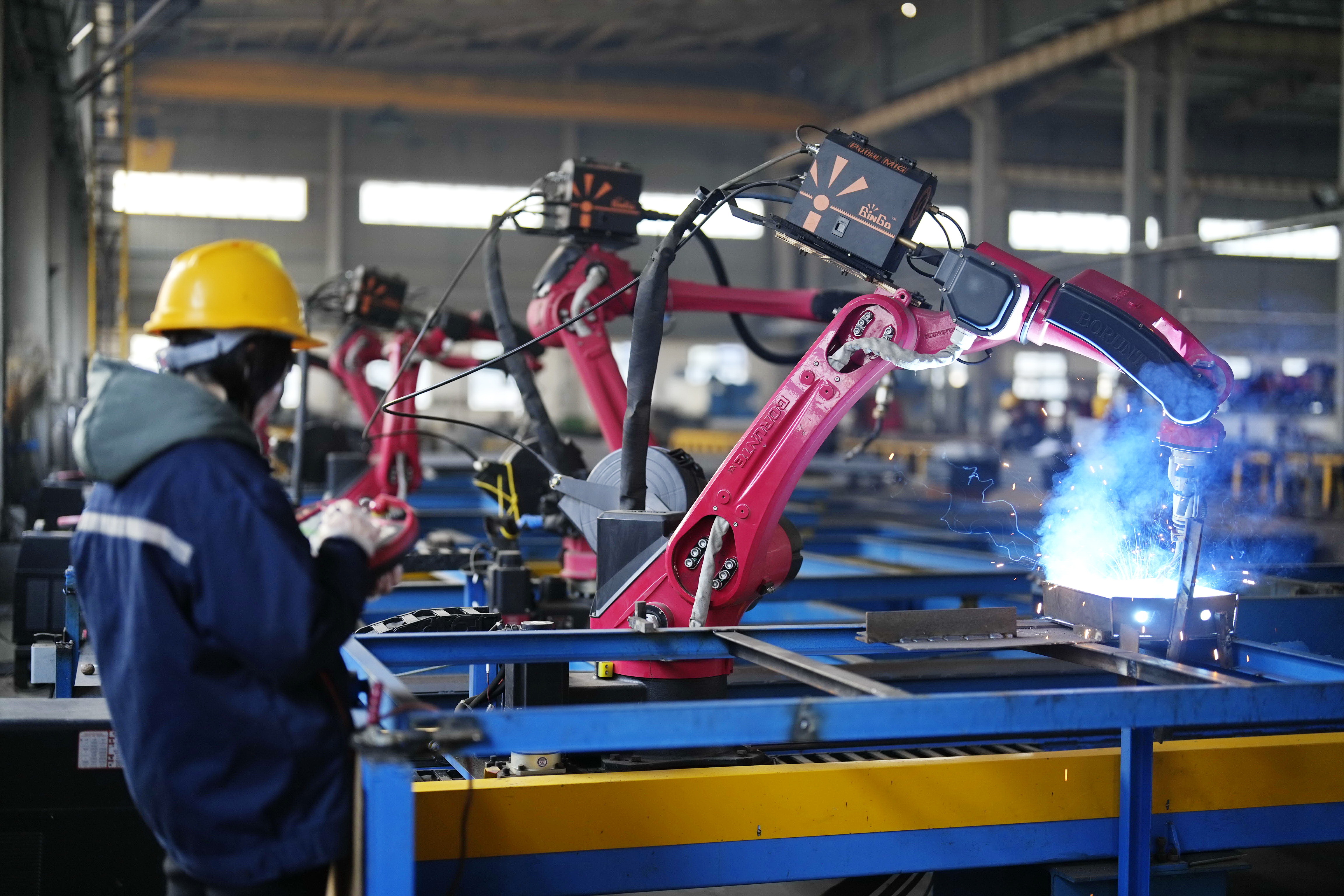
“十四五”期间我国钢铁品种结构进一步优化升级
Xin Hua Wang· 2025-10-31 08:40
Core Viewpoint - The Chinese steel industry is undergoing structural optimization and upgrading during the "14th Five-Year Plan" period, focusing on high-end steel products for various sectors such as automotive, home appliances, infrastructure, and construction [1] Industry Structure and Trends - The proportion of steel used in manufacturing is expected to rise from 42% in 2020 to 50% by 2024, with projections indicating it will exceed 50% by 2025 [1] - Conversely, the share of steel used in the construction industry is anticipated to decrease from 58% in 2020 to 50% by 2024 [1] Product Development and Innovation - The production of high-end products, particularly silicon steel, is projected to reach approximately 18 million tons in 2024, marking a 48% increase from 2020 [1] - New steel varieties such as 2200 MPa ultra-high-strength bridge cable steel, "hand-tear steel," and "cicada wing steel" have achieved international leading standards [1] Future Development Plans - The Chinese steel industry aims to enhance its "gold content" and "green content" in response to higher demands for high-end and environmentally friendly products, providing ample space and prospects for transformation and upgrading [1] - The industry will focus on the overall planning for the "15th Five-Year Plan" and implement the "Steel Industry Stabilization and Growth Work Plan (2025-2026)," emphasizing technological innovation and the development of high-precision products [1]
科技赋能 智造未来--中国钢铁产业锻造高质量发展新范式观察
Zhong Guo Chan Ye Jing Ji Xin Xi Wang· 2025-08-19 00:13
Group 1: High-end Development - The Chinese steel industry has invested 1.2 trillion yuan in capacity replacement over the past decade, completing nearly 300 million tons of capacity replacement and spending over 1 trillion yuan on R&D to drive high-end product breakthroughs [2][3] - The world's first third-generation thin slab continuous casting and rolling production line has been established, reducing the time from molten steel to steel coil to just 25 minutes, which is 1/8 of the traditional hot continuous rolling process [2] - Ansteel Group has produced hot-formed wheel steel with a strength six times that of aluminum alloy wheels, while maintaining comparable weight and dimensional accuracy, at a cost of only 70% of aluminum alloy wheels [2] Group 2: Intelligent Transformation - The steel industry's intelligent transformation is accelerating, integrating new information technologies such as artificial intelligence and industrial internet into steel manufacturing [4] - Hebei Steel has developed a carbon-neutral digital platform that integrates digital technology with green low-carbon manufacturing, achieving over 75% automation in carbon data collection across 40 processes [4] - China Baowu has initiated the "2526" project to promote the localization of AI applications in the steel industry, aiming to redefine steel production through digitalization and intelligent transformation [5] Group 3: Green Revolution - The Chinese steel industry is advancing a green revolution driven by technological innovation, focusing on ultra-low emissions and low-carbon technology development [6] - By June 2025, 598 million tons of steel production capacity will have undergone ultra-low emission transformation, with an expected 80% coverage by the end of the year, involving an investment of over 300 billion yuan [7] - The industry has developed a low-carbon steel evaluation standard recognized by multiple international organizations, showcasing its commitment to global decarbonization efforts [7]
科技赋能 智造未来——解码中国钢铁产业转型升级新趋势
Xin Hua She· 2025-08-12 07:23
High-end Development - The Chinese steel industry has invested 1.2 trillion yuan in capacity replacement over the past decade, replacing nearly 300 million tons of old capacity and spending over 1 trillion yuan on R&D to drive high-end product breakthroughs [2] - The world's first third-generation thin slab continuous casting and rolling production line has been established, reducing the time from molten steel to steel coil to just 25 minutes, with a minimum product thickness of 0.7 mm, leading globally [2] - Ansteel Group has produced hot-formed wheel steel with a strength six times that of aluminum alloy wheels, while maintaining comparable weight and dimensional accuracy, at 70% of the cost of aluminum wheels [2] Intelligent Transformation - The integration of AI, digital twins, and industrial internet technologies is accelerating the intelligent transformation of the steel industry, pushing the entire industry chain towards "digital intelligence" [4] - The WesCarber carbon neutrality digital platform developed by Hebei Steel focuses on carbon neutrality goals, achieving over 510 million carbon data points collected with an automation coverage rate of over 75%, improving efficiency by 83% [4] - China Baowu has initiated the "2526" project to promote localized applications of AI, aiming to redefine steel production through digital and intelligent transformation [4][6] Green Development - The Chinese steel industry is advancing a green revolution across the entire industry chain, driven by technological innovation and aiming for ultra-low emissions and low-carbon standards [7] - By June 2025, 598 million tons of steel production capacity will have undergone ultra-low emission transformations, with an expected 80% coverage by the end of the year, involving over 300 billion yuan in investments [7] - The development of hydrogen metallurgy and efficient low-cost electric furnace smelting technologies is being pursued to support the green and low-carbon transition in the steel industry [7] Overall Industry Outlook - The transformation driven by innovation is not only crucial for the future of the steel industry but also provides a Chinese solution for global industrial low-carbon development [8]
中国钢铁产业锻造高质量发展新范式观察
Xin Hua Cai Jing· 2025-08-10 23:37
Core Viewpoint - The Chinese steel industry is focusing on innovation-driven high-quality development amidst global economic green recovery and deep industrial chain adjustments, as discussed during the 14th China International Steel Conference and the inaugural China International Steel Week held in Shanghai from August 5 to 10 [1] High-end Development - The Chinese steel industry has invested 1.2 trillion yuan (approximately 1.2 billion) over the past decade for capacity replacement, achieving nearly 300 million tons of capacity reset and spending over 1 trillion yuan on R&D to push product upgrades towards high-end development [2] - The world's first flexible production model third-generation thin slab continuous casting and rolling production line has been established, reducing the time from molten steel to steel coil to just 25 minutes, which is one-eighth of traditional hot continuous rolling processes [2] - Ansteel Group has produced hot-formed wheel steel with a strength six times that of aluminum alloy wheels, while maintaining comparable weight and dimensional accuracy, at a cost of only 70% of aluminum alloy wheels [2] Technological Innovation - The Ministry of Industry and Information Technology has issued the "Steel Industry Normative Conditions (2025 Edition)," emphasizing the need to strengthen technological innovation capabilities, establish research institutions, and increase R&D investment to enhance product innovation and quality brand building [3] - Technological innovation is becoming the core engine for the steel industry's transformation and upgrade, leading to the emergence of internationally competitive high-end products and a leap towards new productive forces [3] Intelligent Transformation - The steel industry's intelligent transformation is accelerating, with the integration of artificial intelligence, digital twins, and industrial internet technologies driving the entire industry chain towards "digital intelligence" [4] - The WesCarber carbon neutrality digital platform developed by Hebei Steel focuses on carbon neutrality goals, achieving over 510 million carbon data collections across 40 processes with an automation coverage rate exceeding 75% [4] - China Baowu has initiated the "2526" project to promote localized applications of DeepSeek, redefining steel production with AI, marking a significant step in its digital and intelligent transformation [4][5] Green Development - The Chinese steel industry is advancing a green revolution driven by technological innovation, focusing on ultra-low emissions transformation, low-carbon technology R&D, and digital empowerment to establish a comprehensive green manufacturing system [7] - By June 2025, 598 million tons of steel production capacity will have undergone ultra-low emissions transformation, with an expected 80% coverage by the end of the year, involving an investment of over 300 billion yuan [7] - The Chinese low-carbon steel emission standards have gained recognition from multiple international professional organizations, aligning with global climate governance and the Paris Agreement [8]
这里为何能引来京津创新活水 ——来自河北唐山的调查
Jing Ji Ri Bao· 2025-06-09 21:42
Core Viewpoint - Tangshan, as an important energy raw material base and industrial city, is leveraging the Beijing-Tianjin-Hebei coordinated development strategy to create new advantages for its development through industrial collaboration, innovation-driven transformation, and talent empowerment. Group 1: Industrial Collaboration - Since the implementation of the coordinated development strategy in 2014, Tangshan has undertaken 948 industrial projects from Beijing and Tianjin, with a total investment of 606.59 billion yuan, completing investments of over 491.78 billion yuan [1] - The establishment of the Beijing-Tianjin-Hebei collaborative development demonstration zone has facilitated the relocation of enterprises like Shougang Group, which has transitioned to high-end, intelligent, and green development [2] - The Tianjin-Hebei (Lutai-Hangu) collaborative development demonstration zone has attracted companies such as Tianjin Huari New Materials Technology Co., which relocated from Beijing and began production in 2023 [4] Group 2: Innovation and Technology Transfer - Tangshan is enhancing its technological transformation capabilities and establishing a regional innovation chain to absorb technology spillovers from Beijing and Tianjin [7] - The Beijing Institute of Technology Tangshan Research Institute has developed new materials that reduced procurement costs for local ceramic enterprises by 62% [8] - The Hebei Sixth Mirror Intelligent Technology Co., based in Tangshan, is focusing on smart manufacturing solutions, with its R&D in Beijing and production in Tangshan [9] Group 3: Talent Acquisition and Development - The "Phoenix Talent" program and other initiatives have been implemented to attract talent from Beijing and Tianjin, with over 1,170 graduate students recruited since 2020 [16] - Tangshan has established a high-level talent base and has been actively engaging with universities in Beijing for collaborative projects [16] - The city provides various support services for talent, including medical care, housing subsidies, and educational opportunities for children, enhancing its attractiveness for professionals [17]