退货运费险

Search documents
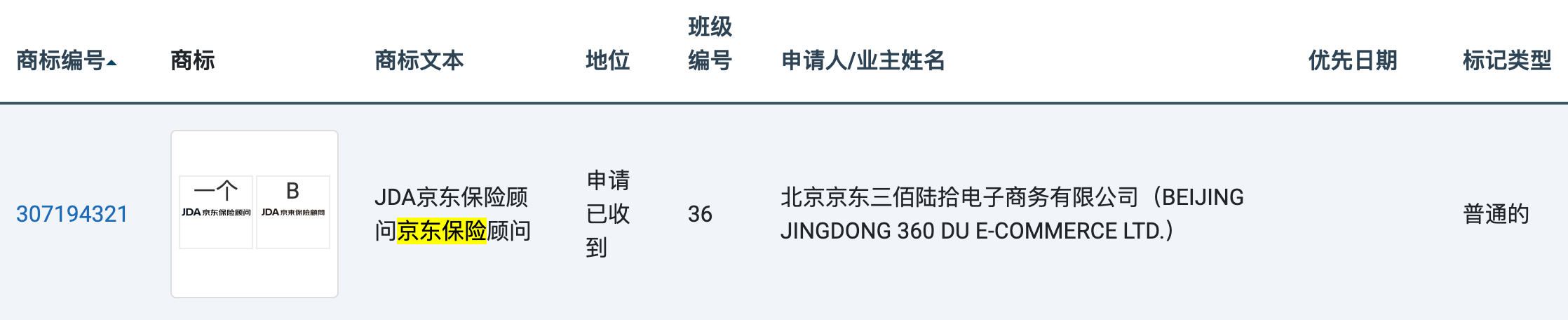
从拿牌到筑牌:京东已递交“保险顾问”商标
Hua Er Jie Jian Wen· 2026-02-25 07:13
Core Insights - JD.com is expanding its financial services in Hong Kong, moving from compliance to brand establishment with the application for the "JDA JD Insurance Consultant" trademark [1][3]. Group 1: Trademark Application and Business Scope - The trademark application covers a wide range of categories, including financial management, insurance brokerage, and real estate management, indicating a strategic move into various financial sectors [3]. - This application follows JD.com's acquisition of an insurance brokerage license in October last year, marking the official launch of its insurance intermediary business in Hong Kong [3][4]. Group 2: Business Strategy and Market Position - JD.com is adopting a "license first, team follow" approach, actively recruiting for key positions in Hong Kong, which suggests a transition from planning to actual team formation [4]. - Compared to competitors like Alibaba and Tencent, JD.com is entering the market with a lighter asset model, focusing on independent brokerage rather than heavy investments in underwriting [5][6]. Group 3: Market Challenges and Strategic Vision - The Hong Kong insurance market is highly mature and relies heavily on offline agents, presenting challenges for JD.com to replicate its mainland success [9]. - The trademark's broad scope hints at a larger strategic vision for JD.com, targeting high-net-worth individuals with services like wealth management and supply chain finance [10]. - The launch of the "JD Insurance Consultant" brand is just the first step, as the company needs to convert its digital capabilities into actual premium revenue in a regulated environment [11][12].


阳光财险:护航新场景,激发新动能
Sou Hu Cai Jing· 2026-01-29 06:17
Group 1 - The core idea is that Sunlight Property Insurance is actively integrating into national strategic development by empowering scene development through insurance products, which stimulates consumption and supports industrial upgrades [1][2]. Group 2 - Sunlight Property Insurance is addressing new consumption demands by providing insurance services that enhance consumer confidence and market vitality, including the "Zhejiang Gift Insurance" solution that integrates blockchain traceability and intellectual property protection [2]. - The company has launched the Motor Vehicle Replacement Cost Compensation Insurance (GAP Insurance) to cover vehicle depreciation and replacement losses, with over 7 billion yuan in risk coverage since 2025, thereby reducing consumer costs in the growing new energy vehicle market [2]. - Sunlight Property Insurance has provided coverage for over 4 billion orders on platforms like Douyin and Taobao by continuously improving specialized insurance for e-commerce and digital economy scenarios [2]. Group 3 - The company is optimizing its financial products and services to support the "technology-industry-finance" cycle, focusing on risks associated with technology project development and transformation failures [3]. - Sunlight Property Insurance has introduced insurance solutions for research and development costs and transformation costs, reducing uncertainties for enterprises and supporting regional technological innovation ecosystems [3]. - The company offers tailored insurance services based on 11 dimensions related to technology enterprises, providing critical support during the trial-and-error phase of innovation [3]. Group 4 - Sunlight Property Insurance is providing comprehensive risk protection to support national strategies such as manufacturing upgrades and energy transitions, promoting high-end, intelligent, and green industrial development [4]. - The company has launched environmental pollution liability insurance to address challenges in pollution remediation, contributing to innovative ecological restoration methods [4]. - Sunlight Property Insurance has assisted a chemical enterprise in Gansu Province with alternative remediation methods for air pollution, showcasing its commitment to ecological value transformation [4]. Group 5 - In the clean energy sector, Sunlight Property Insurance has provided risk coverage totaling 492.6 billion yuan for renewable energy projects, supporting over 27,000 projects in solar, wind, and hydropower [5]. - The company has also introduced ship oil pollution liability insurance, providing 2.921 billion yuan in coverage and supporting marine ecological protection and the green development of the shipping industry [5]. - Sunlight Property Insurance aims to continue focusing on national strategies and market demands, enhancing product innovation and service integration for various industries [5].
非车险“见费出单”标准化落地:监管破局与行业价值重构
Xin Lang Cai Jing· 2026-01-15 14:09
Core Viewpoint - The regulatory transformation in the non-auto insurance sector, driven by risk prevention, is moving from fragmented exploration to a nationwide compliance consensus, addressing long-standing issues such as receivable premium misrepresentation and improper commission payments, while reshaping the competitive logic and value orientation of the property insurance industry [2][11]. Group 1: Policy Evolution - The concept of "fee-for-service" is not new, but its comprehensive implementation in the non-auto insurance sector has progressed from principle-based requirements to detailed execution [3][12]. - Local practices in Shandong and Yunnan have laid the groundwork for national standards, with Yunnan specifying full coverage for ten types of insurance and requiring a minimum of 40% upfront payment for certain policies [3][12]. - The recent issuance of guidelines by the Financial Regulatory Bureau clarifies the execution boundaries, distinguishing between different types of insurance and ensuring compliance with the "fee-for-service" principle [3][12][13]. Group 2: Market Resonance - The rigid constraints of "fee-for-service" are reshaping the cash flow management models of property insurance companies, moving away from irrational competition based on premium advances [5][14]. - Larger insurance firms are leveraging their capital and technological advantages to quickly adapt to new regulations, while smaller firms are focusing on niche markets to differentiate themselves [6][16]. - Insurance intermediaries are facing pressure to transition from commission-dependent models to professional service-oriented approaches, enhancing value-added services such as risk control and customer service [6][16]. Group 3: Value Return - The regulatory changes aim to guide the non-auto insurance industry back to its core function of risk protection, addressing issues like high receivable premiums and chaotic expense management [7][17]. - The restructuring of the industry ecosystem requires collaborative efforts, with companies implementing operational, assessment, and ecological strategies to ensure compliance and enhance service quality [8][17]. - The standardization of "fee-for-service" is seen as the starting point for high-quality development in the non-auto insurance sector, promoting a competitive landscape focused on professional capabilities and service quality [9][18].

终结高费用乱象,非车险“报行合一”落地
Hua Xia Shi Bao· 2026-01-13 13:37
Core Viewpoint - The non-auto insurance sector in China's property insurance market is evolving from a supplementary role to a primary growth driver, prompting regulatory changes to address irrational competition and ensure industry health [2][9]. Regulatory Changes - The China Banking and Insurance Regulatory Commission (CBIRC) has introduced significant documents in 2025 to enhance non-auto insurance regulation, applying the "reporting and operation in unison" principle previously effective in auto insurance [2][3]. - The recent issuance of the "Q&A on Comprehensive Governance of Non-Auto Insurance" provides detailed clarifications on policy execution, covering various aspects such as applicable insurance types, company classification, premium collection, and policy issuance timing [3][4]. Insurance Type Exclusions - Short-term health insurance and accident insurance are explicitly excluded from the non-auto insurance governance scope, recognizing their unique attributes [3][4]. - However, any health insurance that combines with property insurance must adhere to the "reporting and operation in unison" requirements, closing potential loopholes [3]. Company Classification - The regulatory framework categorizes companies into three groups based on market share: large companies (e.g., PICC, Ping An, Taikang), medium companies (e.g., China Life, Zhonghua United), and small companies [4][5]. - This classification allows for differentiated regulatory standards, providing smaller companies with a 5% higher buffer on premium rates compared to larger firms, facilitating their transition [4][5]. Premium Collection and Policy Issuance - The "reporting and operation in unison" principle aims to address high accounts receivable issues by ensuring that premium collection aligns with insurance liability timing [5][6]. - Specific provisions clarify that premiums collected by intermediaries do not count as "reporting and operation in unison," compelling insurers to regain control over premium collection [5][6]. Flexibility in Special Cases - The regulations allow for flexible recognition of payment methods in complex scenarios, such as accepting verifiable payment receipts for policy issuance [5][6]. - For public interest insurance using government funds, the strict "reporting and operation in unison" requirement is relaxed under certain conditions, ensuring continuity in policy-related services [6]. Market Dynamics and Company Strategies - The new regulations are expected to reshape the competitive landscape of the property insurance market, favoring large firms with strong capital and brand influence while posing challenges for smaller companies [7][9]. - Smaller companies must pivot towards specialization and differentiation rather than competing solely on price, as the regulatory environment discourages traditional scale-driven growth [7][8]. Shift in Industry Focus - The regulations encourage insurers to abandon the "scale-first" mentality, emphasizing value and efficiency over mere growth [8][9]. - Internal assessment metrics within companies are expected to shift focus from premium volume to compliance, quality, and customer satisfaction [8][9]. Long-term Implications - The comprehensive implementation of "reporting and operation in unison" is anticipated to enhance market transparency and accountability, ultimately fostering a healthier competitive environment [9][10]. - Experts believe that while short-term adjustments may be painful for some, the long-term benefits will include improved risk management and customer trust [10].

重磅!告别内卷,非车险“报行合一”再出细则:政策类、退运险业务不必“见费出单”
Xin Lang Cai Jing· 2026-01-09 08:25
Group 1 - The non-auto insurance market is transitioning towards high-quality development, moving away from intense competition, with the implementation of the "reporting and execution" policy starting November 1, 2025 [2][10] - The "Questions and Answers on Comprehensive Governance of Non-Auto Insurance" provides detailed standards for key terms such as "reporting upon payment" and "installment payment" [3][11] - The policy allows for flexibility in issuing policies for government-funded insurance while maintaining strict adherence to "reporting upon payment" for enterprises and individuals [3][11] Group 2 - The regulatory framework for non-auto insurance has evolved, with the introduction of guidelines that emphasize transparency in fees and compliance in operations, marking a shift from a focus on scale to compliance and efficiency [4][12] - Major insurance companies, such as China Life, have begun to implement the "reporting and execution" model, achieving cost reductions prior to regulatory announcements [13] - The comprehensive cost ratio for major insurers has shown improvement, with China Life's non-auto insurance cost ratio decreasing by 0.1% to 95.7% [13][14] Group 3 - The overall industry comprehensive cost ratio reached 97.59% by the end of September 2025, the lowest in five years, with a decrease in both the comprehensive claims ratio and expense ratio [6][14] - The health insurance cost ratio for Ping An dropped to 89.8%, reflecting a significant increase in underwriting profit [14] - The "reporting and execution" policy is expected to lead to a reduction in costs and improved underwriting performance, although it may adversely affect smaller insurance intermediaries [8][16]

厘清争议边界、松绑“见费出单”、遏制非理性竞争行为,监管明确非车险“报行合一”执行标准
Xin Lang Cai Jing· 2026-01-08 10:40
Core Viewpoint - The Financial Regulatory Bureau has issued a notice clarifying the implementation of the "reporting and issuing together" policy for non-auto insurance, aiming to standardize industry practices and address various practical issues encountered during implementation [2][10]. Industry Situation - The non-auto insurance sector is characterized by a wide variety of products and complex scenarios, with the governance work proceeding under principles of legality, practicality, and gradual advancement [2][10]. - In 2025, the regulatory body issued two documents to further clarify the "reporting and issuing together" policy for non-auto insurance [2][10]. Key Clarifications in the Notice - Insurance companies must issue policies and invoices only after receiving premiums, and intermediaries collecting premiums do not qualify as "reporting and issuing together" [3][11]. - For agricultural insurance, the additional premium rate for subsidized products cannot exceed 25%, and no handling fees can be charged [3][11]. - Policies can be issued based on government documents for public interest projects, but for businesses receiving government subsidies, the "reporting and issuing together" requirement applies [3][11]. Internet Insurance Regulations - Internet insurance businesses must generally collect premiums directly before issuing policies and invoices, with specific provisions for high-frequency and fragmented products [4][12]. Market Feedback and Implications - The notice aims to prevent the misuse of payment structures and ensure that premium payment conditions are reasonable, prohibiting extreme arrangements like "low upfront, high later" [5][14]. - The regulations are expected to reduce cash flow risks, lower claims disputes, and curb irrational competition in the market [6][14]. Overall Impact - The notice serves as a systematic and operational supplement to the "reporting and issuing together" policy, balancing standardization with respect for practical realities, thereby enhancing predictability and enforceability of rules [7][15].

重磅!非车险“报行合一”最权威解释出炉:松绑“见费出单”,政策性业务满足一定条件可出单,退运险等应实时结算或2日内结算
Sou Hu Cai Jing· 2026-01-08 03:54
Core Viewpoint - The implementation of the "reporting and issuing together" policy for non-auto insurance continues to advance, with the National Financial Regulatory Administration providing detailed answers to various issues arising during the process, aiming to clarify policy implications and unify industry standards [1][2]. Group 1: Regulatory Framework - The core content of the recent notification includes that short-term health insurance is not applicable under the "reporting and issuing together" policy, with some exceptions [2]. - Insurance intermediaries collecting premiums are not considered as "reporting and issuing together" [4]. - Agricultural insurance should follow relevant regulations and execute "reporting and issuing together" [8]. Group 2: Business Scenarios and Requirements - Certain businesses, such as those involving public interest funded by government finances, may not strictly adhere to "reporting and issuing together" [8][10]. - From July 1, 2026, high-frequency, fragmented, and scenario-based internet insurance products like return freight insurance should achieve real-time settlement or periodic settlement within two natural days after issuance [9]. - Policies issued after March 1, 2026, should generally be issued after premium collection and invoicing, with allowances for companies facing difficulties in changing payment methods [12][17]. Group 3: Specific Business Types - For foreign currency or offshore RMB businesses, insurance companies can use bank transfer or other verifiable payment proofs to issue policies [5]. - In the case of RMB business, a bank acceptance bill can be considered as "reporting and issuing together" [6]. - For co-insurance, the main underwriting company can issue policies and invoices after collecting premiums, which will be regarded as "reporting and issuing together" [7]. Group 4: Payment Management - The notification specifies that for public interest businesses using government funds, insurance companies can issue policies based on signed government documents without immediate premium collection [10]. - For businesses where the government subsidizes premiums, the full premium must be collected before issuing policies [10]. - The notification emphasizes that installment payment structures should not be manipulated as competitive leverage, and the last payment should not exceed the average installment amount [12].



多维构建消费者权益保护新生态 阳光财险获评“年度杰出消费者权益保护企业”
Cai Jing Wang· 2025-12-31 13:32
Core Viewpoint - The company emphasizes consumer rights protection as a strategic priority, achieving recognition as the "Outstanding Consumer Rights Protection Enterprise" in the 2025 financial industry awards due to its comprehensive approach to consumer protection [1] Group 1: Strategic Integration of Consumer Protection - The company integrates consumer rights protection into its top-level design, linking it with strategic planning and party organization assessment mechanisms [2] - It has revised over a hundred regulations to establish a consumer protection mechanism covering the entire process from product development to claims [2] - A dedicated consumer protection fund has been established to support educational and assistance initiatives, reinforcing the institutional and cultural foundation for consumer rights protection [2] Group 2: Transparency and Information Disclosure - The company has developed a comprehensive information disclosure system covering pre-sale, in-sale, and post-sale processes to ensure consumer awareness and choice [3] - Information is presented clearly through multiple channels, with special attention to vulnerable groups such as the elderly and foreigners [3] - A regular self-inspection mechanism is in place to ensure the accuracy and accessibility of information, with significant data disclosed through annual reports and other channels [3] Group 3: Financial Education Initiatives - The company has established a regular educational outreach mechanism, allocating specific funds for financial education separate from brand promotion [4] - Over 4,900 educational activities were conducted in 2024, significantly increasing frequency and impact [4] - Innovative use of technology, such as GPT, has been employed to create educational content, merging technology with traditional culture and financial education [4] Group 4: Complaint Handling and Governance - The company has implemented a "one-stop" complaint handling scheme, categorizing cases for efficient processing and achieving 100% closure through a cloud customer service center [5] - A dynamic monitoring system tracks key performance indicators, and a rapid approval channel for complex cases has been established [5] - The company employs a monthly ranking system for consumer protection leaders to enhance accountability and performance [5] Group 5: Inclusive and Innovative Services - The company provides tailored services for special groups, including the elderly, new citizens, and disabled individuals, demonstrating a commitment to equitable and inclusive financial services [6] - New products such as electric vehicle replacement insurance and return shipping insurance have been launched to align with consumer trends [7] - The company is shifting from passive claims to proactive risk management, utilizing technology to reduce consumer risks at the source [7] Group 6: Industry Leadership and Standardization - The company has taken on industry responsibilities by sharing its best practices and has led the development of national standards for complaint handling in the insurance sector [8] - It has participated in the creation of service standards for elderly consumers and has contributed to self-regulatory rules for consumer suitability in the insurance industry [8] - Since 2022, the company has conducted numerous training sessions to share advanced consumer protection concepts and management experiences with the industry [8]
雷军“神话”遭难,左手4.99万京东卖车,右手杀入保险业,刘强东又要卷谁?
Sou Hu Cai Jing· 2025-11-14 08:12
Core Insights - The automotive industry is experiencing intense competition during the Double Eleven shopping festival, with companies employing aggressive marketing strategies to boost sales figures [1][2] - The entry of JD.com into the automotive market signifies a shift in marketing dynamics, leveraging its platform to create a new model of car sales [11][12] - The use of "small deposits" and "large deposits" by car manufacturers to inflate order numbers raises questions about the authenticity of reported sales figures [3][2] Group 1: Automotive Sales Dynamics - Monthly sales rankings in the automotive sector are highly competitive, with fewer than 40,000 units sold failing to make the top ten [1] - The trend of using "big order" and "small order" data to create hype around new car launches has become commonplace, with some companies reporting over 10,000 orders within 24 hours of a vehicle's release [2][3] - The distinction between small deposits (flexible, refundable) and large deposits (binding, non-refundable) is crucial for understanding consumer commitment and production planning [2] Group 2: JD.com's Market Entry - JD.com has launched its own vehicle, priced at 49,900 yuan for a battery rental version, aiming to compete directly with established brands like BYD [1][11] - The marketing strategy for JD.com's vehicle includes a unique collaboration model with GAC and CATL, focusing on a "platform + manufacturing + technology" approach [12] - JD.com's extensive service network, comprising over 3,000 self-operated car stores and 40,000 partner stores, enhances the customer experience from test drives to after-sales service [13] Group 3: Industry Challenges and Opportunities - The insurance market for new energy vehicles faces significant challenges, including high claim rates and difficulties in obtaining coverage, leading to losses for insurers [15][16] - Regulatory efforts are underway to improve the insurance landscape for new energy vehicles, including the introduction of a platform to prevent insurers from refusing coverage [15] - The need for a more accurate risk pricing system is emphasized as essential for making insurance affordable for new energy vehicle owners while ensuring profitability for insurers [15]


刘强东雷军马斯克杀入保险业,都和新能源汽车有关?
Sou Hu Cai Jing· 2025-11-13 23:02
Core Viewpoint - Liu Qiangdong's entry into the 600 billion insurance market highlights his focus on addressing industry pain points, following the footsteps of Alibaba and Tencent in Hong Kong's insurance sector [2][16]. Group 1: Company Developments - Jingda HK Trading Co., Limited recently obtained an insurance brokerage license in Hong Kong, which has been renamed to "JD Insurance Consultant (Hong Kong) Limited" shortly after [2]. - JD Insurance is actively recruiting for various insurance-related positions in Hong Kong, indicating a serious commitment to establishing a presence in the insurance market [4]. - Liu Qiangdong's long-standing interest in the insurance sector dates back to 2010, with previous attempts to acquire insurance licenses and partnerships, including a significant stake in Allianz China [5][7]. Group 2: Industry Context - The insurance market in Hong Kong is robust, with a market size of 637.8 billion HKD in 2024, and a new policy issuance amounting to 219.8 billion HKD, reflecting a 22% increase [16]. - The insurance penetration rate in Hong Kong reached 18.2% in 2024, making it one of the most developed insurance markets globally [14]. - The challenges faced by the insurance industry, particularly in the context of insuring new energy vehicles, have created significant opportunities for companies like JD to innovate and address these pain points [9][12]. Group 3: Competitive Landscape - Other tech companies, such as Xiaomi and Tesla, are also entering the insurance market, leveraging their data and technology to create tailored insurance products [10][12]. - The competitive dynamics in the insurance sector are intensifying, with established players like Alibaba and Tencent already making significant investments and acquisitions in the Hong Kong insurance market [17].