
金融产品服务

Search documents
发放超10亿元“新春红包”
Xin Lang Cai Jing· 2026-02-09 17:11
Group 1 - Hefei has announced 12 policy measures to promote livelihood and development, effective until March 31, 2026 [1] - The city plans to issue over 1 billion yuan in subsidies and bonuses in the first quarter to stimulate large-scale consumption in sectors like automobiles and home appliances [2] - Hefei will extend operating hours for key commercial areas during the Spring Festival and support financial institutions in offering various consumer incentives [2] Group 2 - During the Spring Festival from February 15 to 23, cultural and sports venues in Hefei will offer free or low-cost access, and certain attractions will waive entry fees for specific ticket holders [3] - Hefei will implement free parking in public areas managed by state-owned enterprises during the holiday to encourage visits to shopping centers [3] - The city supports continuous production in manufacturing enterprises during the holiday, providing bonuses for employees who remain on duty [4] Group 3 - Hefei will conduct over 900 recruitment events in the first quarter to facilitate employment and support companies in organizing workforce transportation [4] - Financial assistance will be provided to companies for employee transportation costs, covering 50% to 80% of actual expenses [4]
十大协会签约共推设备更新,大规模设备更新对接活动在京举行
仪器信息网· 2026-02-02 09:02
Core Viewpoint - The second "Green Update · Digital Intelligence Leading" large-scale equipment update matching event concluded in Beijing, where ten national industry associations signed a strategic cooperation agreement to shift equipment updates from scale expansion to quality and efficiency improvement [1][2]. Group 1: Policy and Financial Support - In 2026, the first batch of 936 billion yuan in ultra-long-term special government bond funds has been allocated, supporting approximately 4,500 projects in industrial, energy, power, energy conservation, and environmental protection sectors, driving total investment exceeding 4,600 billion yuan [3]. - The ultra-long-term special government bonds clarify support directions, including key areas such as industry, energy power, grain and oil processing, customs inspection, and old residential elevator upgrades [3]. - The 2026 policy features "three optimizations": expanding support to include livelihood safety sectors and lowering investment thresholds for small and medium-sized enterprises; adopting a "proportional subsidy + capped amount" model for subsidy standards; and implementing a "full-chain management" and fund pre-allocation system [3]. Group 2: Industry Focus on Green and Digital Transformation - The event featured three specialized supply-demand matching sessions focusing on energy-saving and carbon-reducing equipment updates, equipment recycling and reuse, and green finance enabling equipment update financing services [4]. - The president of the China Industrial Development Promotion Association emphasized that equipment updates should adhere to principles of intelligence, greenness, and integration, considering the capacity of enterprises and consumer acceptance, guiding market entities towards energy-saving, carbon reduction, safe production, and digital transformation [5]. - A professor from Tsinghua University's School of Environment pointed out that global industrial competition is shifting from energy dependence to energy technology dependence, necessitating the construction of a large-scale equipment technology system that adapts to new energy [5]. Group 3: Building Collaborative Platforms - The president of the China Energy Conservation Association stated that the collaborative platform established during the event leverages the resource advantages of national industry associations to gather forces, break down information barriers, and achieve precise supply-demand matching [6]. - The ten industry associations signed a strategic cooperation agreement aimed at creating a long-term mechanism for "policy collaboration, resource sharing, and service linkage" [6]. - Representatives from 15 companies, including Shougang Group and China Southern Power Grid, shared their equipment update needs, technical solutions, and financial product services, promoting resource integration across the industry chain and collaborative development [6].


商务部、央行、金融监管总局三部门发文:加强商务和金融协同,更大力度提振消费
Jin Rong Jie· 2025-12-15 07:48
Core Viewpoint - The Ministry of Commerce, the People's Bank of China, and the Financial Regulatory Administration have jointly issued a notice to enhance collaboration between commerce and finance, aiming to boost consumption through targeted policies and measures [1][2]. Group 1: Policy Measures - The notice outlines three main areas and eleven specific policy measures to strengthen the synergy between commerce and finance [1]. - The first area focuses on deepening collaboration between the commerce and finance systems, encouraging local departments to improve communication and cooperation mechanisms, and detailing implementation guidelines [1]. - The second area emphasizes increasing financial support in key consumption sectors, urging financial institutions to optimize products and services to better align with consumer needs and promote new consumption models [1]. - The third area aims to expand cooperation among government, financial institutions, and enterprises, promoting diverse consumption activities and ensuring effective policy implementation [1]. Group 2: Implementation and Monitoring - The notice stresses the importance of coordinated efforts, policy alignment, and leveraging strengths among departments to effectively stimulate consumption [2]. - It encourages local departments and financial institutions to refine financial support measures based on actual conditions to unlock consumption potential [2]. - There is a call for ongoing tracking and guidance, with an emphasis on sharing progress and promoting successful practices [2].
金融“活水”精准润泽新型工业化 向“新”向“智”向“绿”表现亮眼
Yang Shi Wang· 2025-12-12 01:29
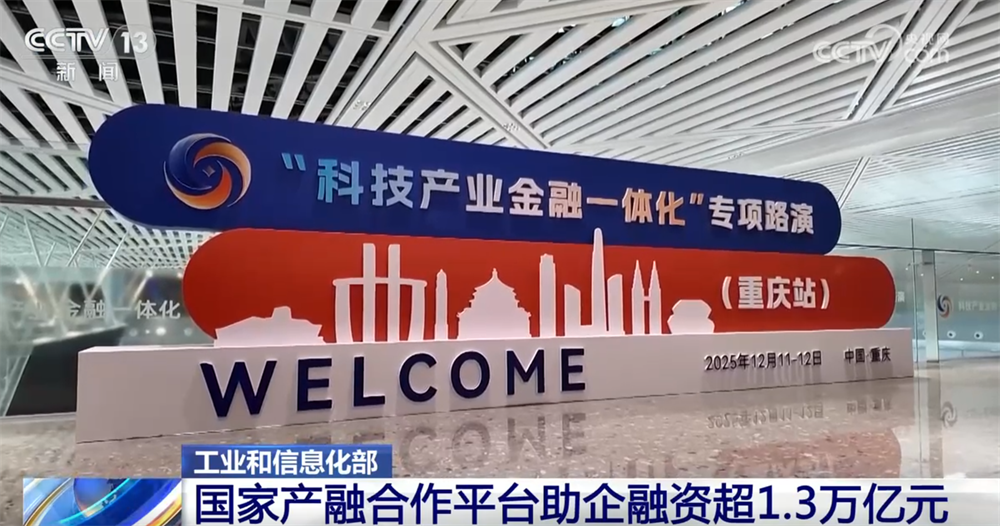
Group 1 - The core viewpoint is that the national financing cooperation platform has significantly increased its support for enterprises, with a total financing amount exceeding 1.3 trillion yuan, and 70% of this financing is directed towards innovative enterprises in specialized and advanced manufacturing sectors [1] - In the first 11 months of this year, the national financing cooperation platform added 289.7 billion yuan in financing for enterprises, indicating a strong commitment to supporting the manufacturing sector [1] - The platform has established 25 specialized service zones and has gathered over 400,000 enterprises, 3,000 financial institutions, and more than 800 financial products [1] Group 2 - In the first 11 months, loans in the manufacturing sector saw significant growth, with 18.1% increase in loans for high-end equipment manufacturing and 28.2% increase in loans for artificial intelligence [3] - Industrial green loans reached 735.6 billion yuan, reflecting a year-on-year growth of 22.3%, showcasing the emphasis on sustainable industrial practices [3] - The People's Bank of China and other departments have set a goal to fully meet the effective credit demand of manufacturing enterprises by 2027, indicating a long-term commitment to financial support for the sector [5] Group 3 - The Ministry of Industry and Information Technology has initiated 66 national pilot cities for financing cooperation, promoting integrated financing activities for technology and industry [5] - Over 130 hard technology projects have received equity financing exceeding 11 billion yuan, demonstrating the effectiveness of the financing initiatives [5]
助力沪语电影《菜肉馄饨》出炉,上海银行金融活水烹调“上海味道”
Zhong Guo Jing Ji Wang· 2025-11-13 03:25
Core Viewpoint - The film "Cai Rou Hun Tun," which portrays the life of urban elderly in Shanghai using the local dialect, is supported by Shanghai Bank through innovative financial services, showcasing the bank's role in empowering local culture [1][2]. Group 1: Cultural and Financial Collaboration - Shanghai Bank identified the potential of the "Cai Rou Hun Tun" project, which connects generations through a simple dish, and recognized its cultural significance in preserving the Shanghai dialect and memories [2]. - The bank provided financial support through mortgage loans, transforming intangible cultural value into tangible financial backing [2]. Group 2: Marketing and Promotion Strategies - Shanghai Bank is actively promoting the film by placing co-branded posters in over 50 branches and collaborating with local cinemas to enhance visibility and audience engagement [3]. - The bank plans to host exclusive movie screenings for elderly customers, further integrating cultural experiences with financial services [3]. Group 3: Broader Cultural Financial Initiatives - Shanghai Bank has been expanding its cultural financial services since 2013, establishing specialized branches to cater to the creative industry, and has supported over 2,000 cultural enterprises in the region [6]. - The bank's efforts have led to a loan scale exceeding 8 billion yuan in the cultural and entertainment sectors, demonstrating its commitment to enhancing cultural supply [6]. Group 4: Future Directions - The bank aims to continue developing cultural finance, focusing on high-quality artistic projects and major cultural infrastructure, providing specialized credit support and diverse financial products [7].

斥资逾千亿港元私有化收购恒生银行 汇丰控股有何算盘?
Jing Ji Guan Cha Wang· 2025-10-13 11:09
Core Viewpoint - HSBC Holdings and Hang Seng Bank announced a proposal for the privatization of Hang Seng Bank, with HSBC Asia offering HKD 155 per share, representing a 33% premium over the average closing price of HKD 116.5 over the last 30 trading days, valuing Hang Seng Bank at HKD 290 billion, which is 1.8 times its book value for the first half of 2025 [1][2]. Group 1 - HSBC's privatization strategy aims to streamline operations and enhance investment opportunities in Hong Kong [1][2]. - The proposal is perceived as high by the market, especially given Hang Seng Bank's declining profits, with a 30.46% drop in shareholder profit to HKD 6.88 billion and a 28.39% decrease in pre-tax operating profit [2]. - HSBC plans to finance the acquisition using internal resources, which is expected to reduce its Common Equity Tier 1 (CET1) capital ratio by approximately 125 basis points [3]. Group 2 - HSBC's decision to halt share buybacks for the next three quarters is seen as a move to stabilize its capital ratio, targeting a CET1 ratio of 14% to 14.5% [3][4]. - The market response has been negative, with HSBC's stock price declining over 7% following the announcement of the privatization [3]. - Investors are concerned about the impact of geopolitical risks and economic uncertainties, leading some to shift investments away from HSBC [4]. Group 3 - HSBC is actively involved in managing Hang Seng Bank's non-performing real estate loans, facilitating the sale of over USD 3 billion in assets [5]. - Hang Seng Bank's commercial real estate loan quality is under pressure, with significant increases in credit impairment [5]. - The collaboration aims to enhance business synergies between HSBC and Hang Seng Bank, allowing for a focus on wealth management and other growth areas [5][6]. Group 4 - Post-privatization, Hang Seng Bank will retain its identity as an independent licensed bank, maintaining its management structure and brand [6]. - There is potential for future capital operations, including the possibility of a spin-off listing if business synergies lead to significant performance improvements [6].

郭永航会见英国汇丰集团行政总裁艾桥智一行
Guang Zhou Ri Bao· 2025-06-20 01:50
Group 1 - The core viewpoint emphasizes the importance of financial innovation in supporting urban industrial upgrades and enhancing competitiveness in Guangzhou [2][3] - Guangzhou is implementing comprehensive reforms and expanding high-level openness, aiming to build a modern industrial system and enhance its urban capabilities [2] - HSBC's global training center in Nansha is seen as a pivotal opportunity for financial support in the transformation and upgrading of local industries [2][3] Group 2 - HSBC expresses gratitude for Guangzhou's support and plans to leverage the global training center to enhance investment and cooperation in cross-border financial services [3] - The global training center, located in Nansha, is set to be the largest training base for HSBC globally, capable of training thousands of management personnel annually [3]