
铂主连

Search documents
每日商品期市纵览-20260324
Dong Ya Qi Huo· 2026-03-24 10:42
1. Report Industry Investment Rating No relevant content provided. 2. Core Views of the Report - The overall market is affected by geopolitical situations, Fed policies, and supply - demand fundamentals. Different sectors show various trends, with some in short - term adjustment, some in long - term upward potential, and others in high - level volatility or decline. [1][2][3] 3. Summary by Categories Financial Futures - **Stock Index**: There may be a technical rebound due to the easing signal of the Middle - East situation, but the sustainability is weak. In the medium - to - long - term, there is no trend turning point, and it is mainly in short - term adjustment. [2] - **Treasury Bonds**: The funds are stable, and purchases by banks and insurance institutions provide support. Yields rise, and after the rise, there is value for layout. It shows a short - term rebound following the fluctuation of risky assets. [2] Shipping (Container Shipping to Europe) - The SCFIS European line index continues to rise due to the game between geopolitical sentiment and off - season fundamentals. The market is in high - level wide - range oscillation, with near - month contracts affected by news and far - month contracts pricing long - term conflict expectations. [3] Non - ferrous Metals - **Platinum and Palladium**: The Fed's delayed rate - cut rhythm and Middle - East easing expectations put pressure on prices. Weak - dollar logic and South African supply disturbances support prices. It is in short - term weak - side oscillation and has medium - to - long - term upward potential. [4] - **Gold and Silver**: Trump's easing remarks cause a V - shaped reversal. Geopolitical conflicts and interest - rate hike expectations are the core trading logics. It lacks short - term upward drivers and maintains low - level oscillation. [5] - **Copper**: The expectation of US - Iran easing drives a rebound. Domestic social inventory decreases significantly, and downstream purchasing supports prices. The probability of a sharp rise is small, and attention should be paid to volume - price matching and upper pressure levels. [5] - **Aluminum**: The cooling of the Fed's rate - cut expectation and lack of new Middle - East production - cut news lead to weak - side oscillation. Supply shortages may cause price increases, and overseas fundamentals provide some resistance to decline. [6] - **Alumina**: Domestic production capacity decreases, and the oversupply situation narrows. Overseas, geopolitical impacts and rising shipping costs bring a balance between cost support and supply pressure, with prices in oscillation. [6] - **Cast Aluminum Alloy**: It follows the trend of Shanghai Aluminum, and has strong lower - side support due to raw material shortages and tax - refund policies. [7] - **Zinc**: Supply - side pressure is released, and demand is delayed with high inventory. Zinc prices face upward pressure and remain weak. [8] - **Nickel and Stainless Steel**: The Fed's hawkish stance and US - Iran conflicts suppress prices. Uncertainty in sulfur supply and slow quota approval in Indonesia affect the industry. Stainless - steel price decline is limited, and demand release rhythm needs attention. [8] - **Tin**: Supply has a buffer, and demand starts to resume. Inventory is high, but the spot market shows warming. It is in weak - side oscillation with no obvious bullish turning point. [9] - **Lithium Carbonate**: Supply is loose, and demand is mainly for rigid needs. The market is jointly led by supply - demand fundamentals and capital sentiment, with prices in oscillation. [9] - **Industrial Silicon and Polysilicon**: The industry is in a supply - demand double - weak situation. Global energy transformation is an irreversible trend, and it is at the bottom of the production - capacity cycle. [10][11] - **Lead**: Supply - side pressure is obvious, and demand recovers slowly. Lead prices are expected to oscillate and gradually stop falling. [11] Black Metals - **Rebar and Hot - Rolled Coil**: Rising oil prices drive up coking coal, and tight iron - ore inventory and rising freight provide cost support. High inventory and high warehouse receipts limit the upward space, and the short - term rebound height is limited. [12] - **Iron Ore**: The market is a mix of long and short factors. It shows a "near - strong, far - weak" feature, with prices supported by cost and tight spot supply but suppressed by medium - to - long - term demand and supply increase expectations. [13] - **Coking Coal and Coke**: The rise is driven by expectations, but the fundamentals are insufficient. Domestic production increases, and inventory is close to the same - period level. The price increase may trigger delivery risks. [14] - **Ferrosilicon and Ferromanganese**: Manganese - ore prices are firm, and the lower - side cost support for ferroalloys is gradually strengthening. Attention should be paid to the impact of hurricanes on mining areas. [14] Energy and Chemicals - **Crude Oil**: Trump's easing signal causes a sharp drop in oil prices, but the conflict may still escalate. Geopolitical progress is the only core driver, and short - term volatility increases. [15] - **Fuel Oil**: Low - sulfur fuel oil is dragged by weak downstream demand, and high - sulfur fuel oil is slightly supported. The market's strength eases, and the price decline space is limited. [15] - **Asphalt**: Geopolitical disturbances lead to short - term price increases in crude oil, which is the core factor overriding asphalt's own fundamentals. [16][17] - **Pure Benzene - Styrene**: Fluctuations in crude oil due to US - Iran news cause large - scale adjustments in chemicals. Short - term oscillation is on the strong side, and attention should be paid to the duration of the Strait closure and supply reduction. [17] - **LPG**: Futures prices rise due to capital, showing an internal - strong, external - weak and futures - strong, spot - weak pattern. It is expected to return to fundamentals and oscillate at a high level, with a risk of回调. [18] - **Methanol**: Geopolitical games are the core logic. Supply - interruption concerns push up prices. The pricing logic changes, and port inventory decreases. The inter - month spread follows the US - Iran situation. [18] - **PP and Propylene**: Supply - side refinery maintenance and open export windows support the supply - demand situation. Geopolitical easing will reduce risk premiums, but supply reduction provides support. [19] - **Plastic**: Middle - East conflicts lead to supply reduction. Downstream resistance to high prices and demand feedback are obvious. The price has toughness, and short - term volatility increases. [20] - **Rubber**: Geopolitical news causes large fluctuations in synthetic rubber and small fluctuations in natural rubber. Cost support is strengthened, and inventory is reduced. Medium - to - long - term supply - demand supports valuation. [20] - **Soda Ash**: Supply pressure is high, and demand is stable but weak. Inventory is better than expected. The price increase space is limited, and the downward space depends on inventory accumulation. [21] - **Glass**: Cold - repair expectations continue, and medium - level inventory is a risk. Supply return expectations and high inventory limit the price increase, and demand needs verification. [22] - **Caustic Soda**: Supply pressure eases due to domestic and overseas device disturbances. Demand improves, but inventory is relatively high. Futures prices oscillate. [23][24] Agricultural Products - **Hogs**: The supply - demand situation is loose, with high supply and weak demand. Futures prices are under pressure and lack upward drivers. [25] - **Oilseeds**: The delay of Sino - US negotiations and short - term supply factors affect the market. The medium - term large - supply logic remains unchanged, and the price difference between soybean and rapeseed meal is being repaired. [25] - **Oils**: Crude - oil price changes are the main factor affecting the oil market. Attention should be paid to the progress of bio - fuel policies in Indonesia and the US. [26] - **Cotton**: Geopolitical conflicts and increased supply lead to a decline in Zhengzhou cotton, but low downstream inventory and good consumption provide support. Attention should be paid to US cotton exports. [26] - **Sugar**: The expected reduction in Brazilian sugar production and geopolitical tensions affect the market. The supply - demand situation is stable, and prices oscillate. [27] - **Eggs**: Supply shortages in some areas and cost support lead to a rebound in futures prices. The supply - demand situation remains unchanged, and the upward space is limited. [27] - **Red Dates**: The market focus is on demand, and downstream sales are weak. Prices are under pressure and may oscillate at a low level. [27]
每日商品期市纵览-20260317
Dong Ya Qi Huo· 2026-03-17 10:21
1. Report Industry Investment Rating No relevant content provided. 2. Core Viewpoints of the Report - The overall market is affected by geopolitical conflicts in the Middle East, with significant price fluctuations in various sectors. The short - term market is mainly in a state of shock, and investors need to pay attention to geopolitical changes and economic data trends [1][2][3]. 3. Summary by Related Catalogs Financial Futures - **Stock Index**: The expectation of the easing of the Middle East crisis boosts global risk appetite, and domestic economic data from January to February is favorable. However, due to the influence of the Spring Festival month - shift and external uncertainties, the market sentiment needs to be repaired, and the short - term trend is mainly oscillatory [2]. - **Treasury Bonds**: Rising oil prices and improved economic data from January to February put pressure on the bond market. The short - term bond market lacks bullish factors, and attention should be paid to the sustainability and strength of economic recovery [2]. Non - ferrous Metals - **Platinum and Palladium**: The continuous escalation of geopolitical conflicts in the Middle East, tariff policy uncertainties, and rising South African electricity prices support the long - term upward trend of platinum - group metals [3]. - **Gold and Silver**: Precious metals are in a low - level shock. The market focuses on geopolitical risks and Fed rate - cut expectations, and the Fed's March FOMC meeting is a key focus [3][4]. - **Copper**: The replenishment demand of downstream enterprises supports the domestic social inventory reduction, and the US energy department's plan to support key mineral processing is a long - term positive [5]. - **Aluminum**: The blockade of the Strait of Hormuz intensifies the supply shortage of electrolytic aluminum in the Middle East, and the short - term price is mainly affected by the war situation [5]. - **Alumina**: Domestic production is affected by regular maintenance and new capacity release, and overseas is affected by geopolitical situations, with mixed long and short news [5]. - **Cast Aluminum Alloy**: It has a strong follow - up to Shanghai aluminum, and there is strong support below [6]. - **Zinc**: The market is trading on macro - bearish factors. Supply and demand are under pressure, and the zinc price is expected to be in a weak shock [6][7]. - **Nickel and Stainless Steel**: The shipping volume of nickel ore is seasonally declining, and the downstream of new energy is in the off - season. Stainless steel inventory is decreasing, but the consumer market is not hot [7]. - **Tin**: Geopolitical and rate - cut delay factors are bearish. Supply has a buffer, demand is starting to resume, and the market is in a weak shock [8]. - **Lithium Carbonate**: The short - term price is affected by the Middle East situation, but the long - term demand growth logic remains unchanged [9]. - **Industrial Silicon and Polysilicon**: The industry is at the bottom of the production capacity cycle, and attention should be paid to the process of "anti - involution" and supply - demand optimization [9]. - **Lead**: Affected by macro factors, the supply is increasing, demand recovery is slow, and the price is expected to oscillate [10]. Black Metals - **Rebar and Hot - rolled Coil**: Geopolitical conflicts in Iran drive up the prices of coking coal and iron ore, providing cost support for steel. The production of rebar is expected to increase, while hot - rolled coil may reduce production [11]. - **Iron Ore**: The short - term price is strengthened by negotiation events, but the supply - demand situation is still oversupplied, and the price may reverse quickly [12]. - **Coking Coal and Coke**: In the terminal demand verification period, the black - series prices may face downward pressure, but the price has some support at the bottom [13]. - **Ferrosilicon and Silicomanganese**: The cost support is gradually strengthening, but the upward space is limited due to weak downstream demand and high inventory [14]. Energy and Chemicals - **Crude Oil**: Geopolitical situations dominate the pricing logic, and the oil price fluctuates greatly. The supply reduction continues, and the market sentiment is cautious [15]. - **Fuel Oil**: The Asian fuel oil market is strongly supported by supply concerns, and the short - term strong pattern continues [15]. - **Asphalt**: Geopolitical factors drive up the price of crude oil, leading to preventive production cuts. The demand is weak, showing a state of high price but low trading volume [16]. - **Pure Benzene - Styrene**: The chemical sector fluctuates with geopolitical situations, and the cost is supported by rising crude oil prices. The market sentiment is affected by the US attitude [17][18]. - **PP and Propylene**: The PP market follows the crude oil price. The supply of PP is reduced, and the export window is opened. The supply of propylene is relatively loose [18]. - **Plastic**: It follows the crude oil price. The supply is reduced, and the export may increase. The demand is suppressed by high prices [19]. - **Rubber**: The macro - sentiment and geopolitical factors are mixed. The demand for rubber is bearish, but synthetic rubber has cost support [19]. - **Soda Ash**: The supply pressure is high, and the demand is relatively stable. The price space is limited, and the long - term supply is expected to remain high [20][21]. - **Glass**: The cold - repair expectation of float glass continues, and the mid - stream inventory is high. The supply return expectation and high inventory limit the price increase, and the demand needs to be verified [21]. - **Caustic Soda**: The supply is at a relatively high level, and the demand is differentiated. The inventory is high, and the export has a certain supporting effect on the market [22]. Agricultural Products - **Hogs**: The current market is mainly trading on the weak post - Spring Festival demand. The price decline is supported by secondary fattening sentiment, but the upward driving force is weak [23][24]. - **Oilseeds**: The Sino - US negotiation in April is postponed, and the market shows a pattern of "buying expectations and selling reality". The short - term spot price is firm, but the medium - term supply is abundant [24]. - **Oils**: The oil market follows the crude oil trend, and short - term policies are favorable. It is expected to maintain a strong operation [25]. - **Cotton**: Affected by geopolitical conflicts, the market sentiment is volatile, but the cotton price is relatively firm. The supply - demand tightening expectation supports the price, and the import quota policy may lead to a small - scale correction [25]. - **Sugar**: The oil - alcohol - sugar transmission mechanism supports the sugar price, and the price increase mainly depends on the supply - demand fundamentals [26]. - **Eggs**: The supply is sufficient, and the demand is gradually recovering. The inventory pressure is relieved, and the demand is expected to be boosted by the approaching Tomb - sweeping Festival [27][28]. - **Apples**: The futures market is strongly supported by fundamentals and delivery logic, and the short - term trend is strong [28]. - **Red Dates**: The market focus is on the demand side. The downstream sales are average, and the price is expected to oscillate at a low level [28].
国内期货12日收盘多数下跌,丁二烯胶主连下跌1.93%
Jin Rong Jie· 2026-02-12 09:02
Group 1 - The domestic futures market closed mostly lower on February 12, with notable declines in various contracts such as butadiene rubber down 1.93% and palm oil down 1.58% [1] - The European shipping index saw a significant increase of 6.4%, while lithium carbonate and urea contracts rose over 2.5% [1] Group 2 - Leading gainers included the European shipping index with a rise of 6.4% to a price of 1258.92 yuan and lithium carbonate up 3.66% to 1494 yuan, with trading volumes of 2.35 billion yuan and 55.23 million yuan respectively [2] - Leading decliners included butadiene rubber down 1.93% to 1271.5 yuan and palm oil down 1.58% to 782.02 yuan, with trading volumes of 1.78 billion yuan and 91.01 million yuan respectively [2]
国内期货5日收盘多数下跌,沪银主连下跌10.85%
Jin Rong Jie· 2026-02-05 08:53
Group 1 - The domestic futures market closed mostly lower on February 5, with notable declines in various commodities such as silver, lithium carbonate, platinum, tin, and copper, all dropping over 3.5% [1] - The leading gainers included European shipping contracts, which rose by 3.86%, along with fuel and low-sulfur fuel contracts, both increasing by over 1% [1] Group 2 - The top-performing futures contracts included European shipping contracts at 1,268.22 yuan with a trading volume of 788 million yuan, and fuel contracts at 2,824.01 yuan with a volume of 536.1 million yuan [2] - The worst-performing contracts were led by silver, which fell by 10.85% to 2,055.05 yuan with a trading volume of 4,792.9 million yuan, and lithium carbonate, which dropped by 10.68% to 1,327.80 yuan with a volume of 270 million yuan [2]
国内期货14日收盘多数上涨,沪银主连上涨8.03%
Jin Rong Jie· 2026-01-14 09:46
Group 1 - The domestic futures market closed mostly higher on January 14, with notable increases in various contracts such as silver, tin, fuel oil, rapeseed, and platinum, all rising over 3.5% [1] - The leading gainers included: - Silver main contract up 8.03% at 22,763.04 CNY with a transaction volume of 2.676 billion CNY - Tin main contract up 8.04% at 131,170.01 CNY with a transaction volume of 618.06 million CNY - Fuel oil main contract up 6.07% at 25,586.02 CNY with a transaction volume of 280.26 million CNY [2] Group 2 - The leading decliners included: - Lithium carbonate main contract down 3.53% at 161,940.09 CNY with a transaction volume of 741.5 million CNY - Caustic soda main contract down 2.33% at 20,093.03 CNY with a transaction volume of 610 million CNY - Glass main contract down 2.06% at 1,096.03 CNY with a transaction volume of 225.1 million CNY [2]
金属近全线上涨 伦铜、沪铝涨逾3% 铂主连涨超8% 碳酸锂涨逾7%
Sou Hu Cai Jing· 2026-01-05 09:07
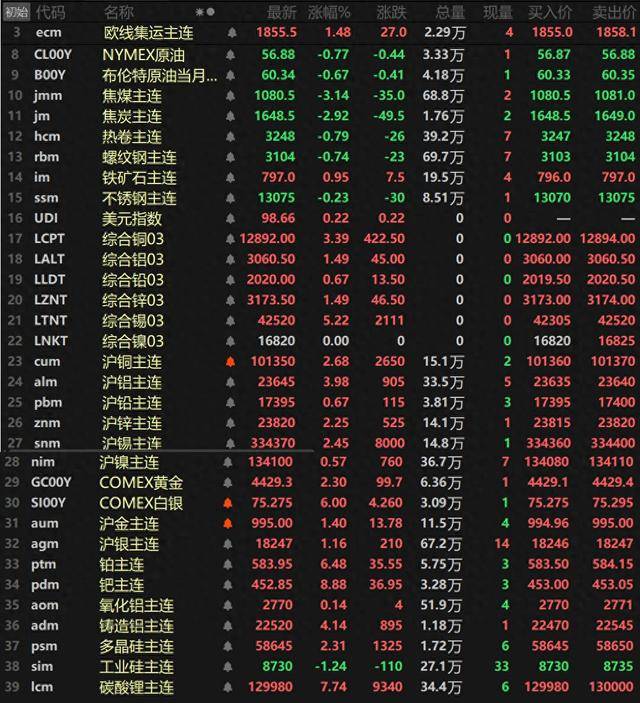
Metal Market - Domestic base metals experienced a general increase, with Shanghai aluminum leading at a rise of 3.98%, reaching a peak of 23,780 yuan/ton, a new high since March 2022 [1] - Shanghai copper, zinc, and tin also saw gains exceeding 2%, with copper up 2.68%, zinc up 2.25%, and tin up 2.45% [1] - Other metals had increases of less than 1%, while alumina rose by 0.14% and casting aluminum surged by 4.14%, hitting a historical high of 22,695 yuan/ton since its listing [1] - Lithium carbonate increased by 7.74%, and polysilicon rose by 2.31%, while industrial silicon fell by 1.24% [1] - In the black metal sector, iron ore was the only metal to rise, up 0.95%, while hot-rolled and rebar both fell over 0.7% [1] - As of 15:04, foreign base metals were generally up, with London nickel stable at $16,820/ton, and tin rising by 5.22% and copper by 3.39% [1] - Precious metals also saw gains, with COMEX gold up 2.3% and silver up 6%, while domestic gold and silver rose by 1.4% and 1.16% respectively [1][2] Macro Environment - The Chinese Commodity Price Index rose for the eighth consecutive month, reaching 117.9 points in December 2025, a 3.2% increase from the previous month, indicating improved market conditions [6] - The People's Bank of China conducted a net withdrawal of 468.8 billion yuan through reverse repos, maintaining a stable monetary policy [7] - The US dollar index increased by 0.22% to 98.66, with expectations of potential interest rate cuts by the Federal Reserve later this year [8]

国内期货29日收盘多数下跌,铂主连下跌10.0%
Jin Rong Jie· 2025-12-29 08:30
Group 1 - The domestic futures market closed mostly lower on December 29, with platinum futures dropping by 10.0%, while palladium, lithium carbonate, polysilicon, and wire rod futures fell over 3.5% [1] - Iron ore futures increased by 2.58%, and both rubber paper and corn futures rose by more than 1.5% [1] Group 2 - The leading futures contracts that gained included iron ore with a rise of 2.58% to a price of 796.53 yuan and a transaction volume of 6.62 billion yuan, rubber paper up by 1.87% to 4150.09 yuan with a transaction volume of 9.01 billion yuan, and corn up by 1.86% to 2249.01 yuan with a transaction volume of 6.43 billion yuan [2] - The leading futures contracts that declined included platinum down by 10.06% to 334.35 yuan with a transaction volume of 854.36 million yuan, palladium down by 10.04% to 494.13 yuan with a transaction volume of 47.86 million yuan, and lithium carbonate down by 7.89% to 1188.20 yuan with a transaction volume of 70.20 million yuan [2]
国内期货22日收盘多数上涨,欧线集运主连上涨8.77%
Jin Rong Jie· 2025-12-22 10:46
Group 1 - The domestic futures market closed mostly higher on December 22, with the European shipping main contract rising by 8.77% [1] - Palladium and platinum main contracts increased by over 4.5%, while Shanghai silver and nickel main contracts also saw significant gains [1] - The average monthly main contract for plastic fell by 2.53%, with both plastic main and polysilicon main contracts dropping over 2.0% [1] Group 2 - Leading gainers included the European shipping main contract with an increase of 8.77%, closing at 1,871.84 yuan and a transaction volume of 8.02 billion yuan [2] - Palladium main contract rose by 7.05% to 8,450 yuan with a transaction volume of 136.45 billion yuan, while platinum main contract increased by 6.99% to 5,685.45 yuan with a transaction volume of 295.41 billion yuan [2] - Leading decliners included the average monthly main contract for plastic, which fell by 2.53% to 6,154.01 yuan with a transaction volume of 1.47 billion yuan [2]
国内期货15日收盘多数上涨,铂主连上涨7.0%
Jin Rong Jie· 2025-12-15 09:25
Group 1 - The domestic futures market saw most contracts rise, with platinum leading the gains at 7.0% [1] - Other notable increases included palladium at 4.7%, polysilicon at 3.6%, European shipping at 3.3%, and coking coal at 3.1% [1][2] - Conversely, apple futures fell by 2.95%, with other declines including vegetable oil at 1.9% and international copper at 1.4% [1][2] Group 2 - The closing prices and trading volumes for the leading gainers included platinum at 482.42 yuan with a transaction volume of 198.34 billion yuan, and palladium at 407.61 yuan with 24.13 billion yuan [2] - The leading losers included apple futures at 9232.02 yuan with a trading volume of 10.98 billion yuan, and vegetable oil at 9196.02 yuan with 203.05 million yuan [2]
国内期货27日收盘多数上涨,铂主连上涨6.25%
Jin Rong Jie· 2025-11-27 08:19
Group 1 - The domestic futures market closed mostly higher on November 27, with platinum futures leading the gains, rising by 6.25% [1] - Other notable gainers included Shanghai silver futures up 3.35%, Shanghai tin futures up 2.11%, egg futures up 2.08%, and palm oil futures up 1.74% [2] - Conversely, lithium carbonate futures fell by 1.68%, with asphalt futures and short fiber futures both declining over 1.0% [1] Group 2 - The highest closing futures included platinum at 430.32 yuan with a transaction volume of 731.8 million yuan, and Shanghai silver at 1,252.50 yuan with a transaction volume of 380.72 million yuan [2] - The lowest closing futures included lithium carbonate at 958.20 yuan with a transaction volume of 194.5 million yuan, and asphalt at 3,007.06 yuan with a transaction volume of 72.8 million yuan [2]