隔离霜

Search documents
万亿个护大战,除了讲故事,谁在真解决问题?| 2025清洁个护年终盘点TOP15创新发布
新消费智库· 2026-02-05 13:33
Core Insights - The article highlights the significant growth in the online sales of body care products, which increased by 27% year-on-year, indicating a shift in consumer focus from basic grooming to more personalized and emotional value-driven care [2][7][19] - The Chinese personal care market is expected to undergo a transformation by 2025, moving from basic cleaning to precise care and emotional value [2][6] Industry Landscape - The personal care market in China is experiencing a dual trend, with traditional segments growing slowly while emerging niches expand rapidly. The hair care market reached 55.9 billion yuan in 2023 and is projected to exceed 70 billion yuan by 2026 [6] - The body care segment has become the largest highlight, with online sales surpassing 65.1 billion yuan, accounting for 56% of the personal care market [7] Consumer Demographics - The primary consumer demographic consists of women aged 21-35 in first-tier and new first-tier cities, making up over 70% of the market. Female users account for over 85% of personal care consumers, with a notable increase in the under-30 age group [9] Consumer Pain Points - There is a growing disconnect between product promises and actual results, leading to a trust crisis in the industry. 63% of consumers no longer believe in the efficacy claims made by brands [12][13] - The complexity of ingredient lists and lack of transparency create confusion for consumers, making it difficult to discern necessary components from potential irritants [14][15] - Consumers face decision fatigue due to an overload of choices, with 71% stating they cannot find products that fully meet their needs [15][16] - The mismatch between price and perceived value is evident, as high-end products often do not deliver significantly better results than lower-priced alternatives [17] Market Trends - Body care has surpassed hair care as the largest segment in personal care, driven by a shift in consumer attitudes towards self-care and holistic well-being [19][21] - Domestic brands are moving from a focus on cost-effectiveness to value leadership, addressing specific local consumer needs that international brands may overlook [22] - Fragrance has become the primary purchasing decision factor in body care, with over 50% of consumer discussions centered around scent experiences [23] Product Innovation - The concept of "clean beauty" is transitioning from niche to mainstream, with the global market expected to grow from $7.15 billion in 2024 to $8.09 billion in 2025, reflecting a shift in consumer attitudes towards ingredient safety [24][25] - Traditional herbal ingredients are making a strong comeback, providing a unique competitive advantage for domestic brands in hair and scalp care [26][27] - High-efficacy ingredients from facial care are increasingly being applied to body care, indicating a rising consumer expectation for body products to deliver similar results [30] Consumer Experience - The personalization of fragrance choices is on the rise, with unique scents becoming a way for consumers to express their identity [31] - The emergence of therapeutic fragrances reflects a growing consumer focus on emotional well-being, although the subjective nature of these experiences can lead to polarized reviews [32][33] - The expansion of personal care consumption into various life scenarios, such as gifting and travel, is creating new market opportunities while also raising concerns about over-packaging and single-use products [34][35] Brand Innovation - Brands are redefining their core competencies by focusing on specific consumer needs and creating products that resonate with modern lifestyles, such as health-oriented solutions [36][37] - The trend towards comprehensive scalp care reflects a shift in consumer perception, viewing scalp health as integral to overall well-being [39][41]

金甲虫刘船高:即时零售改变不了线下
Sou Hu Cai Jing· 2025-12-24 12:29
Core Viewpoint - The recent announcement by the National Medical Products Administration regarding 37 batches of non-compliant cosmetics has highlighted the challenges of counterfeit products in the instant retail sector, particularly on platforms like Meituan [1] Group 1: Instant Retail Growth and Market Potential - The instant retail market in China is projected to exceed 1 trillion yuan by 2026 and reach 2 trillion yuan by 2030, with an average annual growth rate of 12.6% during the 14th Five-Year Plan period [1][2] - Major e-commerce platforms, including JD.com and Alibaba, have significantly invested in instant retail, with JD.com entering the food delivery sector and offering substantial subsidies to attract users and merchants [2][4] - Instant retail has shown remarkable performance during the Double 11 shopping festival, with total e-commerce sales reaching 16,950 billion yuan, a year-on-year increase of 14.2%, while instant retail sales surged to 670 billion yuan, up 138.4% [4] Group 2: Adaptability of Beauty Products in Instant Retail - Beauty products are well-suited for instant retail due to their small size, high price points, and standardized nature, making them ideal for quick delivery [5] - The beauty industry has embraced instant retail as a pioneering sector, with major platforms like Meituan and JD.com seeing significant growth in beauty product sales [6] Group 3: Differentiated Development of Beauty Brands - Beauty brands are primarily adopting an indirect entry model into instant retail, relying on beauty collection stores and large supermarkets to reach consumers [7] - Notable brands like L'Oréal and Lin Qingxuan have successfully completed official certifications for entry into instant retail platforms, while many others are still in the process [7][8] Group 4: Consumer Behavior and Market Dynamics - Despite the rise of instant retail, some industry experts argue that it may not significantly alter the current landscape of offline retail, as consumers often stock up on beauty products rather than relying on immediate purchases [9] - The overlap between instant retail customer bases and existing offline store customers suggests that speed may not be the primary concern for beauty consumers [9] Group 5: Strategic Considerations for Retailers - Retailers are advised to focus on brand strength, quality, pricing, and service rather than chasing every market trend, as a strong brand presence can naturally attract consumers regardless of channel changes [11][12] - Companies like Jinjia Chong have maintained a sustainable development model by emphasizing authenticity and affordability, which has contributed to their long-term success in the market [11]

瞄准平台流量 自然堂接入淘宝闪购
Guo Ji Jin Rong Bao· 2025-08-13 16:21
Core Insights - The skincare brand Chando has entered the competitive food delivery market by integrating with Taobao Flash Purchase, launching one-hour and half-day delivery services in five cities: Shanghai, Suzhou, Wuhan, Tianjin, and Qingyuan [1] Group 1: Product Strategy - Chando has adjusted its product selection strategy, warehousing layout, and supply chain for the flash purchase scenario, designing its inventory with a "6:3:1" ratio: 60% high-repurchase products like masks and serums, 30% seasonal new products like sunscreen, and 10% sample sets [2] - The company has differentiated its warehouse configurations across cities, significantly increasing stock for popular items and employing various delivery methods to achieve one-hour delivery [3] Group 2: Market Positioning - Within two weeks of launching on Taobao Flash Purchase, Chando ranked among the top five in the beauty category, benefiting from exposure on multiple platforms such as Taobao App, Amap, Alipay, and Ele.me, which greatly enhances brand visibility and sales opportunities [3] - The brand recognizes a shift in consumer preferences towards more environmentally friendly products, with 75% of young consumers indicating a preference for sustainable options [3] Group 3: Sustainability Initiatives - Chando has established a raw material fermentation factory to support its sustainable development strategy, aiming to mitigate supply chain vulnerabilities and enhance its green product offerings [3][4] - The company is leveraging five advanced green raw material technologies, including microbial fermentation and ultra-low temperature freeze-drying, to improve the efficiency and sustainability of its production processes [4] - The growth of domestic beauty brands is expected to continue, driven by young consumers, with projections indicating a significant rise in market presence over the next 3-5 years [4]
底妆市场与消费者洞察报告-青眼情报
Sou Hu Cai Jing· 2025-07-25 14:23
Market Overview - The Chinese foundation makeup market is expected to grow steadily, with the market size increasing from 73.19 billion yuan in 2022 to 93.70 billion yuan in 2024, and is projected to exceed 100 billion yuan in 2025, indicating a healthy and active industry phase [1][9][10] - Online sales are dominated by Douyin, which holds a 51.23% share of the online GMV, followed by Taobao with 29.02%, while Pinduoduo has surpassed JD, highlighting the potential of lower-tier markets [1][12][15] Consumer Insights - The core consumer group is aged 31-35, with 37.54% residing in third-tier cities or below; nearly 90% of consumers have skin blemishes, emphasizing the demand for coverage and long-lasting makeup [2][5] - Daily commuting (64.36%) and social gatherings (85.64%) are the primary usage scenarios, with consumers preferring natural makeup (70.24%) and valuing lightweight, breathable, and long-lasting products [2][5] Product Trends - The market is witnessing continuous upgrades in long-lasting makeup technology, with brands like Caitang and Laose achieving 24-hour wear through patented technologies; the trend of combining makeup with skincare is becoming mainstream [2][7] - Scene-specific innovations, such as mini portable products and exclusive solutions for different occasions, are gaining popularity, along with cultural empowerment and IP collaborations enhancing product appeal [2][7] Competitive Landscape - The foundation makeup category is primarily dominated by basic foundation products, with Douyin users showing a strong preference for three-dimensional makeup effects [1][16] - Estee Lauder leads the foundation liquid market on Taobao, while Douyin is dominated by brands like Passional Lover; in the cushion category, YSL has a significant advantage on Taobao, while Douyin is a stronghold for domestic brands like Ruikefu and Laose [1][25][29] Category Performance - The foundation makeup products can be categorized into four main types: base makeup, makeup primer, local touch-up products, and setting products [7] - The basic foundation category holds a dominant position across platforms, with Douyin's local touch-up category accounting for 8.7%, reflecting users' pursuit of a three-dimensional makeup look [1][16]

215个品牌GMV破亿!上半年美妆电商战事揭榜
Sou Hu Cai Jing· 2025-07-17 11:48
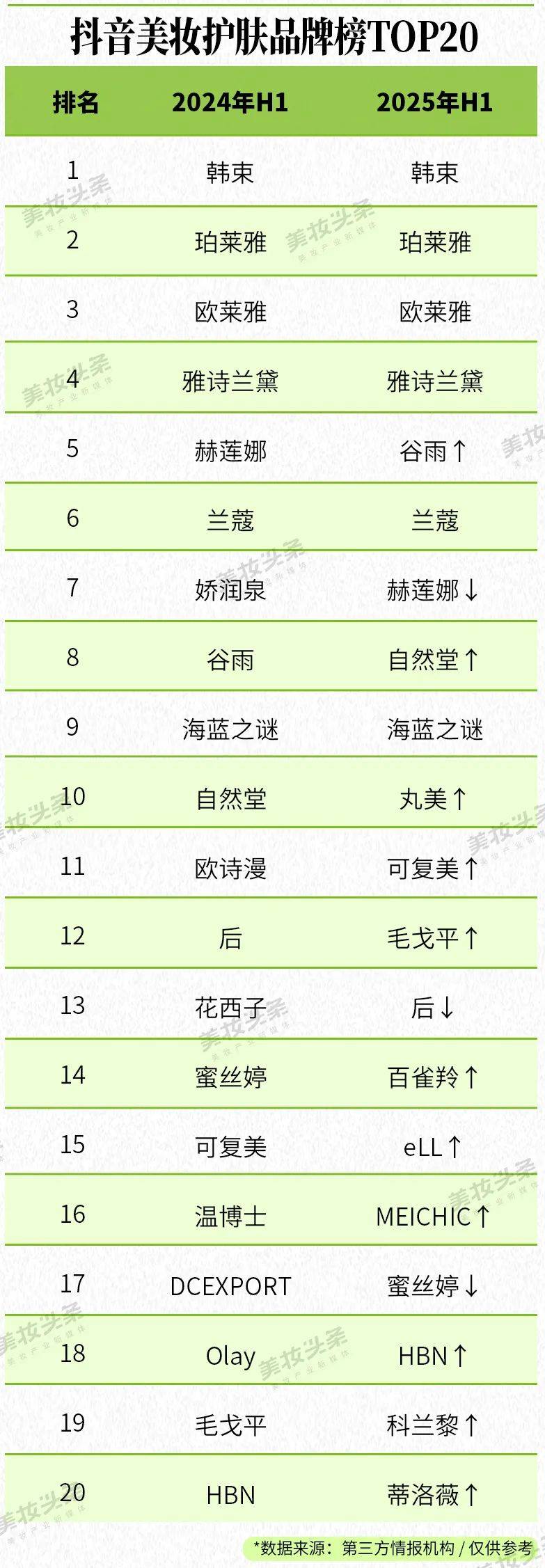
Core Insights - The beauty brand competition on various platforms has intensified, with brands needing to adapt to changing consumer preferences and marketing strategies to survive in the market [1][21][29] Group 1: Douyin Platform Insights - 215 beauty and skincare brands achieved a GMV of over 100 million yuan on Douyin in the first half of 2025 [1] - The top 10 brands in terms of sales include both domestic and international brands, with notable names like 韩束 (Hanshu), 珀莱雅 (Proya), and 欧莱雅 (L'Oreal) [1][5] - Domestic brands such as 谷雨 (Guyu), 自然堂 (Naturally), and 丸美 (Marubi) have shown steady sales growth due to precise product positioning and marketing strategies [5][15] Group 2: Tmall Platform Insights - The top 20 skincare brands on Tmall accounted for 46.2% of the total category GMV, while the top 20 makeup and perfume brands accounted for 39.53% [10] - The presence of domestic brands in the top 20 has decreased compared to the previous year, with brands like 珀莱雅 (Proya) and 自然堂 (Naturally) losing their positions [10][11] - International brands such as 欧莱雅 (L'Oreal), 兰蔻 (Lancôme), and 雅诗兰黛 (Estée Lauder) have maintained strong positions, with some showing upward trends in rankings [11][14] Group 3: JD Platform Insights - JD's beauty sales exceeded 13.32 billion yuan in the first four months of 2025, with a projected total sales of over 30 billion yuan for the first half of the year [21][27] - International beauty brands dominate the rankings on JD, with no domestic brands appearing in the top five during major promotional events [25][27] - The growth of beauty products on JD has been significant, with some categories seeing sales increases of over 500% during promotional events [27][28] Group 4: Market Trends and Strategies - The competition among beauty brands is characterized by the need for tailored strategies that align with the unique ecosystems and user preferences of each platform [29] - Brands like MEICHIC and 蒂洛薇 (Tilowei) have achieved explosive growth on Douyin through innovative marketing strategies involving influencers and live streaming [29] - The overall beauty market in 2025 is expected to continue evolving, with brands needing to understand platform-specific dynamics to thrive [29]


酷暑催热多元清凉消费,分期乐商城助力激活夏日经济潜力
Xin Lang Zheng Quan· 2025-07-11 08:53
Group 1 - The extreme heat wave across various regions in China has led to a surge in demand for cooling appliances such as air conditioners and refrigerators, driving a "cooling economy" that boosts consumer spending [1][2] - Xiaomi reported a dramatic increase in air conditioner sales, with peak sales reaching 20 times that of the same period last year in Northeast and Inner Mongolia, highlighting the significant impact of high temperatures on the cooling appliance market [2] - The sales of alternative cooling products like evaporative coolers and electric fans have also surged, with cooler sales increasing by 3.5 times and fan sales by 54% [3] Group 2 - The demand for sun protection products and beauty care items has also seen explosive growth, with sunglasses sales doubling and women's purchases of sun protection products outpacing men's by more than four times [3] - The "Zhenpin Hui" and "Factory Store" retail models of Fenqile Mall have effectively catered to the diverse consumption needs of young consumers, providing a "light consumption" shopping experience through interest-free installments and discount coupons [3] - Fenqile Mall aims to continuously innovate consumption scenarios and deepen collaborations with brands and platforms to stimulate consumer spending and enhance the multi-category shopping experience for young consumers [3]