
非浓缩还原橙汁

Search documents
Orange Facts E202601| 全球甜橙简报:橙汁消费增量 引领全球橙类行情回暖
Xin Lang Cai Jing· 2026-02-24 13:12
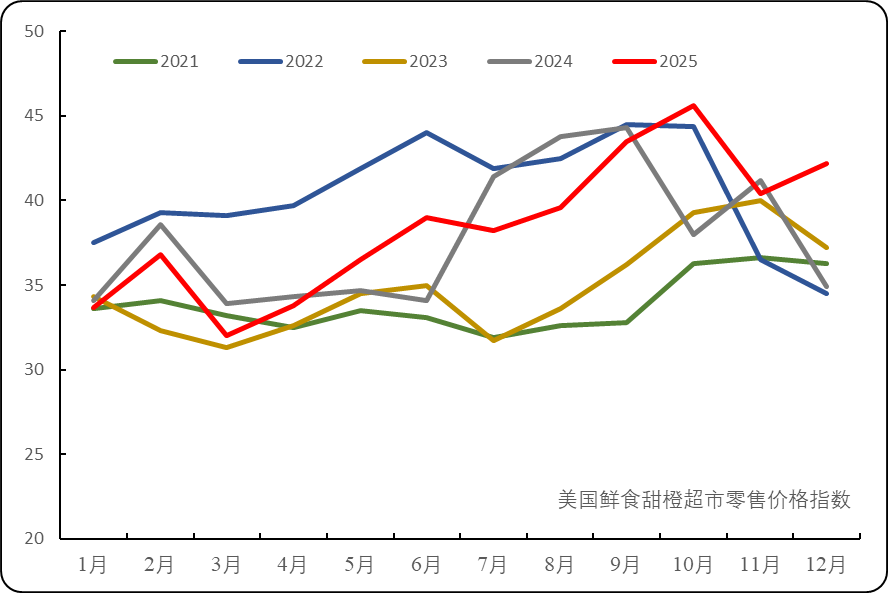
Group 1 - The global orange juice production and sales have shown significant growth in January, driven by festive demand, leading to a slight recovery in fresh orange market prices [1] - The differences in import and export trade among major markets are key factors affecting fresh orange market price fluctuations [1] - The U.S. fresh orange market is experiencing a strong price trend due to increased export expectations, while the EU market is facing downward pressure from low-priced Egyptian oranges [1][2] Group 2 - The USDA-FAS reports that U.S. orange juice consumption is expected to rise to 440,000 tons in the 2025/2026 season, a 6.80% increase from the previous year, while fresh orange exports are projected to reach 330,000 tons, up 0.92% [2] - The average retail price of fresh sweet oranges in the U.S. increased by 4.46% month-on-month and 20.92% year-on-year as of December [2] - Global orange juice production is forecasted at 1.351 million tons for the 2025/2026 season, a modest increase of 1.10 million tons, while consumption is expected to rise by 44,000 tons to 1.168 million tons [3] Group 3 - The EU's import of sweet oranges surged by 420.15% month-on-month in January, primarily due to increased imports from Egypt, although year-on-year figures remain low [5][7] - The wholesale average price of fresh sweet oranges in the EU was €94.00 per 100 kg in January, reflecting a 1.05% decrease month-on-month but a 1.84% increase year-on-year [7] - The EU's internal supply of sweet oranges remains dominant, with imports primarily aimed at addressing regional shortages [10] Group 4 - In China, the fresh orange market saw a temporary price increase leading up to the Spring Festival, with the wholesale price of citrus fruits rising by 3.74% month-on-month [11] - The out-of-factory price index for frozen concentrated orange juice in China increased by 6.33% during the month, indicating a strengthening market [11] - The search index for orange juice products has shown a positive trend, suggesting a potential increase in consumer demand [12][14]

新华指数|非浓缩还原橙汁出厂价小幅上涨 三峡库区脐橙引领全国鲜橙价格回升
Xin Lang Cai Jing· 2026-02-14 08:18
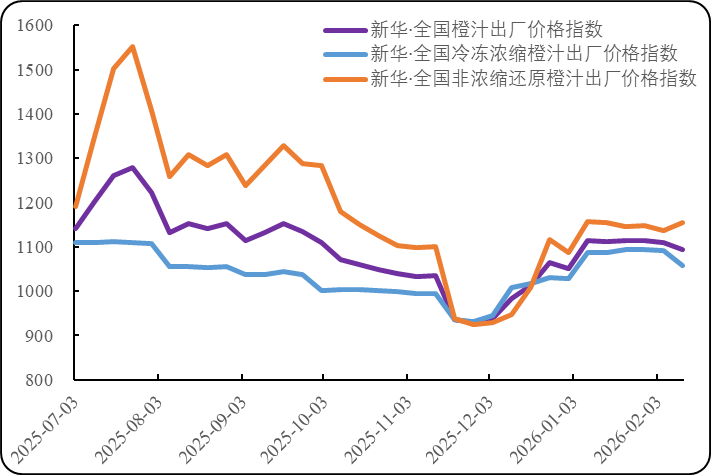
Core Viewpoint - The EU's fresh sweet orange production decline and high prices may lead to increased consumption of lower-priced orange juice, with the upcoming Chinese New Year boosting demand for fresh oranges and orange juice [1] Price Trends - As of February 12, the global frozen concentrated orange juice futures contract (FCOJ2603) settled at 171.93 cents per pound (equivalent to 26.38 yuan per kilogram), a week-on-week decrease of 4.20% [1] - The national frozen concentrated orange juice factory price index reported 1056.81 points, down 3.15% week-on-week, while the non-concentrated reconstituted orange juice factory price index rose to 1153.73 points, up 1.43% [1] - The overall national orange juice factory price index stood at 1093.98 points, reflecting a week-on-week decline of 1.35% [1] Domestic Market Dynamics - Domestic citrus production is steadily increasing, but the consumption of fresh sweet oranges is declining, leading to pressure on wholesale prices [4] - As of February 12, the national citrus wholesale average price was 6.38 yuan per kilogram, with navel oranges averaging 7.44 yuan per kilogram, showing a week-on-week increase of 4.49% [4] - The price of the "Zhi Gui" navel orange at the production site was 2.31 yuan per kilogram, up 2.41% week-on-week, while the "Chun Jian" orange was priced at 3.98 yuan per kilogram, up 1.53% [4] Consumer Behavior and Trends - The processing ratio of domestic sweet oranges remains low at around 10%, but there is a gradual shift towards increased consumption of orange juice, particularly non-concentrated reconstituted orange juice [5] - The search index for navel oranges on Baidu has shown a decline, indicating reduced consumer interest, with the average index for "Feng Jie" navel oranges at 318.57 points, down 2.83% week-on-week [8] - The search index for orange juice averaged 254.00 points, reflecting a slight increase of 0.97% week-on-week, but a significant year-on-year decline of 46.43% [9] Future Market Outlook - The market for navel oranges is expected to remain strong during the Chinese New Year, with prices likely to continue rising, particularly for navel oranges from the Three Gorges Reservoir area [8] - The overall national citrus wholesale price is at a low point and is expected to fluctuate within a narrow range [8]
专项抽检超227万批次、查办案件逾1.3万件 堵住食品添加剂使用漏洞
Jing Ji Ri Bao· 2025-11-13 00:16
Core Viewpoint - Strict regulation of food additives remains a key focus of food safety oversight, with a comprehensive governance action launched to protect consumer safety [1] Group 1: Regulatory Actions and Results - As of now, the special action has led to the investigation of 13,180 cases of excessive or unauthorized use of food additives, involving a total amount of 23.31 million yuan and fines of 90.38 million yuan, with 89 cases referred to law enforcement [1] - In the first three quarters of this year, 2.12 million batches of food additives were tested, with 21,200 non-compliant samples found, resulting in a non-compliance rate of 0.93%, a decrease of 0.02 percentage points compared to the same period last year [1][2] Group 2: Focus Areas for Inspection - The regulatory body is focusing on 21 categories of high-risk products, including agricultural products and processed foods, particularly those labeled as "zero additives" or "no preservatives" [2] - Among the tested categories, beverages, nuts, and dairy products showed no non-compliant samples, while grain products and baked goods had varying degrees of violations related to the use of additives like sulfur dioxide and sweeteners [2] Group 3: Enhanced Measures for Specific Products - New guidelines for meat products require strict adherence to standards for food additive usage, including defined quantities and types, with regular monitoring implemented [3] - In the beverage sector, production guidelines mandate the establishment of product formulation management systems to ensure compliance with national safety standards [3] Group 4: Industry Responsibility and Future Directions - The industry is urged to adopt a "non-essential, no-addition" philosophy to reduce reliance on food additives, promoting self-regulation and accountability among producers [3] - The regulatory authority emphasizes that quality and safety are non-negotiable, and future efforts will focus on strengthening the governance of food additive production and usage [4]