鸿蒙Next系统

Search documents
一天之内,三件大事联动!从美联储到A股,全球市场迎来关键日
Sou Hu Cai Jing· 2025-10-16 04:57
Core Insights - The global financial market experienced a historic upheaval on October 16, 2025, marked by the Federal Reserve's policy shift, a significant rebound in A-shares, and gold prices soaring past $4,200, fundamentally altering global capital flow dynamics [3][4]. Group 1: Federal Reserve Policy Shift - The Federal Reserve announced the end of its balance sheet reduction, with its balance sheet size decreasing from a peak of $9 trillion to $6.6 trillion, concluding a three-year quantitative tightening cycle [3]. - The anticipated interest rate cut of 25 basis points on October 28, with a 93.5% probability of a total cut of 50 basis points by December, was driven by a deteriorating job market and tariff impacts [3]. - The unemployment rate rose to 4.3% in August, prompting the Fed to abandon its anti-inflation priority strategy [3]. Group 2: A-share Market Dynamics - The A-share market saw a dramatic rebound, with the ChiNext Index surging 2.36% to surpass 3,000 points, and the Sci-Tech 50 Index rising 1.4% to reach a new yearly high [3]. - Northbound capital inflow reached 12.9 billion, with the electronic sector receiving a significant boost of 67.78% in main capital allocation [3]. - Semiconductor stocks were ignited by the announcement from SMIC regarding a 90% yield on 14nm chips, highlighting the domestic substitution narrative [3]. Group 3: Gold Market Surge - COMEX gold futures rose by 1.48% to $4,224.9, marking a 23% increase year-to-date [4]. - Global gold ETFs saw a net inflow of $3.3 billion in a single day, the highest since 2020 [4]. - The revaluation of gold's safe-haven status was driven by the Fed's interest rate cut cycle and escalating geopolitical conflicts [4]. Group 4: Market Restructuring Effects - The anticipated Fed rate cut led to a 0.39% decline in the US dollar index, stabilizing the RMB at around 7.12, with northbound capital increasing by over 5 billion in electronic stocks [4]. - The ChiNext Index's price-to-earnings ratio recovered from 50 times to 67 times, while the average price-to-sales ratio for semiconductor firms on the Sci-Tech board exceeded 15 times [4]. - Technology growth stocks, with a PE ratio of 72 times, took over the leadership from financial heavyweight stocks, which had a PE ratio of 8 times [4]. Group 5: Technological Revolution - The demand for AI computing power ignited a chip revolution, with Apple's M5 chip pre-orders starting and TSMC's 3nm capacity fully booked [4]. - The national supercomputing internet phase II project commenced, with data center construction investments surpassing 1 trillion [4]. - The photovoltaic leader Longi Green Energy announced mass production of perovskite batteries, creating a "dual drive" effect between new energy and semiconductors [4]. Group 6: Geopolitical Dynamics - China implemented quota controls on rare earth exports, leading to a daily surge in Northern Rare Earth stocks [4]. - The US escalated AI chip export restrictions to China, with Cambrian receiving a 10 billion investment from the national team [4]. - The passage of a nationalization bill for lithium mines in Chile accelerated CATL's expansion in South America [4]. Group 7: Future Market Restructuring - The valuation system is shifting from PE to PS, with the median PS for Sci-Tech board companies reaching 12 times, breaking the traditional 20 times PE framework [4]. - The visibility of orders for semiconductor equipment companies extends to 2026, with advance payments exceeding 40% of revenue [4]. - The digital yuan's cross-border payment pilot expanded to 47 countries, while SWIFT system transaction volume decreased by 12% [4]. Group 8: Investment Strategies - Recommended investments include infrastructure for computing power (Zhongji Xuchuang), servers (Inspur), and IDC (Baoxin Software) [5]. - Focus on domestic substitution in semiconductor equipment (Northern Huachuang), EDA software (Hua Da Jiu Tian), and materials (Hu Silicon Industry) [5]. - Capture policy dividends by monitoring the Ministry of Industry and Information Technology's monthly updates on "little giant" companies [5].

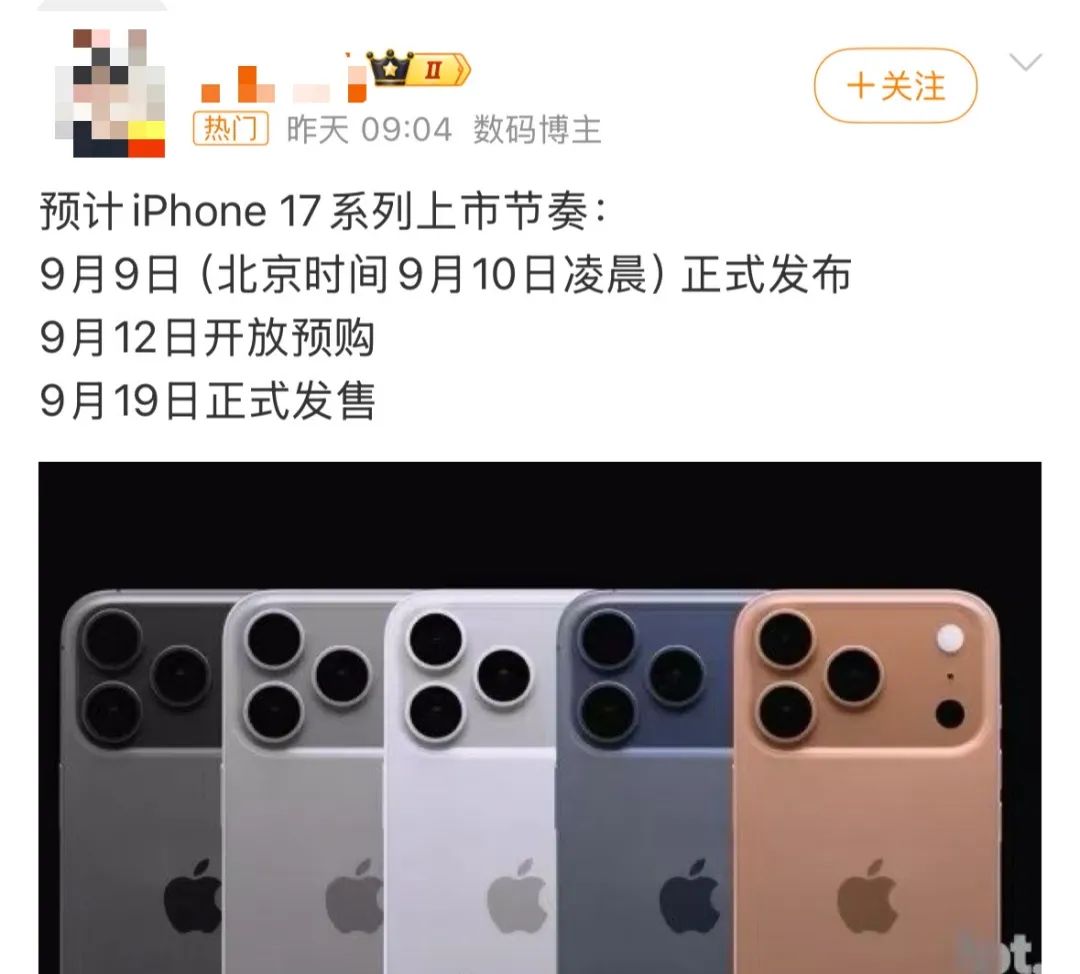
苹果硬刚华为,iPhone 17五连暴击升级,Mate80绝地反击,年度最强手机大战来了
3 6 Ke· 2025-08-13 01:15
Core Viewpoint - The upcoming release of Apple's iPhone 17 and Huawei's Mate 80 is set to intensify competition in the smartphone market, with both companies introducing significant upgrades to their devices, appealing to different consumer preferences and needs [1][36]. Group 1: iPhone 17 Features - The iPhone 17 introduces a new model, the iPhone 17 Air, which is notably thin at 5.5mm and features a 6.6-inch display, emphasizing a lightweight design [7][28]. - The Pro series of the iPhone 17 has undergone a redesign of the camera module, allowing for larger image sensors, which is expected to enhance photography capabilities [12][21]. - All models in the iPhone 17 series will feature a 48-megapixel camera system, with the Pro models supporting 8x optical zoom and a 24-megapixel front camera, catering to photography enthusiasts [24][27]. - The iPhone 17 Pro Max is expected to include a 5000mAh battery, the largest in Apple's history, along with improved charging capabilities [27][35]. - The new A19 series chip, built on a 3nm process, will be featured in the Pro models, along with an upgrade to 12GB of RAM, enhancing performance for multitasking and AI applications [32][35]. Group 2: Huawei Mate 80 Features - The Huawei Mate 80 is anticipated to launch with the new Kirin 9030 chip and HarmonyOS Next, aiming to compete directly with Apple's offerings [36][37]. - The Mate 80 is expected to feature a 6000mAh battery with fast charging capabilities of 100W wired and 80W wireless, potentially offering superior battery life compared to the iPhone 17 Pro Max [41][45]. - Huawei's focus on camera technology continues, with rumors of higher pixel sensors and advanced algorithms, which may enhance its photography capabilities, particularly in low-light conditions [39][41]. - The Mate 80 is also rumored to support satellite communication 3.0, further enhancing its communication capabilities [44][45]. Group 3: Market Implications - The competition between Apple and Huawei is expected to escalate, with both companies making significant advancements in technology and features, appealing to their respective user bases [45][49]. - Price adjustments are anticipated, with the iPhone 17 Pro series potentially increasing by 4%-5% due to tariffs, while Huawei's pricing strategy remains unclear but is expected to be competitive [51].