
30年期抵押贷款

Search documents
美国楼市迎来“开年红” 大额利率触及2023年4月以来低位 签约量与再融资回暖
Zhi Tong Cai Jing· 2026-01-07 13:37
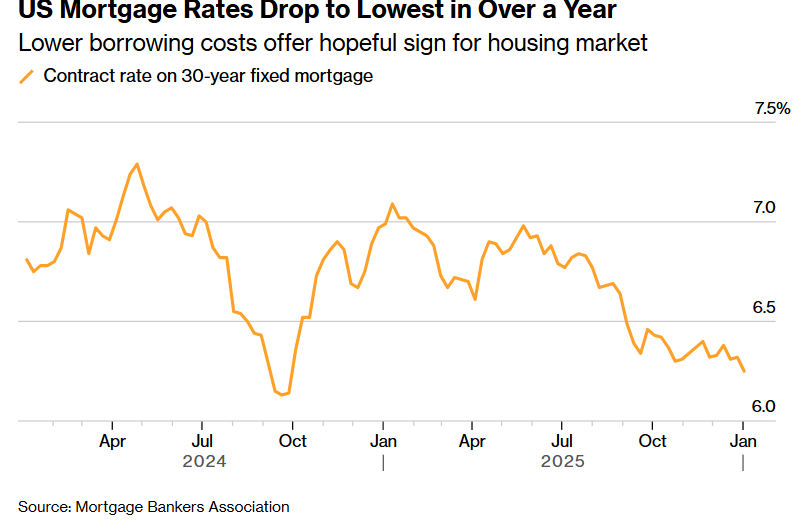
Group 1 - The core viewpoint of the articles indicates that the recent decline in mortgage rates in the U.S. brings renewed hope for the housing market, which has been struggling under high rates and inflation pressures [1][4] - The 30-year fixed mortgage rate fell by 7 basis points to 6.25%, while the rate for jumbo loans dropped to 6.32%, marking the lowest levels since April 2023 [1] - The National Association of Realtors (NAR) reported that contract signings have increased for four consecutive months, suggesting a strengthening momentum in U.S. real estate sales as the new year begins [1] Group 2 - Despite the decrease in borrowing costs, the Mortgage Bankers Association (MBA) reported a seasonally adjusted decline of 6.2% in the purchase index, which is typical during the holiday season [4] - Conversely, the refinancing index unexpectedly rose by 7.4% after seasonal adjustments, indicating a potential shift in borrower behavior [4] - The MBA's survey, conducted weekly since 1990, covers over 75% of retail residential mortgage applications in the U.S., providing a comprehensive view of the mortgage market [4]

利率降至2024年9月来新低 美国楼市新年现复苏曙光
Xin Lang Cai Jing· 2026-01-07 13:07
Core Viewpoint - The recent decline in mortgage rates in the U.S. offers hope for the sluggish housing market as it reaches the lowest level since September 2024, potentially boosting buyer interest and sales momentum [1] Group 1: Mortgage Rate Trends - The 30-year fixed mortgage rate decreased by 7 basis points to 6.25% as of the week ending January 2 [1] - The rate for 30-year jumbo loans, used for high-priced homes, fell to 6.32%, marking the lowest point since April 2023 [1] Group 2: Housing Market Indicators - The National Association of Realtors reported that the number of signed contracts has increased for four consecutive months, indicating a strengthening sales momentum entering the new year [1] - Despite the decrease in borrowing costs, the Mortgage Bankers Association's purchase index adjusted for seasonality fell by 6.2% last week [1] - The refinancing measure, after adjustment, rose by 7.4%, suggesting increased activity in refinancing despite the overall market fluctuations [1]
美国抵押贷款利率下滑至6.32% 有助于提振购房活动
Xin Lang Cai Jing· 2025-12-03 12:25
Core Insights - The recent decline in mortgage rates in the U.S. is expected to stimulate home buying activity, with the 30-year fixed mortgage rate dropping to 6.32%, the lowest in a month [1][2] - The adjustable-rate mortgage for the first five years has also decreased to 5.4%, marking the lowest level since May 2023 [1] - The Mortgage Bankers Association (MBA) reported a 2.5% increase in mortgage applications, reaching the highest level since early 2023, indicating stable potential demand in a challenging housing market [2] Mortgage Activity - The MBA's refinancing activity index has declined for the fifth consecutive week, marking the longest streak of declines in a year [2] - The MBA's survey, conducted weekly since 1990, includes feedback from mortgage bankers, commercial banks, and savings institutions, covering over 75% of the total retail residential mortgage applications in the U.S. [2]
Could the Federal Reserve interest rate cut boost the US housing market?
BBC· 2025-09-17 23:02
Core Insights - The article discusses the potential impact of recent interest rate cuts by the Federal Reserve on the US housing market, highlighting that while mortgage rates have decreased, significant changes in borrowing costs may not be forthcoming [4][8][9] Mortgage Rates and Housing Market - The average rate on a 30-year mortgage fell to 6.35%, marking the largest weekly decline in a year and the lowest in 11 months [4] - Despite the Federal Reserve's interest rate cut, mortgage rates may not decrease significantly further as banks had already adjusted rates in anticipation of this cut [5][8] - Approximately 80% of mortgage borrowers have locked in rates below the current average, which contributes to a reluctance among homeowners to sell and thus limits housing supply [13][12] Buyer Sentiment and Market Activity - Some prospective buyers, like Aileen Barrameda, are motivated to enter the market despite high mortgage rates, anticipating future price increases [3][11] - Real estate agents report increased activity, with some buyers encouraged by recent declines in mortgage rates, although the overall market remains unaffordable for many [10][11] - Cautious optimism exists among lenders regarding the housing market, but the recent dip in mortgage rates is not expected to resolve underlying affordability issues [18][19]
美国流动性是否存在隐忧?(国金宏观钟天)
雪涛宏观笔记· 2025-08-08 00:47
Core Viewpoint - The current liquidity level in the US remains healthy, but the focus should shift to the effectiveness of monetary policy stimulus, particularly the transmission of interest rate cuts to long-term rates, which is crucial for the recovery of the real economy [2][4][22] Group 1: Liquidity Status - Following the Silicon Valley Bank crisis, there has been no large-scale financial risk exposure in the US, and the stock market has recovered and reached new highs [4] - The US liquidity stock level is healthy, with concerns not stemming from insufficient liquidity but from potential mismatches and increased risk exposure due to further liquidity injections [4][11] - The current excess reserves in the US are approximately $900 billion, significantly higher than the $80 billion level during the 2019 repo market crisis [7] Group 2: Monetary Policy and Economic Impact - The effectiveness of interest rate cuts in stimulating the real economy is under scrutiny, as the transmission to long-term rates remains weak, limiting recovery in sectors like manufacturing and real estate [22] - The average duration of assets on bank balance sheets is increasing, raising concerns about interest rate sensitivity and liquidity risks [22][18] - The low supply of non-bond assets, such as commercial loans and residential mortgages, has led banks to allocate more to bond assets, further increasing average duration and interest rate risk [18] Group 3: Structural Changes in Financial System - The proportion of US Treasury securities in banks' loanable assets has increased by nearly 8 percentage points to 53%, primarily due to an increase in held-to-maturity assets [13] - The overall losses in the US banking sector amount to $410 billion, with approximately $260 billion stemming from held-to-maturity assets, which limits banks' credit supply capabilities [17] - The distribution of reserves has become more even, with the largest banks bearing the brunt of the Fed's balance sheet reduction, indicating a more resilient financial system [8][10]

房利美:美国30年期抵押贷款利率降至6.74%。
news flash· 2025-07-24 16:02
Core Viewpoint - The article highlights that the average rate for a 30-year fixed mortgage in the United States has decreased to 6.74% [1] Group 1: Mortgage Rates - The current average rate for a 30-year fixed mortgage is reported at 6.74% [1]
房地美称美国30年期抵押贷款利率升至6.75%。
news flash· 2025-07-17 16:04
Core Viewpoint - The article highlights that the average interest rate for a 30-year fixed mortgage in the United States has risen to 6.75%, indicating a significant increase in borrowing costs for homebuyers [1] Group 1: Interest Rate Trends - The current average interest rate of 6.75% represents a notable increase compared to previous rates, impacting the affordability of mortgages for potential buyers [1] - This rise in mortgage rates is likely to influence the housing market dynamics, potentially leading to a slowdown in home sales and affecting overall housing demand [1] Group 2: Implications for Homebuyers - Higher mortgage rates may deter first-time homebuyers and those with tighter budgets, as monthly payments will increase significantly [1] - The increase in borrowing costs could lead to a shift in buyer preferences, with more individuals considering adjustable-rate mortgages or lower-priced homes [1]
7月18日电,房地美称美国30年期抵押贷款利率升至6.75%。
news flash· 2025-07-17 16:03
Core Viewpoint - The article reports that the 30-year mortgage rate in the United States has risen to 6.75% according to Freddie Mac [1] Group 1 - The increase in the 30-year mortgage rate indicates a trend in rising borrowing costs for homebuyers [1] - This rate change may impact the housing market dynamics, potentially leading to decreased affordability for buyers [1] - The rise in mortgage rates could also affect refinancing activities among existing homeowners [1]
美国抵押贷款利率一个月来首次下降 但仍维持在6.9%附近
Sou Hu Cai Jing· 2025-06-06 05:10
Group 1 - Mortgage rates have seen a slight decline for the first time in a month, with the 30-year average rate at 6.85%, down from 6.89% the previous week, and the 15-year average at 5.99%, down from 6.03% [1] - The Mortgage Bankers Association (MBA) reported a 4% week-over-week decline in purchase applications, although they remain higher than the same period last year, with refinancing applications also down by 4% [1] - The decline in mortgage rates is closely linked to a drop in the 10-year Treasury yield, which fell significantly following weak service sector activity and a sharp decrease in private sector job growth [1] Group 2 - The Federal Reserve does not directly control mortgage rates but influences them through expectations regarding benchmark interest rates [2] - The upcoming non-farm payroll report is anticipated to provide insights into the health of the job market, with economists predicting an addition of 128,000 jobs last month [2]
美国抵押贷款利率升至三个月高点 购房和再融资申请双双下滑
news flash· 2025-05-21 12:02
Core Insights - The article highlights that U.S. mortgage rates have risen to a three-month high, leading to a decline in both home purchase and refinancing applications [1] Mortgage Rate Trends - As of the week ending May 16, the 30-year fixed mortgage rate increased by 6 basis points to 6.92% [1] - The adjustable-rate mortgage (ARM) with a fixed rate for the first five years also reached its highest level since February [1] Application Trends - Mortgage Bankers Association (MBA) reported a decrease of approximately 5% in both home purchase and refinancing applications [1]