30Y国债老券

Search documents
华源晨会精粹20260319-20260319
Hua Yuan Zheng Quan· 2026-03-19 11:28
Group 1: Fixed Income and Banking - The 2026 bond market is expected to perform better than anticipated, with a projected net issuance of around 20 trillion yuan, maintaining the same level as the previous year, and an increase in bank proprietary bond investments expected to reach 16 trillion yuan [2][8] - The anticipated policy interest rate cut of 10-20 basis points in 2026 is expected to lead to a corresponding decline in the Loan Prime Rate (LPR), with the 10Y government bond yield projected to fluctuate between 1.6% and 1.9% [2][8] - The credit investment strategy for March 2026 suggests a preference for medium-term duration strategies, with the M2 bank perpetual bonds showing significant outperformance compared to other bonds [9][10] Group 2: Media Industry - MiLian Technology has shown rapid revenue growth, with revenues increasing from 10.52 million yuan in 2022 to 19.17 million yuan in the first half of 2025, and a significant increase in average monthly active users by 45.81% year-on-year [14][15] - The company has expanded its application matrix, launching overseas market applications in 2024, which contributes to its growth potential in the online emotional market [14][15] - The platform fosters a vibrant user community through various interactive modes led by host users, enhancing user engagement and retention [15][16] Group 3: Pharmaceutical Industry - Yuan Dong Bio's revenue has grown from 162 million yuan in 2013 to 1.35 billion yuan in 2024, with a compound annual growth rate of 21.3%, driven by its anesthetic products and the strategic acquisition of Super Yang Pharmaceutical [18][19] - The company is focusing on innovative drug development, particularly in the CRBN molecular glue space, with its core product HP-001 showing Best-in-Class potential [18][19] - The internationalization of its anesthetic products is expected to contribute to revenue growth, with overseas sales increasing from 0.02 million yuan in 2017 to 0.25 million yuan in 2024 [20][21]

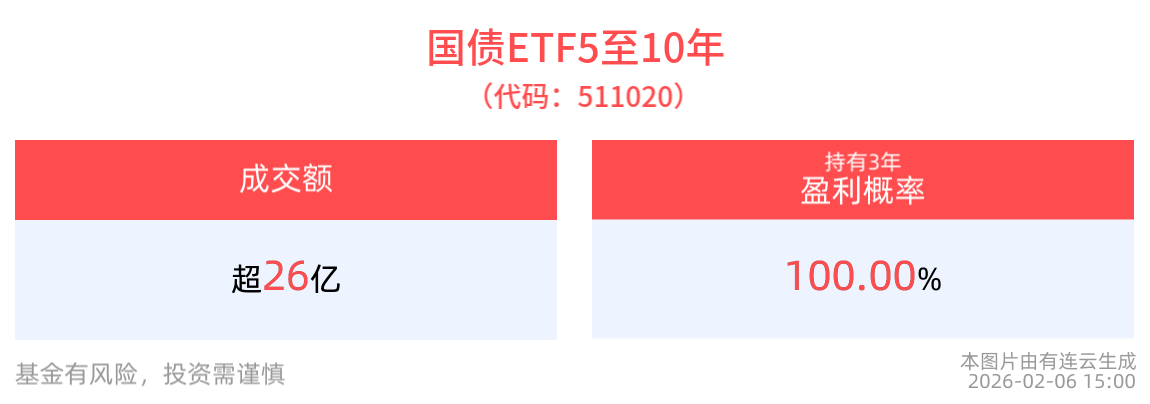
成交额超26亿元,国债ETF5至10年(511020)历史持有3年盈利概率为100.00%
Sou Hu Cai Jing· 2026-02-09 01:59
Group 1 - Institutions remain bullish on long-term bonds, driven by allocation despite net selling by brokers and funds of over 108.6 billion yuan in ultra-long-term bonds (maturity over 20 years) from January 1 to February 6, compared to a net sell of only 5.7 billion yuan in the same period last year [1] - Insurance funds net purchased 120.6 billion yuan of ultra-long-term bonds, while city and rural commercial banks net bought 50 billion yuan, showing a significant increase of 55.4 billion yuan and 68.8 billion yuan year-on-year respectively [1] - The steepening yield curve and declining funding costs for city and rural commercial banks enhance the incentive to allocate government bonds, with expectations that the cost of liabilities for these banks will drop below 1.6% in Q1 2026 [1] Group 2 - From November 20, 2025, to February 6, 2026, brokers, funds, and pension funds collectively net sold 354.8 billion yuan of ultra-long-term bonds, indicating a preference for mid- to short-term bonds [2] - The positive impact of rising stock markets on ultra-long-term bonds has significantly diminished, and if market expectations for stocks decline, there may be a rebound in ultra-long-term bond purchases, potentially driving the 30-year government bond yield down significantly [2] - Institutions predict that the 10-year government bond yield will break 1.80% and trend towards 1.75%, while the 30-year government bond yield may return below 2.2% [2] Group 3 - As of February 6, 2026, the active bond index for 5-10 year government bonds rose by 0.06%, with the corresponding ETF also increasing by 0.06% to a latest price of 116.01 yuan [4] - The liquidity of the 5-10 year government bond ETF was active, with a turnover of 227.23% and a transaction volume of 2.674 billion yuan, indicating strong market activity [4] - The ETF's management fee is 0.15% and the custody fee is 0.05%, with a tracking error of 0.024% over the past three months, closely following the active bond index [4]