
债券收益率曲线

Search documents
存单收益率继续下行支撑中短债,曲线陡峭趋势仍在持续:国内经济起步有力,全球滞涨交易影响货币预期
Zhong Tai Qi Huo· 2026-03-22 13:09
1. Report Industry Investment Rating No relevant content provided. 2. Core Viewpoints of the Report - The core of current bond market trading lies in the contrast between loose liquidity and a significant rise in inflation expectations. The bond market shows little volatility, but the curve steepening trend continues. Due to the decline in inter - bank certificate of deposit rates, the yields of medium - and short - term bonds within 10 years may still decline, while the yields of ultra - long - term bonds are more significantly affected by fundamentals and show a weak trend [8]. - Overseas stagflation trading is the current macro - mainline but will not affect domestic monetary policy, as the core lies in the different supply - demand contradictions between domestic and overseas markets. High - frequency real - estate data is not sufficient to change the medium - term data conclusion, and it is too early to change the cyclical conclusion. Looking forward, the probability of a steeper bond market yield curve is still high, and there is insufficient evidence of a bond market bear market [8]. 3. Summary According to the Table of Contents 3.1 Logic and Strategy - The decline in certificate of deposit yields continues to support medium - and short - term bonds, and the curve steepening trend persists [6]. - Regarding the money and policy front, after the tax period, the money price is stable with a slight decline, and the LPR quote remains unchanged, meeting market expectations. The certificate of deposit rate continues to decline. The MLF due next Wednesday is 450 billion yuan, and if the central bank maintains a 50 - billion - yuan bond - buying scale and a 1 - trillion - yuan monthly medium - and long - term liquidity injection, the MLF needs to be renewed by 1.7 trillion yuan. There is a large gap, and the central bank may use other tools such as future reserve requirement ratio cuts. The central bank's research on canceling the 5% lower limit of the deposit reserve ratio lacks market - recognized authenticity, but the market logic has some merit. Currently, the certificate of deposit rate is likely to continue approaching 1.5%. The central bank may cut the reserve requirement ratio in the second quarter, and the pace of interest rate cuts may be postponed [8][32]. - On the fundamental front, domestic economic indicators in January - February showed a significant recovery, except for the real - estate sector. The industrial sector played a key role in production, and new - quality productivity accelerated. The three - horse - carriage of demand worked together, and both domestic and external demand improved. The CPI rose by 0.8% year - on - year, and the core CPI rose by 1.3%, indicating a mild recovery in demand and a further alleviation of deflationary pressure. However, the macro - data from January - February was significantly affected by the Spring Festival, and the data in March may be negatively affected. Overseas, during the "super week" of global central banks from March 16 - 22, 2026, major central banks' policy stances turned hawkish or cautious, and the previously expected easing cycle was postponed or reversed. The market's expectation of interest rate cuts in major developed economies has basically disappeared, replaced by concerns about possible interest rate hikes [8][18]. 3.2 Macro Main Asset Fund Flow Changes - Affected by inflation, the yields of Chinese and US bonds have both increased, the US dollar has rebounded with fluctuations, and the US and Chinese stock markets have significantly declined. The stagflation expectation continues to prevail. The China Securities Commodity Index has weakened with severe differentiation, precious metals and non - ferrous metals have weakened significantly, and crude - oil - related commodities have continued to rise sharply [12]. 3.3 Recent Macro Data Analysis and Review - Domestic data from January - February showed a comprehensive recovery in most economic indicators except for real - estate. However, the data was affected by the Spring Festival, and the data in March may be under pressure. Overseas, major central banks' policy stances turned hawkish or cautious during the "super week" due to the energy price shock caused by the escalation of the Middle - East geopolitical conflict [8][18]. - In February, domestic inflation showed that the CPI increase expanded, and the PPI decline narrowed, both exceeding expectations. Foreign trade exports increased significantly, mainly driven by the global AI investment boom in the semiconductor industry chain. Financial data showed that the growth rate of social financing was flat, and government bonds were the key support for social financing growth. Overseas, in February, the US CPI and core CPI met expectations and were the same as the previous values, with structural differences in the sub - categories of the CPI [24]. - In February, the domestic manufacturing PMI declined unexpectedly, mainly due to the impact of the extended Spring Festival holiday. Overseas, the unexpectedly weak February non - farm payrolls report in the US and the tense Middle - East situation have created a stagflation combination, putting the Fed in a difficult policy dilemma. The market's expectation of the Fed's interest rate cut rhythm has changed [25]. 3.4 Fundamentals Analysis and Bond Futures and Spot Indicator Monitoring - The money price is stable with a slight decline after the tax period, the LPR quote remains unchanged, and the certificate of deposit rate continues to decline. The MLF due next Wednesday is 450 billion yuan, and there is a large gap in the renewal amount. The central bank may use other tools such as reserve requirement ratio cuts. The central bank's meeting in March emphasized maintaining liquidity and the stability of financial markets, and the necessity of interest rate cuts has decreased. The central bank may cut the reserve requirement ratio in the second quarter, and the interest rate cut rhythm may be postponed [8][32]. - The yields of Chinese and US bonds, the US dollar index, and the RMB exchange rate have shown certain trends. The bond market curve shows a steepening trend, and the yields of medium - and short - term bonds within 10 years may decline [12][36]. 3.5 Equity Broad - Based Index Fundamentals, Liquidity, and Futures - Spot Indicator Monitoring - The ROE of listed companies and macro - economic data show certain relationships. The EPS and PE of major broad - based indexes have different trends, reflecting the performance and valuation of the equity market [90][91]. - The trading volume, turnover rate, and margin trading balance of the equity market show the market's liquidity and activity. The style of the equity index and the basis rate of stock index futures also reflect the market's characteristics [110][129]. 3.6 Medium - Term Fundamental Tracking and Monitoring of the Macroeconomy - The net financing amounts of government bonds, local bonds, and policy - bank bonds, as well as the fiscal revenue and expenditure, show the government's financing and fiscal situation. The relationship between social financing, M2, and M1 reflects the money supply and demand in the market [137][156]. - The real - estate market data, including land transactions, housing sales, and prices, show the current situation and trends of the real - estate market. The inflation data, including the CPI, PPI, and price indexes of various commodities, reflect the inflation situation [164][186]. - The industrial production and inventory data, including production capacity utilization, output, and inventory levels, show the operation of the industrial sector. The import and export data, BCI index, and power generation data reflect the economic situation and business confidence [207][240]. 3.7 Long - Wave Fundamental Tracking and Monitoring of the Macroeconomy No relevant content provided. 3.8 Appendix - The comparison of central meetings shows the economic goals, policy tones, and key points of different periods, reflecting the government's economic decision - making and policy orientation [326][327][328]. - The comparison of public - offering fund sales regulations shows the changes in fees such as subscription fees, redemption fees, and sales service fees for different types of funds, which will affect the investment cost and return of investors [332]. - The event of the US tariff policy change shows the development process, impact, and future prospects of the US - China trade war, which will have an impact on the global economic and trade situation [333][334][335]. - The comparison of government work report indicators shows the economic goals, fiscal and monetary policies, and development priorities of different years, reflecting the government's economic development strategy [340].
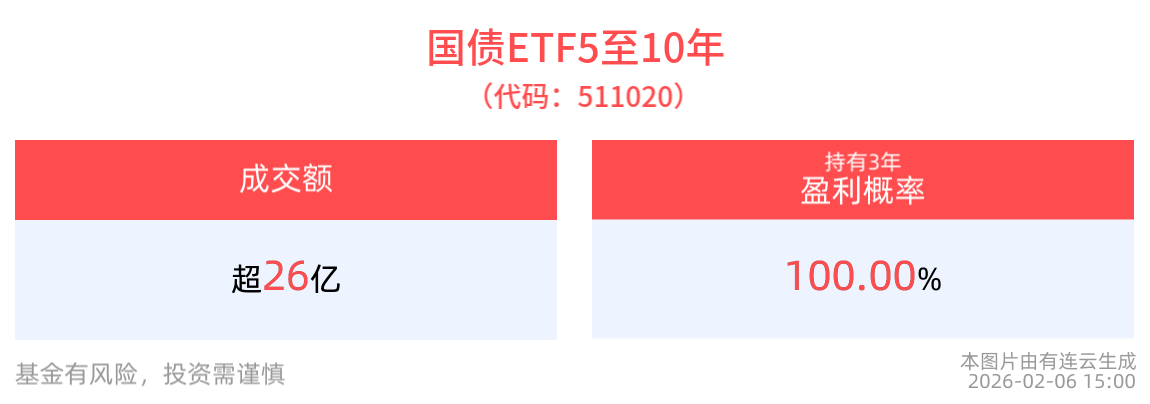
成交额超26亿元,国债ETF5至10年(511020)历史持有3年盈利概率为100.00%
Sou Hu Cai Jing· 2026-02-09 01:59
Group 1 - Institutions remain bullish on long-term bonds, driven by allocation despite net selling by brokers and funds of over 108.6 billion yuan in ultra-long-term bonds (maturity over 20 years) from January 1 to February 6, compared to a net sell of only 5.7 billion yuan in the same period last year [1] - Insurance funds net purchased 120.6 billion yuan of ultra-long-term bonds, while city and rural commercial banks net bought 50 billion yuan, showing a significant increase of 55.4 billion yuan and 68.8 billion yuan year-on-year respectively [1] - The steepening yield curve and declining funding costs for city and rural commercial banks enhance the incentive to allocate government bonds, with expectations that the cost of liabilities for these banks will drop below 1.6% in Q1 2026 [1] Group 2 - From November 20, 2025, to February 6, 2026, brokers, funds, and pension funds collectively net sold 354.8 billion yuan of ultra-long-term bonds, indicating a preference for mid- to short-term bonds [2] - The positive impact of rising stock markets on ultra-long-term bonds has significantly diminished, and if market expectations for stocks decline, there may be a rebound in ultra-long-term bond purchases, potentially driving the 30-year government bond yield down significantly [2] - Institutions predict that the 10-year government bond yield will break 1.80% and trend towards 1.75%, while the 30-year government bond yield may return below 2.2% [2] Group 3 - As of February 6, 2026, the active bond index for 5-10 year government bonds rose by 0.06%, with the corresponding ETF also increasing by 0.06% to a latest price of 116.01 yuan [4] - The liquidity of the 5-10 year government bond ETF was active, with a turnover of 227.23% and a transaction volume of 2.674 billion yuan, indicating strong market activity [4] - The ETF's management fee is 0.15% and the custody fee is 0.05%, with a tracking error of 0.024% over the past three months, closely following the active bond index [4]

国开债券ETF(159651)实现4连涨
Sou Hu Cai Jing· 2026-01-29 01:40
Group 1 - The core viewpoint indicates that the long-term bonds are experiencing a rebound driven by allocation strategies, with significant net buying from various institutions [1] - Since the beginning of January, the trading data shows that insurance funds have increased their allocation to long-term bonds significantly, benefiting from a notable decline in liability costs [1] - The market anticipates that the yield on 10Y government bonds will drop below 1.8% in the coming month, with potential for 30Y bonds to fall below 2.2% [2] Group 2 - The National Development Bank bond ETF has seen a 1.10% increase over the past year, ranking it in the top half of comparable funds [2] - The ETF's trading volume has been robust, with an average daily turnover of 281 million yuan over the past year [3] - The ETF has experienced a significant growth in scale, increasing by 47 million yuan in the past month [3] Group 3 - The management fee for the National Development Bank bond ETF is set at 0.15%, while the custody fee is 0.05% [4] - The ETF closely tracks the China Bond - 0-3 Year National Development Bank Bond Index, which includes bonds with a maturity of up to 3 years [5]
日本国债暴跌后 德国长期国债收益率小幅下行
Xin Lang Cai Jing· 2026-01-21 08:52
Core Viewpoint - German long-term bond yields have slightly decreased but are expected to achieve the largest weekly increase in a month, influenced by global market volatility following a sell-off in Japanese bonds [1][5]. Group 1: German Bond Market - The latest yield for the German 10-year government bond is reported at 2.8443%, down approximately 1 basis point, while the 30-year bond yield also fell by 1 basis point to 3.473%. However, this week, the yields have cumulatively increased by 4.7 basis points, marking the largest weekly gain since the beginning of the year, with bond prices declining simultaneously [2][6]. - Analysts from ING indicate that the fluctuations in German bond yields and market pricing related to the upcoming European Central Bank (ECB) interest rate decision suggest that the macroeconomic conditions in the Eurozone have not changed significantly. The volatility in Japanese bonds is currently dominating bond pricing rather than local European factors [2][6]. Group 2: Global Market Influences - The global market has also been impacted by geopolitical tensions, particularly the opposition from European leaders to U.S. President Donald Trump's claims over Greenland, which has led to renewed threats of tariffs from Trump [7]. - Analysts note that the long end of the Eurozone bond yield curve is influenced by global spillover effects, while the short end remains relatively stable. They highlight that fiscal concerns are a global issue, with rising government spending worries leading to a steeper yield curve being the path of least resistance [7]. - As global uncertainty increases or market expectations for future borrowing rise, long-term bond yields may increase as investors demand higher risk premiums [7]. Group 3: European Central Bank Outlook - The uncertainty surrounding the market may affect the ECB's decisions in the coming months, with a reduced likelihood of interest rate hikes and a slight inclination towards further rate cuts [3][4][7]. - Overall, the market anticipates that the ECB will maintain stable interest rates for the time being [4][7].
固收深度报告20260114:债市逆风中的生存法则:历史调整对当前的启示
Soochow Securities· 2026-01-14 13:11
Group 1: Report Industry Investment Rating - Not provided in the given content Group 2: Core Viewpoints of the Report - The current bond market situation cannot simply be compared to the 2017 bear market as the interest rate change sequence is different. Currently, long - term interest rates rise first due to economic recovery expectations while short - term interest rates remain stable under the central bank's liquidity - maintaining policy [36]. - Systemic bear markets usually require the combination of rising short - term interest rates and tightened liquidity. Expectations alone can only lead to a phased rise in long - term interest rates but are insufficient to trigger a full - scale bear market [37]. - Given the current low short - term interest rates and the need for economic recovery, the yield inversion between money market funds and bond funds will improve. A steeper bond yield curve allows for leveraging strategies to obtain returns [37]. Group 3: Summary by Directory 1. Historical Review: Structural Anomalies from 2016 - 2018 1.1 Yield Trends - From 2016Q4, bond fund yields slowed significantly, and were outperformed by money market funds in many quarters. For example, in 2016Q4, the quarterly return of money market funds was 2.62%, while short - term pure bond funds had - 0.66% and medium - long - term pure bond funds had - 1.29%. Bond funds faced high capital costs and a flattened yield curve, resulting in large net value drawdowns [10]. 1.2 Key Policies and Major Events during the Period - In December 2016, the central bank included off - balance - sheet wealth management in the MPA's broad credit indicator, tightening non - bank institutions' funding sources. In March 2017, the CBRC launched the "Three Threes and Four Tens" special governance, shrinking bank inter - bank business and intensifying liquidity stratification. From 2016 - 2018, the central bank raised MLF and OMO rates multiple times, increasing financial institutions' capital costs. In April 2018, the asset management new regulations were officially implemented, promoting the institutionalization of de - leveraging [13]. 2. Cause Analysis 2.1 Policy Aspect: Central Bank's Open - Market Operation Interest Rate Adjustment - From 2016 - 2018, the central bank raised OMO and MLF rates, achieving a de facto interest rate hike. The 1 - year MLF rate rose from 3% in February 2016 to 3.3% in April 2018, indicating a tightening policy [16]. 2.2 Funding Aspect: Intensified Liquidity Stratification - Financial de - leveraging policies restricted inter - bank business, leading to severe liquidity stratification in the inter - bank market. The spread between R007 and DR007 widened from less than 20bp in the first three quarters of 2016 to a maximum of 71bp in March 2017, eroding bond funds' leverage arbitrage space [17][19]. 2.3 Fundamental Aspect: Strong Growth Supported Policy Implementation - In 2017, financial de - leveraging was an active policy choice during a period of strong economic fundamentals. China's GDP growth in 2017 was 6.9%, providing confidence for de - leveraging. The "high PPI, low CPI" inflation structure in 2017 created a good policy window [20][23]. 3. Relationship between Bond Yield Curve Shape and Bond Fund Yields - In 2017, the bond yield curve showed a two - stage V - shaped trend. From the end of 2016 to June 2017, it was bear - flattening due to tight funding. From July to December 2017, it was bear - deepening as strong economic fundamentals drove long - term interest rates up [25]. - The monthly returns of short - term and medium - long - term pure bond funds reflected the "first flat, then steep" change of the yield curve. From the end of 2016 to June 2017, short - term pure bond funds had lower returns, while from July to December 2017, medium - long - term pure bond funds suffered more capital losses [28]. - Bond funds' leverage ratios first decreased and then increased. In the first half of 2017, most funds reduced leverage. In the second half, short - term pure bond funds actively increased leverage as the yield curve steepened [30][32]. 4. How Did the Structural Anomaly Recover? 4.1 Policy Turnaround and Decline in Short - Term Interest Rates - In the second half of 2018, the policy shifted from de - leveraging to stabilizing growth. The central bank implemented multiple rounds of reserve requirement ratio cuts from 2018 to early 2019, releasing long - term low - cost liquidity and lowering short - term interest rates [33]. 4.2 Changes in Bond Yield Curve Shape - After the easing policy, short - term interest rates dropped rapidly, while long - term interest rates declined more slowly. The yield curve changed from bear - flat to bull - steep, reopening profit opportunities for bond funds' carry and duration strategies [34]. 5. Implications for the Current Market - The current situation is different from 2016 - 2018. The current long - term interest rate rise is driven by economic recovery expectations, and short - term interest rates are stable. The yield inversion between money and bond funds will improve, and leveraging strategies can be used [36][37].
全球“最惨”!日债大溃败恐未完待续:十余年来最猛净供应洪峰将至
Sou Hu Cai Jing· 2026-01-08 01:47
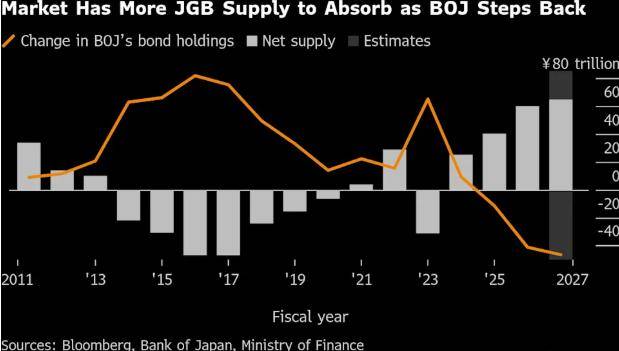
Group 1 - The Japanese government bond market is facing significant challenges due to the largest net supply growth in over a decade, with an expected increase of 8% to approximately 65 trillion yen (415 billion USD) in the new fiscal year starting in April [1] - The increase in net supply is driven by the Bank of Japan's reduction in bond purchases, which is projected to decrease by over 25% to about 2.1 trillion yen monthly, leading to a potential reduction in holdings by 46.5 trillion yen in the next fiscal year [2] - Local banks and pension funds have been the primary buyers of bonds since the Bank of Japan began easing control over the yield curve, with net purchases exceeding 30 trillion yen since April 2023, although concerns remain about whether this will be sufficient given the surge in net supply [4] Group 2 - The benchmark 10-year Japanese government bond yield has risen to 2.13%, the highest level since 1999, with expectations that it could reach a fair level of 2.2%-2.3% [5] - The rise in yields, particularly for short-term bonds, suggests that the Japanese Ministry of Finance may further adjust its issuance plans, with a slight decrease in medium to long-term bond supply expected while increasing issuance of 2-year and 5-year bonds [6] - The ongoing inflation pressures indicate that the Bank of Japan is likely to continue raising interest rates to achieve a neutral rate, which may lead to a flattening of the yield curve as long-term bond supply decreases [6]
高盛闭门会-全球市场26展望,股市波动性加剧ai主题扩散,利率新兴市场外汇
Goldman Sachs· 2025-12-22 01:45
Investment Rating - The report indicates a constructive outlook for the stock market, suggesting it may continue to rise despite increased volatility [1][2]. Core Insights - Current stock and credit market valuations are high, which contradicts the macroeconomic cycle that has not yet shown typical late-cycle characteristics [1][2]. - AI capital expenditure is expected to drive growth, while a weak labor market may prompt the Federal Reserve to adopt a more accommodative stance, creating a favorable environment for the stock market [1][4]. - The cyclical growth outlook has room for upward adjustment, with tight fiscal conditions potentially pushing long-term bond yields higher, resulting in a steep yield curve [5]. Summary by Sections Macroeconomic Background - The macroeconomic backdrop for 2025 is described as relatively mild, with steady economic growth and a clear trend towards disinflation [2]. - The stock and credit markets are experiencing high valuations, which do not align with the current macroeconomic cycle [2]. Stock Market Outlook - The S&P 500's risk-adjusted returns are expected to be slightly lower than the highs of the past three years, but short-term valuation constraints are not strong [4]. - The market is sensitive to earnings misses and inflation concerns, with AI capital expenditure expected to create more cyclical opportunities [4][3]. Bond Market Dynamics - The report anticipates that the process of disinflation will return to a positive trajectory, keeping front-end yields low in the U.S. and the U.K. [5]. - Long-term U.S. bond yields are expected to fluctuate within a range, with a favorable outlook for U.K. government bonds due to weak economic data and supportive central bank policies [5]. Currency Market Trends - The foreign exchange market in 2026 is expected to differ significantly from 2025, with the U.S. dollar projected to depreciate moderately due to expectations of interest rate cuts [8][9]. - The Chinese yuan is expected to gradually appreciate, with policymakers likely to accept this trend to maintain export competitiveness [9]. Emerging Market Opportunities - Emerging market equities are projected to deliver a total return of approximately 15%, supported by a favorable macro environment and declining inflation [10]. - Countries with hawkish central banks, such as Hungary and Brazil, are highlighted as having favorable conditions for local rate trades [10]. Hedging Strategies - In the current late-cycle environment, long-term stock holdings are recommended, with a focus on diversification and hedging strategies [11]. - Gold and commodity arbitrage strategies are suggested as effective diversification options, while long call options are recommended for managing stock risk [11].
债券研究周报:年底债市机构行为格局之变-20251130
Guohai Securities· 2025-11-30 10:04
1. Report Industry Investment Rating No relevant content provided. 2. Core View of the Report - The bond market had a slight correction in the latest week. From November 24th to 28th, the yield of the 10-year Treasury bond rose from 1.82% to 1.84%. There is a potential negative change in the institutional behavior pattern of the bond market at the end of the year, i.e., the willingness of rural commercial banks to buy bonds during corrections has decreased, which may amplify market fluctuations if there is a correction in the future [7][12]. - Rural commercial banks have been net buyers in the secondary market this year, with a cumulative net purchase of over 1 trillion yuan of 10Y Treasury bonds, 30Y Treasury bonds, and 10Y China Development Bank bonds as of November 28th, about twice that of previous years. They may have a lower allocation willingness due to their own duration assessment and other indicators [7][12]. - In the latest week, funds significantly net sold Treasury bonds and policy financial bonds, while the allocation of rural commercial banks to 10-year Treasury bonds was less than that of joint-stock banks. Other institutions may partially replace rural commercial banks in "undertaking" bonds, which may cause the interest rate to rise excessively during corrections. However, the market after the correction may still be a good buying point [7][13]. - The capital market was relatively stable this week. The duration of bond funds decreased overall, and large banks continued to buy medium- and short-term bonds [7][13]. 3. Summary by Relevant Catalogs 3.1 This Week's Bond Market Review - The bond market corrected this week. From November 24th to 28th, the yield of the 10-year Treasury bond rose from 1.82% to 1.84%. Rural commercial banks' willingness to buy bonds during corrections has decreased, which may amplify market fluctuations [7][12]. - Rural commercial banks have bought more and sold less this year. The bond market has mostly been in a state of shock and correction, and interest rate declines have been rapid, so they have had few opportunities to take profits. As of November 28th, their cumulative net purchase this year exceeded 1 trillion yuan, about twice that of previous years [7][12]. - Funds significantly net sold Treasury bonds and policy financial bonds this week, while rural commercial banks' allocation of 10-year Treasury bonds was less than that of joint-stock banks. The market after the correction may still be a good buying point. The capital market was stable, the duration of bond funds decreased, and large banks continued to buy medium- and short-term bonds [7][13]. 3.2 Bond Yield Curve Tracking 3.2.1 Key Maturity Interest Rates and Spread Changes - As of November 28th, compared with November 24th, the 1-year Treasury bond yield decreased by 0.17bp to 1.40%; the 10-year Treasury bond yield rose by 2.02bp to 1.84%; the 30-year Treasury bond yield rose by 2.65bp to 2.19%. - The spread between the 30-year and 10-year Treasury bonds rose by 0.63bp to 34.39bp, and the spread between the 10-year China Development Bank bond and the 10-year Treasury bond rose by 0.94bp to 13.28bp [15]. 3.2.2 Treasury Bond Term Spread Changes - As of November 28th, compared with November 24th, the 3Y - 1Y Treasury bond spread rose by 0.20bp to 3.34bp; the 5Y - 3Y Treasury bond spread rose by 2.36bp to 18.32bp; the 7Y - 5Y Treasury bond spread rose by 1.92bp to 12.49bp; the 10Y - 7Y Treasury bond spread decreased by 2.29bp to 9.80bp; the 20Y - 10Y Treasury bond spread rose by 1.48bp to 35.38bp; the 30Y - 20Y Treasury bond spread decreased by 0.85bp to -0.99bp [16]. 3.3 Bond Market Leverage and Capital Market 3.3.1 Balance of Interbank Pledged Repurchase - As of November 28th, compared with November 24th, the balance of interbank pledged repurchase decreased by 0.31 trillion yuan to 11.05 trillion yuan [19]. 3.3.2 Changes in Interbank Bond Market Leverage Ratio - As of November 28th, compared with November 24th, the interbank bond market leverage ratio decreased by 0.20pct to 106.58% [20]. 3.3.3 Pledged Repurchase Turnover - From November 24th to November 28th, the average daily turnover of pledged repurchase was 7.09 trillion yuan. The average daily overnight turnover was about 6.13 trillion yuan, and the average overnight turnover ratio was 86.66% [22][23]. 3.3.4 Operation of the Interbank Capital Market - From November 24th to November 28th, bank capital lending first increased and then decreased. As of November 28th, the net capital lending of large banks and policy banks was 4.40 trillion yuan, the net capital borrowing of joint-stock banks and urban and rural commercial banks was 0.63 trillion yuan, and the net capital lending of the banking system was 3.77 trillion yuan [28]. - Bank single-day capital lending first increased and then decreased. As of November 28th, the single-day capital lending of large banks and policy banks was 3.38 trillion yuan, and that of small and medium-sized banks was -0.67 trillion yuan [28]. - As of November 28th, DR001 was 1.3033%, DR007 was 1.4668%, R001 was 1.4252%, and R007 was 1.5222% [28]. 3.4 Duration of Medium- and Long-Term Bond Funds 3.4.1 Median Duration of Bond Funds - As of November 28th, the median duration of medium- and long-term bond funds (deleveraged) was 2.75 years, a decrease of 0.01 years compared with November 24th; the median duration (including leverage) was 2.93 years, a decrease of 0.03 years compared with November 24th [37]. 3.4.2 Median Duration of Interest Rate Bond Funds - As of November 28th, the median duration of interest rate bond funds (including leverage) was 3.89 years, a decrease of 0.02 years compared with November 24th; the median duration of credit bond funds (including leverage) was 2.72 years, a decrease of 0.01 years compared with November 24th. The median duration of interest rate bond funds (deleveraged) was 3.38 years, unchanged from November 24th; the median duration of credit bond funds (including leverage) was 2.51 years, unchanged from November 24th [41]. 3.5 Changes in Bond Lending Balance - As of November 28th, compared with November 24th, the borrowing volume of 10-year China Development Bank bonds showed fluctuations [45].

债市机构行为周报(9月第3周):当前债市的两个“确定性”-20250921
Huaan Securities· 2025-09-21 08:18
1. Report Industry Investment Rating No relevant content provided. 2. Core Viewpoints of the Report - The bond market yield curve remained steep this week, with the 10Y maturity yield fluctuating around 1.85% and the 1Y Treasury bond maturity yield at 1.40%. The term spreads of 30Y - 10Y and 10Y CDB - 10Y Treasury bonds widened, and the curve steepening continued [3][11]. - There are two "certainties" in the current bond market. First, driven by large - banks' continuous buying of short - term bonds, the short - end is more stable, and the expectation of the central bank buying bonds in the fourth quarter is rising. Second, the anti - decline of credit bonds is expected to continue under the loose funds [3][12]. 3. Summary According to the Directory 3.1 This Week's Institutional Behavior Review: Two "Certainties" in the Bond Market 3.1.1 Yield Curve - Treasury bond yields generally increased. The 1Y yield decreased by 1bp, while the 3Y, 5Y, 7Y, 10Y, 15Y, and 30Y yields increased by about 1bp, 1bp, 5bp, 1bp, 2bp, and 2bp respectively. For CDB bonds, short - end yields increased, and mid - end yields decreased. The 1Y yield increased by 5bp, the 3Y yield increased by 4bp, and the 5Y yield decreased by about 3bp [14]. 3.1.2 Term Spreads - For Treasury bonds, the interest rate spread inversion deepened, and the long - end spreads narrowed. For CDB bonds, the interest rate spread inversion deepened, and the short - end spreads narrowed [16][17]. 3.2 Bond Market Leverage and Funding Situation 3.2.1 Leverage Ratio - From September 15 to September 19, 2025, the leverage ratio decreased weekly. As of September 19, it was about 106.91%, down 0.12pct from last Friday and 0.17pct from Monday [21]. 3.2.2 Average Daily Turnover of Pledged Repurchase - From September 15 to September 19, the average daily turnover of pledged repurchase was about 7.2 trillion yuan, a decrease of 0.33 trillion yuan from last week. The average daily overnight turnover accounted for 87.64%, a decrease of 0.79pct [27][28]. 3.2.3 Funding Situation - From September 15 to September 19, bank - related funds' net lending first decreased and then increased. The main funds' borrowers were securities firms, and money market funds' net lending increased fluctuantly. DR007 and R007 first increased and then decreased. 1YFR007 and 5YFR007 increased fluctuantly [32][33]. 3.3 Duration of Medium - and Long - Term Bond Funds 3.3.1 Median Duration - This week (September 15 - September 19), the median duration of medium - and long - term bond funds was 2.68 years (de - leveraged) and 2.8 years (leveraged). On September 19, the de - leveraged median duration decreased by 0.01 years compared with last Friday, and the leveraged median duration increased by 0.02 years [44]. 3.3.2 Duration by Bond Fund Type - The median duration of interest - rate bond funds (leveraged) decreased to 3.55 years, down 0.12 years from last Friday. The median duration of credit bond funds (leveraged) increased to 2.51 years, up 0.03 years from last Friday [47]. 3.4 Comparison of Category Strategies 3.4.1 Sino - US Yield Spread - The short - end spread widened, and the medium - and long - end spread narrowed. The 1Y, 2Y, and 3Y spreads widened by 5bp, 5bp, and about 3bp respectively, while the 5Y, 7Y, 10Y, and 30Y spreads narrowed [52]. 3.4.2 Implied Tax Rate - The short - end implied tax rate widened, and the mid - end narrowed. As of September 19, the 1Y, 3Y, and 30Y spreads of CDB - Treasury bonds widened, while the 5Y, 7Y, 10Y, and 15Y spreads narrowed [53]. 3.5 Changes in Bond Lending Balance - On September 19, the lending concentration of the second - most active 10Y CDB bond increased, while that of the active 10Y Treasury bond, the second - most active 10Y Treasury bond, the active 10Y CDB bond, and the active 30Y Treasury bond decreased. Except for large banks, all other institutions saw a decline [54].
降息利好≠普涨!投资者如何挑选赢家?花旗给出答案
智通财经网· 2025-09-15 08:21
Group 1 - The core viewpoint is that the upcoming interest rate cuts by the Federal Reserve will not solely determine market winners, but will heavily depend on the economic backdrop and the shape of the yield curve [1] - The current market has largely priced in expectations of a "soft landing" or a mild recovery, but historical patterns show that significant rate cuts typically occur during periods of economic weakness or recession [1] - In scenarios of declining interest rates, a steepening yield curve, and improving economic data, sectors such as real estate, consumer discretionary, and information technology are expected to perform well, while utilities are likely to underperform [1] Group 2 - In scenarios of declining interest rates, a steepening yield curve, and deteriorating economic data, traditional defensive sectors like utilities, real estate, healthcare, and consumer staples are expected to perform better, while sectors like information technology and energy may struggle [2] - The traditional view suggests that the federal funds rate must reach a stimulative level for the market to shift from defensive to cyclical sectors [2] - Citigroup predicts that the Federal Reserve will implement five consecutive rate cuts of 25 basis points each, accompanied by slow but positive economic growth, influencing investment strategies significantly [2]
