4680电芯

Search documents
马斯克彻底搞定大圆柱电池,发布五年终落地,独家专利破解量产难题
3 6 Ke· 2026-02-03 03:17
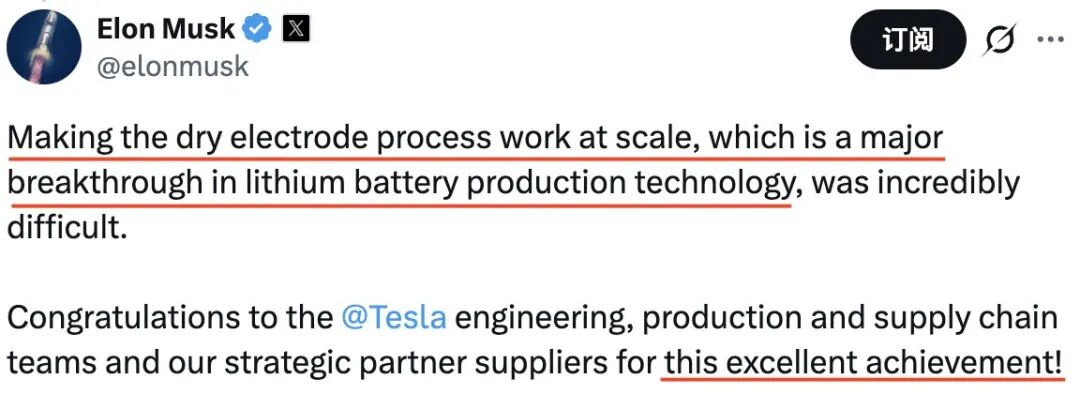
Core Insights - Tesla has achieved a significant milestone by successfully implementing the production of its 4680 battery cells using a dry electrode process at its Austin factory, marking a breakthrough after five years of development [1][23] - The integration of the 4680 battery cells into the Model Y is part of Tesla's strategy to enhance supply chain resilience and mitigate risks associated with trade barriers and tariffs [2][9][21] Group 1: Production and Technology - Tesla has begun producing battery packs for the Model Y that utilize the in-house manufactured 4680 cells, with both the anode and cathode now employing the dry electrode method [1][7] - The dry electrode process is expected to reduce production costs and energy consumption, allowing for a more compact factory footprint and simpler manufacturing processes [12][20] - The new technology has reportedly increased production throughput by three times and reduced factory space requirements by 50% while cutting production energy consumption by 90% [20] Group 2: Strategic Implications - The move to use 4680 cells in the Model Y is seen as a risk mitigation strategy, providing Tesla with an alternative supply option amidst uncertainties in the external supply environment [9][10] - Despite the technological advancements, the performance improvements for consumers may be limited, as the primary focus is on supply chain flexibility rather than significant enhancements in battery performance [10][21] - The announcement has been characterized by some media outlets as a response to tariff challenges rather than a revolutionary step in battery technology [21]


特斯拉拟200亿美元投向锂精炼和LFP产线
高工锂电· 2026-01-31 11:29
Core Viewpoint - Tesla plans to significantly increase its capital expenditure to over $20 billion by 2026, a substantial increase compared to the approximately $8.5 billion planned for 2025, indicating a "doubling" of investment [3][4]. Group 1: Capital Expenditure and Business Expansion - The increased capital expenditure will support the expansion and transformation of multiple business lines, including vertical integration in battery and lithium resource sectors [5]. - Tesla has begun producing battery packs for some Model Y vehicles using its self-developed 4680 battery cells, positioning this as a new supply source to address supply chain complexities due to trade barriers and tariffs [6]. - The company has achieved dual dry electrode production for the 4680 battery in Austin, with both anodes and cathodes manufactured locally, indicating a shift towards a more integrated supply structure [7]. Group 2: Lithium Refining and Local Production - Tesla's lithium refining plant has commenced pilot production, being one of the first facilities in North America to refine spodumene into lithium hydroxide [8]. - The Texas and Nevada LFP production lines are expected to start production in 2026, further promoting the localization of key materials and battery manufacturing [9]. - Tesla's projected installed capacity for the battery supply chain includes 7 GWh for Nevada LFP, 40 GWh for Texas 4680, 10 GWh for cathode materials, and 30 GWh for lithium refining [9][10]. Group 3: Financial Performance and Market Dynamics - Tesla's automotive delivery for 2025 is projected at approximately 1.585 million units for Model 3/Y, with other models expected to deliver around 51,000 units, reflecting a more significant decline in the latter [13]. - The company reported a total gross margin of 20.1% for Q4, with an automotive gross margin (excluding credits) of 17.9%, impacted by delivery declines and rising costs due to tariffs and fixed cost dilution [15]. - Energy business revenue grew by 25% year-over-year, while automotive revenue declined by 11% in Q4, indicating a shift in revenue structure [16].

当特斯拉卖不出电车,锂电应该担心需求吗?
高工锂电· 2025-07-25 10:22
Core Viewpoint - Tesla is facing significant challenges, with a notable decline in its automotive business and overall revenue, indicating a shift in its growth narrative from a solely electric vehicle manufacturer to a broader "physical AI" company [1][2][3] Group 1: Financial Performance - In Q2 of fiscal year 2025, Tesla's revenue decreased by 12% year-over-year to $22.5 billion, marking the largest decline in a decade [1] - The core automotive business revenue fell by 16%, and free cash flow was only $146 million, significantly below expectations [1] - Global vehicle deliveries dropped by 13.5% year-over-year to 384,000 units, with a total delivery decline exceeding 13% in the first half of the year [2] Group 2: Market Challenges - Sales in the U.S. decreased by 13% in the first half of the year, with California experiencing seven consecutive quarters of decline [2] - The European market saw a drastic 33% drop in sales during the same period, while sales in China fell by 12% due to intense competition from local brands like BYD and Xiaomi [2] Group 3: Strategic Shift - Tesla is pivoting its focus towards future technologies such as Robotaxi, humanoid robots (Optimus), and artificial intelligence, moving away from immediate sales figures [2][3] - The introduction of Robotaxi is seen as a short-term bet, while Optimus represents a long-term vision, with production expected to start in 2026 [4] Group 4: Battery Technology and Production - The shift in vehicle utilization necessitates a fundamental change in battery technology, emphasizing longevity and reliability over traditional metrics [4] - The demand for specialized lithium iron phosphate batteries is expected to rise, as Optimus robots will create a stable internal demand for Tesla's battery production [4] Group 5: Energy Storage and Manufacturing - Tesla is expanding its energy storage business, with the Megapack system experiencing strong growth, which serves as a hedge against policy risks [5] - The company is investing in domestic manufacturing, with plans for a lithium iron phosphate factory and a new energy storage super factory by 2026 [5] Group 6: Implications for the Lithium Battery Industry - Short-term, Tesla's slowing vehicle sales may pressure the lithium battery supply chain [6] - Long-term, Tesla's strategic transformation could create new, potentially larger demand spaces for lithium batteries, moving towards a diversified demand matrix [7]