
AITO问界系列

Search documents
2025年我国汽车产销量均突破3400万辆
Zhong Guo Zheng Quan Bao· 2026-01-14 20:51
● 本报记者 李嫒嫒 1月14日,中国证券报记者从中国汽车工业协会月度信息发布会上获悉,2025年,中国汽车产销累计完 成3453.1万辆和3440万辆,产销量再创历史新高,连续17年稳居全球第一。新动能加快释放,新能源汽 车产销量均超1600万辆。 中汽协副秘书长陈士华表示,在刚刚过去的2025年,汽车行业继续展现出强大的发展韧性和活力,多项 指标再创新高,实现了在"十四五"时期的圆满收官。我国汽车行业的产销规模均超过3400万辆,营业收 入突破10万亿元,出口跻身世界第一,电动化与智能化、网联化加速融合,形成产业领先优势。 实现超预期增长 陈士华介绍,2025年,汽车行业顶住贸易保护和全球产业链重构等外部压力,克服技术攻关难题、行 业"内卷"等多重挑战,展现出强大的发展韧性和活力,实现了产业规模与发展质量双提升。 中汽协数据显示,2025年汽车产销分别完成3453.1万辆和3440万辆,同比分别增长10.4%和9.4%,高于 去年年初预期。 对此,中汽协分析称,2025年"两新"政策加力扩围,实现平稳过渡与有序衔接,企业新品密集上市,终 端需求持续释放,全年汽车产销实现超预期增长。 中汽协表示,有关部门聚 ...
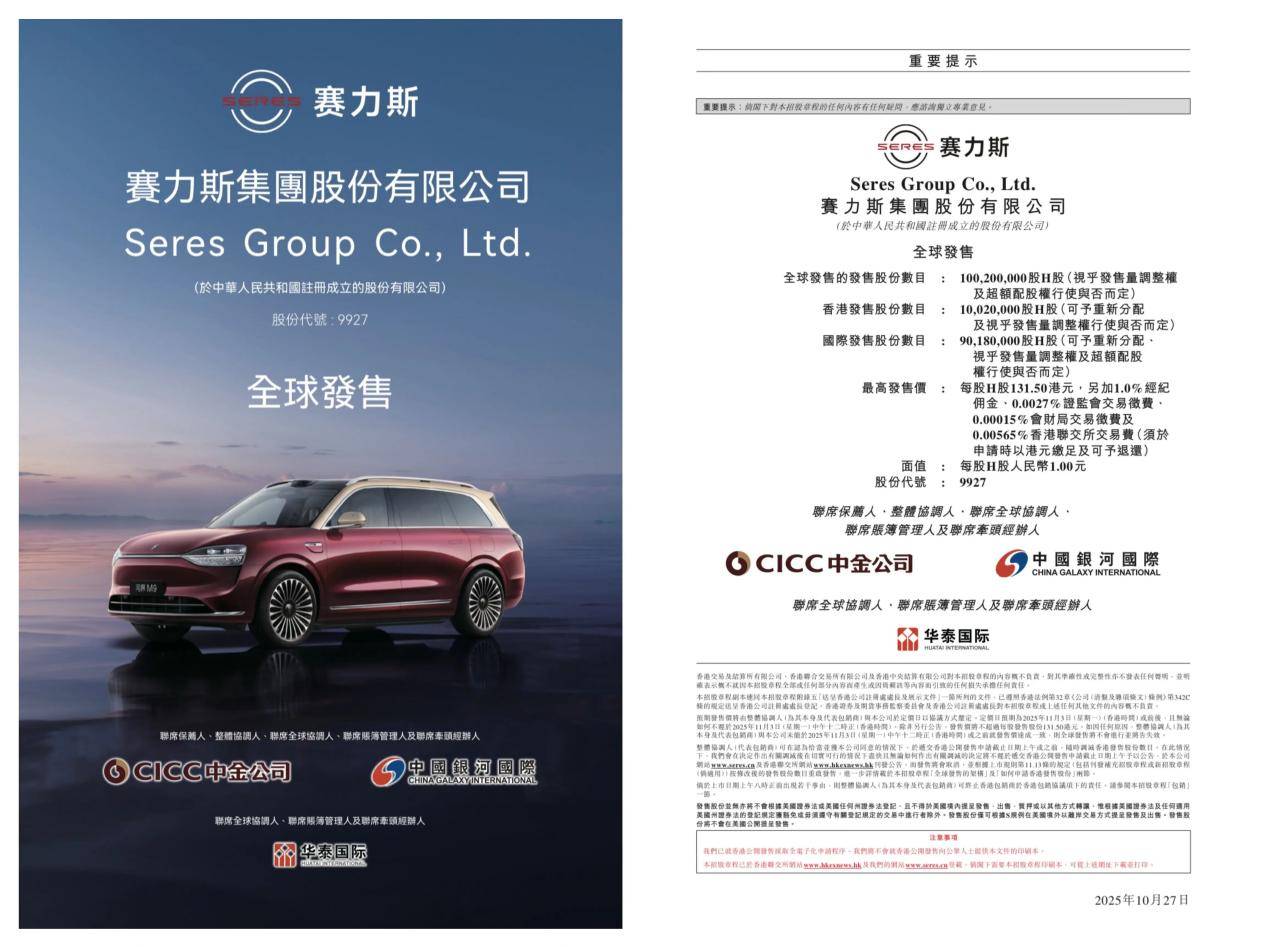
赛力斯启动港股招股,豪华新能源车企“A+H”第一股即将诞生
Sou Hu Cai Jing· 2025-10-27 08:05
Core Viewpoint - The announcement of Seres Group's IPO on the Hong Kong Stock Exchange marks a significant milestone as it becomes the first luxury electric vehicle company in China to be listed in both A-shares and H-shares, indicating a new phase in its capital development [1] Group 1: IPO Details - Seres plans to issue approximately 100.2 million H-shares, with the subscription period ending on October 31, and the final issue price to be determined on November 3 [3] - The entry fee for investors is approximately HKD 13,282.6 for a lot of 100 shares, based on a maximum issue price of HKD 131.50 per share [3] - A strong base of 22 institutional investors has committed to subscribing for approximately USD 826.5 million worth of shares, reflecting confidence in Seres' business model and growth potential [3] Group 2: Fund Utilization - The net proceeds from the IPO are expected to be around HKD 12.9 billion to HKD 13 billion, with about 70% allocated for technology research and development [5] - Approximately 20% of the funds will be used to expand overseas markets and enhance the charging network, supporting Seres' international brand presence [5] - The remaining 10% will be allocated to supplement working capital for daily operations [5] Group 3: Financial Performance - In 2024, Seres achieved revenue of HKD 145.11 billion, a year-on-year increase of 305%, and a net profit of HKD 5.946 billion, marking its transition to profitability [5] - This positions Seres among the few profitable electric vehicle companies globally, alongside Tesla and BYD, breaking the industry's previous trend of losses [5] Group 4: Strategic Partnerships - The collaboration with Huawei has been pivotal, leading to the successful launch of the AITO brand and its popular models, which have significantly impacted market demand [6] - The partnership combines Huawei's technological capabilities with Seres' manufacturing strengths, creating a powerful market presence [6] Group 5: Future Implications - The IPO will provide Seres with a new international financing channel to support its R&D and global market expansion [7] - The dual listing structure (A+H) will enhance Seres' visibility and influence in international capital markets, attracting a diverse range of global investors [7] - The entry of Seres as the first A+H stock in the Chinese electric vehicle sector will reshape the competitive landscape, with capital, technology, and globalization being key growth drivers [7]


自主品牌打响超高端车型“突围战”
Zhong Guo Qi Che Bao Wang· 2025-09-22 09:02
Core Insights - The competition in the ultra-high-end automotive market is intensifying, with domestic brands like Great Wall Motors, BYD, and Chery making significant moves to establish themselves in this segment [2][3][4] - Domestic brands face challenges in brand narrative, service ecosystem, design aesthetics, and consumer perception, which hinder their ability to compete with established international luxury brands [3][4][6] - A shift towards a unique Chinese high-end value system is necessary for domestic brands to differentiate themselves and redefine luxury [6][9] Group 1: Market Developments - Great Wall Motors has initiated a global tender for suppliers with ultra-high-end brand service experience for its BG brand user activity project [2] - BYD's Yangwang U8 has successfully entered the million-yuan high-end car market with innovative technologies like "crab mode" and on-the-spot turning [2] - Chery is rumored to be in talks with Maserati for potential collaboration or acquisition, indicating a competitive push towards ultra-high-end branding among domestic manufacturers [2] Group 2: Challenges Faced - Domestic brands struggle with brand narrative capabilities, lacking the historical depth and emotional value that traditional luxury brands like Mercedes-Benz and BMW possess [3] - There is a significant gap in the service ecosystem, as ultra-high-end consumers expect personalized and comprehensive service experiences that current domestic brands do not adequately provide [3][4] - Design aesthetics are lacking, with many domestic brands failing to create a cohesive and unique design language, leading to a perception of inconsistency [4][7] Group 3: Strategic Responses - Some domestic brands are exploring diverse strategies to enhance their soft power, focusing on cultural value reconstruction and innovative service experiences [6][9] - Collaborations with luxury service providers and cross-industry partnerships are being pursued to elevate brand perception and service offerings [6][7] - A long-term commitment to brand building is essential, with market research indicating that establishing a stable brand recognition in the ultra-high-end market typically requires 5 to 8 years of sustained investment [9] Group 4: Future Outlook - The collective effort of domestic brands to penetrate the high-end market is expected to reshape the value chain structure of the Chinese automotive industry and enhance its global competitive position [10] - The transition from a focus on scale to value leadership in the automotive sector reflects a broader transformation in China's manufacturing image and innovation capabilities [10]
